Regarding spoke lacing and soldering,
the comment asked: "If it doesn't violate the Meshinotaneko Code, could you please teach me the key points of spoke lacing soldering? Thank you."
It completely violates it, so I can't answer.
That might get me in trouble, so
I'll at least write about the difference between meaningful lacing and pointless lacing.
From the final crossing of spokes coming out from the hub flange on the same side, on the rim side,
when you grip the crossed spokes in the front-to-back direction,
the crossing point flexes and shifts toward the rim, right?
The purpose of lacing is to eliminate that and reduce spoke deformation.
It's called "lacing" because you actually "tie" it.
It's not just wrapping wire around and around.
Simple wrapping creates a clicking sound when you grip the spoke,
the wrapped section shifts and loosens. That's just decoration with no real purpose.
This tying method is the secret to proper spoke lacing.
Solder has no power to suppress the deformation at the spoke crossing point.
It only prevents the lacing from coming undone.
The comment mentions "solder won't stick to the spoke,"
and that's because the spokes are stainless steel.
The wire I use is also stainless. Otherwise it rusts later.
This is another difficult point.
I apologize for the many things I can't write about, but if you clear all these hurdles,
then you can call it meaningful spoke lacing and soldering.
the comment asked: "If it doesn't violate the Meshinotaneko Code, could you please teach me the key points of spoke lacing soldering? Thank you."
It completely violates it, so I can't answer.
That might get me in trouble, so
I'll at least write about the difference between meaningful lacing and pointless lacing.
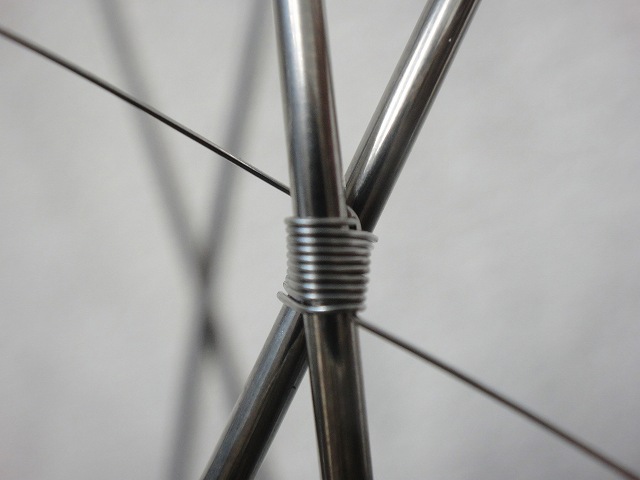
From the final crossing of spokes coming out from the hub flange on the same side, on the rim side,
when you grip the crossed spokes in the front-to-back direction,
the crossing point flexes and shifts toward the rim, right?
The purpose of lacing is to eliminate that and reduce spoke deformation.
It's called "lacing" because you actually "tie" it.
It's not just wrapping wire around and around.
Simple wrapping creates a clicking sound when you grip the spoke,
the wrapped section shifts and loosens. That's just decoration with no real purpose.
This tying method is the secret to proper spoke lacing.
Solder has no power to suppress the deformation at the spoke crossing point.
It only prevents the lacing from coming undone.
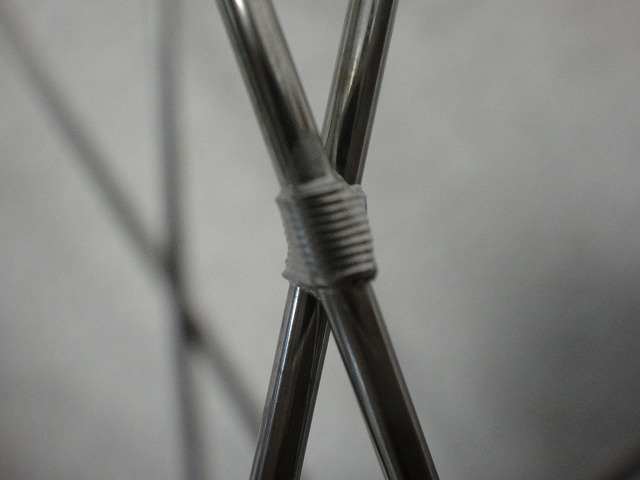
The comment mentions "solder won't stick to the spoke,"
and that's because the spokes are stainless steel.
The wire I use is also stainless. Otherwise it rusts later.
This is another difficult point.
I apologize for the many things I can't write about, but if you clear all these hurdles,
then you can call it meaningful spoke lacing and soldering.