Wheels again today (and so on).
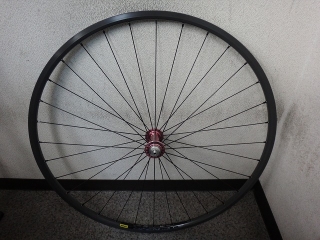
Built a wheel with a Chris King pink anodized hub and
an Open Pro rim.
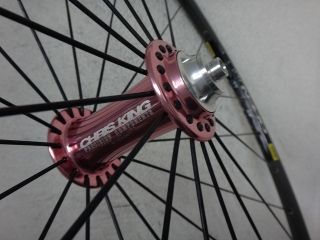
The front wheel is a Classic Low Flange hub, 32H, black Campagnolo outpoke radial build.
Chris King makes a "Classic" hub that doesn't quite reach the large flanges of left and right sides,
but gets pretty close to them.
This "Classic Low Flange" is the small flange version of that.
The flange diameter and width are close enough that you could say they're nearly the same as the R45 front hub,
but the hub shell itself is thicker here,
and while Classic and Classic Low Flange come in 28H, 32H, and 36H configurations,
the R45 comes in 24H, 28H, and 32H (with 20H also available for the front only).
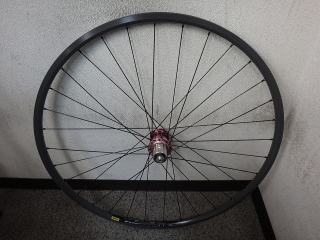
Got the rear wheel built too.
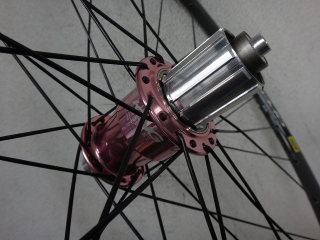
Classic Low Flange hub, 32H, black Campagnolo / Campagnolo 4-cross build.
I'll do the truing later.
The Classic rear hub has a flange hole spacing of 53.0mm on both sides,
but with the Classic Low Flange rear hub,
the freewheel side stays at 53.0mm while the non-freewheel side becomes 44.0mm—
so only the non-freewheel side becomes small flange,
making it more of a hi-lo flange rather than truly small flange.
The reason I listed the flange diameter to one decimal place is
because that's how Chris King specifies it in their literature,
and some hubs do have non-zero values in the last digit.
Incidentally, my actual measurement also came out to 53.0mm and 44.0mm,
but Chris King calls this flange hole spacing measurement
"Flange Diameter".
As I've written before, when people normally say "flange diameter" or "flange dimension,"
they're referring to the flange hole spacing—
it's almost never the outer diameter of the flange itself.
On the non-freewheel side of the Classic Low Flange hub,
the flange itself (the 44.0mm hole-spacing one)
has an outer diameter of 52.3mm by my measurement,
but there's no scenario where that number is actually useful.
In Shimano's catalogs, for example, with the rear hub
FH-M9000 (XETR) on the non-freewheel side,
the "spoke hole pitch diameter" is 44mm and the "flange diameter" is 52.8mm.
The dimension that I call "flange diameter" and Chris King calls "Flange Diameter"
is what Shimano calls "spoke hole pitch diameter"—not flange diameter at all.
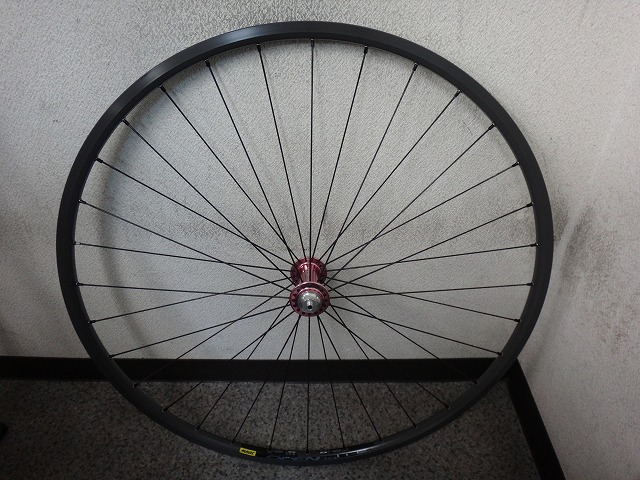
Built a wheel with a Chris King pink anodized hub and
an Open Pro rim.
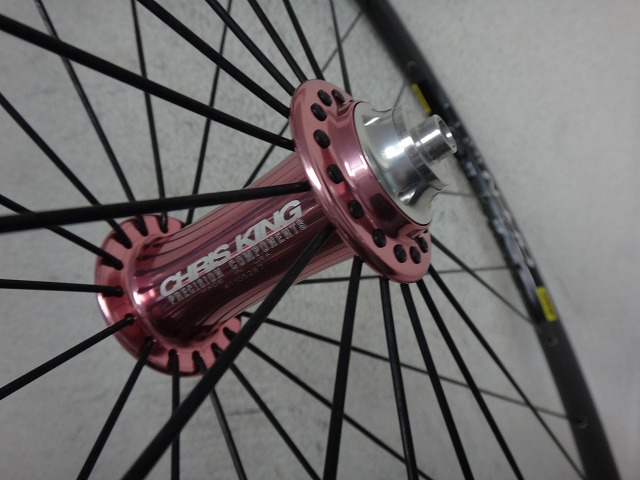
The front wheel is a Classic Low Flange hub, 32H, black Campagnolo outpoke radial build.
Chris King makes a "Classic" hub that doesn't quite reach the large flanges of left and right sides,
but gets pretty close to them.
This "Classic Low Flange" is the small flange version of that.
The flange diameter and width are close enough that you could say they're nearly the same as the R45 front hub,
but the hub shell itself is thicker here,
and while Classic and Classic Low Flange come in 28H, 32H, and 36H configurations,
the R45 comes in 24H, 28H, and 32H (with 20H also available for the front only).
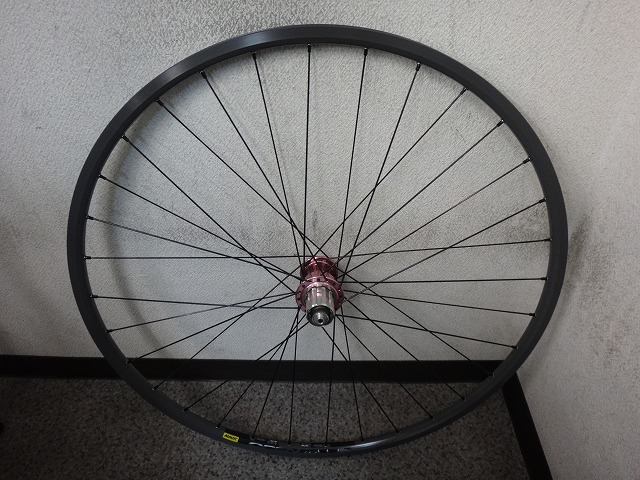
Got the rear wheel built too.

Classic Low Flange hub, 32H, black Campagnolo / Campagnolo 4-cross build.
I'll do the truing later.
The Classic rear hub has a flange hole spacing of 53.0mm on both sides,
but with the Classic Low Flange rear hub,
the freewheel side stays at 53.0mm while the non-freewheel side becomes 44.0mm—
so only the non-freewheel side becomes small flange,
making it more of a hi-lo flange rather than truly small flange.
The reason I listed the flange diameter to one decimal place is
because that's how Chris King specifies it in their literature,
and some hubs do have non-zero values in the last digit.
Incidentally, my actual measurement also came out to 53.0mm and 44.0mm,
but Chris King calls this flange hole spacing measurement
"Flange Diameter".
As I've written before, when people normally say "flange diameter" or "flange dimension,"
they're referring to the flange hole spacing—
it's almost never the outer diameter of the flange itself.
On the non-freewheel side of the Classic Low Flange hub,
the flange itself (the 44.0mm hole-spacing one)
has an outer diameter of 52.3mm by my measurement,
but there's no scenario where that number is actually useful.
In Shimano's catalogs, for example, with the rear hub
FH-M9000 (XETR) on the non-freewheel side,
the "spoke hole pitch diameter" is 44mm and the "flange diameter" is 52.8mm.
The dimension that I call "flange diameter" and Chris King calls "Flange Diameter"
is what Shimano calls "spoke hole pitch diameter"—not flange diameter at all.