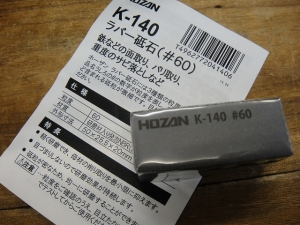
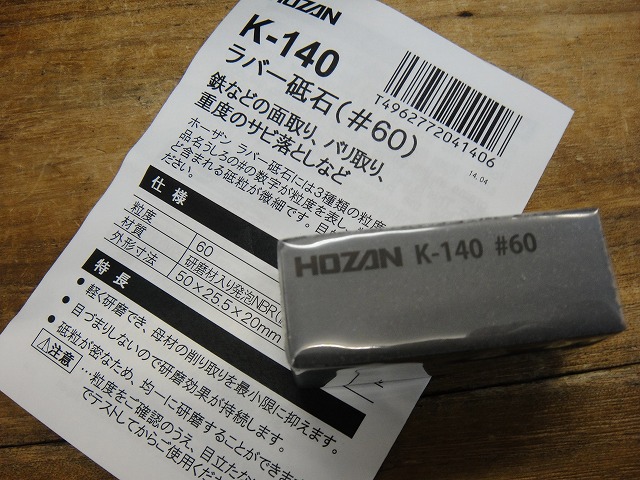
I bought a Hozan K-140.
Fair warning: writing it as K.140 can get confused with Mozart's opus numbers (Köchel catalog numbers).
Hozan's rubber whetstones come in three types: K-140/141/142,
with grit grades of 60/120/320 respectively.
The lower the number, the coarser the stone.

Hozan isn't exclusively a bicycle tool manufacturer,
but they've been putting serious effort into bicycle tools since way back,
and they publish catalogs with non-bicycle tools excluded.
The rubber whetstones listed in that catalog are only the K-140 and K-141 types,
and what bicycle distributors typically keep in stock
is mainly just the K-141.
There's an eraser-type product from Mavic called "Soft Stone" (ソフトストーン)
for cleaning the brake zone on rim sidewalls,
and it has a coarser grit than K-141 with better workability.
Since my shop can't source Soft Stone directly,
I tried buying the K-140 from a place that sells Hozan's general tools.
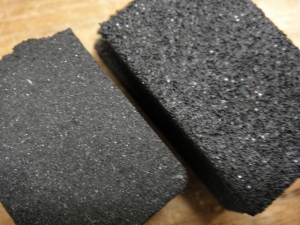
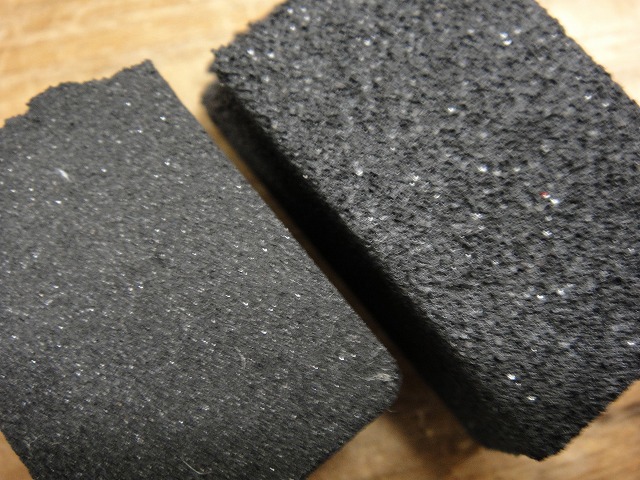
↑The image on the left is K-141, right is K-140.
Actually using it, the K-140 feels pretty close to the Soft Stone.
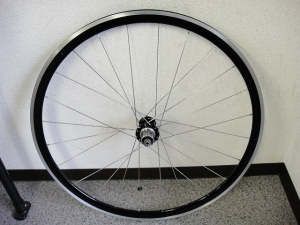
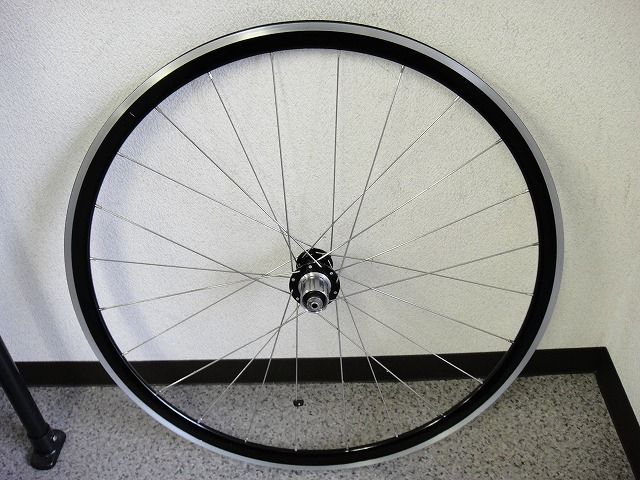
I washed the rear wheel of the Nomu Lab Wheel #1.
While I was at it, I cleaned up the rim sidewall too.

This is neither here nor there, but
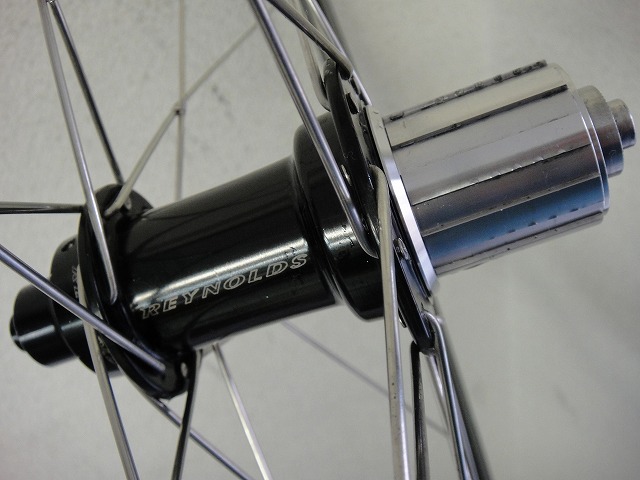
judging from the flange width and high-low geometry of this Reynolds hub,
dimensionally it's probably one of the strongest hand-building hubs out there.
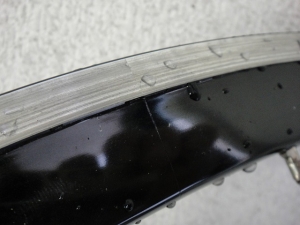

↑You can see from the rim seam and faint scratches that it's the same spot.
Using a rubber whetstone while dunking it in water finishes it quickly and cleanly,
but the stone wears abnormally fast, so I can't recommend it.
For regular folks, dry method is better than wet.
What's the point of doing this? Honestly, not much.
The braking might improve for a while,
but it'll get dirty again soon.
It's really just about making it look nice and feeling good about it.
But whenselling on auctions passing wheels on to others,
thelisting price impression improves quite a bit, so
for those who want tohide the condition hand over wheels in the best condition possible,
it makes a real difference.
That's where the sneaky name "Ninja Ya○○Auction Technique" comes from.
Don't use it for evil!
Fair warning: writing it as K.140 can get confused with Mozart's opus numbers (Köchel catalog numbers).
Hozan's rubber whetstones come in three types: K-140/141/142,
with grit grades of 60/120/320 respectively.
The lower the number, the coarser the stone.

Hozan isn't exclusively a bicycle tool manufacturer,
but they've been putting serious effort into bicycle tools since way back,
and they publish catalogs with non-bicycle tools excluded.
The rubber whetstones listed in that catalog are only the K-140 and K-141 types,
and what bicycle distributors typically keep in stock
is mainly just the K-141.
There's an eraser-type product from Mavic called "Soft Stone" (ソフトストーン)
for cleaning the brake zone on rim sidewalls,
and it has a coarser grit than K-141 with better workability.
Since my shop can't source Soft Stone directly,
I tried buying the K-140 from a place that sells Hozan's general tools.
↑The image on the left is K-141, right is K-140.
Actually using it, the K-140 feels pretty close to the Soft Stone.
I washed the rear wheel of the Nomu Lab Wheel #1.
While I was at it, I cleaned up the rim sidewall too.
This is neither here nor there, but
judging from the flange width and high-low geometry of this Reynolds hub,
dimensionally it's probably one of the strongest hand-building hubs out there.
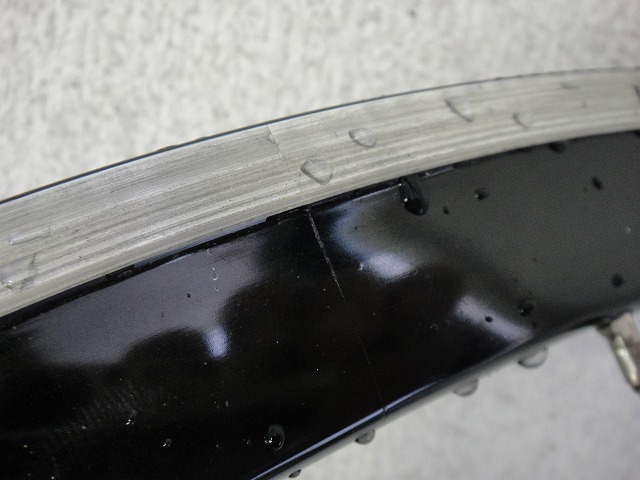

↑You can see from the rim seam and faint scratches that it's the same spot.
Using a rubber whetstone while dunking it in water finishes it quickly and cleanly,
but the stone wears abnormally fast, so I can't recommend it.
For regular folks, dry method is better than wet.
What's the point of doing this? Honestly, not much.
The braking might improve for a while,
but it'll get dirty again soon.
It's really just about making it look nice and feeling good about it.
But when
the
for those who want to
it makes a real difference.
That's where the sneaky name "Ninja Ya○○Auction Technique" comes from.
Don't use it for evil!