I wrote some time ago that the Park Tool for pressing in Campagnolo crank bearings is ridiculous because it's designed for impact loading by striking,
and I received a comment saying
"If the tool is contacting the bearing inner race, wouldn't striking it in be fine?"
So I wrote a reply confirming that
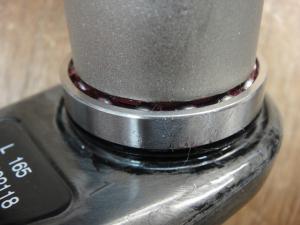
that's exactly what's happening ↑.
Then the other day, someone else commented
"Is there really no stress on the bearing from striking it in?
The reaction from the impact acts on the outer race and it seems bad for the bearing,"
so I'll reply to that.
Setting aside something like a fork lower cup (just a chunk of metal),
I personally don't think pressing in a bearing with impact loading is right.
Even if Park Tool says it's okay, I'm reluctant to actually strike it in.
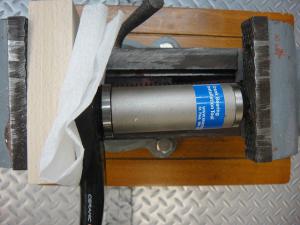
In practice, as shown in the image above, I protect the crank so it doesn't get scratched,
and press it in using static loading instead.
I wrote this when I first published the article too,
but at that initial stage I hadn't confirmed whether the tool's edge was only contacting the bearing's inner race,
so in my previous reply to that comment I thanked them for the opportunity
to confirm that "the edge is only contacting the inner race."
However, just because it only contacts the inner race doesn't mean "well then let's strike it in."
Even if the bearing sustains no damage, I want to press it in with static loading, and that's what I actually do.
When pressing in with static loading, the maximum load on the bearing's inner race occurs
at the moment the bearing seats completely.
With impact loading, momentary force would be applied that exceeds that.
Suppose you hold an egg-like object between both palms and gradually increase pressure.
Eventually the egg cracks, and
trying to reproduce that exact force with a hammer (in your right hand) and an anvil (in your left hand)
would be difficult.
If the egg cracks from impact, you're probably applying more force than you would with static loading.
Strictly speaking, even with static loading the bearing does experience stress (not zero while force is being applied),
but I believe static loading is gentler.
Also, static loading has the advantage of applying force cleanly and straight relative to the pressing direction.
In this case the crankshaft also serves as a straight guide for the bearing,
so striking it in doesn't seem to result in misalignment,
but BB30 pressing or hub bearings aren't so straightforward.
Regarding Campagnolo crank bearing pressing, Syncros' tools are quite well made,
but they're so specialized for Ultra-Torque that they lack versatility—that's a shame.
That's why I use Park Tool.
and I received a comment saying
"If the tool is contacting the bearing inner race, wouldn't striking it in be fine?"
So I wrote a reply confirming that
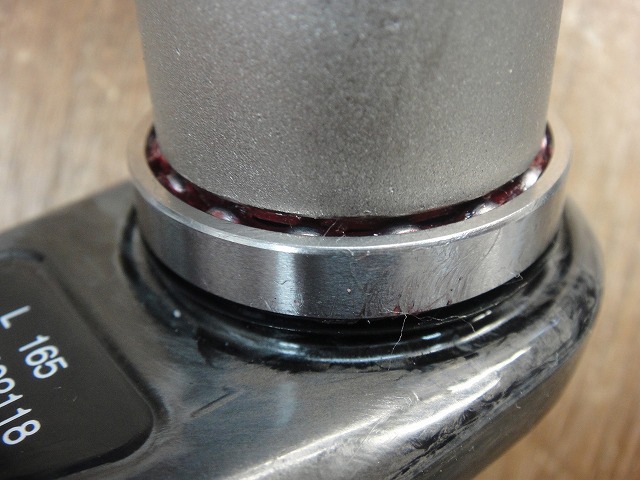
that's exactly what's happening ↑.
Then the other day, someone else commented
"Is there really no stress on the bearing from striking it in?
The reaction from the impact acts on the outer race and it seems bad for the bearing,"
so I'll reply to that.
Setting aside something like a fork lower cup (just a chunk of metal),
I personally don't think pressing in a bearing with impact loading is right.
Even if Park Tool says it's okay, I'm reluctant to actually strike it in.
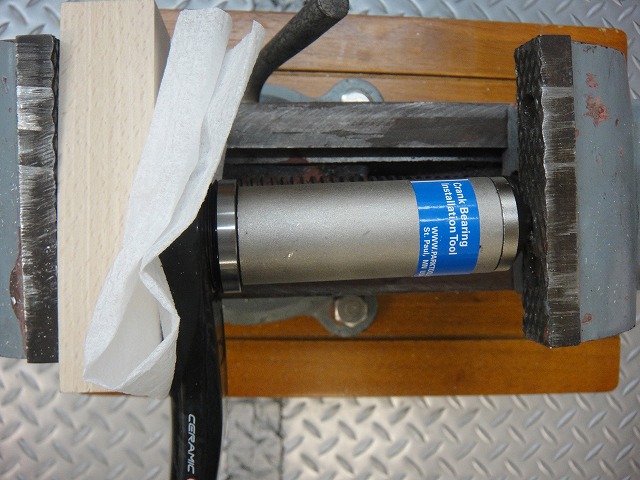
In practice, as shown in the image above, I protect the crank so it doesn't get scratched,
and press it in using static loading instead.
I wrote this when I first published the article too,
but at that initial stage I hadn't confirmed whether the tool's edge was only contacting the bearing's inner race,
so in my previous reply to that comment I thanked them for the opportunity
to confirm that "the edge is only contacting the inner race."
However, just because it only contacts the inner race doesn't mean "well then let's strike it in."
Even if the bearing sustains no damage, I want to press it in with static loading, and that's what I actually do.
When pressing in with static loading, the maximum load on the bearing's inner race occurs
at the moment the bearing seats completely.
With impact loading, momentary force would be applied that exceeds that.
Suppose you hold an egg-like object between both palms and gradually increase pressure.
Eventually the egg cracks, and
trying to reproduce that exact force with a hammer (in your right hand) and an anvil (in your left hand)
would be difficult.
If the egg cracks from impact, you're probably applying more force than you would with static loading.
Strictly speaking, even with static loading the bearing does experience stress (not zero while force is being applied),
but I believe static loading is gentler.
Also, static loading has the advantage of applying force cleanly and straight relative to the pressing direction.
In this case the crankshaft also serves as a straight guide for the bearing,
so striking it in doesn't seem to result in misalignment,
but BB30 pressing or hub bearings aren't so straightforward.
Regarding Campagnolo crank bearing pressing, Syncros' tools are quite well made,
but they're so specialized for Ultra-Torque that they lack versatility—that's a shame.
That's why I use Park Tool.