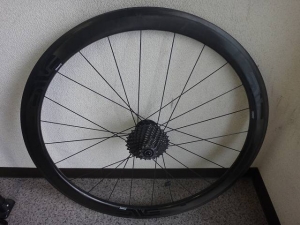
A customer brought in the rear wheel from a Smart Envé 3.4 for service.
Lately, instead of calling it SMART ENVÉ,
they've started calling it "SES" from the acronym
SMART ENVÉ SYSTEM.
The SES 3.4 refers to a set of two rims:
a 35mm front rim with only 20H spokes,
and a 45mm rear rim with only 24H spokes.
Since the rear rim isn't an offset rim,
you could theoretically build a wheel using 45mm 24H rims front and rear,
but there's no compelling reason to deviate from the manufacturer's recommended pairing,
so it's best to use the 35mm front and 45mm rear as intended.
The rim widths differ front to rear as well.
The reason for the service was "severe radial runout."
With a fairly wide rim width, the frame's rear triangle having tight tolerances,
and a rear brake mounted behind the bottom bracket,
all the conditions align to make rim runout very noticeable.
It seems another shop did a truing job on it recently,
but the wheel center was off (off by about one coin diameter, as I showed the customer).
The radial runout appears to be original, but the center offset
likely resulted from that recent lateral truing work.
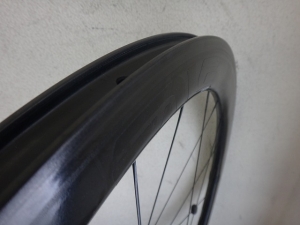
By the way, it was a WO rim with a PowerTap hub.
If you're reading this, you'll remember this job. That's your work right there.
For the radial runout, there was one spot dipping inward
and one spot sticking outward,
but since they were mixed throughout one rotation of the wheel,
it created that wobbling, eccentric appearance.
For a customer to actually notice radial runout speaks volumes.
I showed the customer that I've dialed in both the radial and lateral runout properly
and achieved perfect center alignment with no deviation left or right.

Lately, instead of calling it SMART ENVÉ,
they've started calling it "SES" from the acronym
SMART ENVÉ SYSTEM.
The SES 3.4 refers to a set of two rims:
a 35mm front rim with only 20H spokes,
and a 45mm rear rim with only 24H spokes.
Since the rear rim isn't an offset rim,
you could theoretically build a wheel using 45mm 24H rims front and rear,
but there's no compelling reason to deviate from the manufacturer's recommended pairing,
so it's best to use the 35mm front and 45mm rear as intended.
The rim widths differ front to rear as well.
The reason for the service was "severe radial runout."
With a fairly wide rim width, the frame's rear triangle having tight tolerances,
and a rear brake mounted behind the bottom bracket,
all the conditions align to make rim runout very noticeable.
It seems another shop did a truing job on it recently,
but the wheel center was off (off by about one coin diameter, as I showed the customer).
The radial runout appears to be original, but the center offset
likely resulted from that recent lateral truing work.
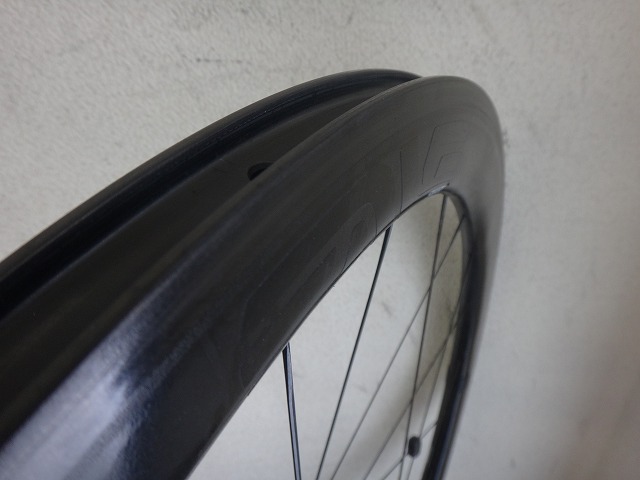
By the way, it was a WO rim with a PowerTap hub.
For the radial runout, there was one spot dipping inward
and one spot sticking outward,
but since they were mixed throughout one rotation of the wheel,
it created that wobbling, eccentric appearance.
For a customer to actually notice radial runout speaks volumes.
I showed the customer that I've dialed in both the radial and lateral runout properly
and achieved perfect center alignment with no deviation left or right.