A customer dropped off a set of wheels built with XR200 rims.
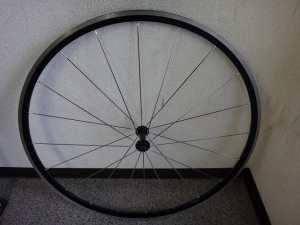
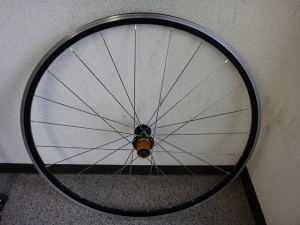
Front wheel 20H, rear wheel 24H, and all spokes are CX-RAY.
I asked the builder about their work.
Since they apparently read this blog, I figure they'll probably see this too.
The rear wheel had runout issues, so they asked me to true it.
Sure enough, there was subtle lateral wobble in both directions.
The front wheel had about a sheet of paper's worth of center offset.
Depending on which centergage you use, it would be judged as "properly centered,"
so there's no real problem there.
There was some radial runout in the rear wheel, but that's unavoidable given the wheel configuration.
The XR200 is a precision rim that can dial in radial runout pretty aggressively,
but this rear wheel is built 2:1, so the compromise on radial runout inevitably gets softer.
Compared to a similarly configured off-the-shelf Racing 3 with steel spokes in 2:1 lacing,
this is far superior.
With radial runout this small, it's way less than the deformation of the tire contact patch,
so you won't feel anything abnormal when riding.
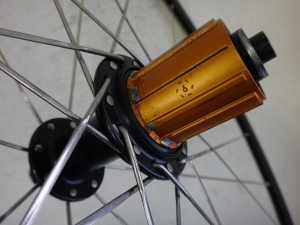
The rear hub is a six-pawl freewheel type,
sibling to a Leaf hub (not sure which is the older brother).
The flange holes are designed for 2:1 spoke lacing.
It's built 60-0, but the spoke tension difference between sides goes beyond 100:100—
the non-freewheel side is actually slightly higher
(at least the minimum on the freewheel side is less than the maximum on the non-freewheel side),
so 40-0 lacing might be better, but that comes down to preference.
Sorry for being presumptuous, but I'll offer two pieces of unsolicited advice:
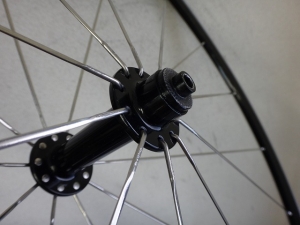
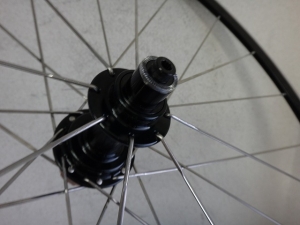
Some cartridge-bearing hubs are better off avoiding pure inpoke radial lacing.
Not all Powerway-type hubs have this issue, but
I don't do it on Leaf front hubs for a specific reason.
Leaf rear hubs are technically OK with it,
but I almost never build rear wheels with non-freewheel-side radial lacing anyway,
so it's irrelevant to me.
I won't write the reason because it touches on trade secrets.
And I won't say whether these particular hubs fall into that category or not.
Addendum: Whether a specific phenomenon occurs during inpoke radial lacing is the criterion for determining whether inpoke radial lacing is possible on a given hub. The bearing type, shaft and locknut design, plus a couple of other conditions determine whether inpoke radial lacing works. I've even tried building wheels by alternating inpoke and outpoke spoke passages through the flange holes from a tangent-laced pattern (since tangent lacing alternates between inpoke and outpoke). But in that case, the magnitude of the phenomenon that occurs ended up being much closer to pure inpoke rather than the middle ground between pure inpoke and pure outpoke.
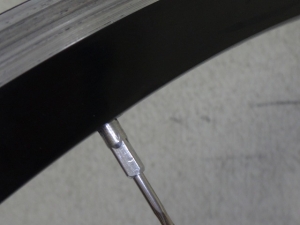
Also, those 14mm silver-aluminum nipples that come with Sapim CX-RAY spokes—
you're better off not using them.
I specifically special-order DT's 12mm silver-aluminum nipples instead.
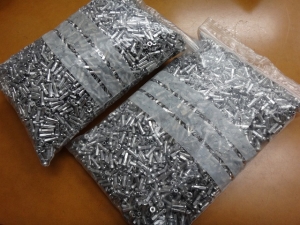
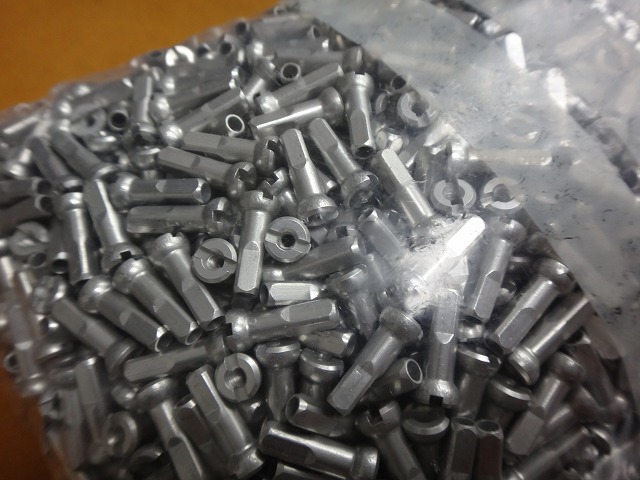
↑ Leftover Sapim aluminum nipples I don't use
Just weighed them—the full bag in back is 1695g,
and the bag I'm still accumulating is 1030g, so together that's 2725g.
These nipples weigh about 36g per 100, so
even being conservative, I've got around 7500 unused nipples sitting here.
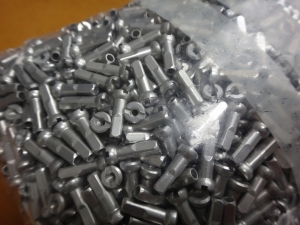
I won't write down why DT nipples are better either.
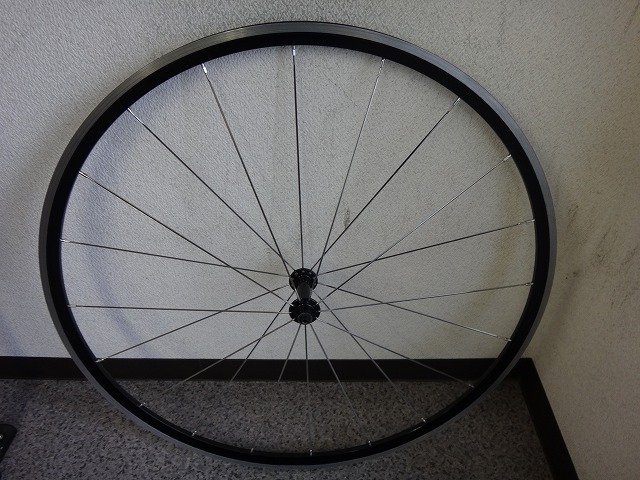

Front wheel 20H, rear wheel 24H, and all spokes are CX-RAY.
I asked the builder about their work.
Since they apparently read this blog, I figure they'll probably see this too.
The rear wheel had runout issues, so they asked me to true it.
Sure enough, there was subtle lateral wobble in both directions.
The front wheel had about a sheet of paper's worth of center offset.
Depending on which centergage you use, it would be judged as "properly centered,"
so there's no real problem there.
There was some radial runout in the rear wheel, but that's unavoidable given the wheel configuration.
The XR200 is a precision rim that can dial in radial runout pretty aggressively,
but this rear wheel is built 2:1, so the compromise on radial runout inevitably gets softer.
Compared to a similarly configured off-the-shelf Racing 3 with steel spokes in 2:1 lacing,
this is far superior.
With radial runout this small, it's way less than the deformation of the tire contact patch,
so you won't feel anything abnormal when riding.
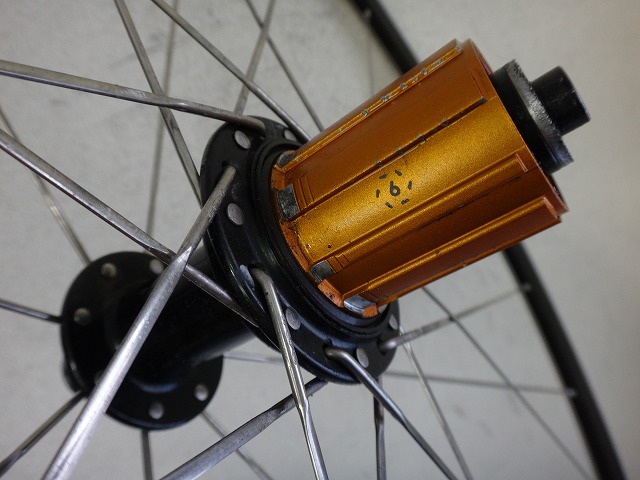
The rear hub is a six-pawl freewheel type,
sibling to a Leaf hub (not sure which is the older brother).
The flange holes are designed for 2:1 spoke lacing.
It's built 60-0, but the spoke tension difference between sides goes beyond 100:100—
the non-freewheel side is actually slightly higher
(at least the minimum on the freewheel side is less than the maximum on the non-freewheel side),
so 40-0 lacing might be better, but that comes down to preference.
Sorry for being presumptuous, but I'll offer two pieces of unsolicited advice:
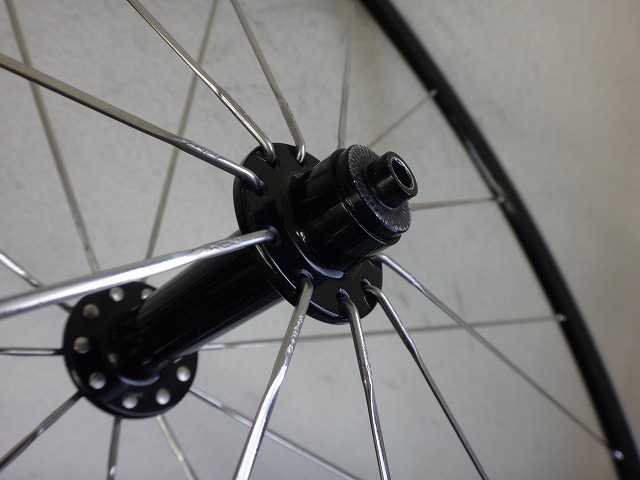
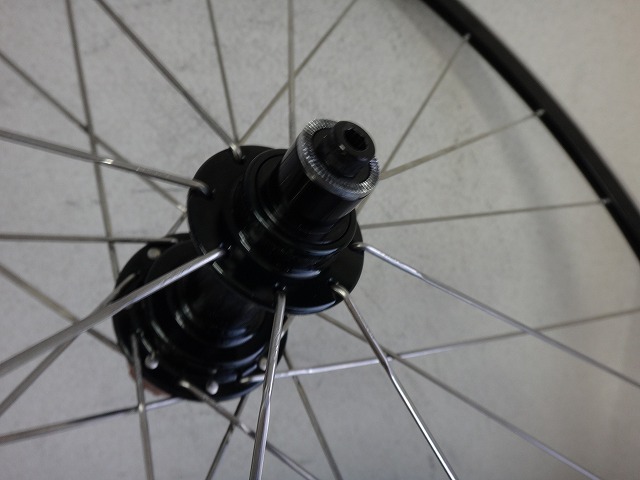
Some cartridge-bearing hubs are better off avoiding pure inpoke radial lacing.
Not all Powerway-type hubs have this issue, but
I don't do it on Leaf front hubs for a specific reason.
Leaf rear hubs are technically OK with it,
but I almost never build rear wheels with non-freewheel-side radial lacing anyway,
so it's irrelevant to me.
I won't write the reason because it touches on trade secrets.
And I won't say whether these particular hubs fall into that category or not.
Addendum: Whether a specific phenomenon occurs during inpoke radial lacing is the criterion for determining whether inpoke radial lacing is possible on a given hub. The bearing type, shaft and locknut design, plus a couple of other conditions determine whether inpoke radial lacing works. I've even tried building wheels by alternating inpoke and outpoke spoke passages through the flange holes from a tangent-laced pattern (since tangent lacing alternates between inpoke and outpoke). But in that case, the magnitude of the phenomenon that occurs ended up being much closer to pure inpoke rather than the middle ground between pure inpoke and pure outpoke.
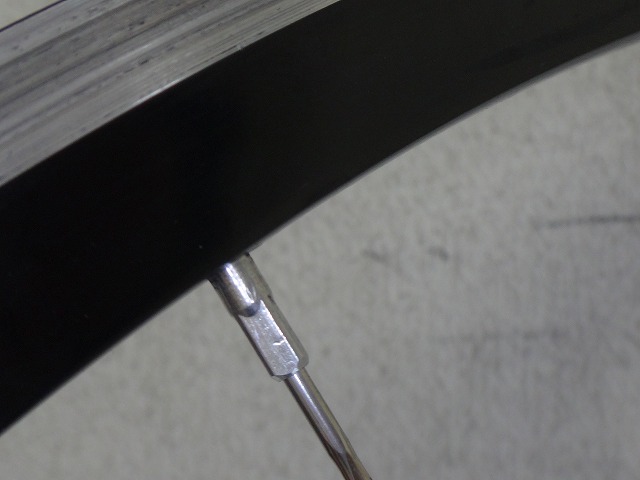
Also, those 14mm silver-aluminum nipples that come with Sapim CX-RAY spokes—
you're better off not using them.
I specifically special-order DT's 12mm silver-aluminum nipples instead.

↑ Leftover Sapim aluminum nipples I don't use
Just weighed them—the full bag in back is 1695g,
and the bag I'm still accumulating is 1030g, so together that's 2725g.
These nipples weigh about 36g per 100, so
even being conservative, I've got around 7500 unused nipples sitting here.
I won't write down why DT nipples are better either.