A customer left me with the rear wheel from a Rovarʼs Rapide SL45 (Rovar hub model).
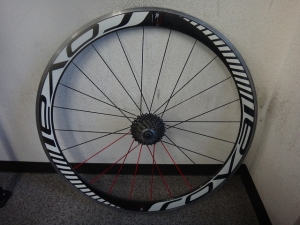
The rim got crushed from brake heat, so they want me to reuse the hub and build them a practice wheel.
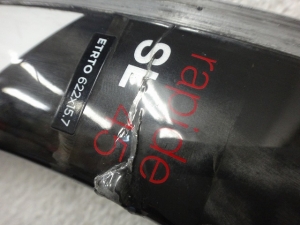
↑The valve hole area is all crushed up.
The sticker has wrinkles because of it, but with "SL (Short Life)" in the name, I guess that's just how it is.
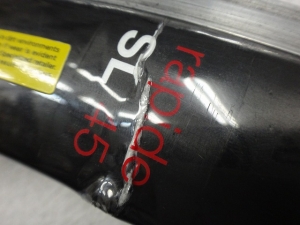
The other side.
The customer checked with Specialized about rim replacement, and apparently there are no spare rims in stock, so they can't do it.
The way they said it makes it sound like spare rims were once actually available.
Can't even repair a wheel from just five or six years ago, can you Specialized?
Postscript: If you can do it, then prove it. If you can't, then shut up.
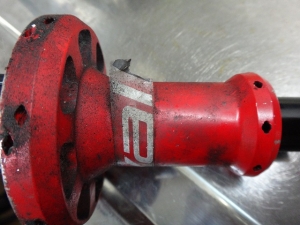
The sticker on the hub body is all peeling up, but the customer gave me permission to remove it when I clean it.
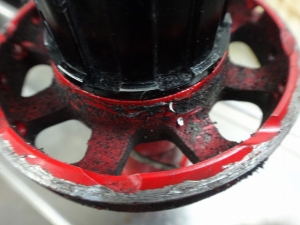
There are chain drop marks on the right flange.
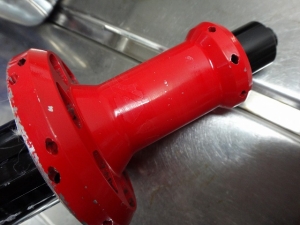
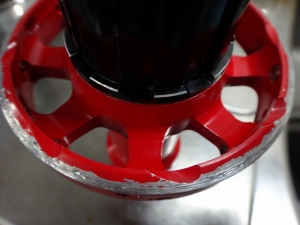
Cleaned it.
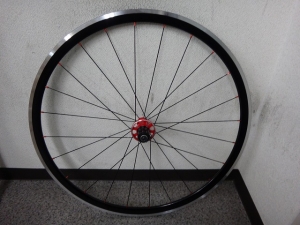
Rebuilt with an XR300 rim.

Since itʼs built 2:1, if we used different diameter spokes left and right, the non-freewheel side could end up with higher tension, so Iʼm using black CX-RAY straight spokes on both sides.
Even with 2:1 lacing, with Fulcrum hubs the freewheel-side crossing is much closer to tangent lacing and has a blunt final crossing angle, but with Rovar the final crossing angle is sharper.
To put it in exaggerated terms, the Rovar is closer to left-right radial lacing than Fulcrum.

For example, with the Racing Quattro, the non-freewheel side radial spokes pass over the freewheel sideʼs final crossing when viewed from the side, so the phase of the rim side beyond the final crossing spokes is
right left rightright leftright, shown in red, but

with Racing 3, the non-freewheel side spokes pass over a crossing that isnʼt the final crossing, so
right leftright right left right
and the rim side phase is closer, so the final crossing angle should be sharper... except that's wrong.
Both Racing Quattro and 3 have a "rest phase," so
right left right restright leftright rest ←Racing Quattro
right leftright restright left right rest ←Racing 3
so the angular difference in rim phase is the same.
The final crossing angle differs because flange diameter and rim height are different.

However, Rovar rims have no rest phase, so the rim holes beyond the final crossing are
right leftright right left right, and because of that the final crossing angle becomes sharper (closer to radial lacing).
The fact that Fulcrum is 21H and the SL45 is 24H is also related.
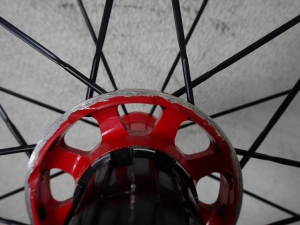
Furthermore, the spoke head phase on the flange isnʼt uniform but has dense and sparse areas, and the fact that spoke holes close together form the final crossing is another reason the angle is sharp.

Looking at it differently, the "sparse" spots and "dense" spots of the dense-sparse flange holes have the same spacing, so
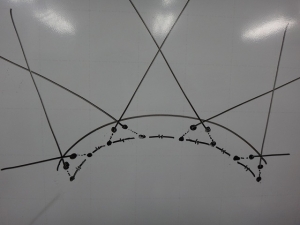
when you extend the spoke line segments inward, you get a virtual flange with uniform hole spacing.
This is the flange diameter youʼd have with a normal hub with evenly spaced holes, so when you think of a normal hub with the same spoke angle,
Rovarʼs dense-sparse hole flange acts like a smaller flange than it looks.
(This is just about spoke angle, not stiffness or anything like that.)
The current Fulcrum rim hole phase repeats right left right rest (with exceptions like Racing Lite and Red Wind), and this is derived by removing half the "left" spokes from a right-left-right-left equal distribution, which makes spoke length calculation easier.
Taking the freewheel-side spokes out of a 28H 60-degree lacing gets you 21H like Racing Zero 3.
With this Rovar, with rim hole phase having no rest and dense-sparse flanges, calculating spoke length was extremely tedious.
Oh wait. What I was trying to say is that with Rovarʼs 2:1 lacing, which is closer to 40-degree than 60-degree lacing, maybe I should have incorporated some left-right diameter difference?
But in reality, with straight spokes there are only three options: spoke weight ratio 100%, 85%, and 65%, so with Race/CX-RAY at 85%:65%, the left-right difference would be too large for 2:1 lacing, so I decided to go with both sides CX-RAY.
If there were a 75% weight spoke that was consistently available, that would be convenient for situations like this (probably).
However, with 65% spokes in round section, I know from experience that "stretchy deformation" happens in the elongation direction before itʼs fully tensioned, but whether that would happen with 75% round spokes in the practical range of wheel building is unknown.
With flat spokes it basically doesnʼt happen, as confirmed with complete wheels and hard-to-find bent-head spokes that work out to about 75%.
Actually, if it doesnʼt happen with 65%, thereʼs no reason it would with 75% usually.
Current models like the Zonda use unequal spoke numbers and different diameters left-right, and that might be a good middle ground.
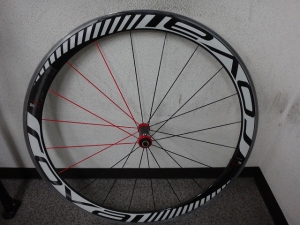
But thereʼs more to come.
Initially I only had the rear wheel, but the front wheel got destroyed by brake heat too, so they want that rebuilt as well.
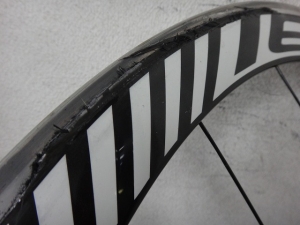
The customer agrees the cause was the rim getting hot from downhill braking, but apparently there was suddenly a loud "BANG!" and the carbon exploded.
At least they didnʼt get hurt.
Incidentally, Specializedʼs answer is that since the warranty period has passed, they wonʼt replace the rim.
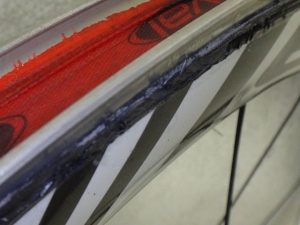
↑The peeling spot
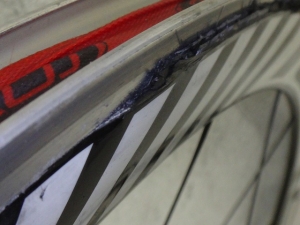
↑Starting to peel
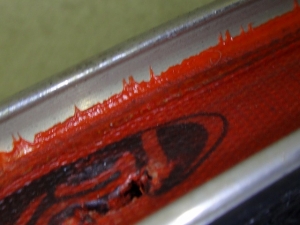
The rim tape shrank in width from the heat and basically fused to the rim.
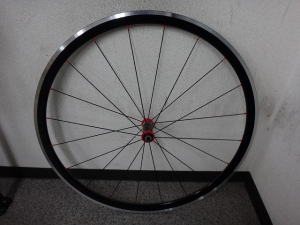
Done building.
This one also uses the XR300 rim
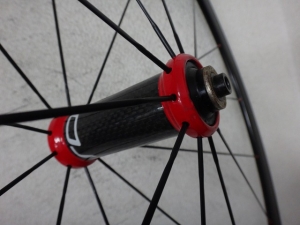
20H black CX-RAY straight spoke, radial lacing.
Actually, radial lacing is the only option for this one.
This hub has the sticker under clear coating so it wonʼt peel off.
The rear hub has a Starling ratchet freewheel body so itʼs DT (DT Swiss), but the front hub has the same anodize color on the axle as Tnʼi and PowerTap, and the bearings are Hokkaido Seiki marked "EZO," so it looks like Novatec (Novatec hub brand).
Now, by switching to XR300 rims, the rim weight has gotten lighter.
Our shop's average weight for XR300 rims is 462g, which is the number I use when explaining to customers.
When I weighed the wheel #1 rim built today, it was 458g.
This is a light individual specimen.
The XR300 is 30mm deep and the SL45 is 45mm deep, so if the rim gets 15mm taller, how much weight gain is acceptable (or even desirable) before one admits it canʼt be helped, and from the height-to-weight ratio, which rim would you consider superior overall?
If the SL45 was say 480g, you could simply consider it a straight upgrade.
But what if itʼs 500g? 550g?
If it turned out to be 600g, even accounting for the weight being distributed in the inner section due to the 15mm depth difference and the aero benefits, from an absolute weight standpoint youʼd have to say "too heavy, no good."
This is about the rim alone; looking at the whole wheel, the rear wheel came out similarly stiff as before, and the front wheel got noticeably stiffer, that's how well it tensioned.
Donʼt want to disappoint anyone, so Iʼm not disclosing the SL45 rim weight.
Who do you think Iʼm gonna tell, buddy. ←Wow, what a disagreeable attitude.
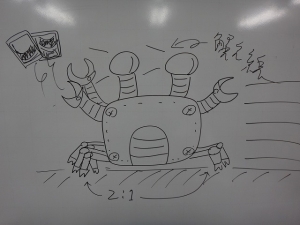
Sorry for the wait! Please take a look at this image!
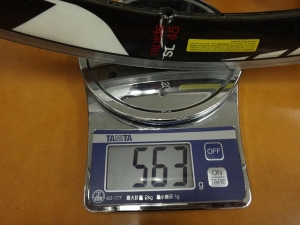
Itʼs the rear rim!
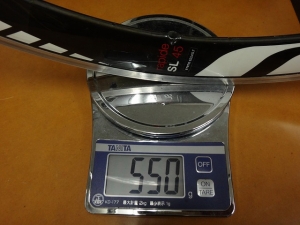
Itʼs the front rim!
I tried to photograph where it split, but the rim wouldnʼt stand up by itself!
↑Stop that right now!

The rim got crushed from brake heat, so they want me to reuse the hub and build them a practice wheel.

↑The valve hole area is all crushed up.
The sticker has wrinkles because of it, but with "SL (Short Life)" in the name, I guess that's just how it is.

The other side.
The customer checked with Specialized about rim replacement, and apparently there are no spare rims in stock, so they can't do it.
The way they said it makes it sound like spare rims were once actually available.
Can't even repair a wheel from just five or six years ago, can you Specialized?
Postscript: If you can do it, then prove it. If you can't, then shut up.
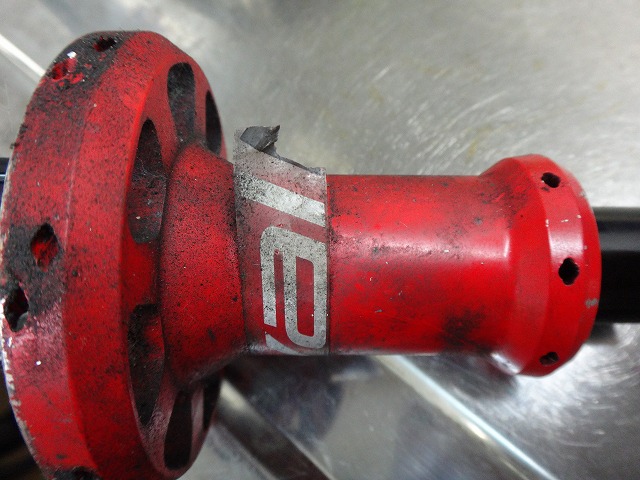
The sticker on the hub body is all peeling up, but the customer gave me permission to remove it when I clean it.

There are chain drop marks on the right flange.

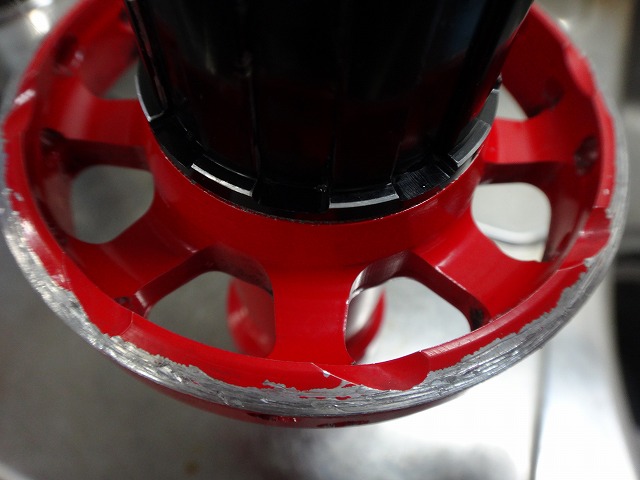
Cleaned it.
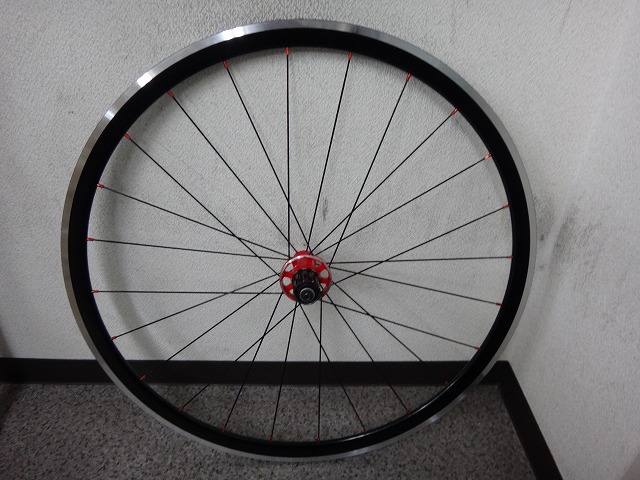
Rebuilt with an XR300 rim.
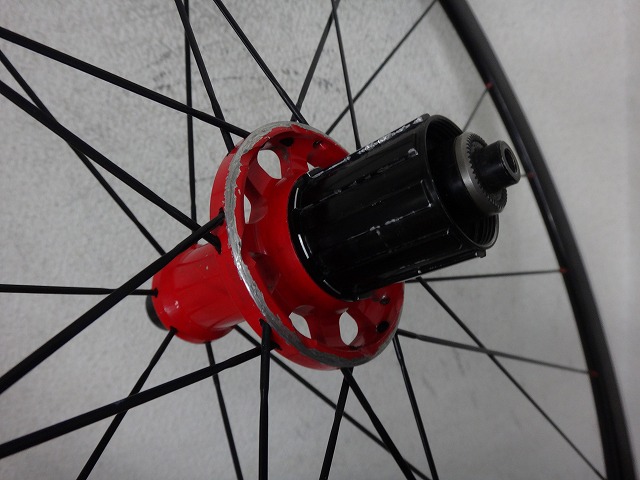
Since itʼs built 2:1, if we used different diameter spokes left and right, the non-freewheel side could end up with higher tension, so Iʼm using black CX-RAY straight spokes on both sides.
Even with 2:1 lacing, with Fulcrum hubs the freewheel-side crossing is much closer to tangent lacing and has a blunt final crossing angle, but with Rovar the final crossing angle is sharper.
To put it in exaggerated terms, the Rovar is closer to left-right radial lacing than Fulcrum.

For example, with the Racing Quattro, the non-freewheel side radial spokes pass over the freewheel sideʼs final crossing when viewed from the side, so the phase of the rim side beyond the final crossing spokes is
right left rightright leftright, shown in red, but
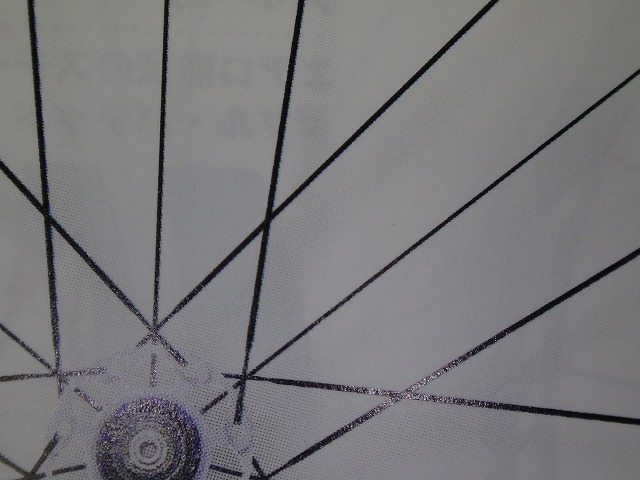
with Racing 3, the non-freewheel side spokes pass over a crossing that isnʼt the final crossing, so
right leftright right left right
and the rim side phase is closer, so the final crossing angle should be sharper... except that's wrong.
Both Racing Quattro and 3 have a "rest phase," so
right left right restright leftright rest ←Racing Quattro
right leftright restright left right rest ←Racing 3
so the angular difference in rim phase is the same.
The final crossing angle differs because flange diameter and rim height are different.
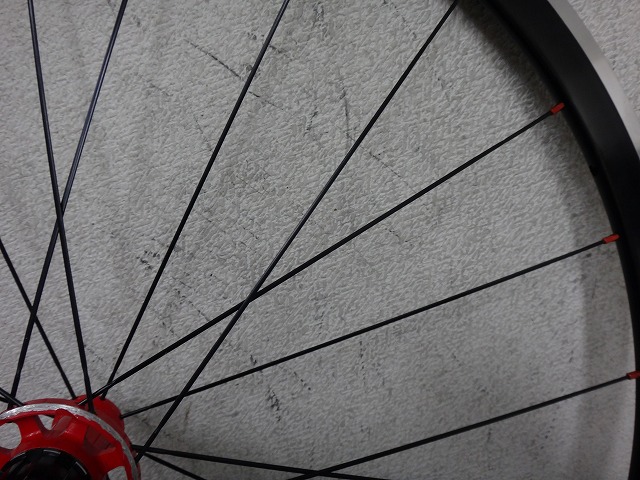
However, Rovar rims have no rest phase, so the rim holes beyond the final crossing are
right leftright right left right, and because of that the final crossing angle becomes sharper (closer to radial lacing).
The fact that Fulcrum is 21H and the SL45 is 24H is also related.
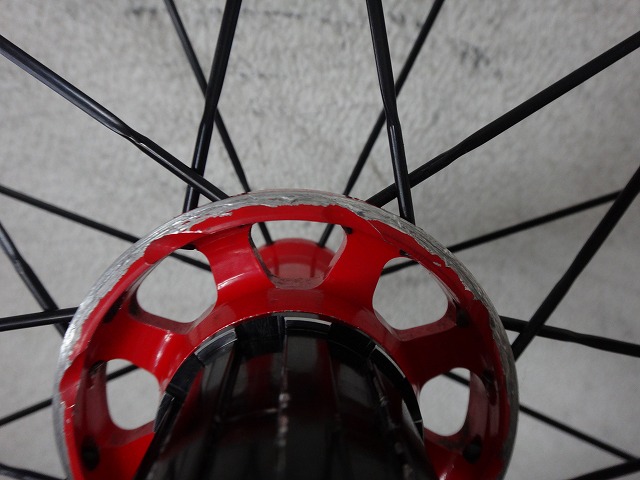
Furthermore, the spoke head phase on the flange isnʼt uniform but has dense and sparse areas, and the fact that spoke holes close together form the final crossing is another reason the angle is sharp.
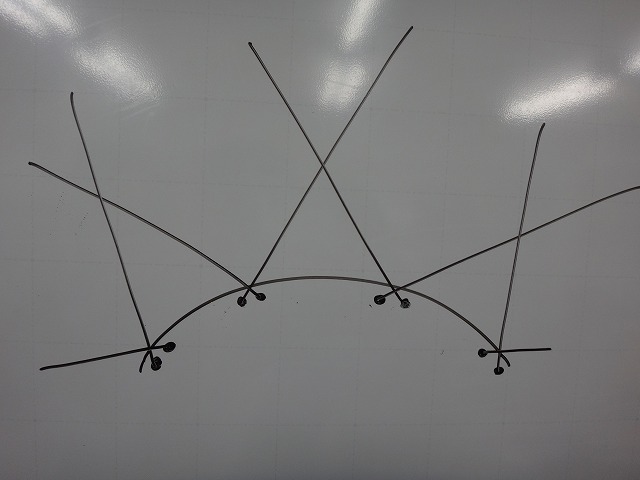
Looking at it differently, the "sparse" spots and "dense" spots of the dense-sparse flange holes have the same spacing, so
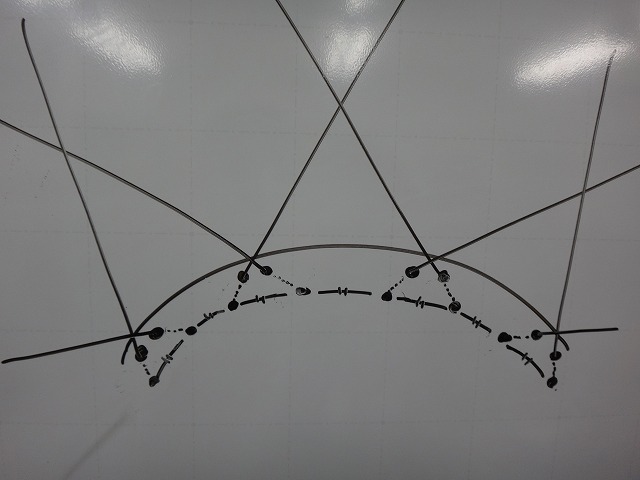
when you extend the spoke line segments inward, you get a virtual flange with uniform hole spacing.
This is the flange diameter youʼd have with a normal hub with evenly spaced holes, so when you think of a normal hub with the same spoke angle,
Rovarʼs dense-sparse hole flange acts like a smaller flange than it looks.
(This is just about spoke angle, not stiffness or anything like that.)
The current Fulcrum rim hole phase repeats right left right rest (with exceptions like Racing Lite and Red Wind), and this is derived by removing half the "left" spokes from a right-left-right-left equal distribution, which makes spoke length calculation easier.
Taking the freewheel-side spokes out of a 28H 60-degree lacing gets you 21H like Racing Zero 3.
With this Rovar, with rim hole phase having no rest and dense-sparse flanges, calculating spoke length was extremely tedious.
Oh wait. What I was trying to say is that with Rovarʼs 2:1 lacing, which is closer to 40-degree than 60-degree lacing, maybe I should have incorporated some left-right diameter difference?
But in reality, with straight spokes there are only three options: spoke weight ratio 100%, 85%, and 65%, so with Race/CX-RAY at 85%:65%, the left-right difference would be too large for 2:1 lacing, so I decided to go with both sides CX-RAY.
If there were a 75% weight spoke that was consistently available, that would be convenient for situations like this (probably).
However, with 65% spokes in round section, I know from experience that "stretchy deformation" happens in the elongation direction before itʼs fully tensioned, but whether that would happen with 75% round spokes in the practical range of wheel building is unknown.
With flat spokes it basically doesnʼt happen, as confirmed with complete wheels and hard-to-find bent-head spokes that work out to about 75%.
Actually, if it doesnʼt happen with 65%, thereʼs no reason it would with 75% usually.
Current models like the Zonda use unequal spoke numbers and different diameters left-right, and that might be a good middle ground.

But thereʼs more to come.
Initially I only had the rear wheel, but the front wheel got destroyed by brake heat too, so they want that rebuilt as well.
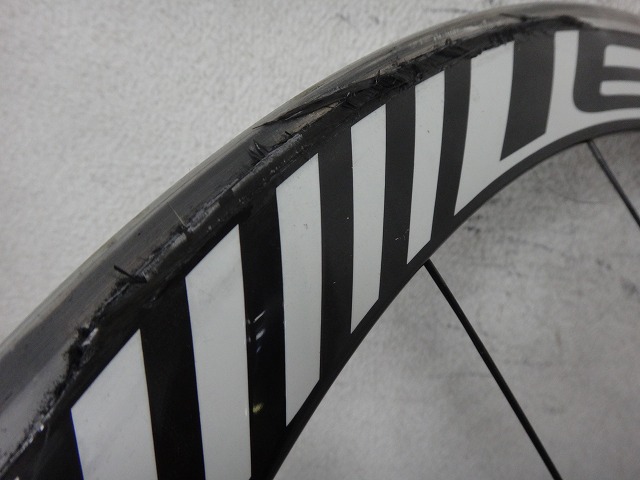
The customer agrees the cause was the rim getting hot from downhill braking, but apparently there was suddenly a loud "BANG!" and the carbon exploded.
At least they didnʼt get hurt.
Incidentally, Specializedʼs answer is that since the warranty period has passed, they wonʼt replace the rim.
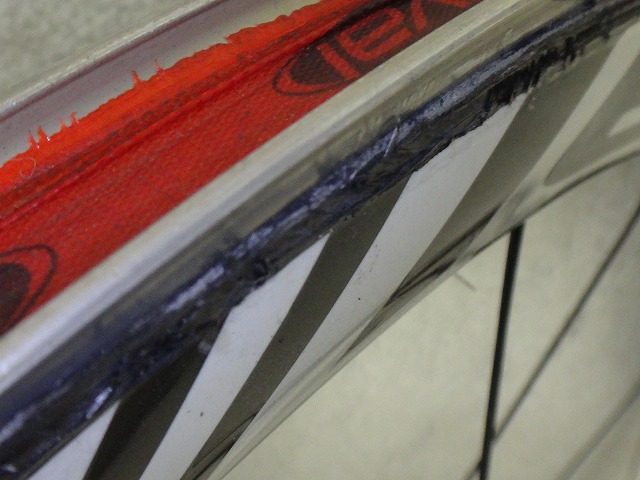
↑The peeling spot
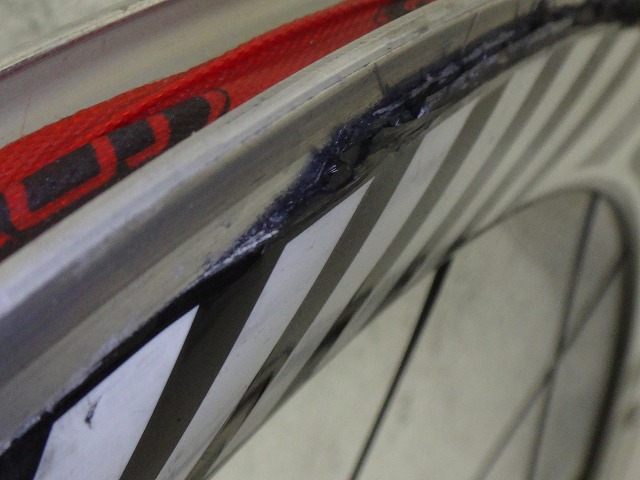
↑Starting to peel

The rim tape shrank in width from the heat and basically fused to the rim.

Done building.
This one also uses the XR300 rim
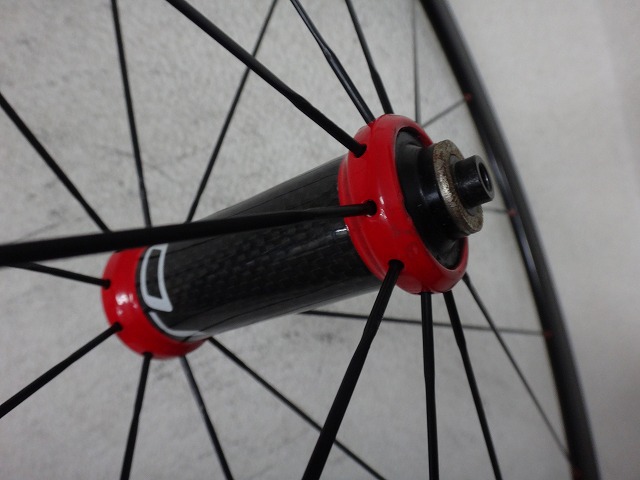
20H black CX-RAY straight spoke, radial lacing.
Actually, radial lacing is the only option for this one.
This hub has the sticker under clear coating so it wonʼt peel off.
The rear hub has a Starling ratchet freewheel body so itʼs DT (DT Swiss), but the front hub has the same anodize color on the axle as Tnʼi and PowerTap, and the bearings are Hokkaido Seiki marked "EZO," so it looks like Novatec (Novatec hub brand).
Now, by switching to XR300 rims, the rim weight has gotten lighter.
Our shop's average weight for XR300 rims is 462g, which is the number I use when explaining to customers.
When I weighed the wheel #1 rim built today, it was 458g.
This is a light individual specimen.
The XR300 is 30mm deep and the SL45 is 45mm deep, so if the rim gets 15mm taller, how much weight gain is acceptable (or even desirable) before one admits it canʼt be helped, and from the height-to-weight ratio, which rim would you consider superior overall?
If the SL45 was say 480g, you could simply consider it a straight upgrade.
But what if itʼs 500g? 550g?
If it turned out to be 600g, even accounting for the weight being distributed in the inner section due to the 15mm depth difference and the aero benefits, from an absolute weight standpoint youʼd have to say "too heavy, no good."
This is about the rim alone; looking at the whole wheel, the rear wheel came out similarly stiff as before, and the front wheel got noticeably stiffer, that's how well it tensioned.
Donʼt want to disappoint anyone, so Iʼm not disclosing the SL45 rim weight.
Who do you think Iʼm gonna tell, buddy. ←Wow, what a disagreeable attitude.

Sorry for the wait! Please take a look at this image!
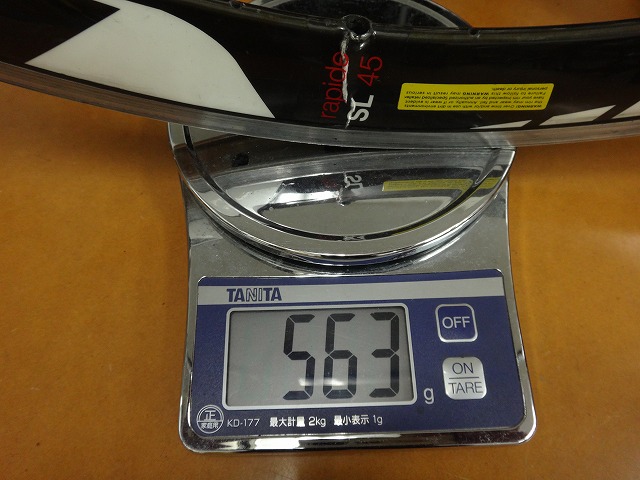
Itʼs the rear rim!
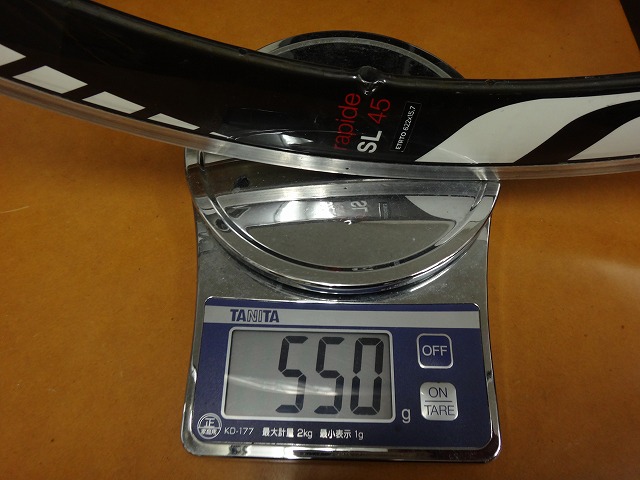
Itʼs the front rim!
I tried to photograph where it split, but the rim wouldnʼt stand up by itself!
↑Stop that right now!