Another day with wheels (and so on).
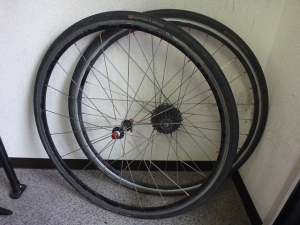
I received a Nomu Lab Wheel #5 from a customer.
The front wheel has runout because it was dropped from a mezzanine level (←what kind of situation is that?)
They may have dropped both a heavy wheel and a light wheel at the same time to see which would land first.
The rear wheel has a broken PowerTap hub internals, so
the customer wants it converted to an Evolite hub.
I suggested they could just use it as a regular heavy wheel,
but since they want the conversion, I'll do it.
Incidentally, even as-is it would be about 12g lighter than a Gokiso hub
with much better lateral stiffness.
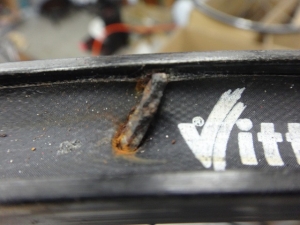
Both wheels came with tires and tubes installed and pressurized,
but there were remnants of something that had previously been embedded in the rear rim.
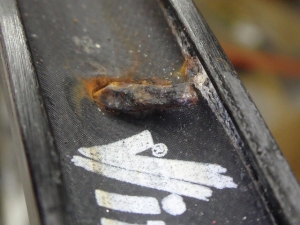
It happened to be embedded at a rim hole location,
and since it was lying flat, it didn't cause a puncture.
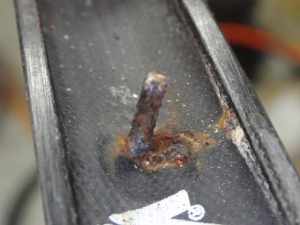
I stood it up.
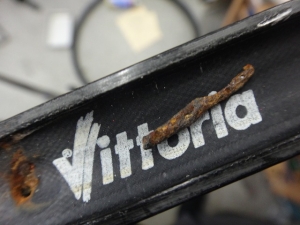
I removed it.
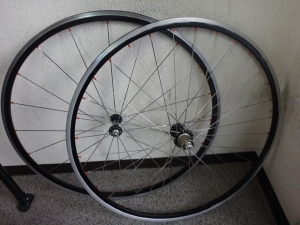
I trued the front wheel and rebuilt the rear wheel.
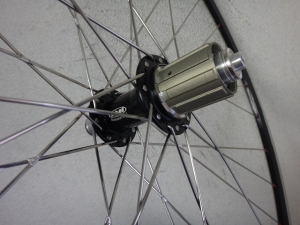
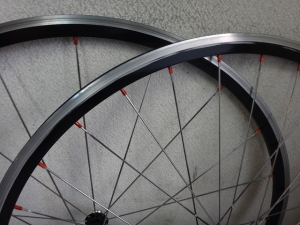
Evolite hub 32H, semi-comp lacing with 4-cross pattern and radial spokes on the freewheel side.
Before the conversion it was 4-8 laced, but
since the Evolite hub's non-freewheel side doesn't have a large flange,
I'm using 6-spoke lacing on that side.
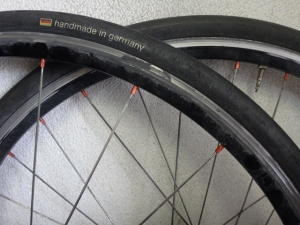
before
after
When I checked the disassembled rear rim against "glass surface plate—always hitting things that look about to break, but shine isn't just decoration,"
it wasn't bent at all, so I reused it.
I washed it while the tire was still on before disassembling.
If you wash it after removing the tire, water gets inside the rim.
I didn't flip the rear rim left-to-right during the rebuild.
The right side of the rear rim has scratched anodizing because the brake shoe
was applied inside the brake zone due to prior use with the PowerTap hub.
Since the PowerTap hub's freewheel body was Shimano 10-speed
and the sprocket was also 10-speed,
there's a very high probability that the customer's frame has a pre-9000 series
dual-pivot brake, in which case the brake zone will definitely have
the C-arm on the right and Y-arm on the left.
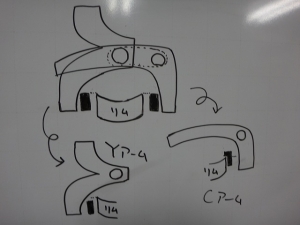
If you set a sufficiently thick brake shoe at the top of the brake zone
and continue using it without changing position, wearing it down,
the C-arm side would have the brake shoe pushed outward (toward the tire),
which doesn't match the inner-edge wear pattern visible on this rim.
On frames with brakes behind the BB, this relationship reverses, but
if that brake were direct-mount or mini-V type,
the shoe position shift from wear wouldn't be as pronounced as with dual-pivot,
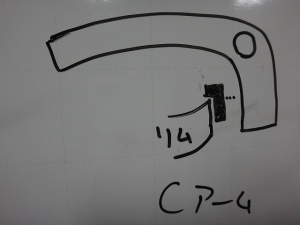
and the amount the C-arm shoe position gets pushed outward by wear wouldn't
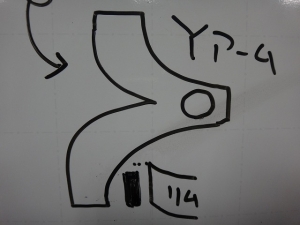
match the amount the Y-arm shoe position gets pushed inward by wear, so
in this case it's more natural to think the brake shoe was simply set too low.
This habit of mine—seeing wear marks and overthinking it—is a bad one.

I received a Nomu Lab Wheel #5 from a customer.
The front wheel has runout because it was dropped from a mezzanine level (←what kind of situation is that?)
They may have dropped both a heavy wheel and a light wheel at the same time to see which would land first.
The rear wheel has a broken PowerTap hub internals, so
the customer wants it converted to an Evolite hub.
I suggested they could just use it as a regular heavy wheel,
but since they want the conversion, I'll do it.
Incidentally, even as-is it would be about 12g lighter than a Gokiso hub
with much better lateral stiffness.

Both wheels came with tires and tubes installed and pressurized,
but there were remnants of something that had previously been embedded in the rear rim.
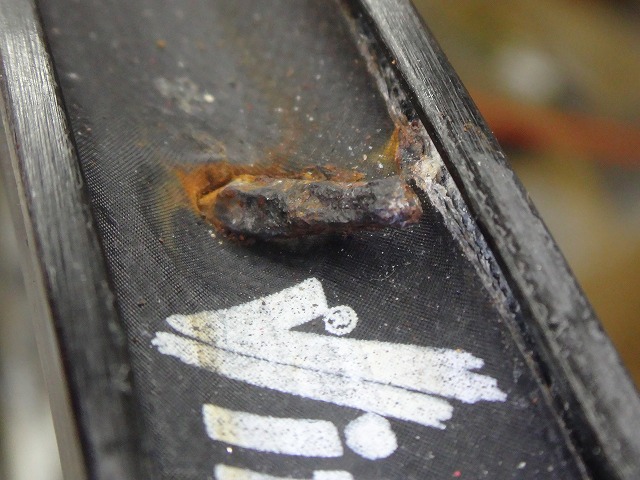
It happened to be embedded at a rim hole location,
and since it was lying flat, it didn't cause a puncture.
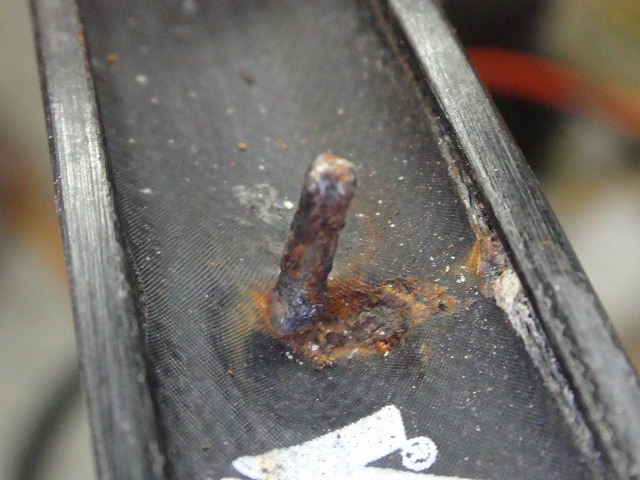
I stood it up.

I removed it.
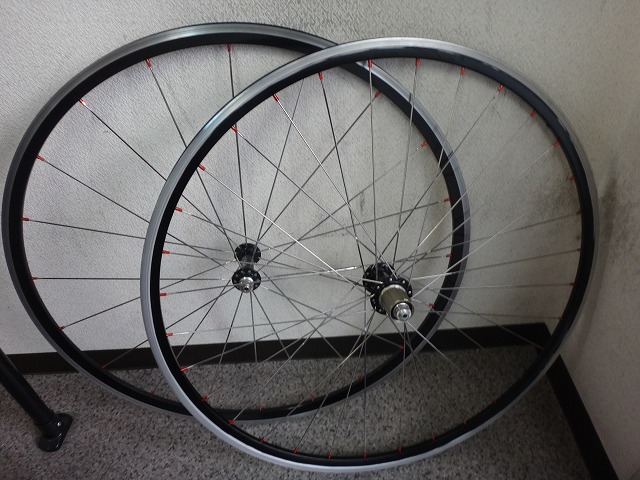
I trued the front wheel and rebuilt the rear wheel.
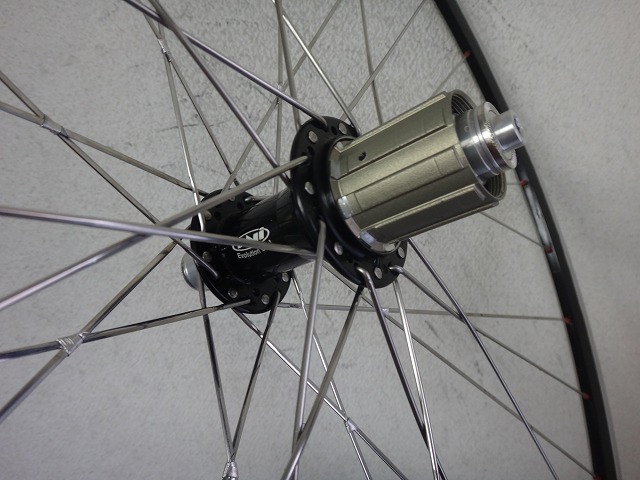
Evolite hub 32H, semi-comp lacing with 4-cross pattern and radial spokes on the freewheel side.
Before the conversion it was 4-8 laced, but
since the Evolite hub's non-freewheel side doesn't have a large flange,
I'm using 6-spoke lacing on that side.
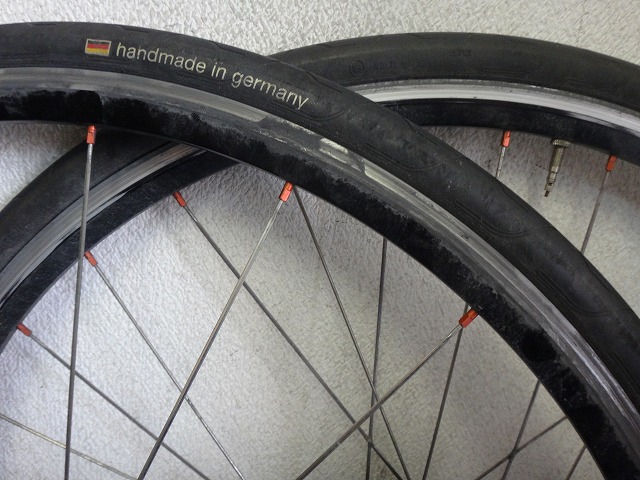
before
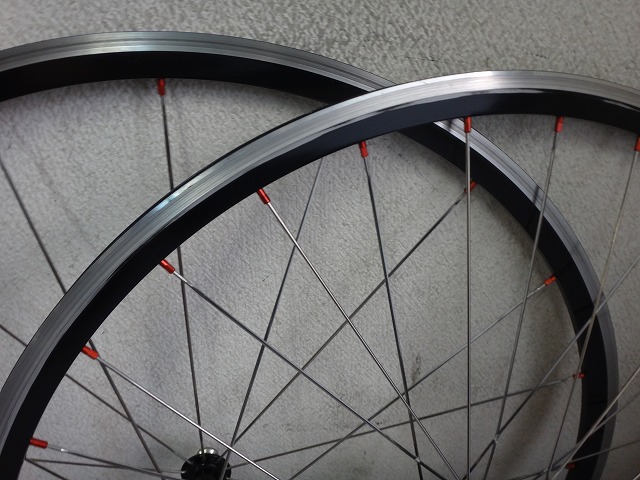
after
When I checked the disassembled rear rim against "glass surface plate—always hitting things that look about to break, but shine isn't just decoration,"
it wasn't bent at all, so I reused it.
I washed it while the tire was still on before disassembling.
If you wash it after removing the tire, water gets inside the rim.
I didn't flip the rear rim left-to-right during the rebuild.
The right side of the rear rim has scratched anodizing because the brake shoe
was applied inside the brake zone due to prior use with the PowerTap hub.
Since the PowerTap hub's freewheel body was Shimano 10-speed
and the sprocket was also 10-speed,
there's a very high probability that the customer's frame has a pre-9000 series
dual-pivot brake, in which case the brake zone will definitely have
the C-arm on the right and Y-arm on the left.
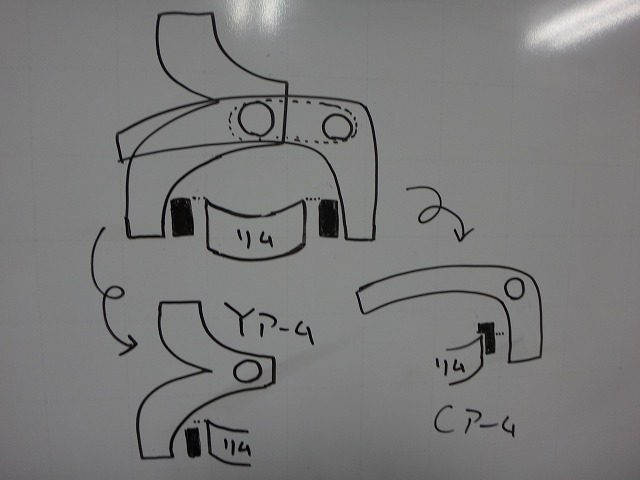
If you set a sufficiently thick brake shoe at the top of the brake zone
and continue using it without changing position, wearing it down,
the C-arm side would have the brake shoe pushed outward (toward the tire),
which doesn't match the inner-edge wear pattern visible on this rim.
On frames with brakes behind the BB, this relationship reverses, but
if that brake were direct-mount or mini-V type,
the shoe position shift from wear wouldn't be as pronounced as with dual-pivot,
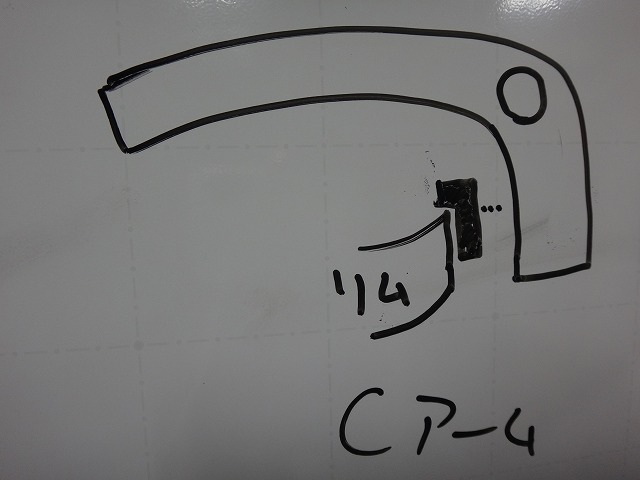
and the amount the C-arm shoe position gets pushed outward by wear wouldn't
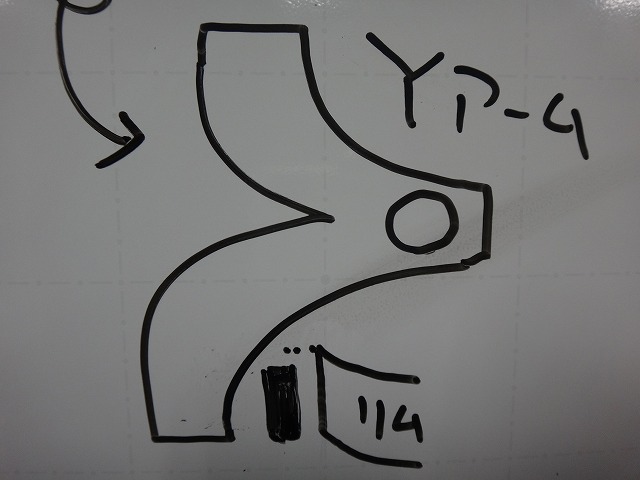
match the amount the Y-arm shoe position gets pushed inward by wear, so
in this case it's more natural to think the brake shoe was simply set too low.
This habit of mine—seeing wear marks and overthinking it—is a bad one.