The other day, a senior I admire who visits our shop several times a year asked me
"You've already built that light bike, haven't you? Tee hee" so I decided to write an article along with
an Instagram-worthy image.
My lightweight bike should be in the 4kg range, but it's right on the edge so
depending on the gravitational acceleration at the measurement point (like the North Pole)
it should exceed 5kg.
So, "we should have a standard place to weigh bikes!"
and decide on a location that becomes the benchmark,
and in my case, that would be
#The Sacred Site of Weight Reduction
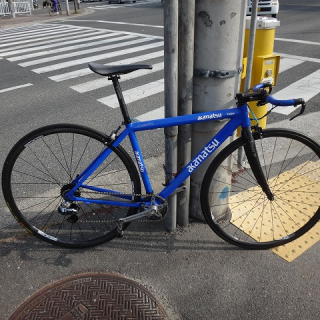
Right here. Be careful not to step on the tactile paving blocks.
The reason this is the sacred site of weight reduction is
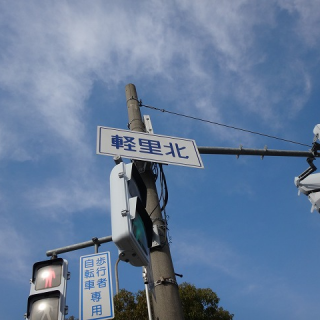
the intersection is named Keiryōka (Weight Reduction).
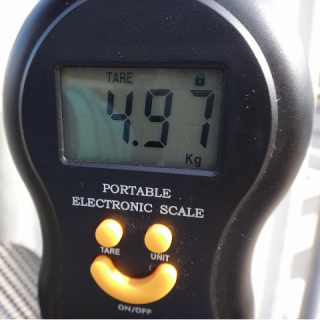
It was 4.97kg.
I'm exaggerating a bit here (though actually, I didn't add weight, I removed it).
It's dressed up for photography, and just before leaving home it was 4.99kg.
At 4.99kg, it would exceed 5kg at the North Pole.
Changing the stem for the shift switch (→here)
has had a negative effect.
There is a bottle cage (→here) installed, but if I attach
a heart rate monitor holder to the handlebar, I can't seem to avoid exceeding 5kg.
To get below 5kg from there,
I could use TUFO tires that are lighter than the current <160g,
but lighter models without the <160g spec omit the puncture-resistant belt,
so the risk of getting a flat tire shoots up dramatically.
Also, I want to swap out the front brake and chainring for more practical options,
but I already know both of those changes would add weight.
If you want reasonable lightness while prioritizing practicality....
building it normally with Dura-Ace is recommended.
Before that, people will probably say "just swap the frame for a lighter one and you'll save 300g!"
but I have my preferences when it comes to the frame,
so that's not an option.
Besides, even if you buy a super-lightweight frame,
if the seatpost diameter isn't 27.2mm,
the headset isn't the same diameter top and bottom,
or the BB standard isn't BSC,
you won't find lighter alternatives to the seatpost, fork, and crankset I currently have,
so even if you save 300g on the frame, the complete bike won't be 300g lighter.
By the way, about that intersection name,
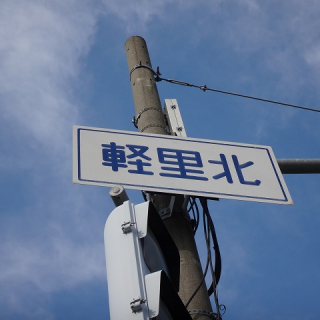
looking more carefully, it's not Keiryōka but Karusatokita.
I received a comment saying "wouldn't the Tni Just9 carbon cage be lighter?"
Well, there's a bottle cage made from the two loops of a BTP Aramid belt
that weighs only 4.5g.
The Just9 takes that concept and makes it from carbon pipe,
adding just a section to support the bottle bottom and a section to hold the bottle neck,
so the basic design is the same.
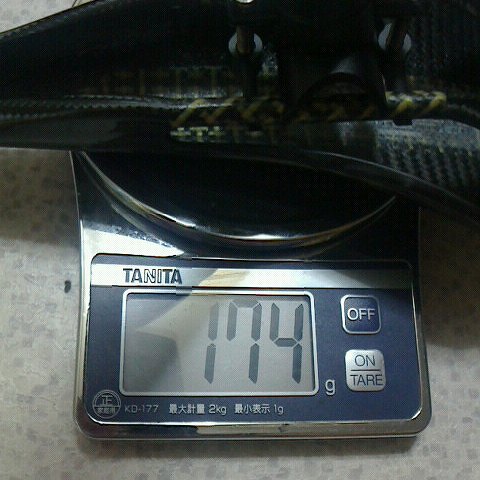
Elite's Legero Mod measures 13.5g in reality, which is
9g heavier than the 4.5g cage,
and with a 9g difference, there's a high probability the 0.01kg digit will change.
If you pursue pure lightness, you could make it even lighter,
but maintenance frequency and durability would become quite problematic.
If you're concerned about that, as mentioned in the main text,
you'd end up with "just build it with Dura-Ace,"
but if you add conditions like barely qualifying as a saddle,
the bottle cage managing to do its job normally,
this is about where the compromise lands. For me, anyway.
I mentioned my complaint about the front brake above.
These kinds of conditions differ from person to person.
In the extreme, if the wheels would be lighter, you could argue
building the rear wheel with radial lacing on both sides with 12 holes would make it lighter too.
The bar tape is Cateye Shiny.
I have a lifetime supply of it in various colors.

A while back, I wrote that if I were to build a LOOK Huez RS as a personal bike,
I'd shove in a seatpost under 100g with no sense of decorum,
and I got a comment asking me to explain that in detail,
so I'll answer.
In the image above, the saddle is an AX Lightness Phoenix,
and the seatpost is a BTP New Ultimate.
BTP has an Ultimate carbon seatpost,
but at 27.2mm diameter the aluminum New Ultimate should be lighter.
The AX Lightness Phoenix weighs just under 60g, so
this seatpost exceeds 100g.
The reason is, I normally only ride horizontal tubes, but when I ordered this frame,
I wanted to save weight by cutting corners on frame tube length,
so instead of ordering my usual horizontal 520mm,
I ordered sloping 460mm,
which made the seatpost longer.
I should have another one with the same seatpost cut to length elsewhere,
but when I looked for it, I couldn't find it.

But I found a different 90g seatpost.
I wrote before that it's safest to follow the distributor's katakana product names,
and by that standard, this seatpost's name is
"Europa."
The current equivalent is the Europa Basic model,
road and MTB hybrid with an 85kg weight limit,
while the separate Europa SL model
is road-only with a 70kg weight limit, but the catalog weight is the same (86-143g).
The range of numbers varies because the lengths come in fine increments.
There's a section woven with Kevlar on the back of the seatpost,
making it stronger against clamp damage,
but you have to use it within the range marked by the lines
at the top and bottom edges of the label.
Since the same company has a setback seatpost model called Daedalus,
and there used to be a saddle model called Apollo (now discontinued),
I suspect the model names are inspired by Greek mythology, so
following that pattern, Europa would be the more accurate name.
Someone might say "shouldn't it be Europē if we're being more accurate?"
but since the o and e in the model name don't have macrons,
Europa or Europé is fine.
The same logic applies to Apollo not being Apollon.
By the way, in this article
there are places where I intentionally write weight reduction as something else,
but don't worry about it.
"You've already built that light bike, haven't you? Tee hee" so I decided to write an article along with
an Instagram-worthy image.
My lightweight bike should be in the 4kg range, but it's right on the edge so
depending on the gravitational acceleration at the measurement point (like the North Pole)
it should exceed 5kg.
So, "we should have a standard place to weigh bikes!"
and decide on a location that becomes the benchmark,
and in my case, that would be
#The Sacred Site of Weight Reduction
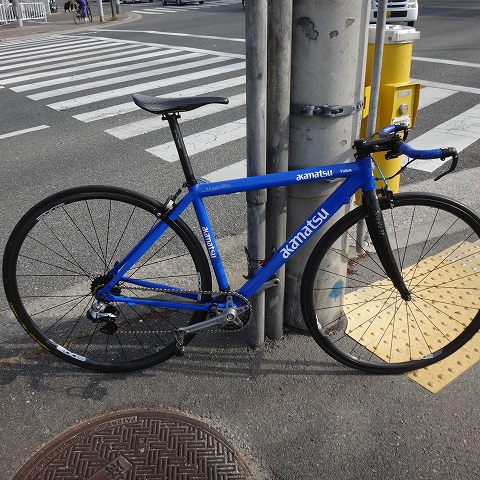
Right here. Be careful not to step on the tactile paving blocks.
The reason this is the sacred site of weight reduction is

the intersection is named Keiryōka (Weight Reduction).
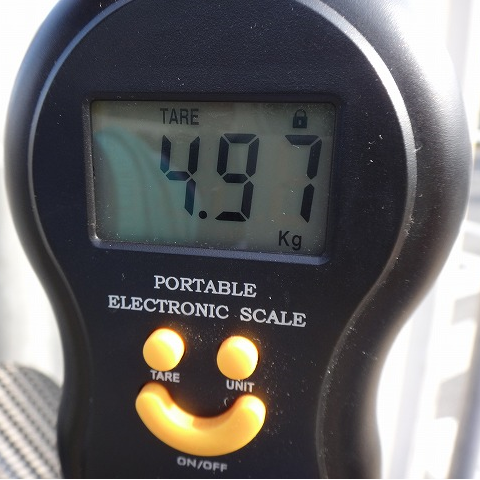
It was 4.97kg.
I'm exaggerating a bit here (though actually, I didn't add weight, I removed it).
It's dressed up for photography, and just before leaving home it was 4.99kg.
At 4.99kg, it would exceed 5kg at the North Pole.
Changing the stem for the shift switch (→here)
has had a negative effect.
There is a bottle cage (→here) installed, but if I attach
a heart rate monitor holder to the handlebar, I can't seem to avoid exceeding 5kg.
To get below 5kg from there,
I could use TUFO tires that are lighter than the current <160g,
but lighter models without the <160g spec omit the puncture-resistant belt,
so the risk of getting a flat tire shoots up dramatically.
Also, I want to swap out the front brake and chainring for more practical options,
but I already know both of those changes would add weight.
If you want reasonable lightness while prioritizing practicality....
building it normally with Dura-Ace is recommended.
Before that, people will probably say "just swap the frame for a lighter one and you'll save 300g!"
but I have my preferences when it comes to the frame,
so that's not an option.
Besides, even if you buy a super-lightweight frame,
if the seatpost diameter isn't 27.2mm,
the headset isn't the same diameter top and bottom,
or the BB standard isn't BSC,
you won't find lighter alternatives to the seatpost, fork, and crankset I currently have,
so even if you save 300g on the frame, the complete bike won't be 300g lighter.
By the way, about that intersection name,

looking more carefully, it's not Keiryōka but Karusatokita.
I received a comment saying "wouldn't the Tni Just9 carbon cage be lighter?"
Well, there's a bottle cage made from the two loops of a BTP Aramid belt
that weighs only 4.5g.
The Just9 takes that concept and makes it from carbon pipe,
adding just a section to support the bottle bottom and a section to hold the bottle neck,
so the basic design is the same.
Elite's Legero Mod measures 13.5g in reality, which is
9g heavier than the 4.5g cage,
and with a 9g difference, there's a high probability the 0.01kg digit will change.
If you pursue pure lightness, you could make it even lighter,
but maintenance frequency and durability would become quite problematic.
If you're concerned about that, as mentioned in the main text,
you'd end up with "just build it with Dura-Ace,"
but if you add conditions like barely qualifying as a saddle,
the bottle cage managing to do its job normally,
this is about where the compromise lands. For me, anyway.
I mentioned my complaint about the front brake above.
These kinds of conditions differ from person to person.
In the extreme, if the wheels would be lighter, you could argue
building the rear wheel with radial lacing on both sides with 12 holes would make it lighter too.
The bar tape is Cateye Shiny.
I have a lifetime supply of it in various colors.
A while back, I wrote that if I were to build a LOOK Huez RS as a personal bike,
I'd shove in a seatpost under 100g with no sense of decorum,
and I got a comment asking me to explain that in detail,
so I'll answer.
In the image above, the saddle is an AX Lightness Phoenix,
and the seatpost is a BTP New Ultimate.
BTP has an Ultimate carbon seatpost,
but at 27.2mm diameter the aluminum New Ultimate should be lighter.
The AX Lightness Phoenix weighs just under 60g, so
this seatpost exceeds 100g.
The reason is, I normally only ride horizontal tubes, but when I ordered this frame,
I wanted to save weight by cutting corners on frame tube length,
so instead of ordering my usual horizontal 520mm,
I ordered sloping 460mm,
which made the seatpost longer.
I should have another one with the same seatpost cut to length elsewhere,
but when I looked for it, I couldn't find it.
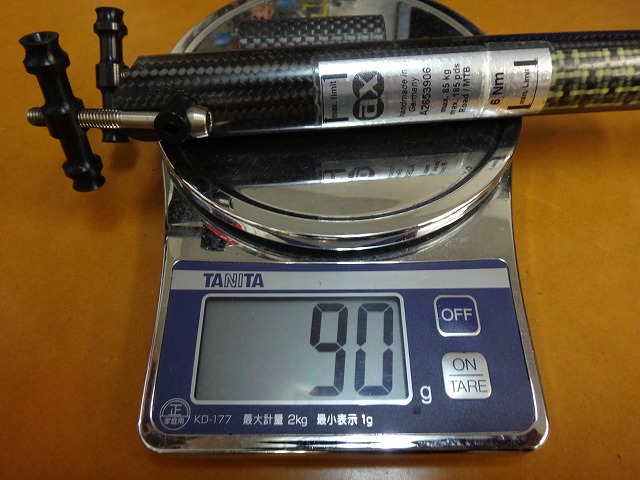
But I found a different 90g seatpost.
I wrote before that it's safest to follow the distributor's katakana product names,
and by that standard, this seatpost's name is
"Europa."
The current equivalent is the Europa Basic model,
road and MTB hybrid with an 85kg weight limit,
while the separate Europa SL model
is road-only with a 70kg weight limit, but the catalog weight is the same (86-143g).
The range of numbers varies because the lengths come in fine increments.
There's a section woven with Kevlar on the back of the seatpost,
making it stronger against clamp damage,
but you have to use it within the range marked by the lines
at the top and bottom edges of the label.
Since the same company has a setback seatpost model called Daedalus,
and there used to be a saddle model called Apollo (now discontinued),
I suspect the model names are inspired by Greek mythology, so
following that pattern, Europa would be the more accurate name.
Someone might say "shouldn't it be Europē if we're being more accurate?"
but since the o and e in the model name don't have macrons,
Europa or Europé is fine.
The same logic applies to Apollo not being Apollon.
By the way, in this article
there are places where I intentionally write weight reduction as something else,
but don't worry about it.