Wheels again today (and so on).
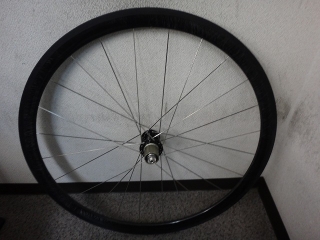
I built the rear wheel for Nomu Lab Wheel #2.
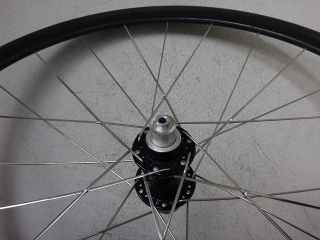
Evo Lite hub, 24H, semi-comp 4-cross lacing with spoke nipples.
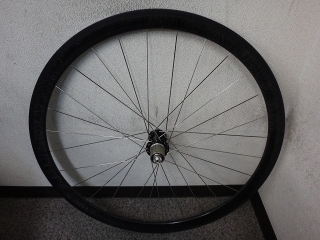
And one more.
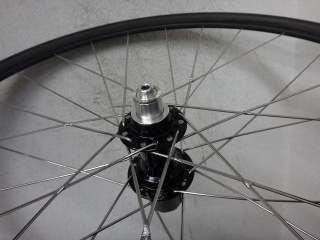
This one is Evo Lite hub, 28H, semi-comp 4-cross lacing with spoke nipples.
Unrelated to these wheels, I received a comment asking:
Why don't you use spokes like Laser on wheels equivalent to CX-RAY?
I don't know how many times I've written about this before, but I'll explain once more.
With round spokes and aero (flattened) spokes of the same specific weight (about 65%) from the same manufacturer—DT's Revolution and Aerolite, Sapim's Laser and CX-RAY—these are absolutely not equivalent as wheel materials.
Unless you're dealing with ancient rims that can't handle high tension, when you fearlessly increase spoke tension, round spokes with 65% specific weight will undergo plastic deformation in the tension direction.
In this blog, I call this "wonky-ness."
Even after wonky-ness occurs, turning the nipple just converts it into spoke stretch rather than increased tension, so you can't build a stiffer wheel beyond that point.
A wheel shares the total spoke tension load across the number of spokes
(this topic is fully explained in the "Beaker Theory" essay I haven't written yet).
With 32H or 36H, it's theoretically possible to get a solid wheel before Laser goes wonky,
but with 20H front wheels or 24H rear wheel drive-side in particular, wonky-ness almost certainly occurs before reaching my target tension.
However, with CX-RAY at the same spoke specific weight, this doesn't happen.
It's probably the work-hardening of the butted section that prevents this.
Based on experience, I'm certain about this.
CX-RAY surely has a yield point, but when you fearlessly keep tightening the nipple, it doesn't go wonky—instead it suddenly snaps (usually at the butted section boundary rather than the neck), which suggests the yield point and breaking point are extremely close.
And the tension at which CX-RAY snaps is above the limit tension of virtually every rim,
making CX-RAY essentially unlimited in practical terms.
Conversely, Revolution and Laser only make sense
in my wheel philosophy paired with rims like Mavic GEL 280, Araya ADX-5 or 16B Gold, Super Champion Metador Oro, or Niji Surudi (the reissue version, not the original)—actual measured weight around 300g lightweight aluminum rims.
For example, with the Nomu Lab Wheel #2 rear wheel I built today,
even if I replaced the non-drive-side spokes with Laser, the wheel weight wouldn't change but it wouldn't accept as much tension as CX-RAY.
Therefore, you can't achieve an equivalent wheel.
I'm not dismissing the aerodynamic effect from the flattened spoke profile, but what I value more is the fact that work-hardening occurs in the flattened sections.
Even if you twist CX-RAY's flattened direction by 90 degrees, the property of "65% specific weight spokes that essentially never go wonky" doesn't change,
but there's no point setting the flattened direction in an aerodynamically disadvantageous orientation, so I prefer the orientation that functions as an aero spoke.
As for domestic distributor stock levels:
CX-RAY comes in even 2mm increments, with all practical lengths for 700C rims available (even with 100mm rim height),
while Aerolite comes in only four lengths—300, 290, 280, 270mm—and you're supposed to make intermediate lengths with a spoke cutter, with the shortest being 260mm,
which isn't enough even for Nomu Lab Wheel #3 with 80mm rim height.
Plus CX-RAY is cheaper and more reliably stocked.
That's why our shop uses CX-RAY for flattened spokes with about 65% specific weight.
Laser and Revolution are outdated-performance spokes that fail before modern aluminum and carbon rims do—
using them on wheels under 28H is fundamentally wrong in my wheel philosophy. But that's just my view, so it doesn't matter if someone else uses them.
The fact that these antiquated spokes are still being produced is a trap that creates victims who think, "If CX-RAY and Laser are the same weight, why not just go with the cheaper one (Laser)?"
If you don't believe me, try building a 24H rear wheel with semi-comp free-side and CX-RAY versus Laser on the non-drive side—you'll see the difference.
You absolutely cannot build the same wheel.
Some amateurs insist, "No, you can!" but they're just building the CX-RAY side loosely under Laser's limits too.
I'll write more about this another time—it's the fact that "Nomu Lab Wheel knockoffs" built by competitors or amateurs almost never meet my standard of "properly built."
Easton and Louvré do use round straight spokes equivalent to 65% specific weight on the verge of wonky-ness,
and I can confidently say those wheels would be better if I rebuilt them with the same rim.
Louvré's round spokes are also hard to true, so I've cursed them here before,
but recent models have adopted flattened spokes so that problem is resolved now.
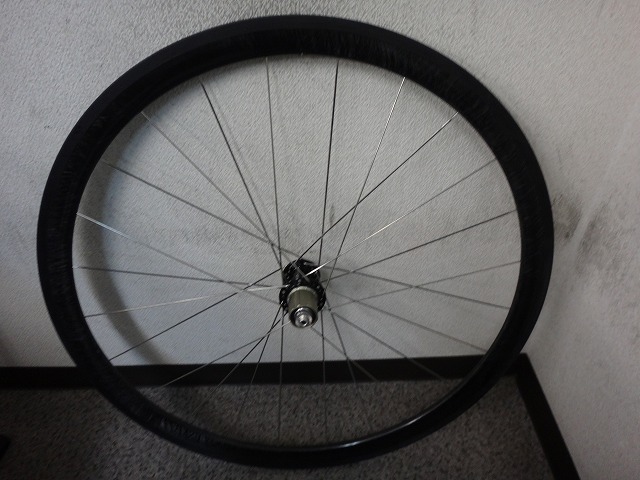
I built the rear wheel for Nomu Lab Wheel #2.
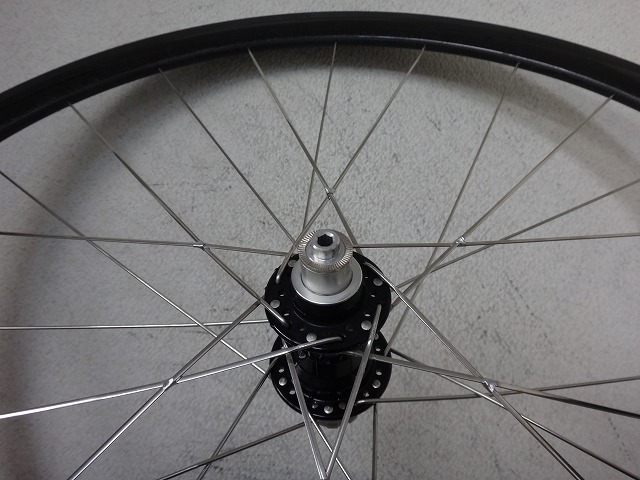
Evo Lite hub, 24H, semi-comp 4-cross lacing with spoke nipples.
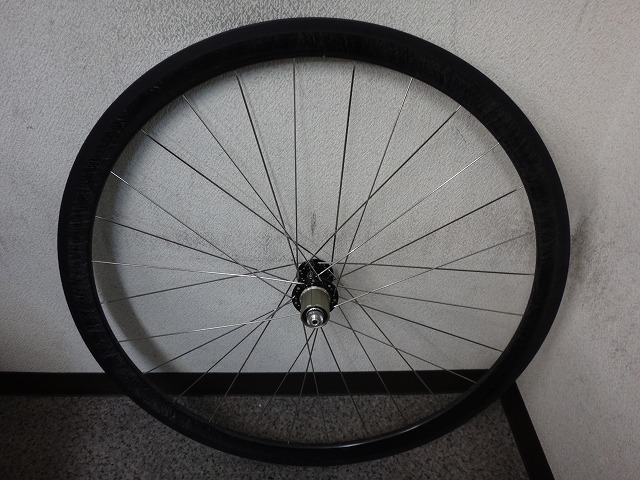
And one more.
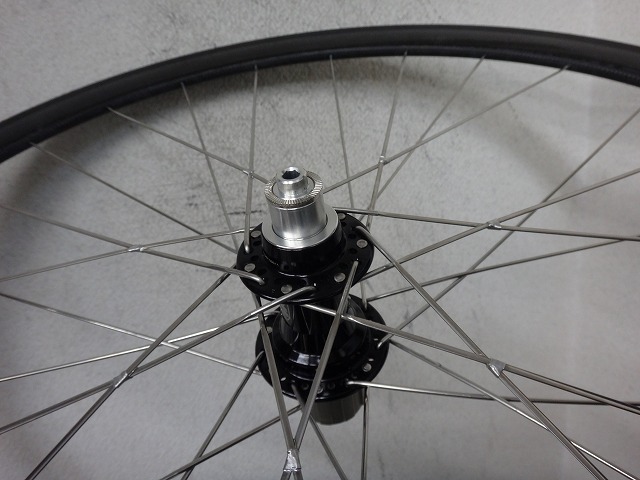
This one is Evo Lite hub, 28H, semi-comp 4-cross lacing with spoke nipples.
Unrelated to these wheels, I received a comment asking:
Why don't you use spokes like Laser on wheels equivalent to CX-RAY?
I don't know how many times I've written about this before, but I'll explain once more.
With round spokes and aero (flattened) spokes of the same specific weight (about 65%) from the same manufacturer—DT's Revolution and Aerolite, Sapim's Laser and CX-RAY—these are absolutely not equivalent as wheel materials.
Unless you're dealing with ancient rims that can't handle high tension, when you fearlessly increase spoke tension, round spokes with 65% specific weight will undergo plastic deformation in the tension direction.
In this blog, I call this "wonky-ness."
Even after wonky-ness occurs, turning the nipple just converts it into spoke stretch rather than increased tension, so you can't build a stiffer wheel beyond that point.
A wheel shares the total spoke tension load across the number of spokes
(this topic is fully explained in the "Beaker Theory" essay I haven't written yet).
With 32H or 36H, it's theoretically possible to get a solid wheel before Laser goes wonky,
but with 20H front wheels or 24H rear wheel drive-side in particular, wonky-ness almost certainly occurs before reaching my target tension.
However, with CX-RAY at the same spoke specific weight, this doesn't happen.
It's probably the work-hardening of the butted section that prevents this.
Based on experience, I'm certain about this.
CX-RAY surely has a yield point, but when you fearlessly keep tightening the nipple, it doesn't go wonky—instead it suddenly snaps (usually at the butted section boundary rather than the neck), which suggests the yield point and breaking point are extremely close.
And the tension at which CX-RAY snaps is above the limit tension of virtually every rim,
making CX-RAY essentially unlimited in practical terms.
Conversely, Revolution and Laser only make sense
in my wheel philosophy paired with rims like Mavic GEL 280, Araya ADX-5 or 16B Gold, Super Champion Metador Oro, or Niji Surudi (the reissue version, not the original)—actual measured weight around 300g lightweight aluminum rims.
For example, with the Nomu Lab Wheel #2 rear wheel I built today,
even if I replaced the non-drive-side spokes with Laser, the wheel weight wouldn't change but it wouldn't accept as much tension as CX-RAY.
Therefore, you can't achieve an equivalent wheel.
I'm not dismissing the aerodynamic effect from the flattened spoke profile, but what I value more is the fact that work-hardening occurs in the flattened sections.
Even if you twist CX-RAY's flattened direction by 90 degrees, the property of "65% specific weight spokes that essentially never go wonky" doesn't change,
but there's no point setting the flattened direction in an aerodynamically disadvantageous orientation, so I prefer the orientation that functions as an aero spoke.
As for domestic distributor stock levels:
CX-RAY comes in even 2mm increments, with all practical lengths for 700C rims available (even with 100mm rim height),
while Aerolite comes in only four lengths—300, 290, 280, 270mm—and you're supposed to make intermediate lengths with a spoke cutter, with the shortest being 260mm,
which isn't enough even for Nomu Lab Wheel #3 with 80mm rim height.
Plus CX-RAY is cheaper and more reliably stocked.
That's why our shop uses CX-RAY for flattened spokes with about 65% specific weight.
Laser and Revolution are outdated-performance spokes that fail before modern aluminum and carbon rims do—
using them on wheels under 28H is fundamentally wrong in my wheel philosophy. But that's just my view, so it doesn't matter if someone else uses them.
The fact that these antiquated spokes are still being produced is a trap that creates victims who think, "If CX-RAY and Laser are the same weight, why not just go with the cheaper one (Laser)?"
If you don't believe me, try building a 24H rear wheel with semi-comp free-side and CX-RAY versus Laser on the non-drive side—you'll see the difference.
You absolutely cannot build the same wheel.
Some amateurs insist, "No, you can!" but they're just building the CX-RAY side loosely under Laser's limits too.
I'll write more about this another time—it's the fact that "Nomu Lab Wheel knockoffs" built by competitors or amateurs almost never meet my standard of "properly built."
Easton and Louvré do use round straight spokes equivalent to 65% specific weight on the verge of wonky-ness,
and I can confidently say those wheels would be better if I rebuilt them with the same rim.
Louvré's round spokes are also hard to true, so I've cursed them here before,
but recent models have adopted flattened spokes so that problem is resolved now.