One of the displayable metrics on the Polar V800 is

"Lap VAM."
VAM is an Italian acronym that translates to something like "average climbing speed" in Japanese,
and refers to the amount of elevation gain per hour.
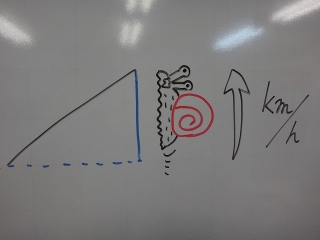
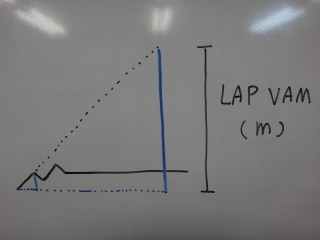
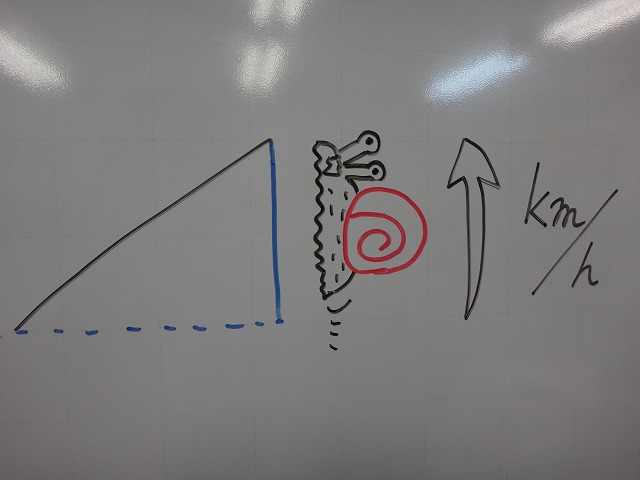
VAM is calculated by dividing the elevation gain obtained from climbing (the blue solid line in the diagram above)
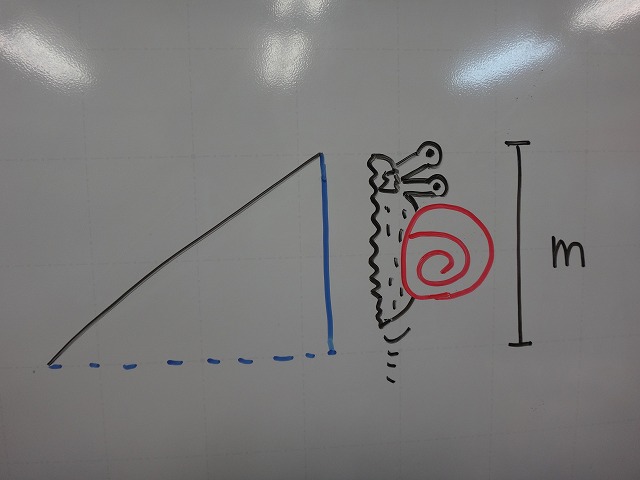
by the time taken, but despite being called average climbing "speed," the unit isn't km/h but rather
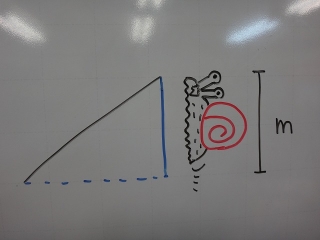
m (meters). While it's technically a distance measurement,
because it's divided "per hour," it's actually a speed metric.
It's like saying "50 kph" as simply "50."
"When converted to an hourly rate, you're climbing 800m"
sounds pretty impressive, but
"0.8 km vertically per hour"
sounds kind of underwhelming.
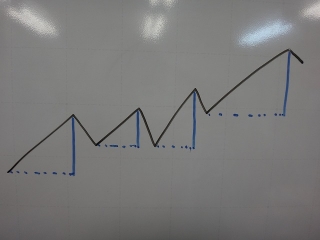
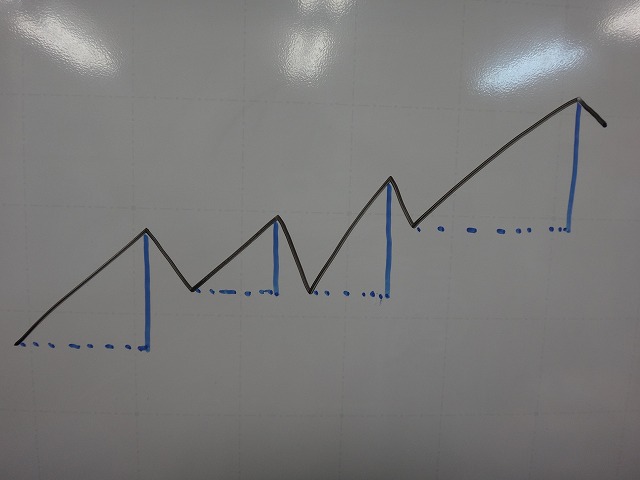
To calculate VAM, you need elevation gain data, so an altimeter is necessary
to extract the uphill portions from the altitude changes.
VAM is calculated by dividing total elevation gain by exercise time (in seconds),
then multiplying by 3600 (seconds). Since it's a metric for evaluating climbing ability,
VAM loses its usefulness if the measured section contains lots of flat or downhill terrain.
The measured section should have less than 10% clear downhill or flat sections—
in other words, you need to measure on a pass.
So Polar doesn't display VAM for the entire exercise time.
If you start lap measurement at the base of a pass, you'll get a meaningful Lap VAM.
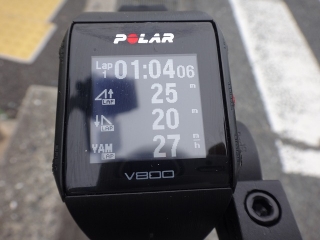
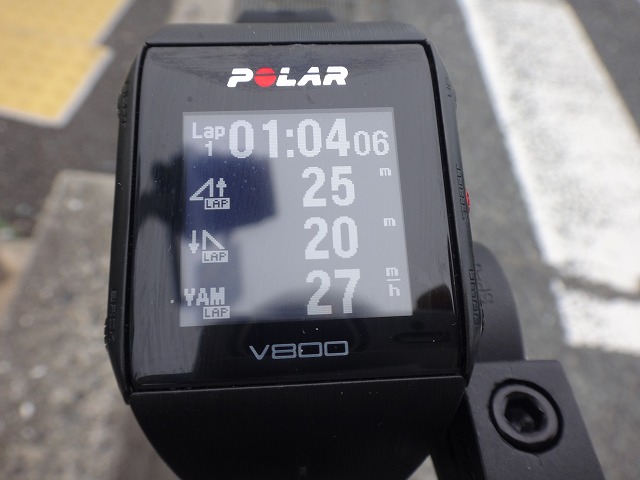
That said, I measured it on flat terrain anyway.
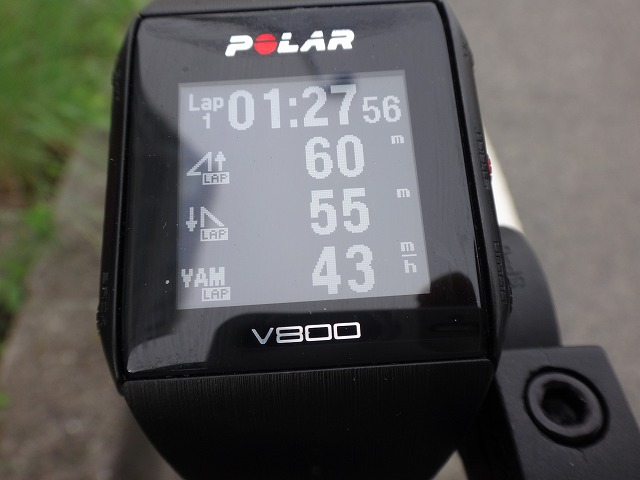
The display items from top are:
Lap time
Elevation gain during the lap
Elevation loss during the lap
Lap VAM
The lap time is 1 hour 4 minutes, and the elevation gain and Lap VAM for exactly one hour should match,
but the Polar displays ascent/descent in 5m increments, so
when there's essentially no elevation gain like this, the error becomes significant.
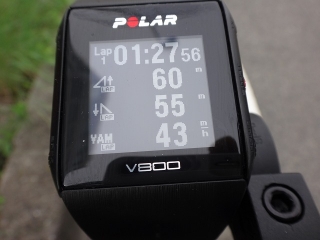
At this point, elevation gain is 60m in just under 1.5 hours,
so per hour that's about 40m.

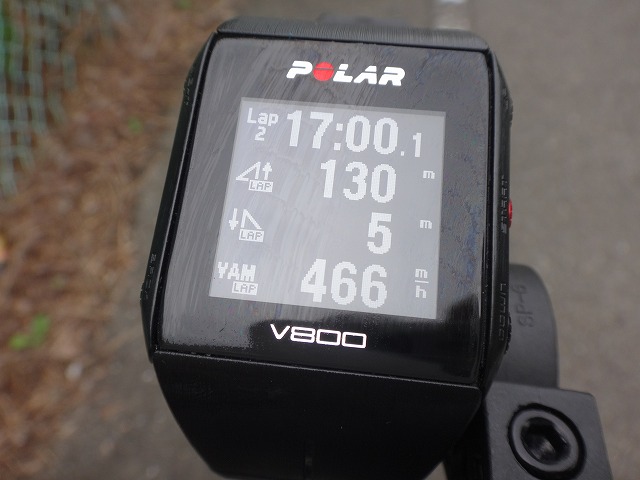
Now I properly measured on a pass.
The Osaka side of Yamanaka-dani (山中渓), which connects Osaka to Wakayama.
The Osaka side of Yamanaka-dani has a very gentle gradient,
with only a moderately steep section at the end.
I basically never shift to the inner ring.
Elevation gain over 17 minutes (1020 seconds) is 130m, so
the calculated VAM is 130 ÷ 1020 × 3600 = 458.8.
Looking at the image now, I notice
Polar displays VAM as m/h.
The displayed VAM is 466, but
as I mentioned, elevation gain displays in 5m increments, so
internally the measurement is probably somewhere between 130m and 135m,
which is what's used for calculation.
(If VAM is 466 and time is exactly 17 minutes,
the calculated elevation gain would be 132.03m).
To fully utilize VAM as a standard for evaluating cyclist ability,
you need to use it in conjunction with a power meter.
But since I don't use a power meter as a training metric,
I won't write about that here.
The relationship between power (watts) and VAM is
quite well researched, so interested readers should look it up (passing the buck).
As for the point of measuring Lap VAM without a power meter:
if the same person records VAM on multiple passes in the same period,
you can compare the quantified difficulty of different passes
(higher VAM is harder to achieve = tougher climb).
Alternatively, if the same person records VAM on the same pass at different times,
you can verify training progress.
If lap time on the same section goes from 30 to 20 minutes (2/3 ratio),
Lap VAM increases by a factor of 1.5 (3/2 ratio).
So VAM on the same pass is just a rephrasing of time, but
measuring on multiple passes lets you explore the relationship:
"how much does steeper gradient impact time?"
By the way, if you start lap measurement at the bottom of a steep climb,
it gives an estimate of "what if this gradient continued for the whole hour,"
so at first you get an absurdly high Lap VAM.
But if it's followed by flat terrain, it steadily drops and
eventually settles around 20-30m.
I forgot to mention, but
the minimum distance recommended for measuring VAM is 5km or more.
The Osaka side of Yamanaka-dani is just under 6km in my case,
depending on where you start measuring.
Polar Flow, the analysis software on Polar's cloud service,
lets you see lap time, distance, elevation gain,
average heart rate, average speed, and more for each lap,
but "doesn't show" Lap VAM. What's up with that?
Since lap time and elevation gain are known, it's mathematically doable...
I think it might be better to set up an Excel sheet where I can calculate Lap VAM
for passes I want to record, even if I don't do it every time.
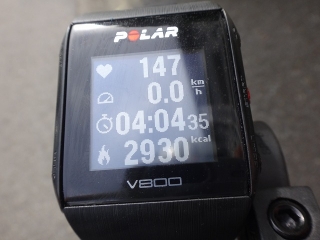
My training metric, as I've mentioned before,
is how much my estimated calorie burn from total exercise time exceeds
1 minute / 10 kcal.
Looking at the screen in the image while riding,
I think "okay, roughly 4 hours, so 240 minutes.
At 1 min/10 kcal, that would be 2400, and I'm over 2640 (2400+240),
so I've hit 1 min/11 kcal. Plus another 240 to 2880 is also exceeded,
so I'm at about 1 min/12 kcal" (in that case it's just over 4 hours,
so it drops slightly—actually about 1 min/11.98 kcal).
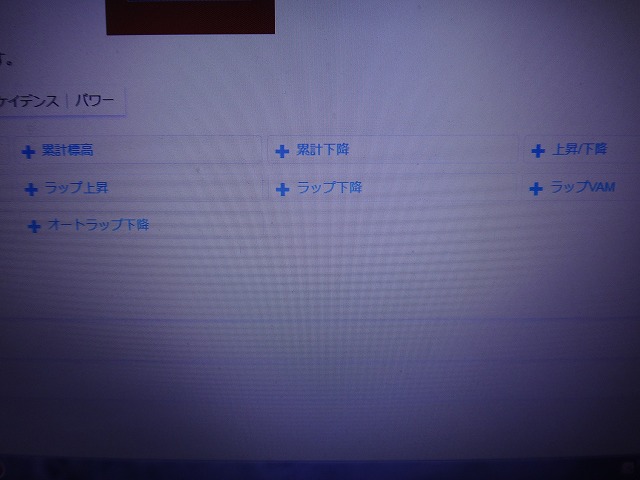
About that Polar settings screen at the start:
the Japanese terminology is a bit off, making it confusing.
For total exercise time, elevation gain is labeled "累計標高" (cumulative elevation)
and descent is "累計下降" (cumulative descent), but
for lap time it becomes "ラップ上昇" (lap ascent) and "ラップ下降" (lap descent).
Following that pattern, "累計標高" should really be "累計上昇" (cumulative ascent).
Also, there's an "Ascent/Descent" item, but
it doesn't mean if ascent is "△↑125m" and descent is "△↓70m,"
showing "125/70m" on one line...
What "Ascent/Descent" actually means is "gradient" (slope percentage). Confusing!
The feature itself is excellent—it's not showing the gradient from a few seconds ago,
but the gradient of the current road in real time.
For example, a 1.3% climb shows as "△↑1.3%," but
a 0.9% descent shows as "△↓0.9%" not "△↑-0.9%."
On nearly flat ground, the gradient might be 0.1% or 0.2%, but
unless you're watching the arrow icon on the left, it's hard to notice.
Though honestly, there's no reason to worry about gradient on such flat roads.
I don't strongly want to know elevation or total elevation gain while riding,
so I'd like to turn "altitude" off in the Polar settings,
but to use the Lap VAM and Ascent/Descent (gradient) features,
I have to keep "altitude" turned on.
On the Polar V800, regarding GPS recording interval settings and
battery life from full charge:
High accuracy (every 1 second) + heart rate monitor: max 13 hours
Standard accuracy (every 30 seconds) + heart rate monitor: max 20 hours
Battery saver mode (every 60 seconds) + heart rate monitor: up to 50 hours
GPS off + heart rate monitor: up to 100 hours
(Note: the original mixes "max" and "up to"—I'm keeping it as written.)
When connected to speed/cadence sensors, power meters,
or running stride sensors, battery life should decrease,
but there's no clear statement on whether the "max" 13 hours for high accuracy
refers to receiving all sensor data simultaneously, or whether altitude monitoring
affects battery life. That said, when I turn altitude off,
battery drain is noticeably slower, so
I usually keep altitude off.
Also, when it's on, you often have to calibrate before measuring,
and dealing with pressure changes showing "-80m" and having to correct them
is a hassle.
I haven't addressed the title yet.
The proponent of VAM is Dr. Michele Ferrari,
formerly team doctor for Giancarlo Benetton's team—
though that probably doesn't mean anything to you.
He became famous for coaching athletes including Lance Armstrong
with training that included doping.
The U.S. Anti-Doping Agency banned him from involvement in sports for life
for violating anti-doping regulations.
France and Italy have long had criminal penalties for doping itself
(not fraud or other charges), which is hardly unrelated to cycling history.
The U.S. and Germany criminalized or increased penalties for doping
from the 2000s onward. Spain also treats doping as criminal,
and Spanish National Police were involved in Operación Puerto.
On the Italian Wikipedia, Dr. Ferrari has categories like "Italian physicians" and "born in Ferrara,"
but on the American Wikipedia, he also has the category
"Italian criminal."
A figure with both merits and faults, but perhaps the faults outweighed everything.
Incidentally, Dr. Conconi, the proponent of heart rate training in cycling,
was an acquaintance of Dr. Ferrari.
Using VAM, you can compare Person A's record on Pass X with Person B's on Pass Y
to evaluate who's stronger, or estimate what time A or B would do on Pass Z.
Outside of race results, it's not like nobody shares the calculation basis of VAM...
well, actually some do these days.
Using that, you can estimate someone's time on another pass (like Hakone Turnpike).
When you compare Marco Pantani's VAM on Alpe d'Huez from 1995 or 1997
with Japanese amateur hill climb racers,
it's actually not that different, but you have to remember
that was in the middle of a Tour de France stage, not Alpe d'Huez in isolation,
and moreover it was a summit finish, and the equipment was from 20+ years ago.
"Lap VAM."
VAM is an Italian acronym that translates to something like "average climbing speed" in Japanese,
and refers to the amount of elevation gain per hour.
VAM is calculated by dividing the elevation gain obtained from climbing (the blue solid line in the diagram above)
by the time taken, but despite being called average climbing "speed," the unit isn't km/h but rather
m (meters). While it's technically a distance measurement,
because it's divided "per hour," it's actually a speed metric.
It's like saying "50 kph" as simply "50."
"When converted to an hourly rate, you're climbing 800m"
sounds pretty impressive, but
"0.8 km vertically per hour"
sounds kind of underwhelming.
To calculate VAM, you need elevation gain data, so an altimeter is necessary
to extract the uphill portions from the altitude changes.
VAM is calculated by dividing total elevation gain by exercise time (in seconds),
then multiplying by 3600 (seconds). Since it's a metric for evaluating climbing ability,
VAM loses its usefulness if the measured section contains lots of flat or downhill terrain.
The measured section should have less than 10% clear downhill or flat sections—
in other words, you need to measure on a pass.
So Polar doesn't display VAM for the entire exercise time.
If you start lap measurement at the base of a pass, you'll get a meaningful Lap VAM.
That said, I measured it on flat terrain anyway.
The display items from top are:
Lap time
Elevation gain during the lap
Elevation loss during the lap
Lap VAM
The lap time is 1 hour 4 minutes, and the elevation gain and Lap VAM for exactly one hour should match,
but the Polar displays ascent/descent in 5m increments, so
when there's essentially no elevation gain like this, the error becomes significant.
At this point, elevation gain is 60m in just under 1.5 hours,
so per hour that's about 40m.
Now I properly measured on a pass.
The Osaka side of Yamanaka-dani (山中渓), which connects Osaka to Wakayama.
The Osaka side of Yamanaka-dani has a very gentle gradient,
with only a moderately steep section at the end.
I basically never shift to the inner ring.
Elevation gain over 17 minutes (1020 seconds) is 130m, so
the calculated VAM is 130 ÷ 1020 × 3600 = 458.8.
Looking at the image now, I notice
Polar displays VAM as m/h.
The displayed VAM is 466, but
as I mentioned, elevation gain displays in 5m increments, so
internally the measurement is probably somewhere between 130m and 135m,
which is what's used for calculation.
(If VAM is 466 and time is exactly 17 minutes,
the calculated elevation gain would be 132.03m).
To fully utilize VAM as a standard for evaluating cyclist ability,
you need to use it in conjunction with a power meter.
But since I don't use a power meter as a training metric,
I won't write about that here.
The relationship between power (watts) and VAM is
quite well researched, so interested readers should look it up (passing the buck).
As for the point of measuring Lap VAM without a power meter:
if the same person records VAM on multiple passes in the same period,
you can compare the quantified difficulty of different passes
(higher VAM is harder to achieve = tougher climb).
Alternatively, if the same person records VAM on the same pass at different times,
you can verify training progress.
If lap time on the same section goes from 30 to 20 minutes (2/3 ratio),
Lap VAM increases by a factor of 1.5 (3/2 ratio).
So VAM on the same pass is just a rephrasing of time, but
measuring on multiple passes lets you explore the relationship:
"how much does steeper gradient impact time?"

By the way, if you start lap measurement at the bottom of a steep climb,
it gives an estimate of "what if this gradient continued for the whole hour,"
so at first you get an absurdly high Lap VAM.
But if it's followed by flat terrain, it steadily drops and
eventually settles around 20-30m.
I forgot to mention, but
the minimum distance recommended for measuring VAM is 5km or more.
The Osaka side of Yamanaka-dani is just under 6km in my case,
depending on where you start measuring.
Polar Flow, the analysis software on Polar's cloud service,
lets you see lap time, distance, elevation gain,
average heart rate, average speed, and more for each lap,
but "doesn't show" Lap VAM. What's up with that?
Since lap time and elevation gain are known, it's mathematically doable...
I think it might be better to set up an Excel sheet where I can calculate Lap VAM
for passes I want to record, even if I don't do it every time.

My training metric, as I've mentioned before,
is how much my estimated calorie burn from total exercise time exceeds
1 minute / 10 kcal.
Looking at the screen in the image while riding,
I think "okay, roughly 4 hours, so 240 minutes.
At 1 min/10 kcal, that would be 2400, and I'm over 2640 (2400+240),
so I've hit 1 min/11 kcal. Plus another 240 to 2880 is also exceeded,
so I'm at about 1 min/12 kcal" (in that case it's just over 4 hours,
so it drops slightly—actually about 1 min/11.98 kcal).
About that Polar settings screen at the start:
the Japanese terminology is a bit off, making it confusing.
For total exercise time, elevation gain is labeled "累計標高" (cumulative elevation)
and descent is "累計下降" (cumulative descent), but
for lap time it becomes "ラップ上昇" (lap ascent) and "ラップ下降" (lap descent).
Following that pattern, "累計標高" should really be "累計上昇" (cumulative ascent).
Also, there's an "Ascent/Descent" item, but
it doesn't mean if ascent is "△↑125m" and descent is "△↓70m,"
showing "125/70m" on one line...
What "Ascent/Descent" actually means is "gradient" (slope percentage). Confusing!
The feature itself is excellent—it's not showing the gradient from a few seconds ago,
but the gradient of the current road in real time.
For example, a 1.3% climb shows as "△↑1.3%," but
a 0.9% descent shows as "△↓0.9%" not "△↑-0.9%."
On nearly flat ground, the gradient might be 0.1% or 0.2%, but
unless you're watching the arrow icon on the left, it's hard to notice.
Though honestly, there's no reason to worry about gradient on such flat roads.
I don't strongly want to know elevation or total elevation gain while riding,
so I'd like to turn "altitude" off in the Polar settings,
but to use the Lap VAM and Ascent/Descent (gradient) features,
I have to keep "altitude" turned on.
On the Polar V800, regarding GPS recording interval settings and
battery life from full charge:
High accuracy (every 1 second) + heart rate monitor: max 13 hours
Standard accuracy (every 30 seconds) + heart rate monitor: max 20 hours
Battery saver mode (every 60 seconds) + heart rate monitor: up to 50 hours
GPS off + heart rate monitor: up to 100 hours
(Note: the original mixes "max" and "up to"—I'm keeping it as written.)
When connected to speed/cadence sensors, power meters,
or running stride sensors, battery life should decrease,
but there's no clear statement on whether the "max" 13 hours for high accuracy
refers to receiving all sensor data simultaneously, or whether altitude monitoring
affects battery life. That said, when I turn altitude off,
battery drain is noticeably slower, so
I usually keep altitude off.
Also, when it's on, you often have to calibrate before measuring,
and dealing with pressure changes showing "-80m" and having to correct them
is a hassle.
I haven't addressed the title yet.
The proponent of VAM is Dr. Michele Ferrari,
formerly team doctor for Giancarlo Benetton's team—
though that probably doesn't mean anything to you.
He became famous for coaching athletes including Lance Armstrong
with training that included doping.
The U.S. Anti-Doping Agency banned him from involvement in sports for life
for violating anti-doping regulations.
France and Italy have long had criminal penalties for doping itself
(not fraud or other charges), which is hardly unrelated to cycling history.
The U.S. and Germany criminalized or increased penalties for doping
from the 2000s onward. Spain also treats doping as criminal,
and Spanish National Police were involved in Operación Puerto.
On the Italian Wikipedia, Dr. Ferrari has categories like "Italian physicians" and "born in Ferrara,"
but on the American Wikipedia, he also has the category
"Italian criminal."
A figure with both merits and faults, but perhaps the faults outweighed everything.
Incidentally, Dr. Conconi, the proponent of heart rate training in cycling,
was an acquaintance of Dr. Ferrari.
Using VAM, you can compare Person A's record on Pass X with Person B's on Pass Y
to evaluate who's stronger, or estimate what time A or B would do on Pass Z.
Outside of race results, it's not like nobody shares the calculation basis of VAM...
well, actually some do these days.
Using that, you can estimate someone's time on another pass (like Hakone Turnpike).
When you compare Marco Pantani's VAM on Alpe d'Huez from 1995 or 1997
with Japanese amateur hill climb racers,
it's actually not that different, but you have to remember
that was in the middle of a Tour de France stage, not Alpe d'Huez in isolation,
and moreover it was a summit finish, and the equipment was from 20+ years ago.