I'll be taking the day off on February 27th (Thursday), the day after tomorrow,
as I have some unavoidable business to attend to.
Also, next Saturday is the final Saturday of the month, so it's our regular closed day.
I apologize for any inconvenience, and thank you for your understanding.

This year marks Beethoven's 250th birth anniversary,
and I think orchestras everywhere are following this trend,
but Beethoven's pieces have become extraordinarily prominent in the programs.
The day after tomorrow features Symphony No. 2,
and the next unavoidable date is May 15th with Symphony No. 5,
the so-called "Fate" symphony.
When the last digit of a famous composer's birth year and death year are
the same, you get a commemorative occasion every 10 years; when they differ, you get two per decade.
Concerts are programmed around "250th birth anniversary" or "190th anniversary of death" concepts,
and within any 10-year loop, someone's birth or death anniversary
comes around every single year.
Incidentally, Beethoven died in 1827, so
seven years from now we can expect special programming for the "200th anniversary of his death."
When it comes to pieces I can prepare for in advance,
I try to study them before attending the concert,
and most of that preparation comes from YouTube videos.
Among those, there's someone uploading Berlin Philharmonic performances
with "柏林" (Berlin) in their account name,
but the kanji for Berlin (伯林) uses the character 伯 (haku),
not 柏 (kashiwa).
It doesn't seem like they're intentionally making a joke,
and it looks like they might just be genuinely making a mistake, which bugs me.
Are they perhaps remembering "kashiwa hayashi" (a local specialty) and converting that instead?
Depending on your input environment,
converting "beririn" should give you 伯林.
Edit:
I received a comment pointing out that in Chinese it's written as 柏林.
Since the account name is "192柏林 Classic" and
the poster's comments are in fluent Japanese (without the awkwardness of machine translation),
I suspect the person behind it is actually Japanese.
However, I'm not posting this as a rebuttal to the comment—
I found the comment itself so interesting that I wanted to share it.
Thank you for the comment!
as I have some unavoidable business to attend to.
Also, next Saturday is the final Saturday of the month, so it's our regular closed day.
I apologize for any inconvenience, and thank you for your understanding.
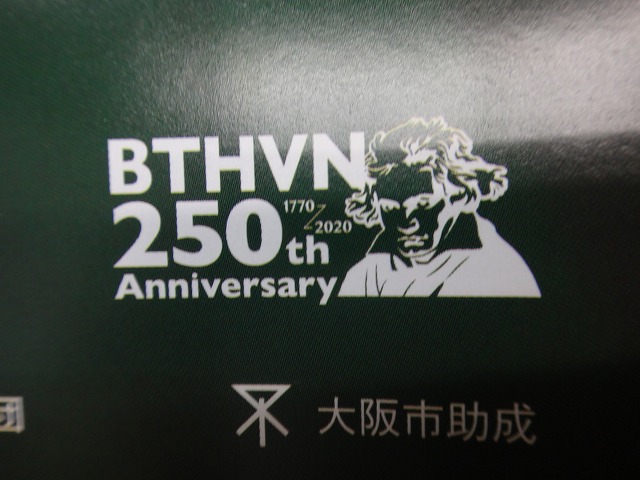
This year marks Beethoven's 250th birth anniversary,
and I think orchestras everywhere are following this trend,
but Beethoven's pieces have become extraordinarily prominent in the programs.
The day after tomorrow features Symphony No. 2,
and the next unavoidable date is May 15th with Symphony No. 5,
the so-called "Fate" symphony.
When the last digit of a famous composer's birth year and death year are
the same, you get a commemorative occasion every 10 years; when they differ, you get two per decade.
Concerts are programmed around "250th birth anniversary" or "190th anniversary of death" concepts,
and within any 10-year loop, someone's birth or death anniversary
comes around every single year.
Incidentally, Beethoven died in 1827, so
seven years from now we can expect special programming for the "200th anniversary of his death."
When it comes to pieces I can prepare for in advance,
I try to study them before attending the concert,
and most of that preparation comes from YouTube videos.
Among those, there's someone uploading Berlin Philharmonic performances
with "柏林" (Berlin) in their account name,
but the kanji for Berlin (伯林) uses the character 伯 (haku),
not 柏 (kashiwa).
It doesn't seem like they're intentionally making a joke,
and it looks like they might just be genuinely making a mistake, which bugs me.
Are they perhaps remembering "kashiwa hayashi" (a local specialty) and converting that instead?
Depending on your input environment,
converting "beririn" should give you 伯林.
Edit:
I received a comment pointing out that in Chinese it's written as 柏林.
Since the account name is "192柏林 Classic" and
the poster's comments are in fluent Japanese (without the awkwardness of machine translation),
I suspect the person behind it is actually Japanese.
However, I'm not posting this as a rebuttal to the comment—
I found the comment itself so interesting that I wanted to share it.
Thank you for the comment!