Wheels again today (etc.).
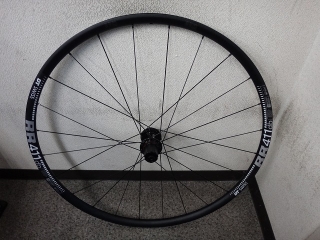
There was an article with the same title three days ago, but this is a different project.
That one was a CX75 hub, 28H, silver spokes, but
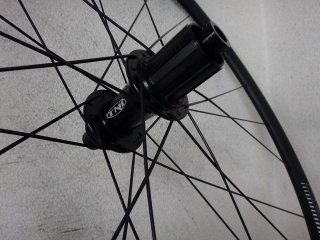
Today's is a Tni Revo disc hub, 24H
black half-Compe 46 JIS laced.
Cable routing will be done later.
The CX75 hub only comes in 28H specification, but
the Tni Revo disc hub is only available in 24H specification.
The Revo disc hub mentioned here refers to
the REVO ROAD disc hub,
with a centerlock rotor mount.
Separately, there's a REVO MTB hub,
which has a BOOST standard / 6-hole rotor mount / 32H specification only.
It's called "REVO MTB hub" not "REVO MTB disc hub"—
the model name doesn't include the word "disc"
but of course it's a hub for disc brakes.
I don't think I'll be using this one much going forward
(unless a 28H specification becomes available ※),
so going forward, when this blog refers to a Revo disc hub,
it means the REVO ROAD disc hub.
※If a 28H specification did exist,
I probably wouldn't have specifically chosen an XTR hub
for that Stans Crest MK3 28H rim I built the other day.
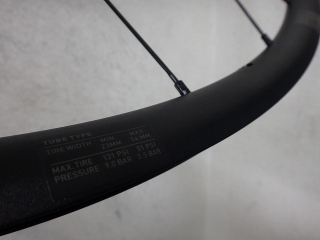
This RR411db rim is also a recently acquired rim, so
it came with that pressure rating sticker based on tire width.
On the rear wheel, it's applied so you can read it in the correct direction from the freewheel side.

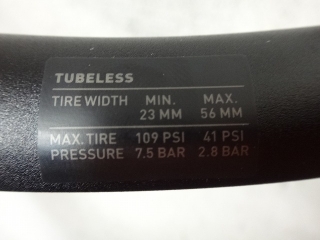
With the XR331 tube and tire, the maximum pressure limit was 8.5 bar,
but with the RR411db it's 9.5 bar.
At first glance, it looks like the maximum pressure changes by rim model,
but that's not actually the case.
I mentioned before that the XR331 rim and RR411db rim have the same maximum pressure under identical conditions.
For example, with tubeless 32C, both rims are 5.3 bar.
The reason the RR411db and XR331 have different maximum pressures is
because the recommended tire mounting width range (upper/lower limits) differs based on the rim's internal width.
DT doesn't use a criterion like "the rim is light so it can't handle high pressure"
or "it's heavy and durable so it can,"
simply the maximum pressure is determined solely by tire width
from one of three charts based on rim shape and tire type.
The three rim shapes and tire types are:
・Hooked rim + tubed tire
・Hooked rim + tubeless tire
・Hookless rim + tubeless tire
Since both RR411db and XR331 are hooked rims,
you consult one of the top two charts depending on tire type.
Looking at tubeless tires as an example,
the XR331 has a specified tire width of 25–64C
with pressure limits of 7 bar at 25C and 2.4 bar at 64C.
For the RR411db, the specified tire width is 23–56C
with pressure limits of 7.5 bar at 23C and 2.8 bar at 56C.
Since air pressure is determined by tire width, not rim model,
even the RR411db at 25C maxes out at 7 bar,
and even the XR331 at 56C maxes out at 2.8 bar—
regardless of rim model, 32C always has the same 5.3 bar limit.

There was an article with the same title three days ago, but this is a different project.
That one was a CX75 hub, 28H, silver spokes, but
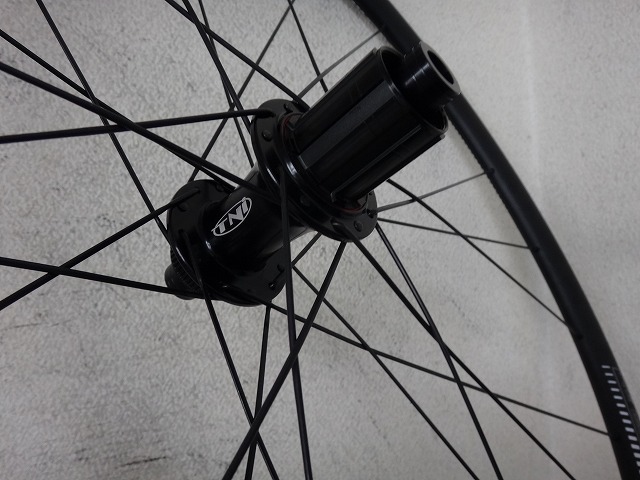
Today's is a Tni Revo disc hub, 24H
black half-Compe 46 JIS laced.
Cable routing will be done later.
The CX75 hub only comes in 28H specification, but
the Tni Revo disc hub is only available in 24H specification.
The Revo disc hub mentioned here refers to
the REVO ROAD disc hub,
with a centerlock rotor mount.
Separately, there's a REVO MTB hub,
which has a BOOST standard / 6-hole rotor mount / 32H specification only.
It's called "REVO MTB hub" not "REVO MTB disc hub"—
the model name doesn't include the word "disc"
but of course it's a hub for disc brakes.
I don't think I'll be using this one much going forward
(unless a 28H specification becomes available ※),
so going forward, when this blog refers to a Revo disc hub,
it means the REVO ROAD disc hub.
※If a 28H specification did exist,
I probably wouldn't have specifically chosen an XTR hub
for that Stans Crest MK3 28H rim I built the other day.
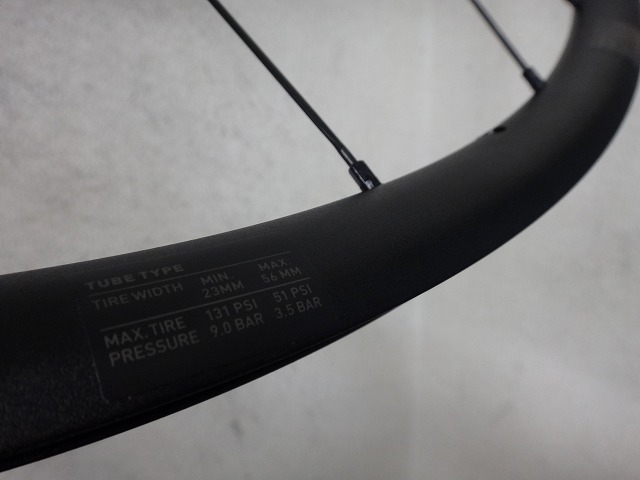
This RR411db rim is also a recently acquired rim, so
it came with that pressure rating sticker based on tire width.
On the rear wheel, it's applied so you can read it in the correct direction from the freewheel side.

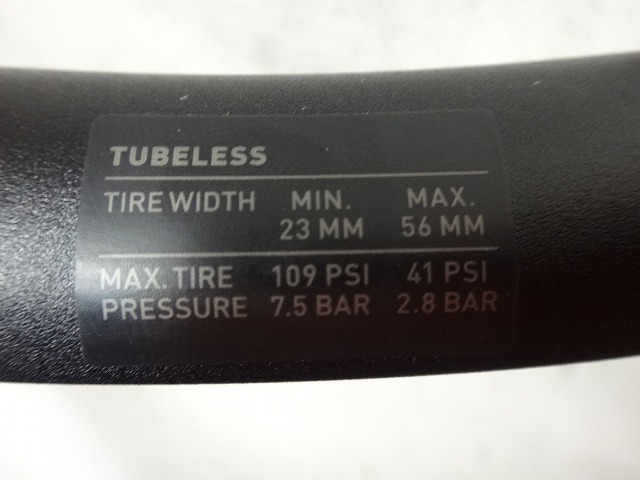
With the XR331 tube and tire, the maximum pressure limit was 8.5 bar,
but with the RR411db it's 9.5 bar.
At first glance, it looks like the maximum pressure changes by rim model,
but that's not actually the case.
I mentioned before that the XR331 rim and RR411db rim have the same maximum pressure under identical conditions.
For example, with tubeless 32C, both rims are 5.3 bar.
The reason the RR411db and XR331 have different maximum pressures is
because the recommended tire mounting width range (upper/lower limits) differs based on the rim's internal width.
DT doesn't use a criterion like "the rim is light so it can't handle high pressure"
or "it's heavy and durable so it can,"
simply the maximum pressure is determined solely by tire width
from one of three charts based on rim shape and tire type.
The three rim shapes and tire types are:
・Hooked rim + tubed tire
・Hooked rim + tubeless tire
・Hookless rim + tubeless tire
Since both RR411db and XR331 are hooked rims,
you consult one of the top two charts depending on tire type.
Looking at tubeless tires as an example,
the XR331 has a specified tire width of 25–64C
with pressure limits of 7 bar at 25C and 2.4 bar at 64C.
For the RR411db, the specified tire width is 23–56C
with pressure limits of 7.5 bar at 23C and 2.8 bar at 56C.
Since air pressure is determined by tire width, not rim model,
even the RR411db at 25C maxes out at 7 bar,
and even the XR331 at 56C maxes out at 2.8 bar—
regardless of rim model, 32C always has the same 5.3 bar limit.