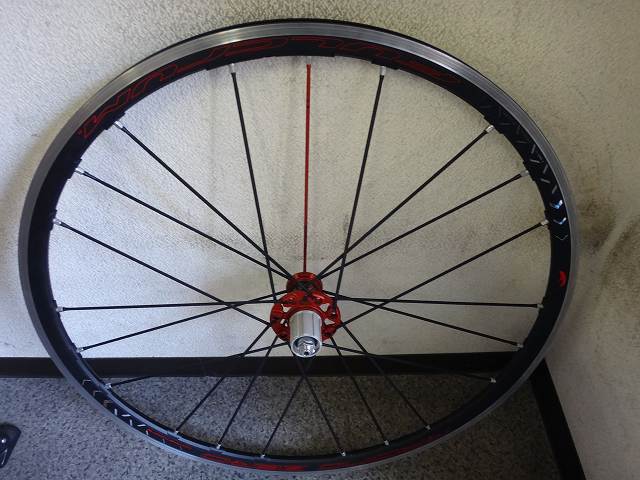
A customer brought me the front and rear wheels of a Campagnolo Fulcrum Racing Zero Competizione.
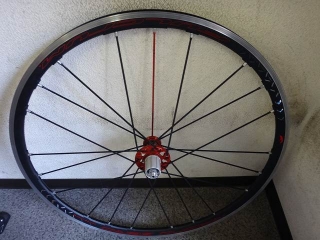
Starting with the rear wheel.
The customer said there's radial runout and asked me to fix it.
Campagnolo Fulcrum wheels with rest-phase holes in the rim have structural radial runout that can't be eliminated,
but the amount of that runout is so small you can't see it with your naked eye without a truing stand,
and it's smaller than the tire deformation when pressurized,
so you won't notice it while riding
(except in extreme situations like pumping the tire to 10 bar and riding on a three-roller trainer).
Also, wheels with abnormally low trueing precision basically don't exist in the as-shipped state,
so when customers self-report radial runout on these types of wheels,
it's only because they've been messed with by truing pretense or similar after leaving the factory.
In this case, it wasn't truing pretense—
it was "rim replacement pretense."
I won't name the shitty shop per my agreement with the customer,
but it's supposedly an established shop. It wasn't a trainee who screwed up—it was the second-generation owner.
Since that shop doesn't work on customer-supplied wheels,
I'm guessing the original wheel was purchased there.
When the customer asked for a repair after damaging the rim,
they were told "rim replacement requires complete spoke replacement."
There it is—the classic line from shitty shops!
The customer had read a blog that said something like:
"For rim replacement on Campagnolo Fulcrum aluminum spoke wheels,
complete spoke replacement is unnecessary.
I've done dozens of these and never needed to replace all the spokes.
Anyone proposing complete replacement is either a scumbag who'll do unnecessary work if it gets them paid,
or a fraud who thinks customers don't know anything."
So the customer emphasized strongly that "complete spoke replacement is not necessary"
before handing over both wheels, but they still had all the spokes on both wheels replaced without permission
and paid a total of 120,000 yen.
If the rim and spokes were all at list price with 10,000 yen labor per wheel (20,000 yen for both),
then 120,000 yen is actually a plausible figure.
But honestly, if it costs that much, shouldn't they have suggested buying new wheels instead...?
Also, the original spokes were disposed of without permission,
so whether replacement was actually necessary remains unclear
(if the rim was deformed that much, maybe a few spokes were genuinely bad,
but all of them? No way).
But after spending 120,000 yen on the rim (and spokes) replacement, the front and rear wheels have visible radial runout and suspected lateral centering issues,
so the customer asked for repairs again—once on the front wheel and twice on the rear—
but they clearly aren't fixed, so they brought them to me.
As for the centering issue, they just said "it's centered" without actually gauging it in front of the customer.
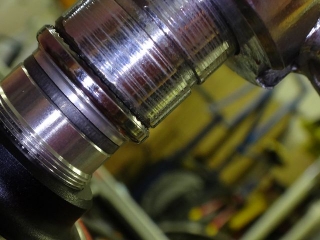
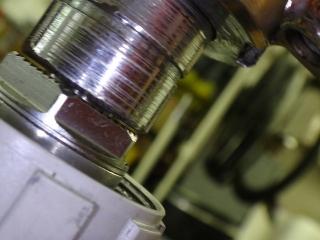
The rim is shifted toward the freewheel side.
After spending 120,000 yen, worse than Fulcrum's as-shipped precision? Are you kidding me?
There was one spot of lateral runout, but they gauged it away from that area.
All work was done in front of the customer.
I explained everything—what it was like before I touched it and what happened after.
If the customer goes to complain to the shitty shop, they can use my name and show them this article—I said they can do either.
I won't let them spout nonsense like "we did it right! Don't accuse us!"
For radial runout, it's fine once the seven rest-phase rim holes on the non-freewheel side are vertically aligned.
In other words, structurally, you can't tighten it beyond that.
I numbered the seven rest-phase rim holes 1-7 clockwise from the valve hole and checked the radial runout.
Position 3 was deeply indented inward,
and position 4 was also indented inward, though not as much as position 3.
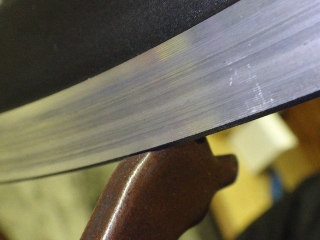
↑This is the position among 1-7 that was most outward.
The rest-phase position goes out further, but you can't compare it to that.

↑Position 3
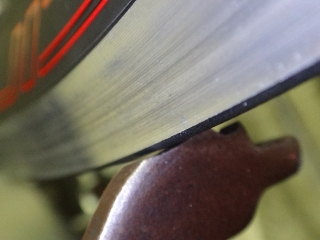
It's hard to see because it's not photographed well,
but it's pretty indented inward.
Also, the spoke tension overall was slack.
Tension isn't just about making it tight, but for this
I compared it using our as-shipped Racing Zero tension meter readings
and showed the customer there was a clear difference before and after.
In the end, I brought it to about the same as a fairly tight as-shipped example.
So I was about to start work
(still hadn't turned any nipples at this point)
when I noticed something terrible.
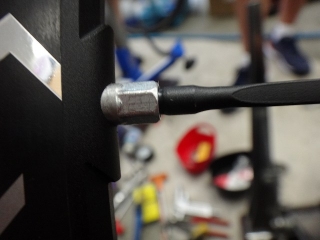
↑These are the non-freewheel side spokes, but they're too short.
It's not that they'd be just right if tightened properly—
the length is clearly wrong.
This rear wheel has "70" stamped on the freewheel side and "68" on the non-freewheel side.
There are exceptions not on this wheel, which I'll cover next time.
Normally, on radial-laced rear wheels, the freewheel side (tangent-laced) spokes are longer,
but since the mega-flange Racing Zero,
because the flange diameter is larger and the spoke path is nearly tangent to the flange,
the freewheel side spokes are actually shorter.
Between "70" and "68," "70" is the shorter one.
In the image above, the thread engagement is clearly shallow and abnormal,
but whether the builder didn't notice this while assembling or just thought something was off but went ahead anyway is unclear.
Either way, it's a fail for a professional shop.
The spoke length being wrong is still just a hypothesis at this point.
Without photographic evidence, the shitty shop might claim
"we couldn't have made a mistake!"
so
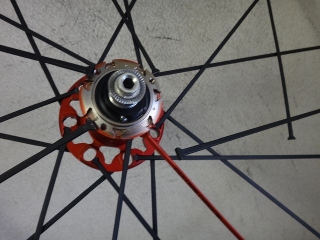
I actually disassembled the entire non-freewheel side.
I thought it would be a simple truing job, but it turned into a lot of work.
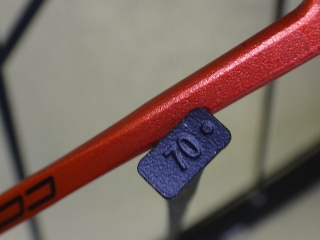
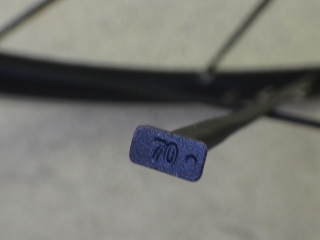
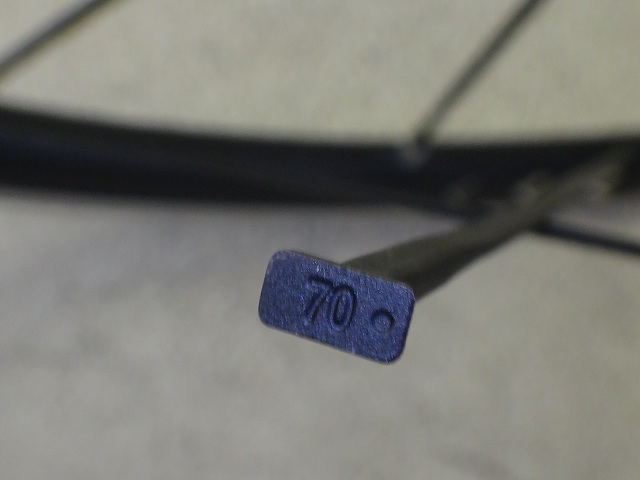
The red spokes with lettering only come in two types—front wheel and rear left—
so "70" red spokes don't exist for the freewheel side.
The red spokes were actually "68."
Of the remaining six black spokes, three were "70."
The thread engagement was abnormally shallow, so if I returned it as-is,
both the customer and I would have an unpleasant experience down the road,
so we arranged for the customer to buy three black "68" spokes from me.
I was about to say I'd give them the three removed "70s" as freeweel side spares
when it suddenly occurred to me:
what if "68" was mistakenly put on the freewheel side too?
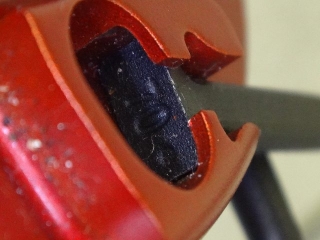
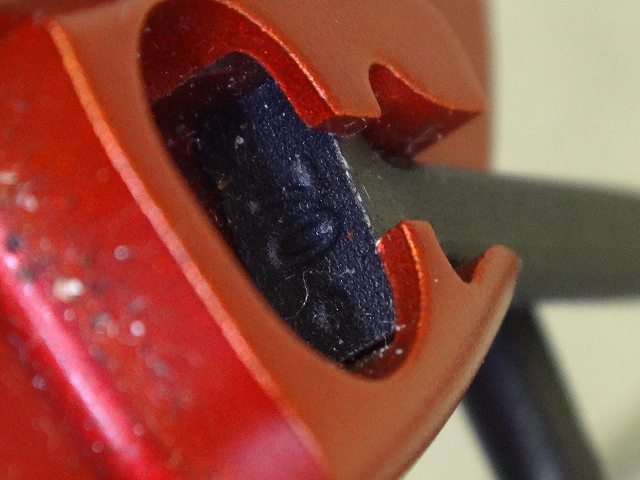
↑"70."
Strictly speaking it says "70・"—
the dot indicates the orientation of the numerals.
If it said "・0ム" the orientation would be reversed.
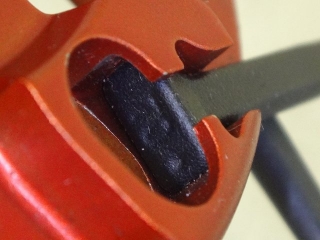
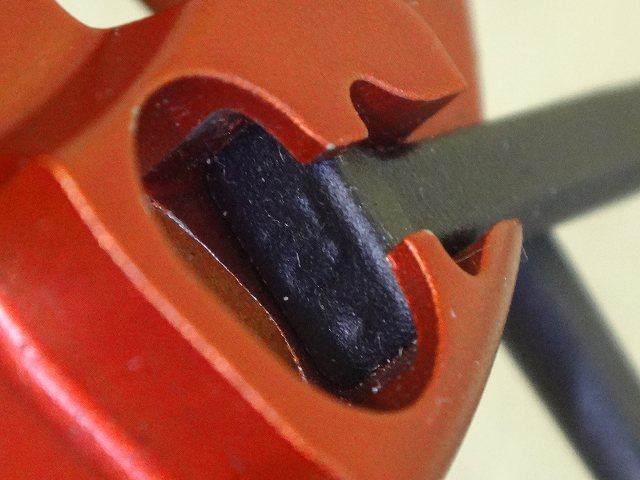
↑This one's also "70."
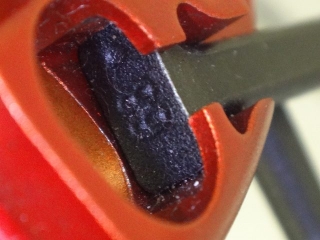
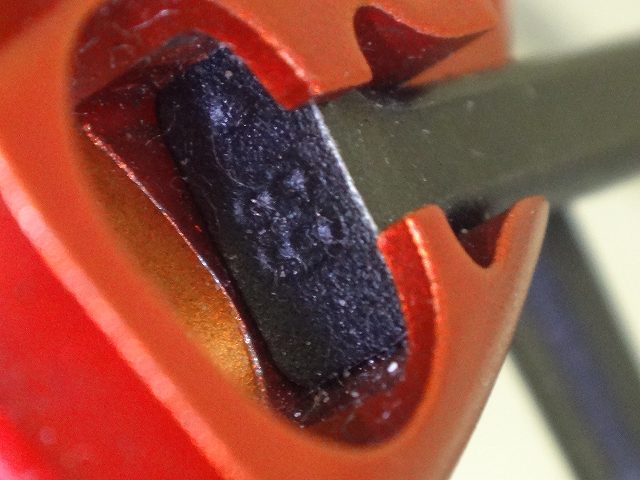
↑This isn't "・89"—it's "68・"
so it's "68."
They put non-freewheel spokes on the freewheel side.
This one has nearly used up all the thread.
Maybe that's why the spoke tension is slack—
the "68" on the freewheel side hit bottom and couldn't tighten more.
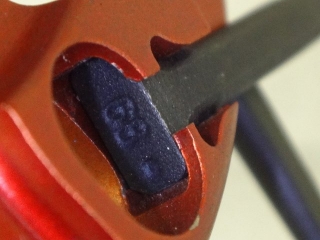
↑This one's also "68."
To belabor the point: I did this work in front of the customer (and another customer waiting for their job),
so there's no way these are doctored images I fabricated.
Well, I'm just putting up a defense line because that's the level of accusation he'd make.
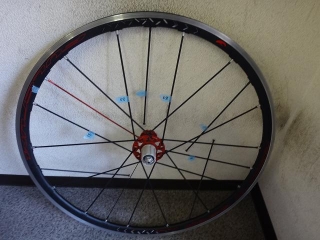
I marked the wrong spokes—non-freewheel "70" and freewheel "68"—with tape.

↑Three non-freewheel "70s."
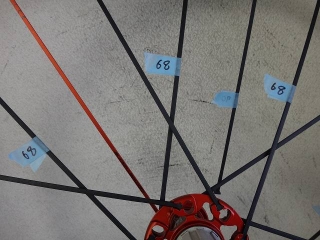
↑Three freewheel "68s" too.
In other words, they only mixed up some spokes,
so I didn't need to buy new ones.
Hey, at least there's that.
Since the freewheel spoke markings are readable without loosening nipples,
I haven't touched any freewheel nipples at this point,
but the freewheel "68s" in the image above all have their final cross with "70."
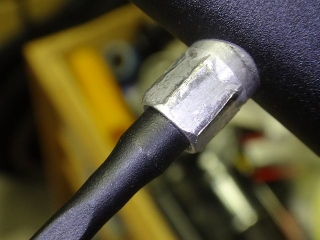
↑Freewheel "70"
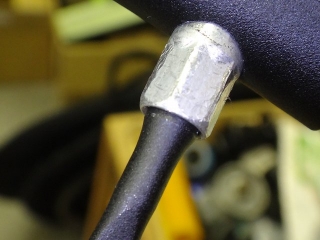
↑Freewheel "68"
As for this wheel's nipples,
the freewheel side in the image hasn't been touched at all,
but the corners are already quite dulled.
Even if nipples were reused from the previous wheel,
this is bad.
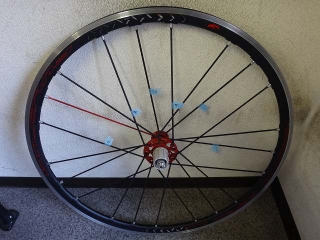
Fixed it.

After swapping out the three wrong spokes on each side,
the temporary centering and the large radial runout at position 3 I mentioned earlier all vanished,
making this more complicated than building a wheel from scratch.
The customer said they never thought their wheel would be the one where they heard me say here
"took longer than building a whole wheel,"
something I've written about before.
For the record, this rear wheel's labor is 4,000 yen.
Even I think that's cheap, but since I'm not responsible for what happened,
I didn't want to double-charge on labor for one wheel.
If the shitty shop pays, I'd bill 10,000 yen.
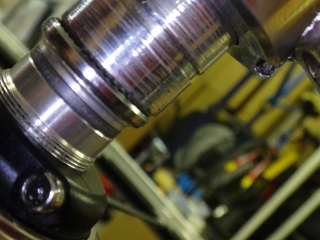
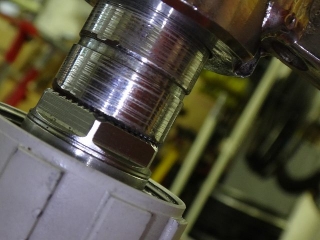
Center dead-on
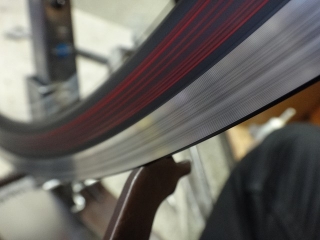
Radial runout dialed in too.
The wheel in the image above is rotating.


Now for the front wheel.
Even without rest-phase holes, it had more radial runout than the rear.
Slight centering offset and the lateral runout was mostly taken out.
In the two images above, the gauge position is the same.
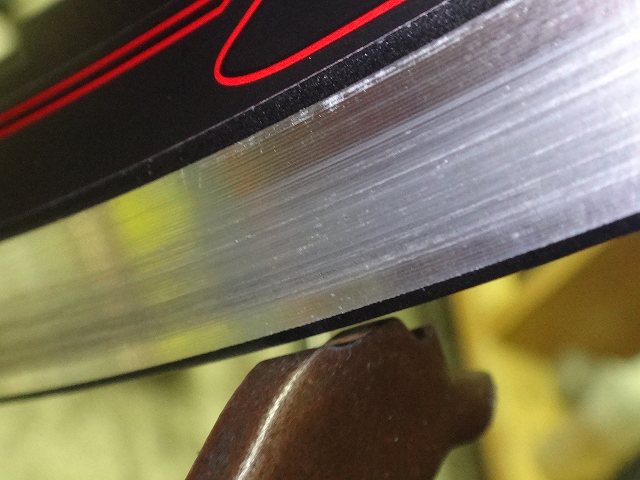
The customer used the wheel a bit after the rim replacement pretense,
so there's wear marks in the brake zone, but
at the time I received it, those wear marks were perfectly round.
If you look at the width of the unbraked section above and below the wear marks
where the brake shoes contacted,
the distance between the wear mark and the truing stand gauge is the same.
When you spin the wheel, the width of the clean section beyond the wear mark
varies up and down depending on position.
Starting from that condition, after taking out the radial runout
(took out lateral too and centered it),
the rim profile became nearly perfectly round,
and the previously round wear mark in the brake zone
now dances up and down as the wheel spins.
I didn't photograph it, but the customer saw it.
And I told them if they never use this front wheel,
the state that visualizes the original radial runout would be preserved,
so they could even show it to the shitty shop if they wanted.
Whether building wheels or truing them,
the approach is actually the same:
"push precision as far as possible to 100% of the builder's compromise point,
within what the materials allow."
This "100% compromise point" varies by individual though.
For professionals, the 100% compromise point is
"finally got it tight enough I'm not ashamed to take payment"—
the arrival point where you've pushed the work that far.
But the original state was far below Fulcrum's as-shipped quality,
with a very low, unprofessional 100% compromise point.
Plus the bonus of spokes installed on the wrong sides.
Both the customer and I agree on this:
I don't think this shitty shop was cutting corners thinking "nobody will find out anyway."
It definitely was 100%—just at a very low level.
Since this shop's owner apparently knows me and this blog,
and will probably see this if the wheel's customer tells them,
I'll write this now.
If a trainee in year 1 or 2 had screwed this up,
there'd be hope for improvement,
but if you—running on nothing but extra years—currently can't do better than this,
you'll never improve technically. Not ever.
I say "never" because I've never seen an exception.
So all you can do is survive on shitty work,
squeezing money from customers too oblivious to notice your work is garbage.
If you claim 100% of your effort was in what you did today,
then you don't even realize you're doing something shameful—
and that in itself is hopeless.
Can you honestly say with pride that this 120,000-yen job was worth it?
The customer actually gave you a couple of chances to do proper work
—asking "there's runout, right? Is it centered?"
twice before finally bringing it to me
(maybe they felt bad going straight to me)—
but you wouldn't even gauge the center in front of them to prove it.
The moment I put the gauge on and it was clearly off,
the first person to actually complete this rim replacement wasn't you.
It was me.
Well, actually before that, you'd already failed by putting spokes on the wrong sides.
And even before that, you'd already failed by forcing complete spoke replacement.
Starting with the rear wheel.
The customer said there's radial runout and asked me to fix it.
Campagnolo Fulcrum wheels with rest-phase holes in the rim have structural radial runout that can't be eliminated,
but the amount of that runout is so small you can't see it with your naked eye without a truing stand,
and it's smaller than the tire deformation when pressurized,
so you won't notice it while riding
(except in extreme situations like pumping the tire to 10 bar and riding on a three-roller trainer).
Also, wheels with abnormally low trueing precision basically don't exist in the as-shipped state,
so when customers self-report radial runout on these types of wheels,
it's only because they've been messed with by truing pretense or similar after leaving the factory.
In this case, it wasn't truing pretense—
it was "rim replacement pretense."
I won't name the shitty shop per my agreement with the customer,
but it's supposedly an established shop. It wasn't a trainee who screwed up—it was the second-generation owner.
Since that shop doesn't work on customer-supplied wheels,
I'm guessing the original wheel was purchased there.
When the customer asked for a repair after damaging the rim,
they were told "rim replacement requires complete spoke replacement."
There it is—the classic line from shitty shops!
The customer had read a blog that said something like:
"For rim replacement on Campagnolo Fulcrum aluminum spoke wheels,
complete spoke replacement is unnecessary.
I've done dozens of these and never needed to replace all the spokes.
Anyone proposing complete replacement is either a scumbag who'll do unnecessary work if it gets them paid,
or a fraud who thinks customers don't know anything."
So the customer emphasized strongly that "complete spoke replacement is not necessary"
before handing over both wheels, but they still had all the spokes on both wheels replaced without permission
and paid a total of 120,000 yen.
If the rim and spokes were all at list price with 10,000 yen labor per wheel (20,000 yen for both),
then 120,000 yen is actually a plausible figure.
But honestly, if it costs that much, shouldn't they have suggested buying new wheels instead...?
Also, the original spokes were disposed of without permission,
so whether replacement was actually necessary remains unclear
(if the rim was deformed that much, maybe a few spokes were genuinely bad,
but all of them? No way).
But after spending 120,000 yen on the rim (and spokes) replacement, the front and rear wheels have visible radial runout and suspected lateral centering issues,
so the customer asked for repairs again—once on the front wheel and twice on the rear—
but they clearly aren't fixed, so they brought them to me.
As for the centering issue, they just said "it's centered" without actually gauging it in front of the customer.
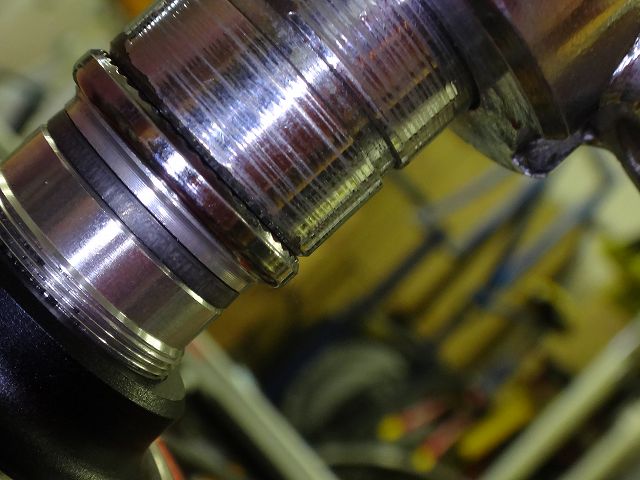

The rim is shifted toward the freewheel side.
After spending 120,000 yen, worse than Fulcrum's as-shipped precision? Are you kidding me?
There was one spot of lateral runout, but they gauged it away from that area.
All work was done in front of the customer.
I explained everything—what it was like before I touched it and what happened after.
If the customer goes to complain to the shitty shop, they can use my name and show them this article—I said they can do either.
I won't let them spout nonsense like "we did it right! Don't accuse us!"
For radial runout, it's fine once the seven rest-phase rim holes on the non-freewheel side are vertically aligned.
In other words, structurally, you can't tighten it beyond that.
I numbered the seven rest-phase rim holes 1-7 clockwise from the valve hole and checked the radial runout.
Position 3 was deeply indented inward,
and position 4 was also indented inward, though not as much as position 3.

↑This is the position among 1-7 that was most outward.
The rest-phase position goes out further, but you can't compare it to that.
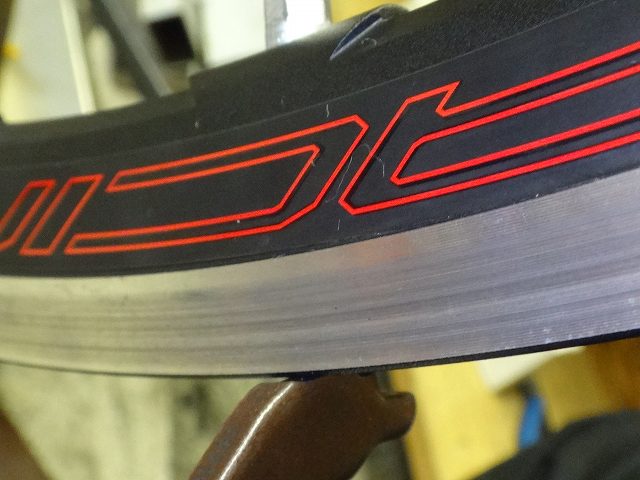
↑Position 3
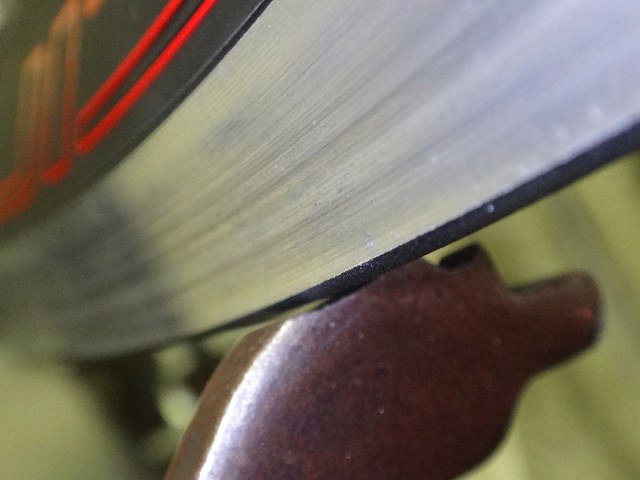
It's hard to see because it's not photographed well,
but it's pretty indented inward.
Also, the spoke tension overall was slack.
Tension isn't just about making it tight, but for this
I compared it using our as-shipped Racing Zero tension meter readings
and showed the customer there was a clear difference before and after.
In the end, I brought it to about the same as a fairly tight as-shipped example.
So I was about to start work
(still hadn't turned any nipples at this point)
when I noticed something terrible.
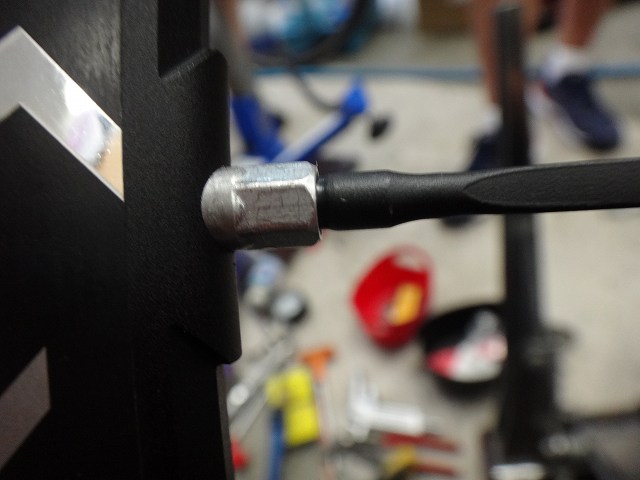
↑These are the non-freewheel side spokes, but they're too short.
It's not that they'd be just right if tightened properly—
the length is clearly wrong.
This rear wheel has "70" stamped on the freewheel side and "68" on the non-freewheel side.
There are exceptions not on this wheel, which I'll cover next time.
Normally, on radial-laced rear wheels, the freewheel side (tangent-laced) spokes are longer,
but since the mega-flange Racing Zero,
because the flange diameter is larger and the spoke path is nearly tangent to the flange,
the freewheel side spokes are actually shorter.
Between "70" and "68," "70" is the shorter one.
In the image above, the thread engagement is clearly shallow and abnormal,
but whether the builder didn't notice this while assembling or just thought something was off but went ahead anyway is unclear.
Either way, it's a fail for a professional shop.
The spoke length being wrong is still just a hypothesis at this point.
Without photographic evidence, the shitty shop might claim
"we couldn't have made a mistake!"
so
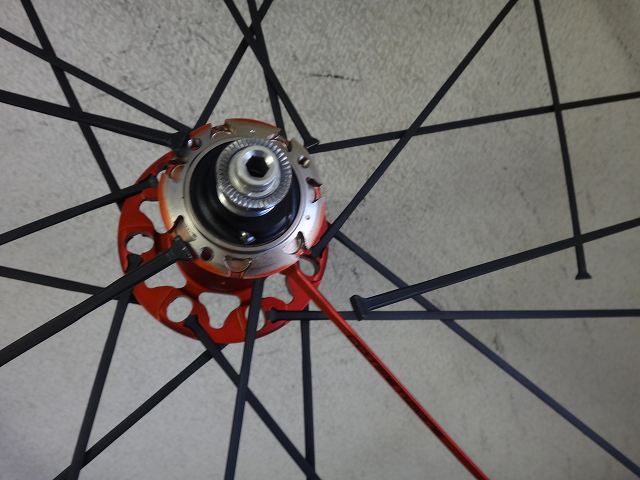
I actually disassembled the entire non-freewheel side.
I thought it would be a simple truing job, but it turned into a lot of work.
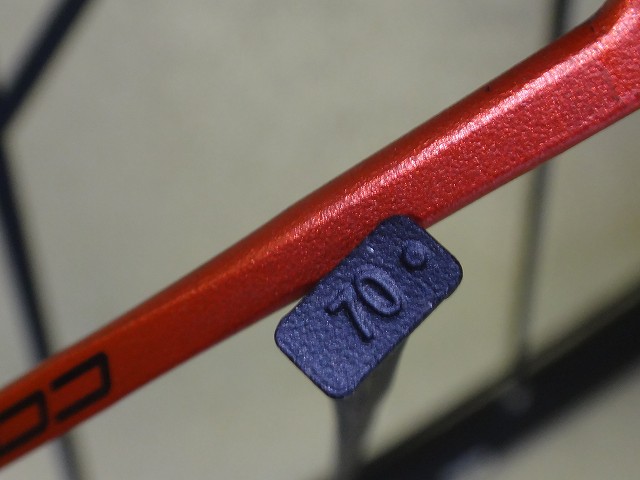
The red spokes with lettering only come in two types—front wheel and rear left—
so "70" red spokes don't exist for the freewheel side.
The red spokes were actually "68."
Of the remaining six black spokes, three were "70."
The thread engagement was abnormally shallow, so if I returned it as-is,
both the customer and I would have an unpleasant experience down the road,
so we arranged for the customer to buy three black "68" spokes from me.
I was about to say I'd give them the three removed "70s" as freeweel side spares
when it suddenly occurred to me:
what if "68" was mistakenly put on the freewheel side too?
↑"70."
Strictly speaking it says "70・"—
the dot indicates the orientation of the numerals.
If it said "・0ム" the orientation would be reversed.
↑This one's also "70."
↑This isn't "・89"—it's "68・"
so it's "68."
They put non-freewheel spokes on the freewheel side.
This one has nearly used up all the thread.
Maybe that's why the spoke tension is slack—
the "68" on the freewheel side hit bottom and couldn't tighten more.
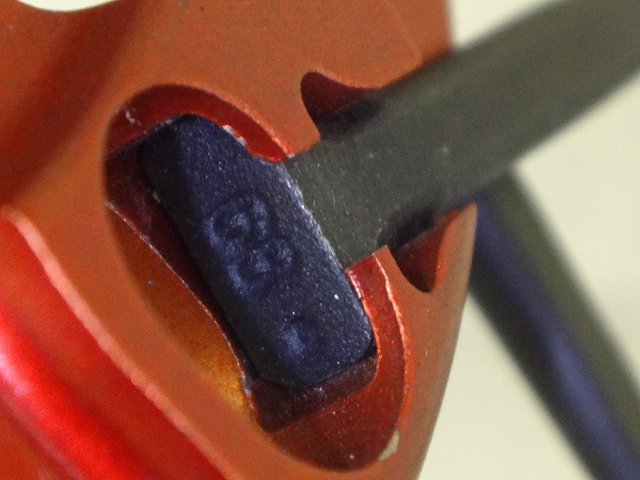
↑This one's also "68."
To belabor the point: I did this work in front of the customer (and another customer waiting for their job),
so there's no way these are doctored images I fabricated.
Well, I'm just putting up a defense line because that's the level of accusation he'd make.
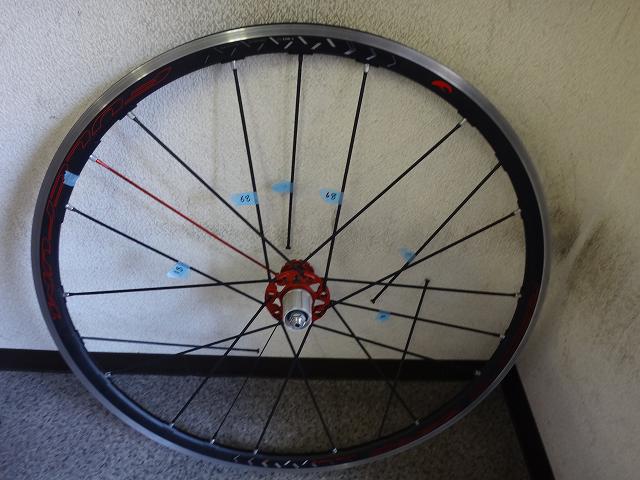
I marked the wrong spokes—non-freewheel "70" and freewheel "68"—with tape.
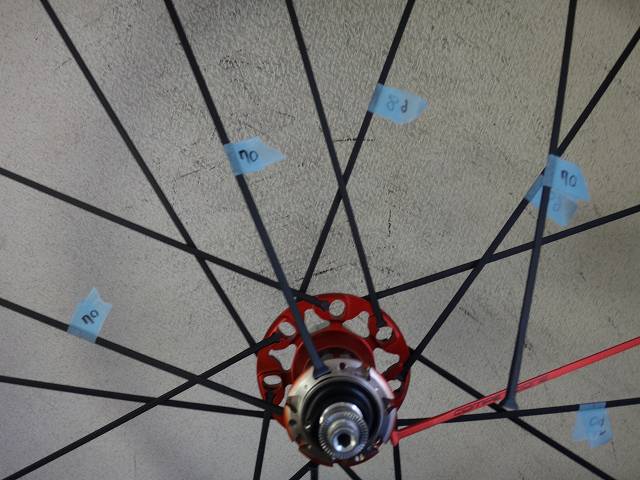
↑Three non-freewheel "70s."
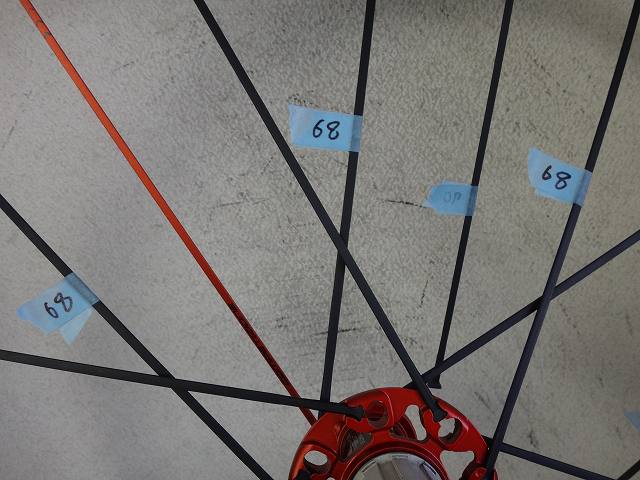
↑Three freewheel "68s" too.
In other words, they only mixed up some spokes,
so I didn't need to buy new ones.
Hey, at least there's that.
Since the freewheel spoke markings are readable without loosening nipples,
I haven't touched any freewheel nipples at this point,
but the freewheel "68s" in the image above all have their final cross with "70."
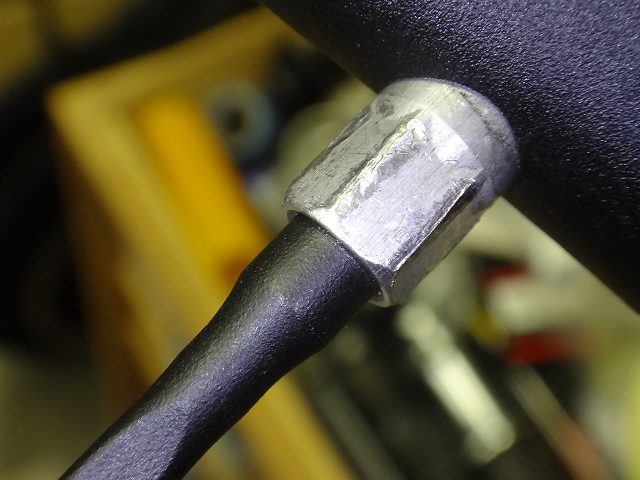
↑Freewheel "70"
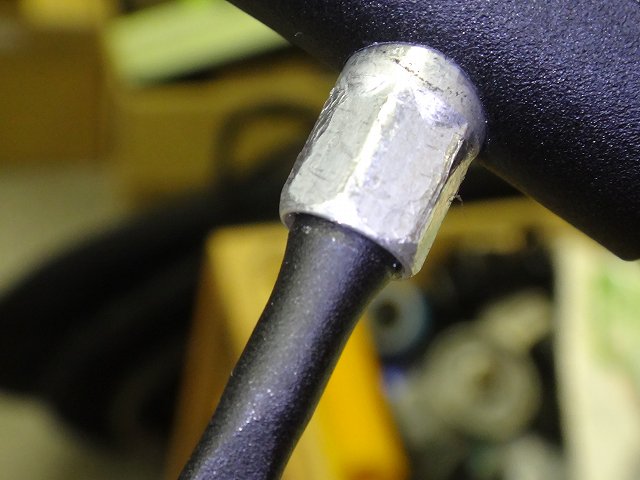
↑Freewheel "68"
As for this wheel's nipples,
the freewheel side in the image hasn't been touched at all,
but the corners are already quite dulled.
Even if nipples were reused from the previous wheel,
this is bad.
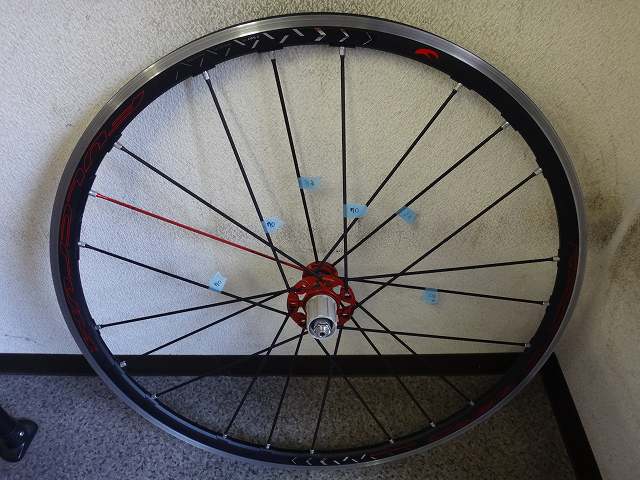
Fixed it.
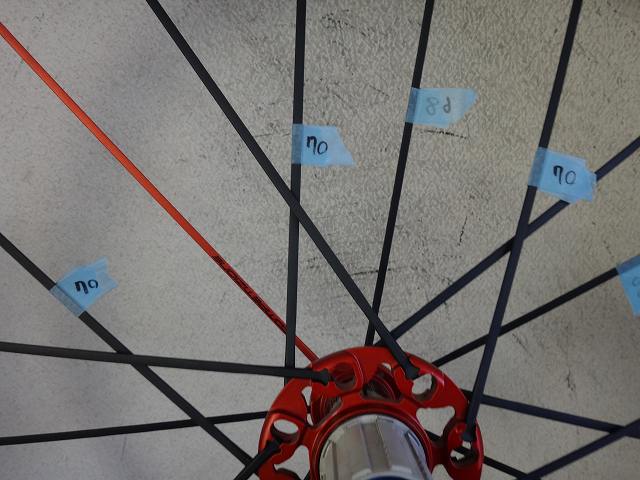
After swapping out the three wrong spokes on each side,
the temporary centering and the large radial runout at position 3 I mentioned earlier all vanished,
making this more complicated than building a wheel from scratch.
The customer said they never thought their wheel would be the one where they heard me say here
"took longer than building a whole wheel,"
something I've written about before.
For the record, this rear wheel's labor is 4,000 yen.
Even I think that's cheap, but since I'm not responsible for what happened,
I didn't want to double-charge on labor for one wheel.
If the shitty shop pays, I'd bill 10,000 yen.
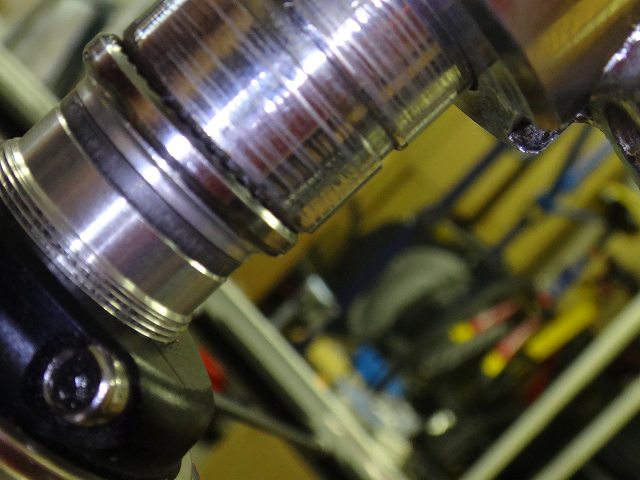
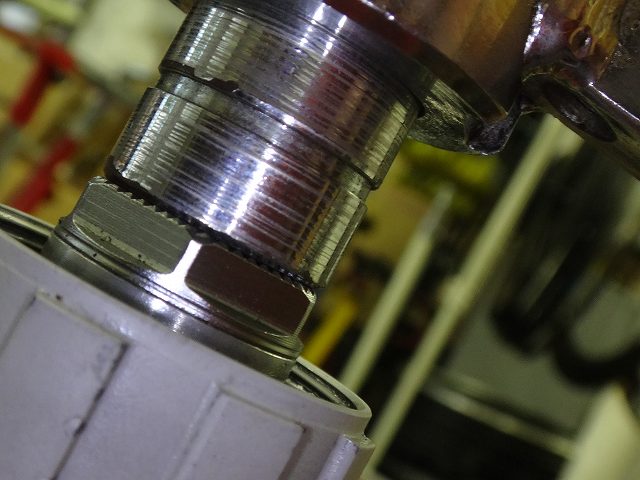
Center dead-on
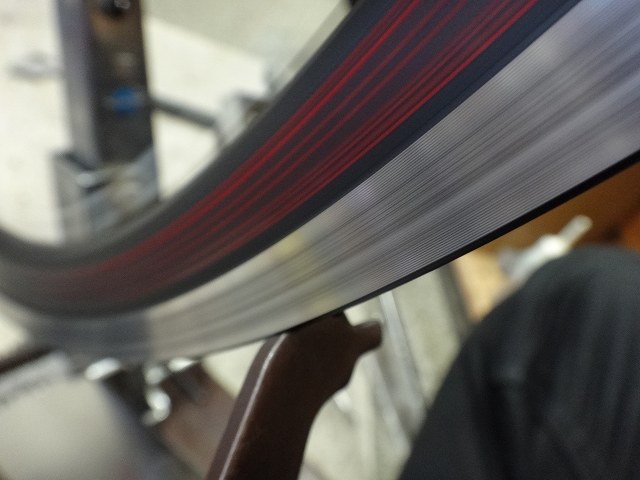
Radial runout dialed in too.
The wheel in the image above is rotating.
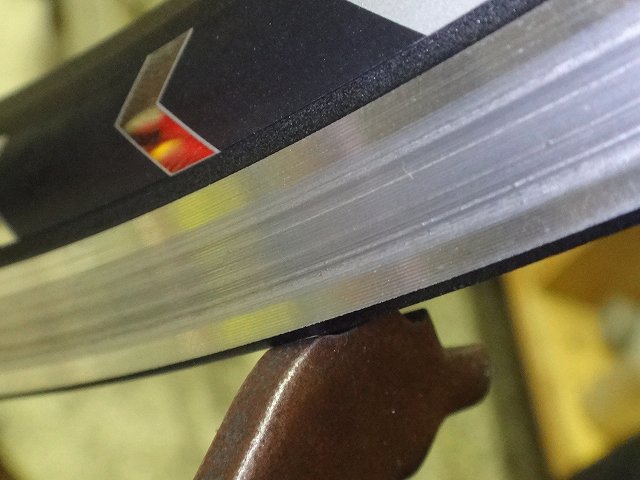
Now for the front wheel.
Even without rest-phase holes, it had more radial runout than the rear.
Slight centering offset and the lateral runout was mostly taken out.
In the two images above, the gauge position is the same.
The customer used the wheel a bit after the rim replacement pretense,
so there's wear marks in the brake zone, but
at the time I received it, those wear marks were perfectly round.
If you look at the width of the unbraked section above and below the wear marks
where the brake shoes contacted,
the distance between the wear mark and the truing stand gauge is the same.
When you spin the wheel, the width of the clean section beyond the wear mark
varies up and down depending on position.
Starting from that condition, after taking out the radial runout
(took out lateral too and centered it),
the rim profile became nearly perfectly round,
and the previously round wear mark in the brake zone
now dances up and down as the wheel spins.
I didn't photograph it, but the customer saw it.
And I told them if they never use this front wheel,
the state that visualizes the original radial runout would be preserved,
so they could even show it to the shitty shop if they wanted.
Whether building wheels or truing them,
the approach is actually the same:
"push precision as far as possible to 100% of the builder's compromise point,
within what the materials allow."
This "100% compromise point" varies by individual though.
For professionals, the 100% compromise point is
"finally got it tight enough I'm not ashamed to take payment"—
the arrival point where you've pushed the work that far.
But the original state was far below Fulcrum's as-shipped quality,
with a very low, unprofessional 100% compromise point.
Plus the bonus of spokes installed on the wrong sides.
Both the customer and I agree on this:
I don't think this shitty shop was cutting corners thinking "nobody will find out anyway."
It definitely was 100%—just at a very low level.
Since this shop's owner apparently knows me and this blog,
and will probably see this if the wheel's customer tells them,
I'll write this now.
If a trainee in year 1 or 2 had screwed this up,
there'd be hope for improvement,
but if you—running on nothing but extra years—currently can't do better than this,
you'll never improve technically. Not ever.
I say "never" because I've never seen an exception.
So all you can do is survive on shitty work,
squeezing money from customers too oblivious to notice your work is garbage.
If you claim 100% of your effort was in what you did today,
then you don't even realize you're doing something shameful—
and that in itself is hopeless.
Can you honestly say with pride that this 120,000-yen job was worth it?
The customer actually gave you a couple of chances to do proper work
—asking "there's runout, right? Is it centered?"
twice before finally bringing it to me
(maybe they felt bad going straight to me)—
but you wouldn't even gauge the center in front of them to prove it.
The moment I put the gauge on and it was clearly off,
the first person to actually complete this rim replacement wasn't you.
It was me.
Well, actually before that, you'd already failed by putting spokes on the wrong sides.
And even before that, you'd already failed by forcing complete spoke replacement.