Another day of wheel building (and so on).
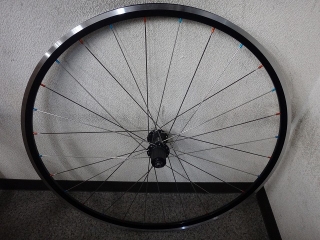
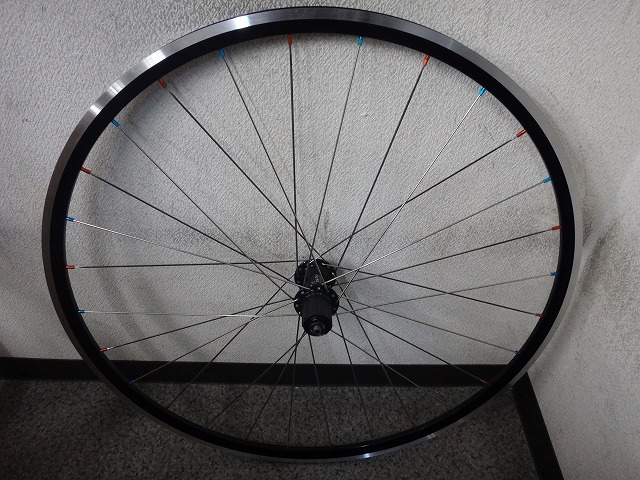
I built the rear wheel for Nomu Lab Wheel No. 5.
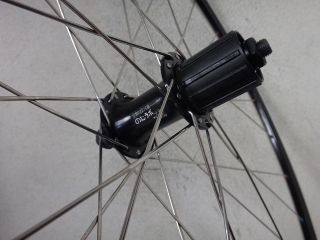
FH-RS300 28H built in semi-comp 4-cross pattern with
turquoise nipples on the freewheel side and orange nipples on the non-freewheel side.
I'll do the truing later.
The hub is on loan from a customer, and
where the RS400 is rated for 11-speed,
he deliberately chose the RS300 which is only rated up to 10-speed
because the right flange width is wider and the dishing isn't too severe.
He's aware that it doesn't have a high-low flange design like the Evolite hub...,
but regarding spoke tension left-right imbalance,
the right flange width is the major factor unless the difference is
as much as mega-flange hubs like Fulcrum.
Apart from being somewhat heavier,
in terms of the wheel elements I consider important,
the RS300 hub is actually superior to a 9000 Dura-Ace hub
and superior to an Evolite hub.
But taking it further, a 126mm-width boss freewheel hub with
a 4mm spacer on the non-freewheel side to make it 130mm
would be even better.
The typical maximum gear count for boss freewheel gears is 8-speed, but
if you were to make a boss freewheel gear with today's 12-speed sprocket width,
knowing that chain life would be short,
9-speed would be easy, 10-speed would have the low gear overhanging inward,
and if there were no spoke interference when shifting to the low gear,
it might be possible.
But reducing gear count for left-right spoke tension balance is unthinkable,
so that will never happen.
When I say "9-speed in 12-speed width," it sounds odd, so
I'd like to try a more precise terminology for chain width.
Chain dimensions for thick-tooth systems like utility bikes (mama-charis), track bikes, and BMX
are noted as 1/2" × 1/8" and such.
The former 1/2 inch refers to the distance between pin centers of one link pitch.
This has virtually no exceptions—I'll cover exceptions in a separate post.
The 1/8 inch refers to the width.
With multi-speed chains, this becomes 3/32 inch,
a slightly narrower chain width, and this standard lasted through 8-speed.
For example, with Shimano, 8-speed chains are compatible with both 6 and 7-speed.
With Shimano chains, there are standards called UG, IG, and HG,
each with their own chains and sprockets,
IG chains and sprockets or chainrings work with each other,
and HG chains and sprockets or chainrings work with each other of course, but
other combinations get a bit complicated.
The new IG chains CN-IG90, 70, 51, 31 that changed width from 7.1mm to 7.3mm
can be used with HG sprockets
but don't fit HG chainrings.
HG chains don't fit either IG sprockets or IG chainrings.
I sometimes see the expression "IG chains can be used with HG gears, but not vice versa,"
but strictly speaking that's inaccurate.
From 9-speed onward, chains are proprietary standards of each manufacturer.
Width notations like "3/32 inch" don't even appear in manufacturer catalogs;
they're referred to as "Shimano's 11-speed chain" or "Campagnolo's 12-speed chain"
and that's it.
With third-party chains, you sometimes see things like
"compatible with 11-speed, component maker agnostic."
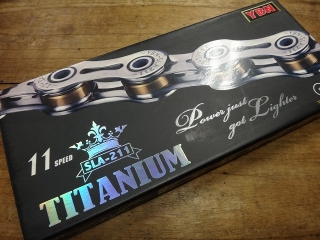
↑This is the box for a chain from the Yaban brand
that I installed on a sub-4kg bike.
It's 11-speed, but
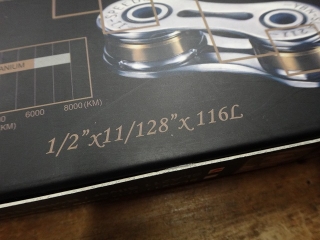
the back of the box listed a width specification of 11/128 inch.
If we equalize the denominators,
thick-tooth chains would be 16/128 inch,
and 6, 7, and 8-speed chains would be 12/128 inch.
With this, if 11-speed chain width could be notated as 11/128 inch,
then instead of saying something like "if there were a 9-speed sprocket in 11-speed width..."
you could say something like "if there were a 9-speed sprocket compatible with 11/128 inch chain..."
So I checked Yaban's manufacturer website to see
how they notate the width of chains for 9-speed and higher multi-speed gears,
and it turns out that the 9, 10, 11, and 12-speed chains are all listed as 11/128 inch.
With that, you can't use the expression "if there were a 9-speed sprocket compatible with 11/128 inch chain..."
That concludes this tangent, which I could have put in a separate post but didn't split off.
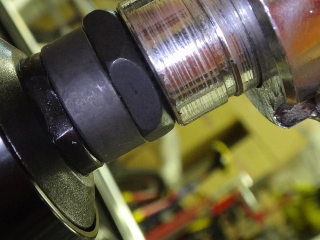

This is the process of pulling the rim to center
by tensioning just the non-freewheel side,
from a state with virtually no radial or lateral runout,
starting from roughly double the amount of center deviation shown in the image above.
The reason I shot it at this point is that this is about how much
left-right imbalance I typically see on the Evolite hub
Nomu Lab Wheel No. 5 that I build regularly.
In other words, the non-freewheel side can still be tensioned one-sidedly
from here until the center comes into spec.
This wheel is 28H, but
the customer already has an Evolite hub 24H
Nomu Lab Wheel No. 5, so
combined with the difference in spoke count, he'll likely
feel a difference noticeable at a perceptible level.
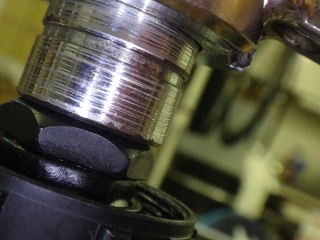
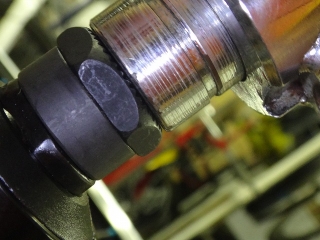
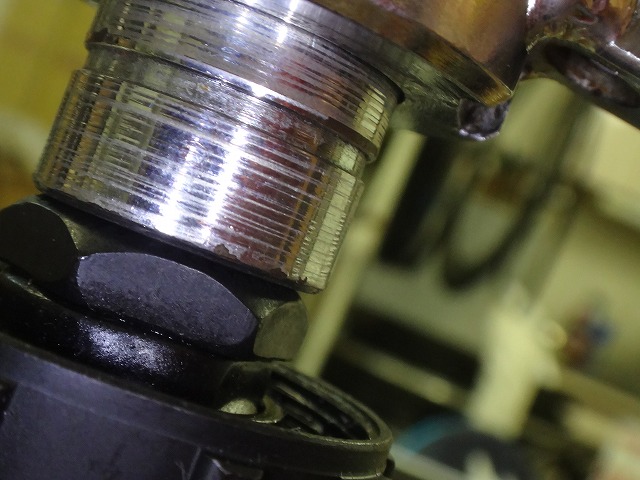
Got the center true.
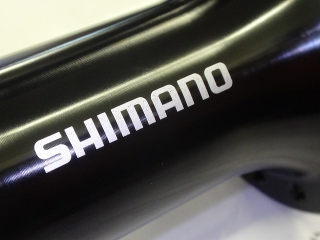
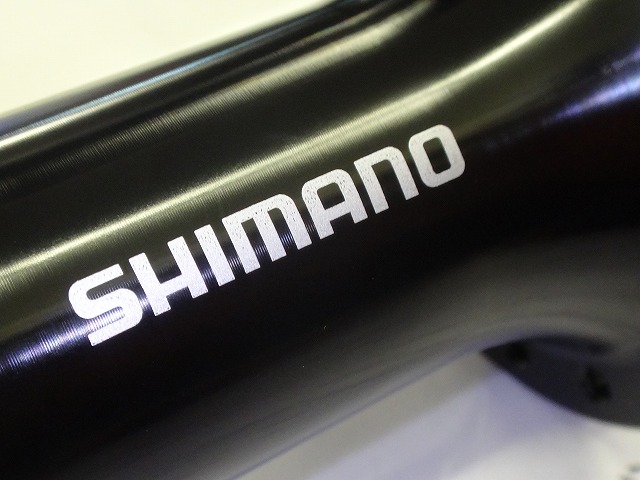
Going back in the timeline, the customer asked me to
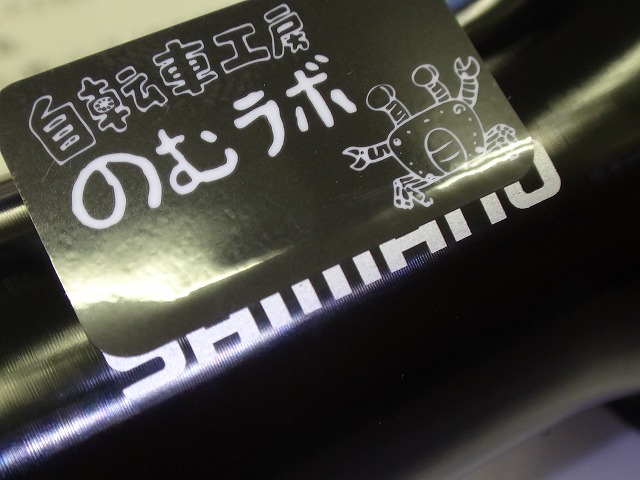
apply a Nomu Lab sticker to the SHIMANO part on the hub shell.
Normally I don't apply stickers myself, but
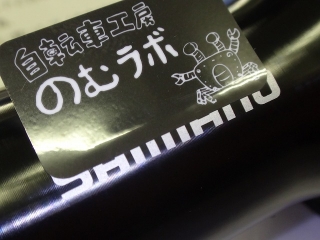
it happened that the SHIMANO width and sticker width were
nearly identical (the sticker is about 0.2mm narrower),
and it would be extremely difficult to apply cleanly afterward
with the wheel already built, so
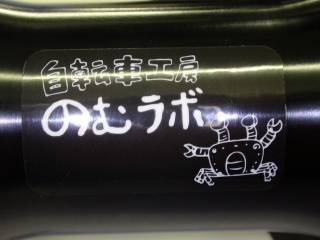
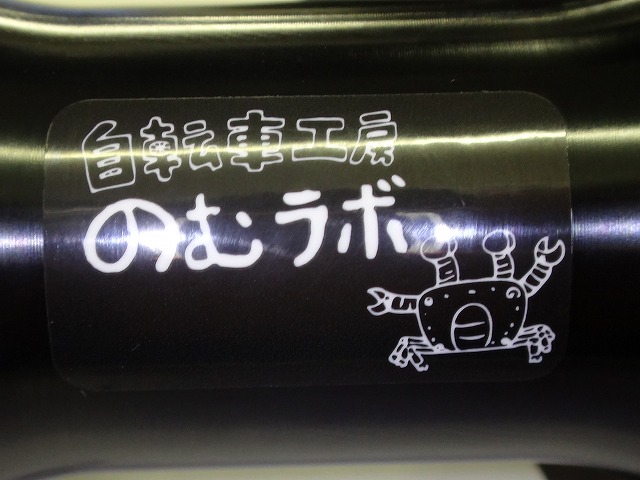
this time I applied it myself.
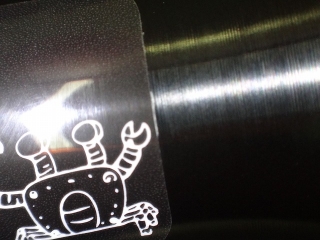
↑The letters slightly overshoot.
If one side doesn't overshoot, the other side will.
With cheaper models, the hub shell finish has
fine notches like a nail file or a musical guiro,
so sticker adhesion weakens, but
with this hub shell I think it's unlikely to peel off.
I built the rear wheel for Nomu Lab Wheel No. 5.
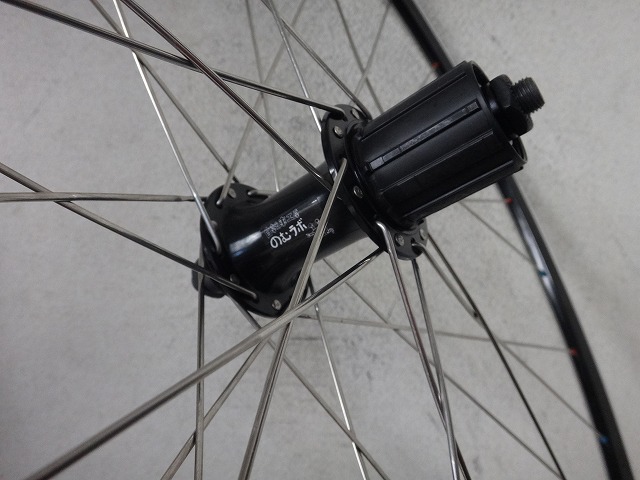
FH-RS300 28H built in semi-comp 4-cross pattern with
turquoise nipples on the freewheel side and orange nipples on the non-freewheel side.
I'll do the truing later.
The hub is on loan from a customer, and
where the RS400 is rated for 11-speed,
he deliberately chose the RS300 which is only rated up to 10-speed
because the right flange width is wider and the dishing isn't too severe.
He's aware that it doesn't have a high-low flange design like the Evolite hub...,
but regarding spoke tension left-right imbalance,
the right flange width is the major factor unless the difference is
as much as mega-flange hubs like Fulcrum.
Apart from being somewhat heavier,
in terms of the wheel elements I consider important,
the RS300 hub is actually superior to a 9000 Dura-Ace hub
and superior to an Evolite hub.
But taking it further, a 126mm-width boss freewheel hub with
a 4mm spacer on the non-freewheel side to make it 130mm
would be even better.
The typical maximum gear count for boss freewheel gears is 8-speed, but
if you were to make a boss freewheel gear with today's 12-speed sprocket width,
knowing that chain life would be short,
9-speed would be easy, 10-speed would have the low gear overhanging inward,
and if there were no spoke interference when shifting to the low gear,
it might be possible.
But reducing gear count for left-right spoke tension balance is unthinkable,
so that will never happen.
When I say "9-speed in 12-speed width," it sounds odd, so
I'd like to try a more precise terminology for chain width.
Chain dimensions for thick-tooth systems like utility bikes (mama-charis), track bikes, and BMX
are noted as 1/2" × 1/8" and such.
The former 1/2 inch refers to the distance between pin centers of one link pitch.
This has virtually no exceptions—I'll cover exceptions in a separate post.
The 1/8 inch refers to the width.
With multi-speed chains, this becomes 3/32 inch,
a slightly narrower chain width, and this standard lasted through 8-speed.
For example, with Shimano, 8-speed chains are compatible with both 6 and 7-speed.
With Shimano chains, there are standards called UG, IG, and HG,
each with their own chains and sprockets,
IG chains and sprockets or chainrings work with each other,
and HG chains and sprockets or chainrings work with each other of course, but
other combinations get a bit complicated.
The new IG chains CN-IG90, 70, 51, 31 that changed width from 7.1mm to 7.3mm
can be used with HG sprockets
but don't fit HG chainrings.
HG chains don't fit either IG sprockets or IG chainrings.
I sometimes see the expression "IG chains can be used with HG gears, but not vice versa,"
but strictly speaking that's inaccurate.
From 9-speed onward, chains are proprietary standards of each manufacturer.
Width notations like "3/32 inch" don't even appear in manufacturer catalogs;
they're referred to as "Shimano's 11-speed chain" or "Campagnolo's 12-speed chain"
and that's it.
With third-party chains, you sometimes see things like
"compatible with 11-speed, component maker agnostic."
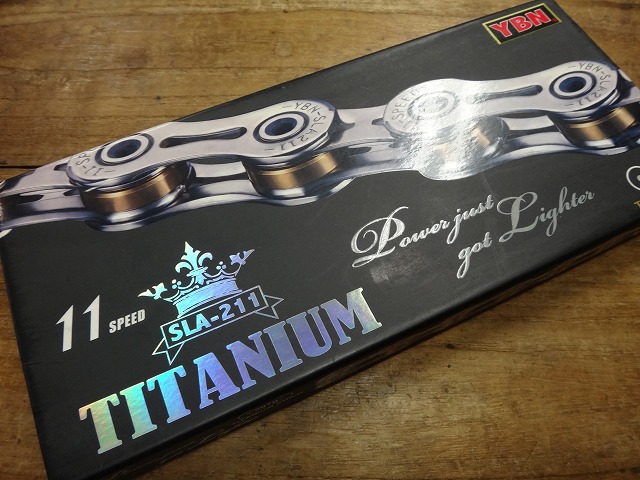
↑This is the box for a chain from the Yaban brand
that I installed on a sub-4kg bike.
It's 11-speed, but
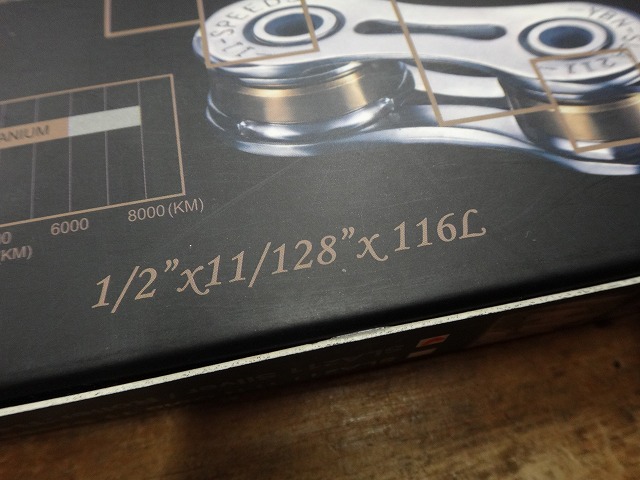
the back of the box listed a width specification of 11/128 inch.
If we equalize the denominators,
thick-tooth chains would be 16/128 inch,
and 6, 7, and 8-speed chains would be 12/128 inch.
With this, if 11-speed chain width could be notated as 11/128 inch,
then instead of saying something like "if there were a 9-speed sprocket in 11-speed width..."
you could say something like "if there were a 9-speed sprocket compatible with 11/128 inch chain..."
So I checked Yaban's manufacturer website to see
how they notate the width of chains for 9-speed and higher multi-speed gears,
and it turns out that the 9, 10, 11, and 12-speed chains are all listed as 11/128 inch.
With that, you can't use the expression "if there were a 9-speed sprocket compatible with 11/128 inch chain..."
That concludes this tangent, which I could have put in a separate post but didn't split off.

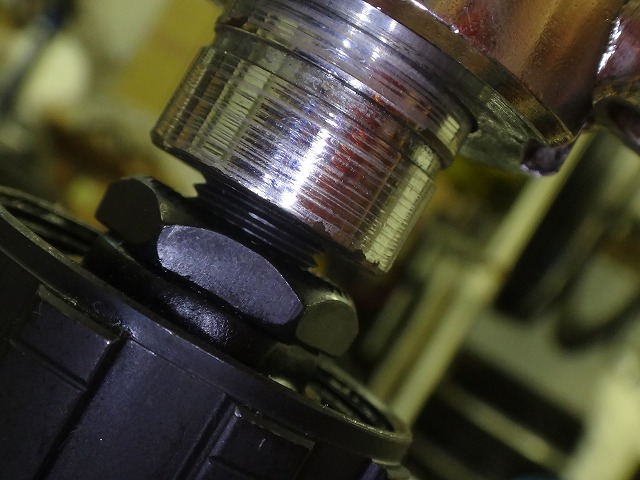
This is the process of pulling the rim to center
by tensioning just the non-freewheel side,
from a state with virtually no radial or lateral runout,
starting from roughly double the amount of center deviation shown in the image above.
The reason I shot it at this point is that this is about how much
left-right imbalance I typically see on the Evolite hub
Nomu Lab Wheel No. 5 that I build regularly.
In other words, the non-freewheel side can still be tensioned one-sidedly
from here until the center comes into spec.
This wheel is 28H, but
the customer already has an Evolite hub 24H
Nomu Lab Wheel No. 5, so
combined with the difference in spoke count, he'll likely
feel a difference noticeable at a perceptible level.

Got the center true.
Going back in the timeline, the customer asked me to
apply a Nomu Lab sticker to the SHIMANO part on the hub shell.
Normally I don't apply stickers myself, but
it happened that the SHIMANO width and sticker width were
nearly identical (the sticker is about 0.2mm narrower),
and it would be extremely difficult to apply cleanly afterward
with the wheel already built, so
this time I applied it myself.
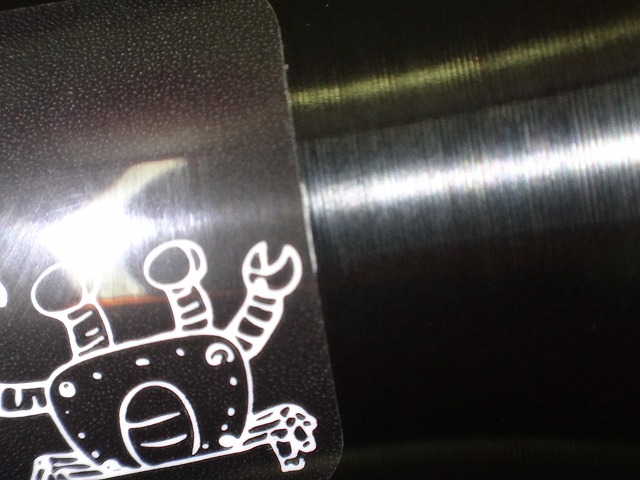
↑The letters slightly overshoot.
If one side doesn't overshoot, the other side will.
With cheaper models, the hub shell finish has
fine notches like a nail file or a musical guiro,
so sticker adhesion weakens, but
with this hub shell I think it's unlikely to peel off.