I sold a Shimano WH-R501 rear wheel with a turbo trainer tire attached.
Obviously, I can't hand-build a rear wheel that retails for around 5,000 yen.
If you want the most affordable rear wheel for a turbo trainer, the WH-R501 is recommended.
(Though it's not compatible with Shimano 11-speed or Campagnolo)
I also did truing and centering.
The runout was minor, but the centering was quite off.
I'll write what I always write here:
When I say "this wheel manufacturer's centering was off,"
I'm not criticizing that manufacturer's quality control.
Wheels from any manufacturer can have centering issues.
Some WH-R501s come perfectly centered from the factory.
The important thing is that in the chain "manufacturer → (if applicable) distributor → shop → user,"
it's really only the shop that can detect and correct wheel defects
before they reach the user.
Selling complete wheels straight through without doing this—from left to right as-is—means
you're just standing between "manufacturer and user" taking a cut of the profit.
My definition of "shop" here
naturally includes "performing 100% inspection on complete wheels as standard practice,"
which means "all shops should NOT sell complete wheels in the condition they arrive in."
You should buy wheels from a "shop."
My way of speaking here includes,
of course, a bit of sarcasm, because I'm well aware
that not all shops are true "shops."
Quite apart from pricing, those who buy wheels through overseas online retailers
probably have considerable distrust of shops like this.
Conversely, if it's a "shop" that seems like it will take care of you down the road,
many customers would put price concerns secondary.
For shops to deny overseas online retailers while failing to present customers with added value beyond price
is not only off-base but a fundamental misunderstanding.
I just mentioned added value, but
"we inspect complete wheels before selling them!"
is not added value—it's just the obvious thing.
If you genuinely think this differentiates you from other shops,
you must believe "shops generally sell complete wheels as-is (but we don't),"
or you used to sell complete wheels without inspection
and are now saying "from now on we'll do it differently!"
Selling complete wheels without inspection is below the obvious standard,
and stating the obvious with pride is deeply embarrassing.
Sujata, famous for coffee creamer and such, has trucks that say things like
"Our drivers don't litter cigarette butts while driving,"
and you think, "Of course they don't, why are you even mentioning it?"
When you see something like this, you start to wonder
just how low driver morality must be on average.
Saying "we inspect complete wheels before selling them!"
is equally embarrassing.
Even at my shop, I sell the occasional complete wheel, and when I do,
I might mention here that "I did truing" or "I did centering."
But I absolutely don't think that's added value or anything particularly special.
There's a difference in probability, but complete wheels with poor centering
are perfectly common—I just want to educate people about that.
It's impossible to true a wheel perfectly,
so we settle on the highest compromise point as "finished."
Say it takes me 50 minutes to build a rear wheel.
If inspection of a complete wheel's rear takes 5 minutes, that's 1/10 of a wheel build,
and if it takes 10 minutes, that's 1/5 of a wheel build.
A complete wheel before inspection should technically be usable without issue,
but if inspection takes 10 minutes, you could say it was finished at 80% of my
compromise point (in terms of work time).
Of course, the state of a rear wheel at the 40-minute mark of a 50-minute build
and a complete wheel before inspection are not identical.
But in the sense that both take the same 10 minutes to reach
my "finished" compromise point, their completion level is the same in terms of work time.
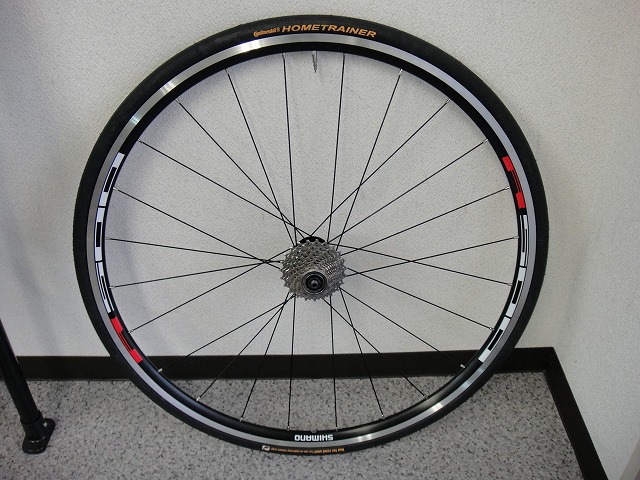
Obviously, I can't hand-build a rear wheel that retails for around 5,000 yen.
If you want the most affordable rear wheel for a turbo trainer, the WH-R501 is recommended.
(Though it's not compatible with Shimano 11-speed or Campagnolo)
I also did truing and centering.
The runout was minor, but the centering was quite off.
I'll write what I always write here:
When I say "this wheel manufacturer's centering was off,"
I'm not criticizing that manufacturer's quality control.
Wheels from any manufacturer can have centering issues.
Some WH-R501s come perfectly centered from the factory.
The important thing is that in the chain "manufacturer → (if applicable) distributor → shop → user,"
it's really only the shop that can detect and correct wheel defects
before they reach the user.
Selling complete wheels straight through without doing this—from left to right as-is—means
you're just standing between "manufacturer and user" taking a cut of the profit.
My definition of "shop" here
naturally includes "performing 100% inspection on complete wheels as standard practice,"
which means "all shops should NOT sell complete wheels in the condition they arrive in."
You should buy wheels from a "shop."
My way of speaking here includes,
of course, a bit of sarcasm, because I'm well aware
that not all shops are true "shops."
Quite apart from pricing, those who buy wheels through overseas online retailers
probably have considerable distrust of shops like this.
Conversely, if it's a "shop" that seems like it will take care of you down the road,
many customers would put price concerns secondary.
For shops to deny overseas online retailers while failing to present customers with added value beyond price
is not only off-base but a fundamental misunderstanding.
I just mentioned added value, but
"we inspect complete wheels before selling them!"
is not added value—it's just the obvious thing.
If you genuinely think this differentiates you from other shops,
you must believe "shops generally sell complete wheels as-is (but we don't),"
or you used to sell complete wheels without inspection
and are now saying "from now on we'll do it differently!"
Selling complete wheels without inspection is below the obvious standard,
and stating the obvious with pride is deeply embarrassing.
Sujata, famous for coffee creamer and such, has trucks that say things like
"Our drivers don't litter cigarette butts while driving,"
and you think, "Of course they don't, why are you even mentioning it?"
When you see something like this, you start to wonder
just how low driver morality must be on average.
Saying "we inspect complete wheels before selling them!"
is equally embarrassing.
Even at my shop, I sell the occasional complete wheel, and when I do,
I might mention here that "I did truing" or "I did centering."
But I absolutely don't think that's added value or anything particularly special.
There's a difference in probability, but complete wheels with poor centering
are perfectly common—I just want to educate people about that.
It's impossible to true a wheel perfectly,
so we settle on the highest compromise point as "finished."
Say it takes me 50 minutes to build a rear wheel.
If inspection of a complete wheel's rear takes 5 minutes, that's 1/10 of a wheel build,
and if it takes 10 minutes, that's 1/5 of a wheel build.
A complete wheel before inspection should technically be usable without issue,
but if inspection takes 10 minutes, you could say it was finished at 80% of my
compromise point (in terms of work time).
Of course, the state of a rear wheel at the 40-minute mark of a 50-minute build
and a complete wheel before inspection are not identical.
But in the sense that both take the same 10 minutes to reach
my "finished" compromise point, their completion level is the same in terms of work time.