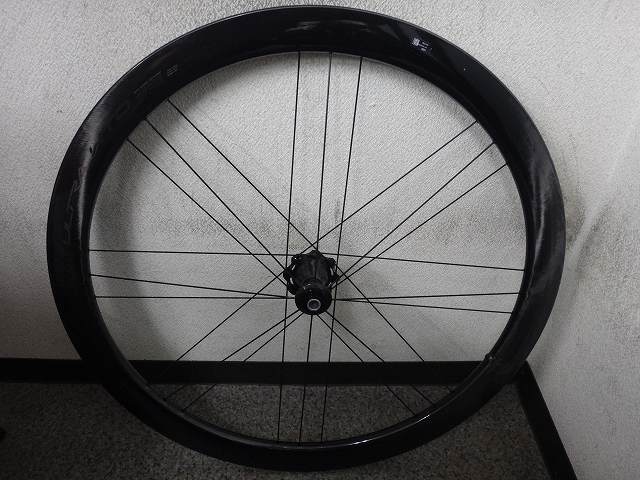
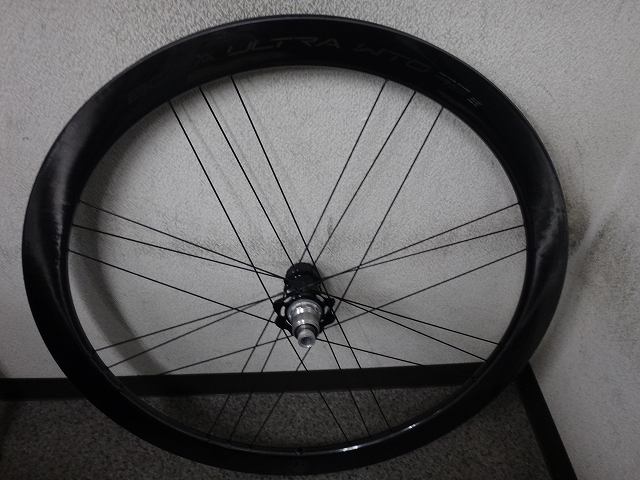
We received the Bora Ultra WTO 45 in stock at our shop.
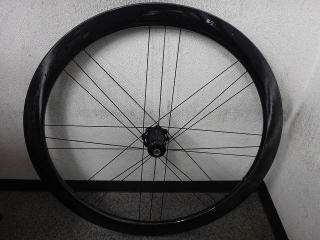
It's a customer's order.
In my view, this Bora Ultra WTO represents
the optimal solution for current steel-spoke disc brake
complete wheelsets.
As for what differs from the non-Ultra WTO—
the bearings aren't USB but CULT type, among other things
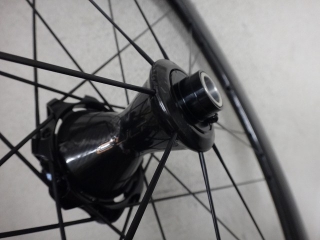
The front hub shell is carbon, and so on—
details like that catch the eye, but honestly, that stuff doesn't matter much.
The fundamental difference from the non-Ultra WTO is the rim itself.
But before getting into that, let me do an inspection.
The wheel runout is virtually nonexistent,
though it was off-center to the left by about two sheets of paper.

I re-tensioned and centered the wheel.
Since we only needed to tighten on the spoke-sparse side, it was straightforward.
This Ultra WTO has extremely stiff nipples and poor serviceability,
so I'd rather avoid touching the spoke-dense side altogether.
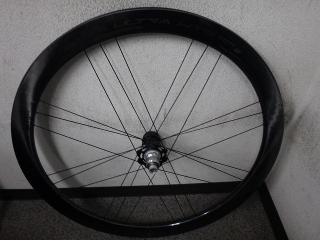
Next, the rear wheel.
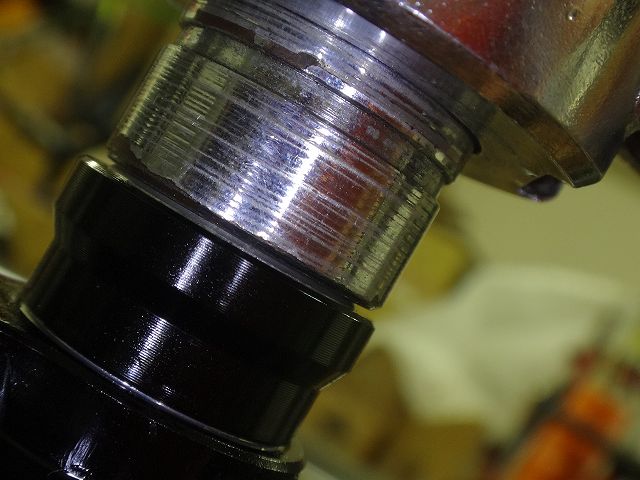
This one also had a center offset of about one sheet of paper.
There was also a faint runout spot.
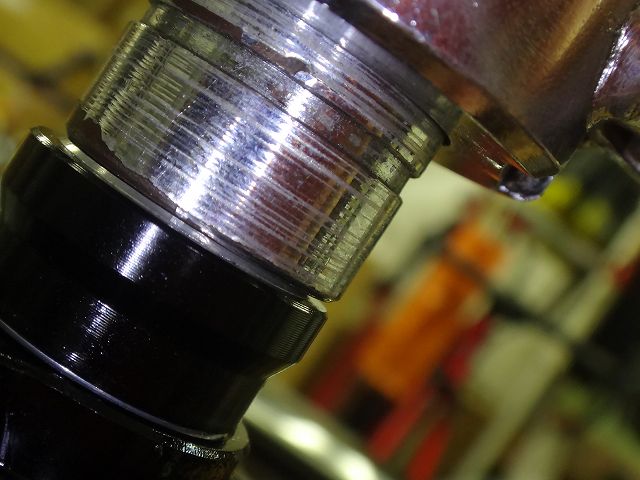
I centered it.
For the rear wheel too, re-tensioning the spoke-sparse side
worked favorably to bring the center into alignment.
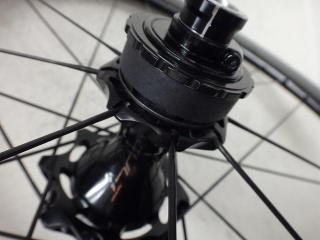
Personally, I've never been fond of 2:1-spoke rear wheels for disc brakes.
Having the disc rotor mounting side on radial spokes is frankly insane.
However, if using straight-gauge spokes prevents frequent spoke breakage,
and considering that the time spent without braking far outweighs
the time spent actually braking while riding,
if the wheel's characteristics as a drive wheel are better optimized,
I've come to think it's acceptable for a complete wheelset.
Roval hedges their bets here, adding tangential lacing on the non-drive side
in 2:1 rear wheels with left-right tangential lacing (non-drive side tangential)
shouldn't be done.
Whether disc or rim brake, with a standard rear hub having
left-right different flange widths but equal-diameter flanges,
2:1 lacing with radial lacing on the non-drive side
results in only slightly higher spoke tension on the drive side,
achieving spoke tension balance that's impossible with equal-number lacing
on both sides.
With super high-low flanges like Campagnolo complete wheelset hubs,
the balance becomes roughly equal on both sides
(this varies depending on G3 lacing, Ж-lacing, XI-lacing,
or 2:1 with rest phases, but that's a topic for another post).
On average the drive side is slightly higher in tension,
yet the difference is so slight that between the highest-tension spoke
on the non-drive side and the lowest-tension spoke on the drive side,
the difference is minimal.
Looking solely at spoke tension balance, unequal-number lacing isn't inherently bad,
but to avoid clear left-right reversal in spoke tension,
the non-drive side must be radial,
and a 2:1 radial rear wheel carries the characteristics of 2:1 radial wheels
(such as braking feel), which is hard to avoid, plus
with straight-gauge spokes, the spoke-sparse side has higher neck-breaking risk,
so I don't use it in hand-built wheels.
In 2:1 lacing with tangential non-drive side lacing,
if we tension the wheel to the rim's limit,
the non-drive side reaches that limit first—which is odd.
In fact, Roval's disc brake rear wheels show
greater deformation in the drive-side spokes.
As I've written before, anyone can observe this.
And such a silly wheel exists only from Roval.
If 2:1 with radial non-drive side is risky,
and 2:1 with tangential non-drive side isn't good either,
people might ask what to do instead—
simple: just use equal-number lacing on the rear wheel.
Then incorporate left-right different-gauge spokes.
Both 2:1 lacing and my usual left-right different-gauge approach
involve weighting differences in spoke load (spoke weight × count) on each side.
Yet it's puzzling that many manufacturers pursue unequal-number lacing
while rarely considering different-gauge lacing.
If we used equal-number lacing with Sapim Strong on the drive side
and Sapim CX Super on the non-drive side,
that's 104.3% vs. 54%, making the non-drive side 51.7 relative to drive-side 100.
This ignores spoke length and considers only weight and count, roughly 100:50 or 2:1.
I've never actually built a wheel with this setup, but
CX Super is a heavily heat-treated 15-gauge base spoke
that feels like it'll snap past yield point,
like walking on thin ice where another quarter-turn would break it—
wheel building becomes delicate work. But add extreme left-right different-gauge lacing
and it becomes nearly impossible to build the wheel without it bursting.
Frankly, carbon spokes are easier to work with.
2:1 lacing is equivalent, in spoke load, to equal-number lacing where
the non-drive side (50:100 ratio) has two spokes fused together
like restoring split chopsticks to their original state,
resulting in 100:100 weight ratio and 2:1 spoke count (again ignoring length),
but unlike Strong/CX Super combinations, the design and wheel-building
doesn't impose unreasonable strain.
However, add tangential lacing to the non-drive side in 2:1,
and spoke deformation balance reverses, making equal-number lacing preferable.
More bluntly: "Don't mess with 2:1 lacing if you're not careful."
Not being bound by philosophy like "2:1 lacing is our brand!"
and avoiding misconceptions about which factors matter most is key.
On a different note, the 1999 Kyserium SSC wheel,
especially the rear, wasn't trying to say
"We want to make a complete wheelset with aluminum spokes!"
Rather, it was pursuing one element of what's called isopulse
(the other element being making the non-drive-side spoke trajectory nearly tangent to the flange)
—specifically, radial drive-side lacing.
However, contemporary technology deemed steel spokes too risky,
so aluminum spokes were used instead.
But afterward, experience showed that with straight-gauge spokes,
steel spokes rarely cause blowouts or rider injury,
and perhaps due to becoming "accustomed," Shimano later released
the Kyserium Elite with isopulse lacing in steel spokes.
Shimano's 7800-series wheels and ZIPP from a certain period
(just before Shimano 11-speed arrived)
also featured radial-laced rear wheels.
Both are discontinued now.
Their non-drive sides, particularly ZIPP's,
differed from isopulse spoke trajectories and were frankly inferior to isopulse.
Road racers until the 1970s (the term "road bike" is modern)
used 36H tangential lacing front and rear as standard,
and for stage-race time trials,
bikes were prepared with heavily drilled frames—even BB shells—
lightened everywhere as time trial machines.
The spoke count for these was 32H.
There was an era when 32H was considered "a risky spoke count for regular use."
Eddy Merckx's hour-record bike in 1972 had a 28H radial-laced front wheel.
At the time, people feared both 28H and radial lacing were too risky,
worrying the front wheel would fall apart before Merckx completed his hour on the track.
In fact, even into the 1980s, radial lacing didn't become standard on road bike wheels.
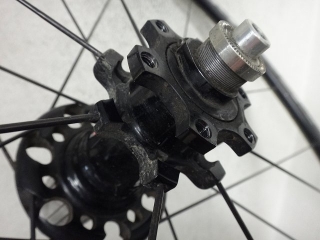
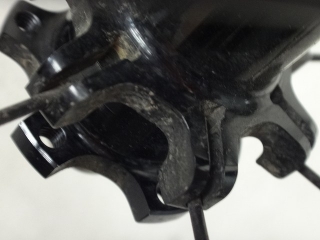
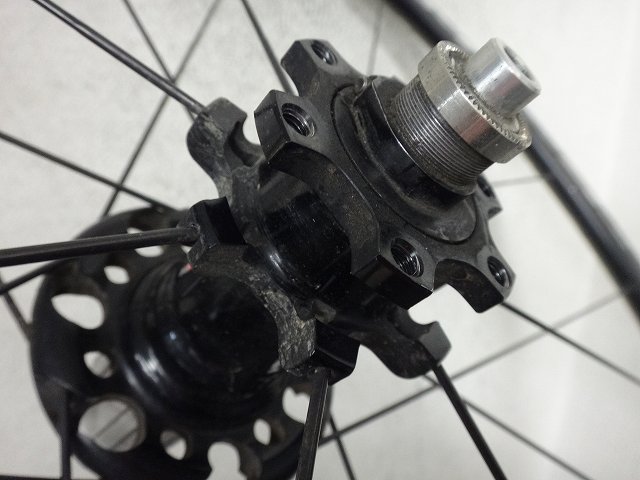
↑This is a disc-road rear wheel from when 2:1 with radial non-drive side was first introduced—
a Racing 5 DB rear wheel showing flanges clearly worried about each spoke.
Jumping way back, looking at the Bora Ultra WTO rear hub flange,
it says without words: "Experience taught us there's less to worry about,
we're accustomed now,"—the flange reflects this confidence.
Therefore, 2:1 rear wheel radial non-drive side isn't something to worry much about
if spokes are straight-gauge, and my earlier assertion of "frankly insane"
may become outdated thinking, like "radial lacing requires aluminum spokes"
or "using 28H or radial wheels regularly can be fatal."
The "Smart" in Smairt Envi doesn't mean clever;
it comes from a person's name, which I've mentioned before.
Smairt Envi is a rim or wheelset with an extremely bossy specification
where Smairt says, "This is what I think is best, so just use it,"
dictating everything.
For example, rim-brake rims come in only 20H for the front and 24H for the rear.
With SES 3.4, the front rim is 38mm-deep 20H only,
and the rear is 42mm-deep 24H only,
but if users request things like "I want both 42mm-deep because
I prefer front and rear matching" or "I want a 28H rear for extra stiffness,"
Envi won't accommodate them.
They can't accommodate them because Smairt Envi rim holes aren't drilled from holeyless blanks—
they're formed into the rim during molding.
So producing a 28H version of a given rim requires commissioning
an entirely new mold, and since minor spoke counts don't justify tooling costs,
manufacturers avoid offering them.
Converting cost-driven decisions into selling points by saying
"We've determined this is best for you" is
very American of them.
Now, the Bora Ultra WTO rim uses the same molded-holes manufacturing method
as Smairt Envi.
The non-Ultra Bora WTO offers the time-trial-oriented rim-brake front wheel only version
Bora WTO 77 at 16H; other rim-brake models come in
18H front and 21H rear, with AC3 surface treatment on the braking zone.
The disc-brake models are all 24H front and rear regardless of rim height.
With Ultra WTO, there's no WTO 77, and only the three disc-brake models
WTO 33, WTO 45, and WTO 60—all at 24H holes regardless of rim height.
Though rim holes have hole offset, since the rear wheel's "right-left-right"
becomes "left-right-left" when flipped for the front,
front and rear rims are interchangeable.
So for each Ultra WTO rim height, there's only one rim type.
This is the reason Ultra WTO is available in disc-brake only,
apart from rim-brake's decline.
The Ultra WTO rim itself is lighter than the non-Ultra WTO rim.
This matters far more than things like the carbon front hub shell
mentioned earlier.
I've learned the actual weight of all Ultra WTO rim heights from a reliable source,
but I can't share it here—it might be proprietary information.
If I get permission, I'll post it.
Regarding height-to-weight ratio, it slightly trails
Roval's Alpinist CLX.
Actually, the Alpinist excels only in rim lightness.
The weight difference between Ultra WTO 33 and 45 is 28g;
45 to 60 is 51g.
The Ultra WTO 33 rim's absolute weight is lighter than Alpinist CLX,
but compared to the tubeless-compatible Alpinist CLX II rim,
it might be competitive in both absolute and relative weight.
Considering the 33-to-45 weight difference, the 45's height-to-weight ratio is excellent.
If choosing among 33, 45, and 60, most would pick 45 as best.
I favor absolute weight, so even if the 33-45 difference were under 10g,
I'd lean toward 33. Actually, a 10g rim difference translates,
when accounting for spoke length, to nearly identical total wheel weight
or possibly even reversal.
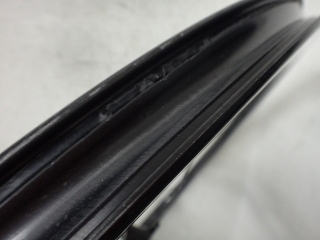
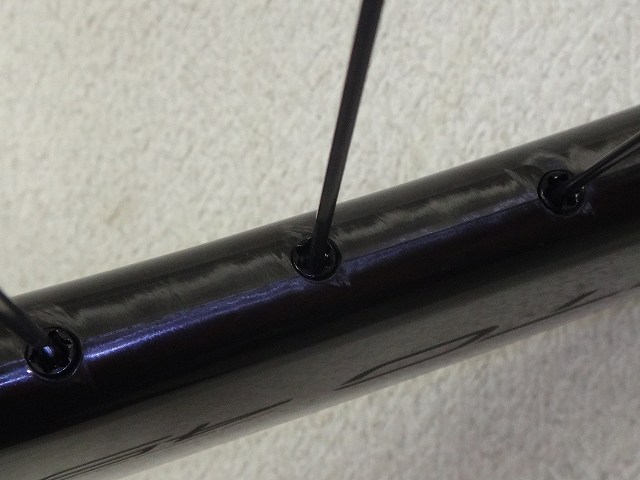
The rim's outer perimeter has no holes except the valve hole.
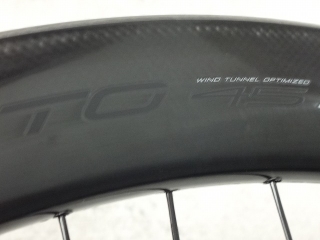
As a difference from non-Ultra WTO, the Ultra WTO's
aerodynamics mimic internal nipples.
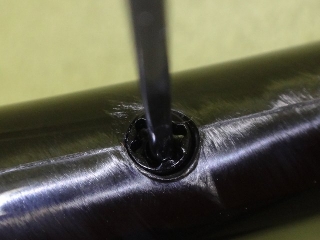
The nipples have a Torx-like slot and sit nearly flush in the rim.
From the dedicated tool's design, even if a spoke bends inside the Torx hole,
the nipple can still turn somehow.
Dirt accumulation seems more problematic.
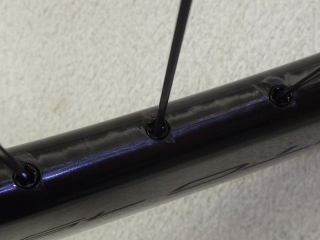
↑Here's the hole offset pattern
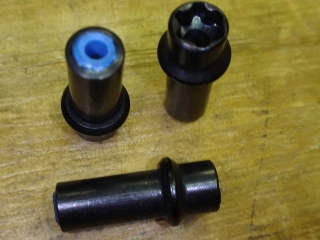
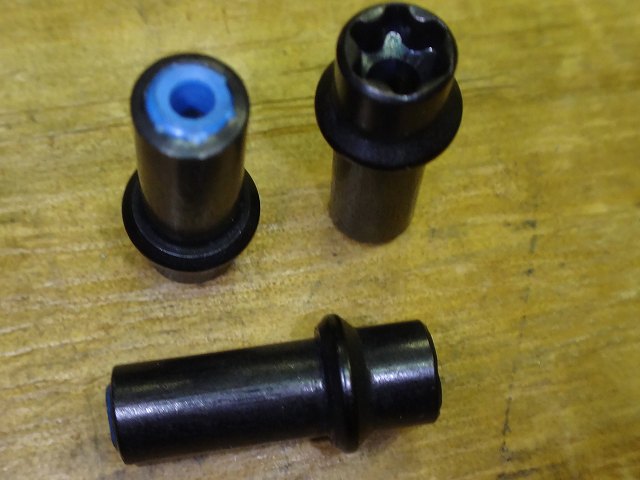
The Ultra WTO 45 already has sales history at our shop,
so we've already stocked spare spokes.
The nipple included with those is in the image above.
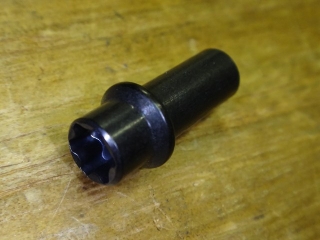
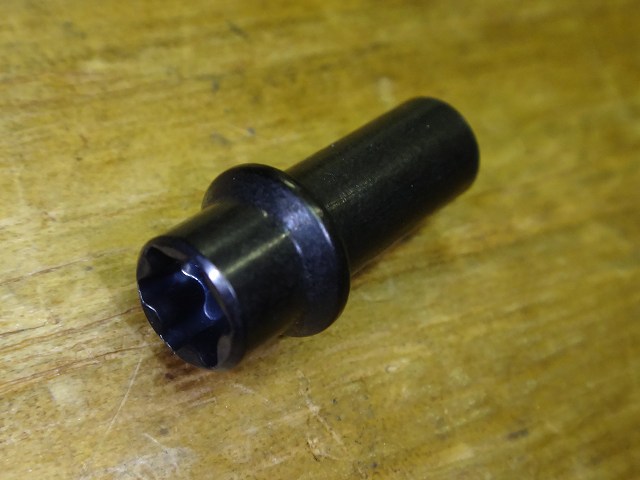
When I first saw it, I thought maybe the rim hole had threads cut in it,
but it's simply a large round hole filled from inside
by the nipple's cylindrical section.
Judging from how far the nipple's flange extends and fills
the rim's inner perimeter (the nipple's end face protrudes slightly),
the rim seems thick, but that's only around the hole areas—
parts without spoke tension are molded quite thin and light.
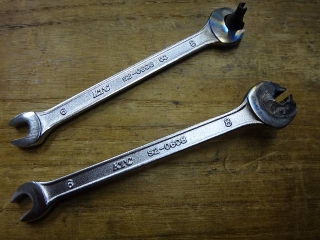
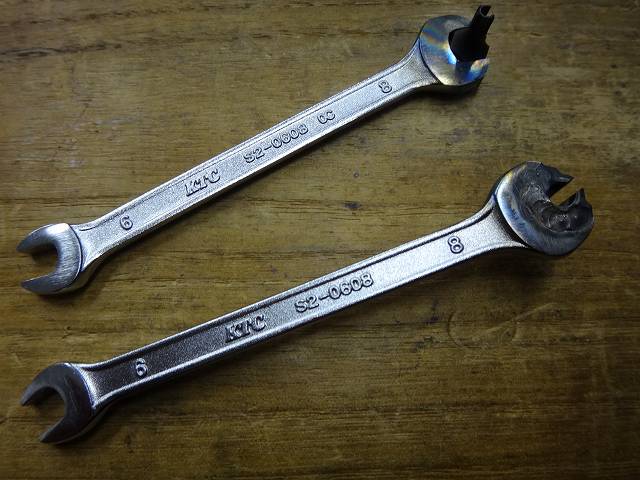
The dedicated tool looks like this,
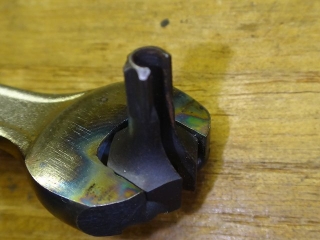
threading the slot through the aero-butted section,
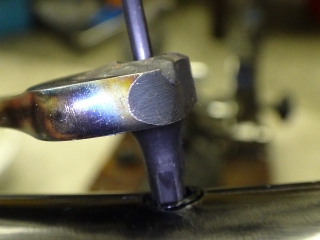
then sliding it toward the rim to grip the Torx hole.
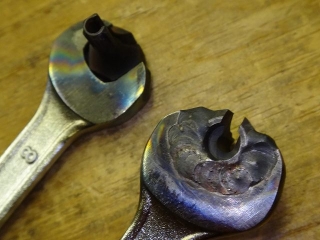
Oh, I forgot to mention—the dedicated tool supplied is just
this small driver-bit-like section grasped with an 8mm wrench.
It's a customer's order.
In my view, this Bora Ultra WTO represents
the optimal solution for current steel-spoke disc brake
complete wheelsets.
As for what differs from the non-Ultra WTO—
the bearings aren't USB but CULT type, among other things
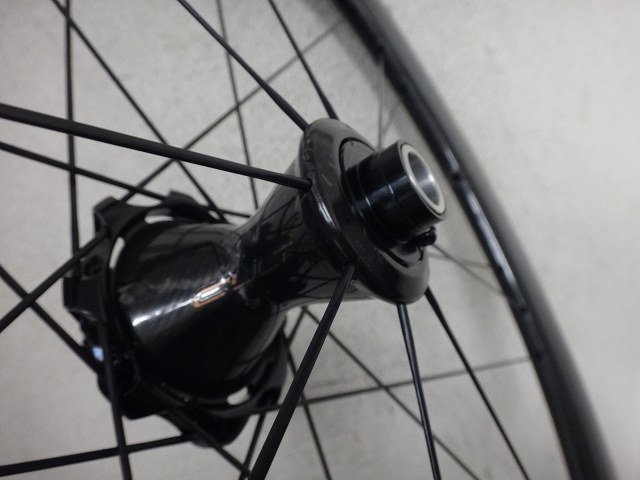
The front hub shell is carbon, and so on—
details like that catch the eye, but honestly, that stuff doesn't matter much.
The fundamental difference from the non-Ultra WTO is the rim itself.
But before getting into that, let me do an inspection.
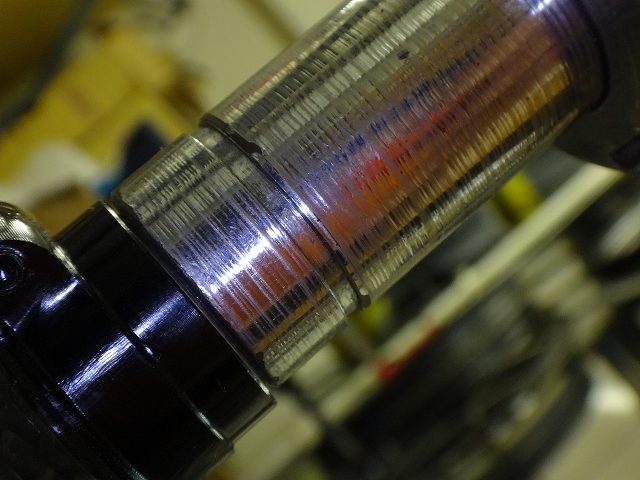
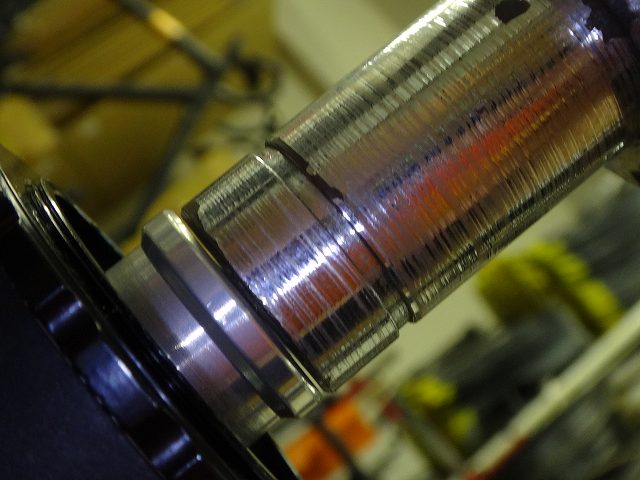
The wheel runout is virtually nonexistent,
though it was off-center to the left by about two sheets of paper.

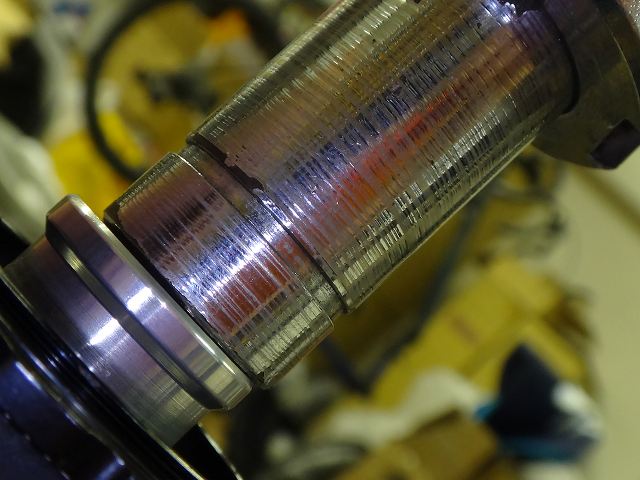
I re-tensioned and centered the wheel.
Since we only needed to tighten on the spoke-sparse side, it was straightforward.
This Ultra WTO has extremely stiff nipples and poor serviceability,
so I'd rather avoid touching the spoke-dense side altogether.
Next, the rear wheel.

This one also had a center offset of about one sheet of paper.
There was also a faint runout spot.

I centered it.
For the rear wheel too, re-tensioning the spoke-sparse side
worked favorably to bring the center into alignment.

Personally, I've never been fond of 2:1-spoke rear wheels for disc brakes.
Having the disc rotor mounting side on radial spokes is frankly insane.
However, if using straight-gauge spokes prevents frequent spoke breakage,
and considering that the time spent without braking far outweighs
the time spent actually braking while riding,
if the wheel's characteristics as a drive wheel are better optimized,
I've come to think it's acceptable for a complete wheelset.
Roval hedges their bets here, adding tangential lacing on the non-drive side
in 2:1 rear wheels with left-right tangential lacing (non-drive side tangential)
shouldn't be done.
Whether disc or rim brake, with a standard rear hub having
left-right different flange widths but equal-diameter flanges,
2:1 lacing with radial lacing on the non-drive side
results in only slightly higher spoke tension on the drive side,
achieving spoke tension balance that's impossible with equal-number lacing
on both sides.
With super high-low flanges like Campagnolo complete wheelset hubs,
the balance becomes roughly equal on both sides
(this varies depending on G3 lacing, Ж-lacing, XI-lacing,
or 2:1 with rest phases, but that's a topic for another post).
On average the drive side is slightly higher in tension,
yet the difference is so slight that between the highest-tension spoke
on the non-drive side and the lowest-tension spoke on the drive side,
the difference is minimal.
Looking solely at spoke tension balance, unequal-number lacing isn't inherently bad,
but to avoid clear left-right reversal in spoke tension,
the non-drive side must be radial,
and a 2:1 radial rear wheel carries the characteristics of 2:1 radial wheels
(such as braking feel), which is hard to avoid, plus
with straight-gauge spokes, the spoke-sparse side has higher neck-breaking risk,
so I don't use it in hand-built wheels.
In 2:1 lacing with tangential non-drive side lacing,
if we tension the wheel to the rim's limit,
the non-drive side reaches that limit first—which is odd.
In fact, Roval's disc brake rear wheels show
greater deformation in the drive-side spokes.
As I've written before, anyone can observe this.
And such a silly wheel exists only from Roval.
If 2:1 with radial non-drive side is risky,
and 2:1 with tangential non-drive side isn't good either,
people might ask what to do instead—
simple: just use equal-number lacing on the rear wheel.
Then incorporate left-right different-gauge spokes.
Both 2:1 lacing and my usual left-right different-gauge approach
involve weighting differences in spoke load (spoke weight × count) on each side.
Yet it's puzzling that many manufacturers pursue unequal-number lacing
while rarely considering different-gauge lacing.
If we used equal-number lacing with Sapim Strong on the drive side
and Sapim CX Super on the non-drive side,
that's 104.3% vs. 54%, making the non-drive side 51.7 relative to drive-side 100.
This ignores spoke length and considers only weight and count, roughly 100:50 or 2:1.
I've never actually built a wheel with this setup, but
CX Super is a heavily heat-treated 15-gauge base spoke
that feels like it'll snap past yield point,
like walking on thin ice where another quarter-turn would break it—
wheel building becomes delicate work. But add extreme left-right different-gauge lacing
and it becomes nearly impossible to build the wheel without it bursting.
Frankly, carbon spokes are easier to work with.
2:1 lacing is equivalent, in spoke load, to equal-number lacing where
the non-drive side (50:100 ratio) has two spokes fused together
like restoring split chopsticks to their original state,
resulting in 100:100 weight ratio and 2:1 spoke count (again ignoring length),
but unlike Strong/CX Super combinations, the design and wheel-building
doesn't impose unreasonable strain.
However, add tangential lacing to the non-drive side in 2:1,
and spoke deformation balance reverses, making equal-number lacing preferable.
More bluntly: "Don't mess with 2:1 lacing if you're not careful."
Not being bound by philosophy like "2:1 lacing is our brand!"
and avoiding misconceptions about which factors matter most is key.
On a different note, the 1999 Kyserium SSC wheel,
especially the rear, wasn't trying to say
"We want to make a complete wheelset with aluminum spokes!"
Rather, it was pursuing one element of what's called isopulse
(the other element being making the non-drive-side spoke trajectory nearly tangent to the flange)
—specifically, radial drive-side lacing.
However, contemporary technology deemed steel spokes too risky,
so aluminum spokes were used instead.
But afterward, experience showed that with straight-gauge spokes,
steel spokes rarely cause blowouts or rider injury,
and perhaps due to becoming "accustomed," Shimano later released
the Kyserium Elite with isopulse lacing in steel spokes.
Shimano's 7800-series wheels and ZIPP from a certain period
(just before Shimano 11-speed arrived)
also featured radial-laced rear wheels.
Their non-drive sides, particularly ZIPP's,
differed from isopulse spoke trajectories and were frankly inferior to isopulse.
Road racers until the 1970s (the term "road bike" is modern)
used 36H tangential lacing front and rear as standard,
and for stage-race time trials,
bikes were prepared with heavily drilled frames—even BB shells—
lightened everywhere as time trial machines.
The spoke count for these was 32H.
There was an era when 32H was considered "a risky spoke count for regular use."
Eddy Merckx's hour-record bike in 1972 had a 28H radial-laced front wheel.
At the time, people feared both 28H and radial lacing were too risky,
worrying the front wheel would fall apart before Merckx completed his hour on the track.
In fact, even into the 1980s, radial lacing didn't become standard on road bike wheels.
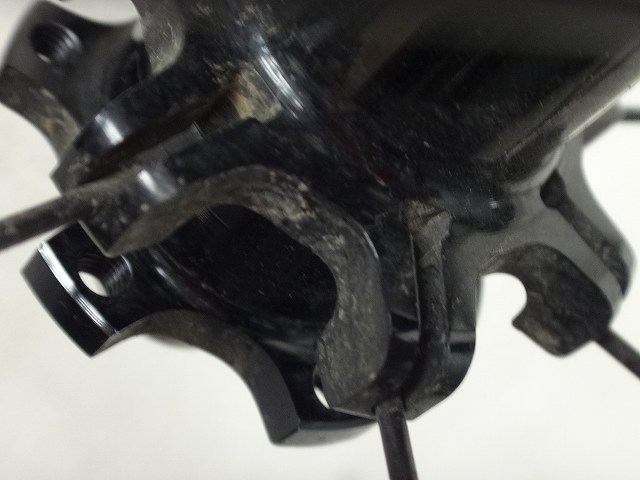
↑This is a disc-road rear wheel from when 2:1 with radial non-drive side was first introduced—
a Racing 5 DB rear wheel showing flanges clearly worried about each spoke.
Jumping way back, looking at the Bora Ultra WTO rear hub flange,
it says without words: "Experience taught us there's less to worry about,
we're accustomed now,"—the flange reflects this confidence.
Therefore, 2:1 rear wheel radial non-drive side isn't something to worry much about
if spokes are straight-gauge, and my earlier assertion of "frankly insane"
may become outdated thinking, like "radial lacing requires aluminum spokes"
or "using 28H or radial wheels regularly can be fatal."
The "Smart" in Smairt Envi doesn't mean clever;
it comes from a person's name, which I've mentioned before.
Smairt Envi is a rim or wheelset with an extremely bossy specification
where Smairt says, "This is what I think is best, so just use it,"
dictating everything.
For example, rim-brake rims come in only 20H for the front and 24H for the rear.
With SES 3.4, the front rim is 38mm-deep 20H only,
and the rear is 42mm-deep 24H only,
but if users request things like "I want both 42mm-deep because
I prefer front and rear matching" or "I want a 28H rear for extra stiffness,"
Envi won't accommodate them.
They can't accommodate them because Smairt Envi rim holes aren't drilled from holeyless blanks—
they're formed into the rim during molding.
So producing a 28H version of a given rim requires commissioning
an entirely new mold, and since minor spoke counts don't justify tooling costs,
manufacturers avoid offering them.
Converting cost-driven decisions into selling points by saying
"We've determined this is best for you" is
very American of them.
Now, the Bora Ultra WTO rim uses the same molded-holes manufacturing method
as Smairt Envi.
The non-Ultra Bora WTO offers the time-trial-oriented rim-brake front wheel only version
Bora WTO 77 at 16H; other rim-brake models come in
18H front and 21H rear, with AC3 surface treatment on the braking zone.
The disc-brake models are all 24H front and rear regardless of rim height.
With Ultra WTO, there's no WTO 77, and only the three disc-brake models
WTO 33, WTO 45, and WTO 60—all at 24H holes regardless of rim height.
Though rim holes have hole offset, since the rear wheel's "right-left-right"
becomes "left-right-left" when flipped for the front,
front and rear rims are interchangeable.
So for each Ultra WTO rim height, there's only one rim type.
This is the reason Ultra WTO is available in disc-brake only,
apart from rim-brake's decline.
The Ultra WTO rim itself is lighter than the non-Ultra WTO rim.
This matters far more than things like the carbon front hub shell
mentioned earlier.
I've learned the actual weight of all Ultra WTO rim heights from a reliable source,
but I can't share it here—it might be proprietary information.
If I get permission, I'll post it.
Regarding height-to-weight ratio, it slightly trails
Roval's Alpinist CLX.
Actually, the Alpinist excels only in rim lightness.
The weight difference between Ultra WTO 33 and 45 is 28g;
45 to 60 is 51g.
The Ultra WTO 33 rim's absolute weight is lighter than Alpinist CLX,
but compared to the tubeless-compatible Alpinist CLX II rim,
it might be competitive in both absolute and relative weight.
Considering the 33-to-45 weight difference, the 45's height-to-weight ratio is excellent.
If choosing among 33, 45, and 60, most would pick 45 as best.
I favor absolute weight, so even if the 33-45 difference were under 10g,
I'd lean toward 33. Actually, a 10g rim difference translates,
when accounting for spoke length, to nearly identical total wheel weight
or possibly even reversal.
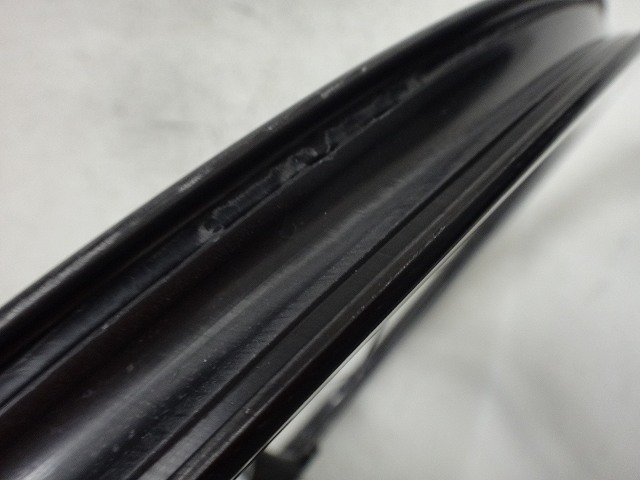
The rim's outer perimeter has no holes except the valve hole.
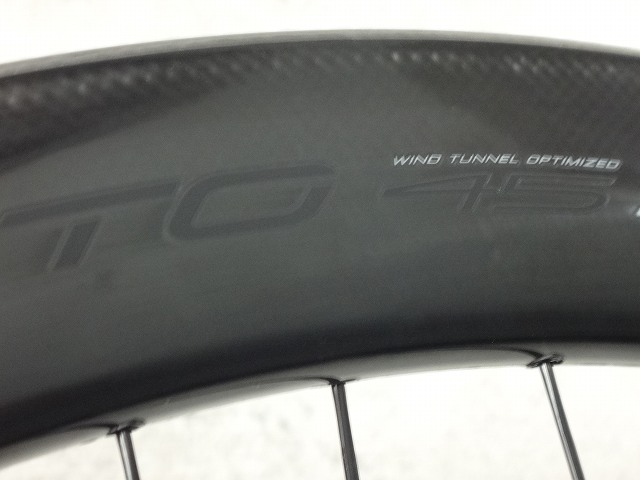
As a difference from non-Ultra WTO, the Ultra WTO's
aerodynamics mimic internal nipples.
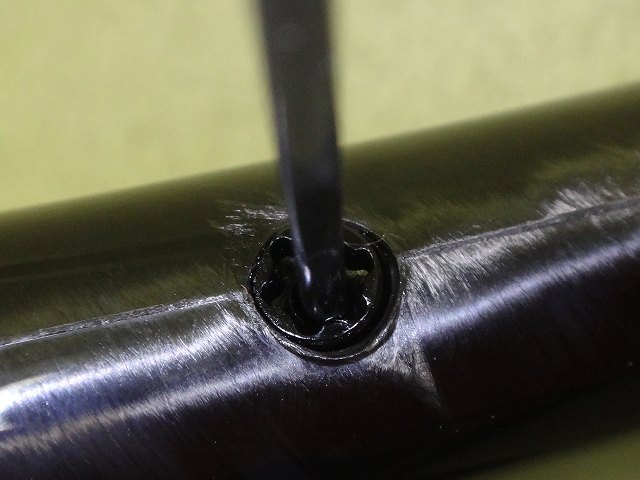
The nipples have a Torx-like slot and sit nearly flush in the rim.
From the dedicated tool's design, even if a spoke bends inside the Torx hole,
the nipple can still turn somehow.
Dirt accumulation seems more problematic.
↑Here's the hole offset pattern
The Ultra WTO 45 already has sales history at our shop,
so we've already stocked spare spokes.
The nipple included with those is in the image above.
When I first saw it, I thought maybe the rim hole had threads cut in it,
but it's simply a large round hole filled from inside
by the nipple's cylindrical section.
Judging from how far the nipple's flange extends and fills
the rim's inner perimeter (the nipple's end face protrudes slightly),
the rim seems thick, but that's only around the hole areas—
parts without spoke tension are molded quite thin and light.
The dedicated tool looks like this,
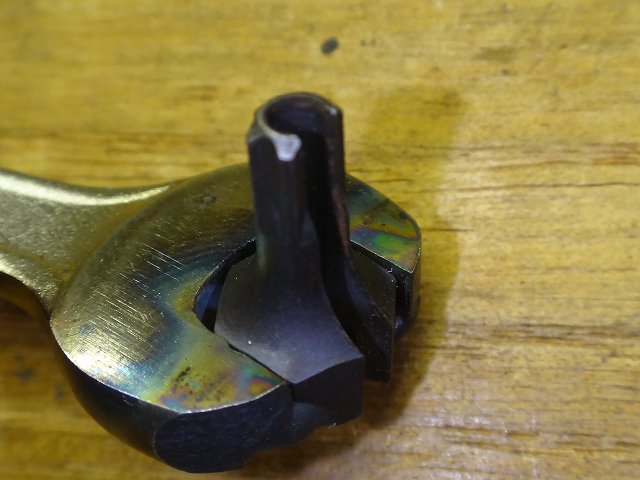
threading the slot through the aero-butted section,
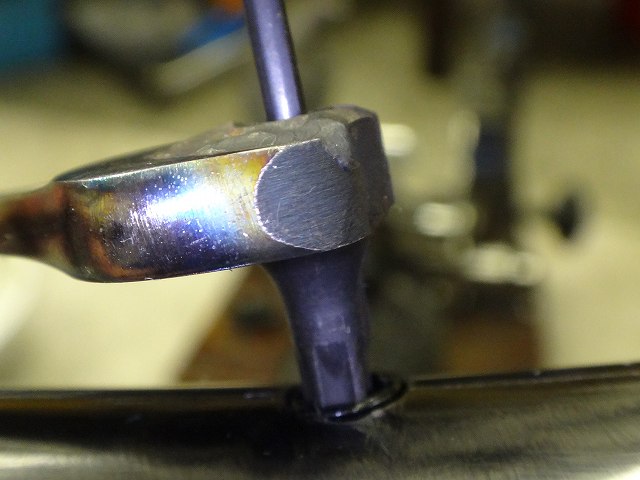
then sliding it toward the rim to grip the Torx hole.

Oh, I forgot to mention—the dedicated tool supplied is just
this small driver-bit-like section grasped with an 8mm wrench.