A customer dropped off the rear wheel of a ZIPP 404 for me to work on.
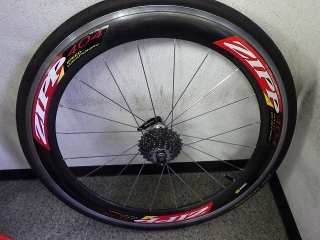
This is from an era before full-carbon WO rims became standard,
so there's aluminum in the brake zone area.
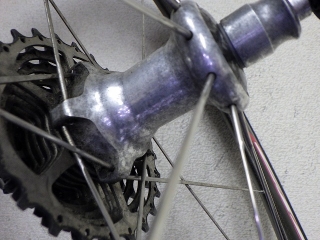
It's a hub with straight spokes and a radial lacing pattern on the non-freewheel side.
The anodizing on the hub shell has peeled off and it's got rust spots like old yen coins,
but that's okay for now...
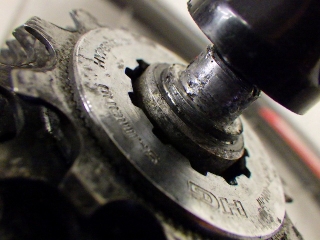
The serrated washer on the right axle end has cracked and come off,
which means the rear wheel can no longer be properly secured.
The customer wants me to fix that.
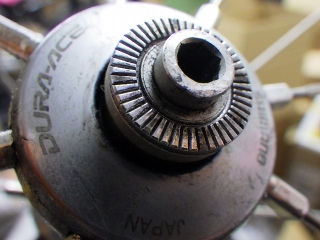
Shimano 7800-series hubs don't crack at the serrated washer,
but they come off pretty regularly.
Once it comes off, the press-fit dimensions seem to expand,
so even after gluing, it keeps coming off all the time.
Since it doesn't crack, at least it won't get lost as long as the quick-release is on there.
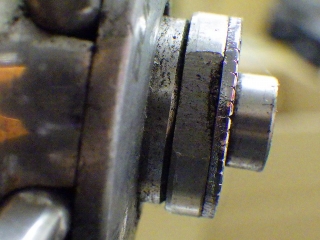
The initial cause of it coming off is that there's a flat surface on the axle end
where you can place a hub wrench,
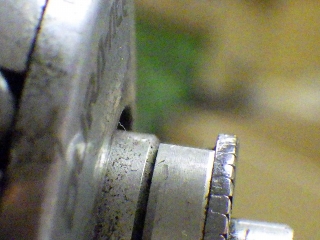
↑ When you place the hub wrench here
and apply a sideways prying force,
it often just pops right off.
Back to the ZIPP—
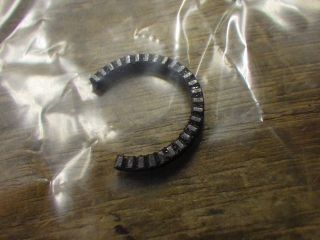
I also received the broken serrated washer.
The inner and outer diameters don't matter much, but it's helpful to know the thickness.
On this ZIPP, the right axle end is also part of the hub axle itself, but
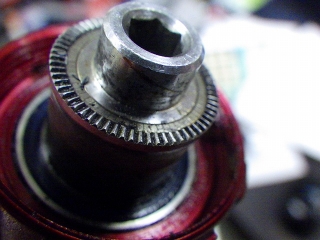
I have a junk rear hub from the next generation of ZIPP in the shop,
so I checked if I could swap it,
but replacing the entire hub axle didn't work
because the thread pitch position on the left axle end was different.
I also checked whether I could extract just the serrated washer,
but the serrations in the image above aren't a separate part from the hub axle—
they're machined directly into the end of the hub axle, so that didn't work either.
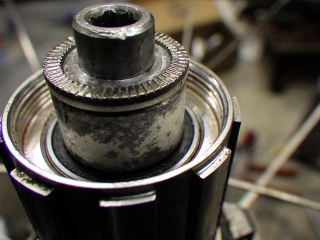
However, I found that a washer with nearly the same inner diameter and the same thickness
from a hub made by a different manufacturer fit perfectly
after a little modification.
I'm gluing it just to be safe.
The end of the hub axle and the serrated washer aren't perfectly flush,
but I've confirmed that the thickness matches
the original serrated washer that the customer brought in.

This is from an era before full-carbon WO rims became standard,
so there's aluminum in the brake zone area.

It's a hub with straight spokes and a radial lacing pattern on the non-freewheel side.
The anodizing on the hub shell has peeled off and it's got rust spots like old yen coins,
but that's okay for now...

The serrated washer on the right axle end has cracked and come off,
which means the rear wheel can no longer be properly secured.
The customer wants me to fix that.

Shimano 7800-series hubs don't crack at the serrated washer,
but they come off pretty regularly.
Once it comes off, the press-fit dimensions seem to expand,
so even after gluing, it keeps coming off all the time.
Since it doesn't crack, at least it won't get lost as long as the quick-release is on there.

The initial cause of it coming off is that there's a flat surface on the axle end
where you can place a hub wrench,

↑ When you place the hub wrench here
and apply a sideways prying force,
it often just pops right off.

Back to the ZIPP—
I also received the broken serrated washer.
The inner and outer diameters don't matter much, but it's helpful to know the thickness.
On this ZIPP, the right axle end is also part of the hub axle itself, but

I have a junk rear hub from the next generation of ZIPP in the shop,
so I checked if I could swap it,
but replacing the entire hub axle didn't work
because the thread pitch position on the left axle end was different.
I also checked whether I could extract just the serrated washer,
but the serrations in the image above aren't a separate part from the hub axle—
they're machined directly into the end of the hub axle, so that didn't work either.

However, I found that a washer with nearly the same inner diameter and the same thickness
from a hub made by a different manufacturer fit perfectly
after a little modification.
I'm gluing it just to be safe.
The end of the hub axle and the serrated washer aren't perfectly flush,
but I've confirmed that the thickness matches
the original serrated washer that the customer brought in.