I received a front wheel from Princeton CarbonWorks from a customer.
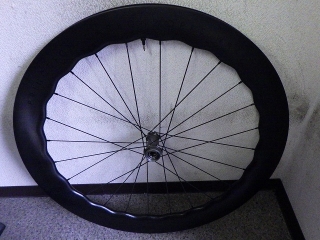
The model is WAKE6560.
When ordering complete wheels with spokes at Princeton, you can choose the hub manufacturer.
The options are White Industries, TUNE (Tune),
Industry Nine, Chris King, DT,
and TACTIC RACING. I'll refer to the last one as Tactic from here on.
This one was built with a Tactic front hub,
but there's play in the hub, and the customer wants it fixed if possible.
When I received it, I could confirm lateral play by pressing both ends of the hub with my thumbs—there was a distinct knocking sound.
Previously there was even more lateral play,
enough that it failed a pre-race mechanical check.
When the customer tried sending the wheel to Tactic Racing,
the return address was Princeton Carbon headquarters,
so they ended up paying for one-way shipping.
The condition when it came back from there is what we received.
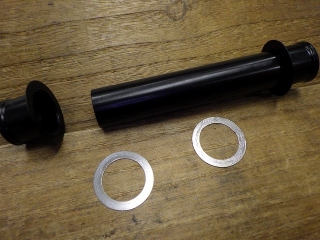
I've already extracted it in the first image, but I removed the hub axle.
Thin washers were in contact with the bearings on both sides,
but the washers are thin—not quite foil-thin—and there's no step that presses only the bearing inner race.
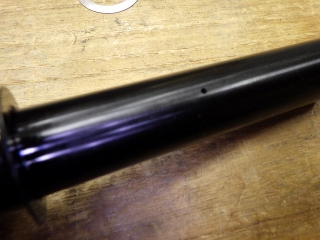
There's a small hole in the center of the hub axle,
which is the same on Shimano hub axles too.
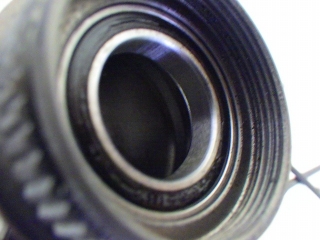
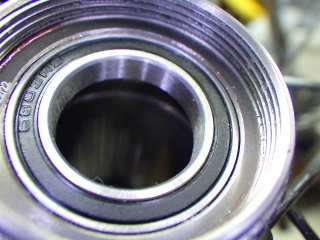
↑Left side (rotor mount side) bearing
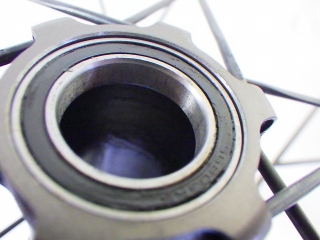
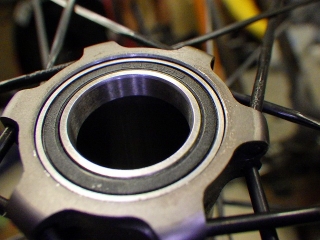
↑Right side bearing
There's lateral play in the inner race relative to the outer race fixed to the hub body,
but touching the bearing by itself didn't reveal any play.
The left bearing's rotation felt a bit gritty.
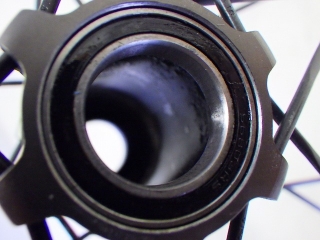
Here's the obvious problem with this hub.
There's no mechanism to support the bearing inner race from the inside.
If the through-axle clamping force acts directly on the inner race,
you can easily destroy the bearing just by over-tightening the through-axle,
and even if you keep it as loose as possible while still allowing the wheel to be used,
the bearing will fail immediately from riding.
This hub was designed so that "the through-axle clamping force doesn't act directly on the inner race,"
but play is inevitable.
Before I write about that,

I removed the bearing from the left side of the hub body.
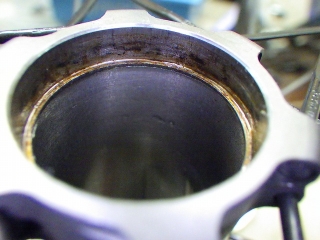
Next I removed the right side bearing.
There's fretting corrosion on the part that contacts the outer race.
As I mentioned earlier, this was the side with better bearing rotation.
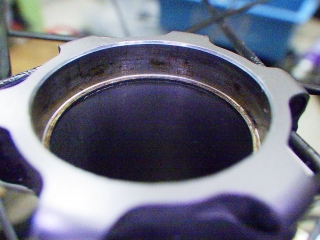
I cleaned the rust with oil as best I could.
I could use coarser sandpaper to make it cleaner,
but that would affect dimensional tolerances, so I won't.
What I learned from this is that this wheel sent to Princeton
had its bearings never replaced at Princeton.
The customer saw that the wheel returned from Princeton still had hub play,
thought "this won't do," and sent it straight to us.
But even if it had been used a little,
if the returned wheel's bearings were new, they wouldn't have

↑ended up like this in such a short time.
Something I didn't mention in the background earlier:
when the customer complained to Tactic about the play being bad enough to fail the pre-race check,
Tactic sent replacement bearings.
But ultimately those weren't used and it went to Princeton instead.
Since those bearings from Tactic are also in our care,
I used those for the replacement.
I returned to the customer the bearings we received,
the original left bearing that wasn't rusted,
and the original right bearing that was rusted,
each in separate labeled bags describing what they contain.
But one of the bearings we received—new or unused, but feeling like it had been pressed into a hub before and then removed, with a gritty rotation—I separated that into another bag too. So that's four bags total.
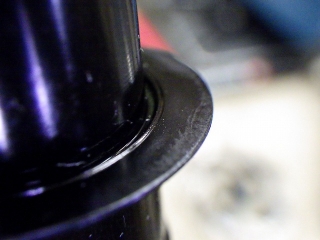
The left hub end and hub axle are integrated into a single part.
There's an internal protrusion to press only the bearing inner race.
There's a recess even further inside, but I don't understand the intent.
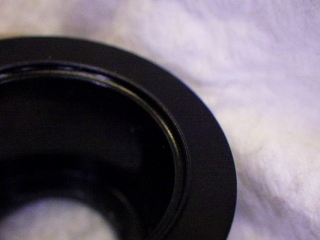
The inside of the right end cap has a similar shape.
I called it an end cap, but
the hub axle and end cap have such tight dimensional tolerances they're practically a press fit.
The end cap bottoms out against the hub axle.
The spacing between the ends at that point is slightly wider than the spacing between the bearings,
which is the manufacturer's basis for thinking they can operate
without a spacer supporting the bearing inner race inside the hub body.
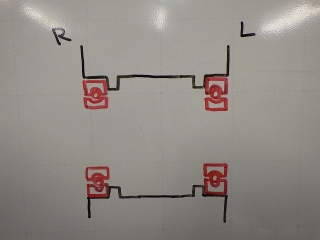
A diagram of the front hub with the hub body width tightened,
omitting details like the disc mount.
I pressed in the bearings.
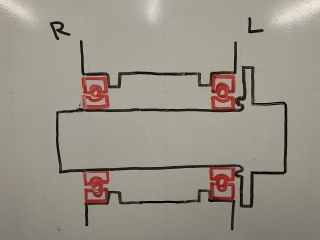
I inserted the hub axle with the left end into the hub body.
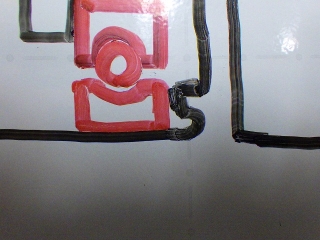
Because there's a protrusion on the end,
it only contacts the bearing inner race.
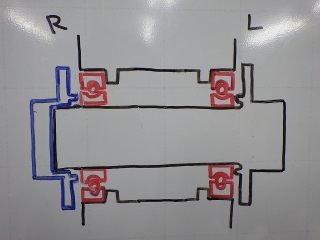
I installed the right end cap that bottoms out.
As I mentioned earlier, with this customer's hub
the relationship between this right end cap and the hub axle
is a tight press fit.
What I'm getting at is that the customer probably won't
be able to remove it easily.
Whether a nearby shop can remove it cleanly is also uncertain.
It's difficult, you know (warning).
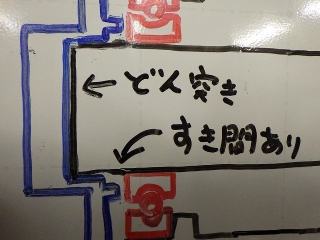
I've exaggerated it quite a bit in this diagram,
but when the right end is bottomed out, there's
a tiny, tiny gap between the end and the inner race.
In other words, lateral play must occur structurally.
If that's not noticeable in actual use, then oh well—that's the design philosophy.
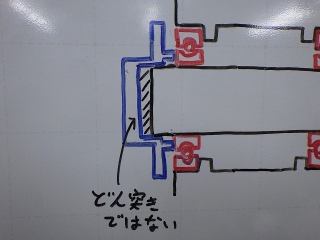
If, hypothetically, the inside of the right end cap didn't
bottom out against the hub axle,

the through-axle clamping force would
hit the bearing inner race directly and
destroy it instantly.
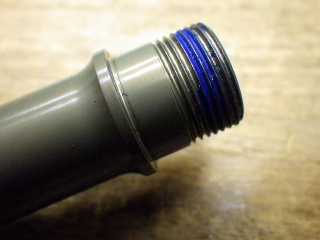
↑This is a Novatec rear hub axle,
and it has a protrusion that supports the bearing inner race.
With this design, you first insert the hub axle into the hub body,
then attach bearings from both sides.
You could also press the bearing into one side of the hub body first
and then insert the hub axle from the other side
(pressing bearings into both sides of the hub body first
and then setting the axle is impossible).
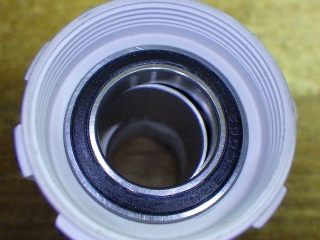
↑This is a Campagnolo freebody,
and to make it clearer, I've offset it, but
there's a spacer that simultaneously holds both bearing inner races.
For hubs that use a hub axle design without an inner race support,
any decent manufacturer will have
a similar spacer in the hub body.
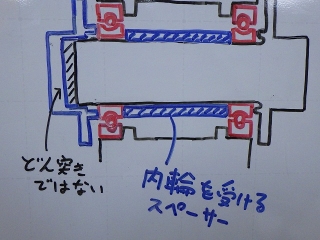
I've drawn in the spacer that's omitted from the Tactic hub.
If this were included, the through-axle clamping wouldn't
push the bearing inner race firmly inward.
This is the second time this image appears in the article, but
the hub we received had very thin spacers
on the outside of each bearing, one on each side.
I can't confirm from this case alone,
but I suspect these spacers weren't originally in the hub—
Princeton added them later to reduce
the amount of lateral play in the inner race relative to the outer race.
A similar example would be the Mavic R-SYS SL's
QRM SL (→here).
That also had faint play in the front hub when brand new,
and the official approach is to chase the growing play from use
by changing the dimensions of the part contacting the bearing inner race—
and if that becomes insufficient, just replace the bearing itself.
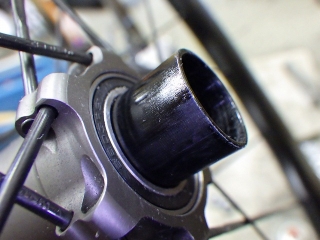
I installed the thin spacer at the base of the left end
and threaded the hub axle through the hub body.
The hub axle's outer diameter has tight dimensional tolerances
not just for the right end but also for the bearings,
and when we received it, it was impossible to pull out by hand alone.
This tight dimensional tolerance is also a measure to
reduce lateral play in the hub axle.
After pressing the right end, the hub axle lateral play
that was easily and clearly detectable when we received it
has become almost negligible.
Almost, because when I push as hard as I can with both thumbs,
I can't detect play, but when I push as hard as I can with both palms, I can barely feel it.
The customer suspected hub precision or bearing defects,
but the cause lies in this flimsy design, so there's nothing to be done.
The trick to keeping the nearly-play-free state for as long as possible is
to tighten the through-axle to just the minimum needed to fix the wheel,
or barely beyond that.
If that thin spacer was added to chase the hub play,
I should have perhaps checked for play without the spacer on the new bearings.
However, because play was detectable when I pushed hard with both palms on both ends,
and because the hub's rotation—which was sluggish when received—became silky smooth after pressing the right end,
I interpret it as something like a 3 or 2-groove start rather than 4-groove start
in terms of the R-SYS SL hub. I haven't tested it, so I can't say for certain,
but without the spacer the lateral play would probably be more pronounced.
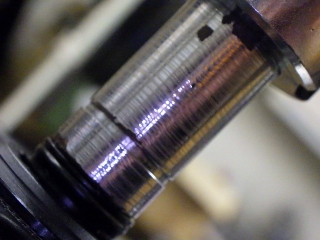
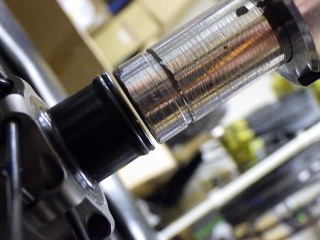
When I happened to check the wheel center after the work,
it was off-center.
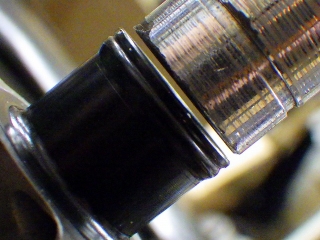
Since I'm using thin spacers on both sides,
the wheel center isn't affected.
Even if I put two on one side, the offset is too large to be absorbed.
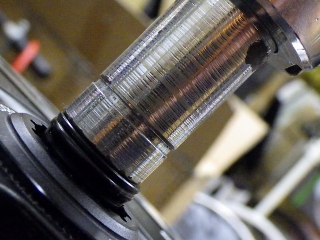
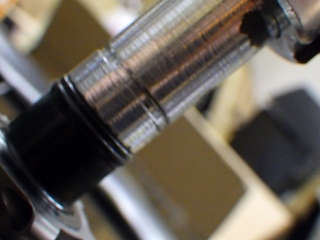
I did a minor lateral truing too and got the center right.
As for Princeton as a manufacturer,
based on the fact that they probably just added a spacer and sent it back,
almost certainly without replacing the bearing,
and that the wheel wasn't centered straight from the factory,
I don't have a good impression.
As for Tactic hubs,
there are examples like Alchemy hubs that reduced rear bearing from the typical four to three
by omitting the one at the end of the freebody, tanking durability,
and ExtraLight hubs that operate the ratchet's two pawls with rubber O-rings—
different approaches but the same sense of cost-cutting corners.
The manufacturers don't say this,
but in my judgment they're not something you can rely on for regular use.
It's true these hubs are exceptionally light.
I don't know about the ride quality of wheels built with Princeton rims,
but if you're choosing a hub from the options listed at the beginning,
I'd think DT or Chris King would be better choices.
For DT, I personally think even the 240 would be fine,
but it seems the manufacturer wants to bundle more expensive hubs together—
when DT is chosen, based on the manufacturer site,
the only option appears to be the 180 hub.

The model is WAKE6560.
When ordering complete wheels with spokes at Princeton, you can choose the hub manufacturer.
The options are White Industries, TUNE (Tune),
Industry Nine, Chris King, DT,
and TACTIC RACING. I'll refer to the last one as Tactic from here on.
This one was built with a Tactic front hub,
but there's play in the hub, and the customer wants it fixed if possible.
When I received it, I could confirm lateral play by pressing both ends of the hub with my thumbs—there was a distinct knocking sound.
Previously there was even more lateral play,
enough that it failed a pre-race mechanical check.
When the customer tried sending the wheel to Tactic Racing,
the return address was Princeton Carbon headquarters,
so they ended up paying for one-way shipping.
The condition when it came back from there is what we received.

I've already extracted it in the first image, but I removed the hub axle.
Thin washers were in contact with the bearings on both sides,
but the washers are thin—not quite foil-thin—and there's no step that presses only the bearing inner race.

There's a small hole in the center of the hub axle,
which is the same on Shimano hub axles too.

↑Left side (rotor mount side) bearing

↑Right side bearing
There's lateral play in the inner race relative to the outer race fixed to the hub body,
but touching the bearing by itself didn't reveal any play.
The left bearing's rotation felt a bit gritty.

Here's the obvious problem with this hub.
There's no mechanism to support the bearing inner race from the inside.
If the through-axle clamping force acts directly on the inner race,
you can easily destroy the bearing just by over-tightening the through-axle,
and even if you keep it as loose as possible while still allowing the wheel to be used,
the bearing will fail immediately from riding.
This hub was designed so that "the through-axle clamping force doesn't act directly on the inner race,"
but play is inevitable.
Before I write about that,

I removed the bearing from the left side of the hub body.

Next I removed the right side bearing.
There's fretting corrosion on the part that contacts the outer race.
As I mentioned earlier, this was the side with better bearing rotation.

I cleaned the rust with oil as best I could.
I could use coarser sandpaper to make it cleaner,
but that would affect dimensional tolerances, so I won't.
What I learned from this is that this wheel sent to Princeton
had its bearings never replaced at Princeton.
The customer saw that the wheel returned from Princeton still had hub play,
thought "this won't do," and sent it straight to us.
But even if it had been used a little,
if the returned wheel's bearings were new, they wouldn't have

↑ended up like this in such a short time.
Something I didn't mention in the background earlier:
when the customer complained to Tactic about the play being bad enough to fail the pre-race check,
Tactic sent replacement bearings.
But ultimately those weren't used and it went to Princeton instead.
Since those bearings from Tactic are also in our care,


I used those for the replacement.
I returned to the customer the bearings we received,
the original left bearing that wasn't rusted,
and the original right bearing that was rusted,
each in separate labeled bags describing what they contain.
But one of the bearings we received—new or unused, but feeling like it had been pressed into a hub before and then removed, with a gritty rotation—I separated that into another bag too. So that's four bags total.

The left hub end and hub axle are integrated into a single part.
There's an internal protrusion to press only the bearing inner race.
There's a recess even further inside, but I don't understand the intent.

The inside of the right end cap has a similar shape.
I called it an end cap, but
the hub axle and end cap have such tight dimensional tolerances they're practically a press fit.
The end cap bottoms out against the hub axle.
The spacing between the ends at that point is slightly wider than the spacing between the bearings,
which is the manufacturer's basis for thinking they can operate
without a spacer supporting the bearing inner race inside the hub body.

A diagram of the front hub with the hub body width tightened,
omitting details like the disc mount.
I pressed in the bearings.

I inserted the hub axle with the left end into the hub body.

Because there's a protrusion on the end,
it only contacts the bearing inner race.

I installed the right end cap that bottoms out.
As I mentioned earlier, with this customer's hub
the relationship between this right end cap and the hub axle
is a tight press fit.
What I'm getting at is that the customer probably won't
be able to remove it easily.
Whether a nearby shop can remove it cleanly is also uncertain.
It's difficult, you know (warning).

I've exaggerated it quite a bit in this diagram,
but when the right end is bottomed out, there's
a tiny, tiny gap between the end and the inner race.
In other words, lateral play must occur structurally.
If that's not noticeable in actual use, then oh well—that's the design philosophy.

If, hypothetically, the inside of the right end cap didn't
bottom out against the hub axle,

the through-axle clamping force would
hit the bearing inner race directly and
destroy it instantly.

↑This is a Novatec rear hub axle,
and it has a protrusion that supports the bearing inner race.
With this design, you first insert the hub axle into the hub body,
then attach bearings from both sides.
You could also press the bearing into one side of the hub body first
and then insert the hub axle from the other side
(pressing bearings into both sides of the hub body first
and then setting the axle is impossible).

↑This is a Campagnolo freebody,
and to make it clearer, I've offset it, but
there's a spacer that simultaneously holds both bearing inner races.
For hubs that use a hub axle design without an inner race support,
any decent manufacturer will have
a similar spacer in the hub body.

I've drawn in the spacer that's omitted from the Tactic hub.
If this were included, the through-axle clamping wouldn't
push the bearing inner race firmly inward.
This is the second time this image appears in the article, but
the hub we received had very thin spacers
on the outside of each bearing, one on each side.
I can't confirm from this case alone,
but I suspect these spacers weren't originally in the hub—
Princeton added them later to reduce
the amount of lateral play in the inner race relative to the outer race.
A similar example would be the Mavic R-SYS SL's
QRM SL (→here).
That also had faint play in the front hub when brand new,
and the official approach is to chase the growing play from use
by changing the dimensions of the part contacting the bearing inner race—
and if that becomes insufficient, just replace the bearing itself.

I installed the thin spacer at the base of the left end
and threaded the hub axle through the hub body.
The hub axle's outer diameter has tight dimensional tolerances
not just for the right end but also for the bearings,
and when we received it, it was impossible to pull out by hand alone.
This tight dimensional tolerance is also a measure to
reduce lateral play in the hub axle.
After pressing the right end, the hub axle lateral play
that was easily and clearly detectable when we received it
has become almost negligible.
Almost, because when I push as hard as I can with both thumbs,
I can't detect play, but when I push as hard as I can with both palms, I can barely feel it.
The customer suspected hub precision or bearing defects,
but the cause lies in this flimsy design, so there's nothing to be done.
The trick to keeping the nearly-play-free state for as long as possible is
to tighten the through-axle to just the minimum needed to fix the wheel,
or barely beyond that.
If that thin spacer was added to chase the hub play,
I should have perhaps checked for play without the spacer on the new bearings.
However, because play was detectable when I pushed hard with both palms on both ends,
and because the hub's rotation—which was sluggish when received—became silky smooth after pressing the right end,
I interpret it as something like a 3 or 2-groove start rather than 4-groove start
in terms of the R-SYS SL hub. I haven't tested it, so I can't say for certain,
but without the spacer the lateral play would probably be more pronounced.


When I happened to check the wheel center after the work,
it was off-center.

Since I'm using thin spacers on both sides,
the wheel center isn't affected.
Even if I put two on one side, the offset is too large to be absorbed.


I did a minor lateral truing too and got the center right.
As for Princeton as a manufacturer,
based on the fact that they probably just added a spacer and sent it back,
almost certainly without replacing the bearing,
and that the wheel wasn't centered straight from the factory,
I don't have a good impression.
As for Tactic hubs,
there are examples like Alchemy hubs that reduced rear bearing from the typical four to three
by omitting the one at the end of the freebody, tanking durability,
and ExtraLight hubs that operate the ratchet's two pawls with rubber O-rings—
different approaches but the same sense of cost-cutting corners.
The manufacturers don't say this,
but in my judgment they're not something you can rely on for regular use.
It's true these hubs are exceptionally light.
I don't know about the ride quality of wheels built with Princeton rims,
but if you're choosing a hub from the options listed at the beginning,
I'd think DT or Chris King would be better choices.
For DT, I personally think even the 240 would be fine,
but it seems the manufacturer wants to bundle more expensive hubs together—
when DT is chosen, based on the manufacturer site,
the only option appears to be the 180 hub.