Wheels again today (and so on).

↑This is the Tni AL22W rim that's on Nomu Lab Wheel #8,
and it's technically a defect—one of only two found
among the dozens I've sourced over time.
The rim has 24 spoke holes,
but this is a spec deviation that couldn't happen except with 24H
(if anything else were possible, it'd be 36H,
but this rim doesn't have a 36H option).

Looking at the rim holes on the outer edge,
in the image above, the hole is offset upward.

The next hole over is also offset upward,

but the next one after that is offset downward.
That's right—this is a
"24H rim drilled for 2:1 lacing."

Looking at the inner edge holes
from the left in the image above,
they're offset "center, center, down,"
which corresponds to "right, right, left" if used for a rear wheel.
Looking more closely at the two holes on the right in the image above:

↑Like this

For some reason, I've taped the outer edge of the rim with masking tape.

↑This is a normal AL22W rim, where
the outer holes aren't offset—they're all centered,

and the inner holes alternate left-right.
In the image above, reading from the left: up, down, up, down—

and zooming in from the left to see up and down,
it looks like this.
I've already reported the 2:1 lacing rim mixed in to the distributor.
AL22W rims come in offset versions, but
based on their geometry, 2:1 lacing rims don't exist for them—or rather, can't be made—
so I don't think they can even be ordered that way.
This rim is apparently an AL22W-equivalent from someone other than Tni,
built as a 2:1 lacing version, that was ordered
either as rim alone or as a complete wheel,
and got mixed into stock by mistake.
The AL22W non-offset 24H for disc brakes
has no stock at the distributor
because inventory was bought out (※),
so if the distributor has alerted the rim maker,
getting any in the future will be extremely difficult.
※Why I can say "bought out" with certainty is unclear
As for the 2:1 lacing rim—I reported it
butit's too interesting to won't return it.
Actually, I want more of these
If I were to build a disc brake rear wheel with this rim,
unless the non-drive side is dished and uses tangent lacing,
it would be radial.
Roval has dishing, while Shimano (with phase control) and
Campagnolo Bora WTO don't.
If I add dished tangent on a rear wheel that has dishing,
the drive-side spokes become weirdly loose by comparison.
What I'm building this time isn't a personal bike,
but if it were mine, I'd only use the front brake even with disc,
so non-drive radial with 2:1 lacing is fine.
That's not why I avoided it, though—
this time I'm building the front wheel.
As I'll explain later,
the rim's hole pattern indicates,
or rather prescribes, not XI lacing but Ж lacing.
If I did XI, the appearance would be wrong.
The hub is Shimano HB-RS470, 32H.
I don't like using J-bend spokes with 2:1 lacing,
but since I'm using opposite-diameter mixed lacing
and putting Sapim Strong on the fewer-spoke side,
the risk of spoke breakage at the bend shouldn't be high.
Doesn't 2.3mm (13g) J-bend resist spoke breakage better than
2.0mm (14g) straight spokes?
I'm more worried about nipple shank failure.
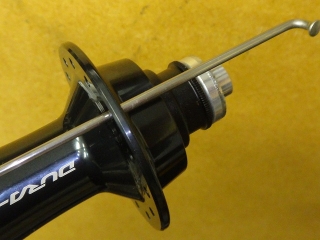
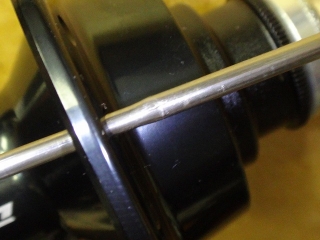
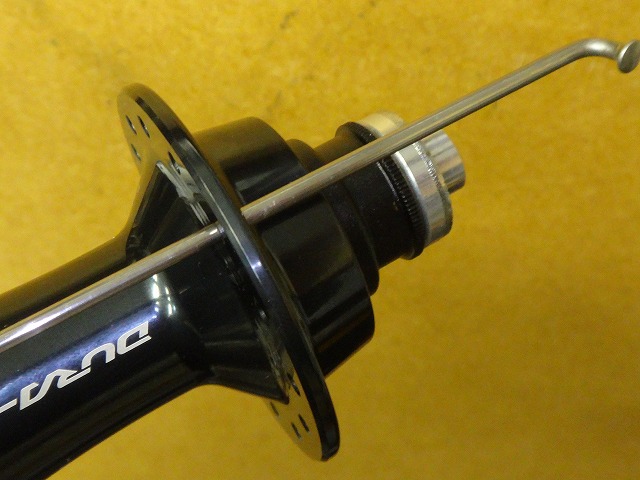
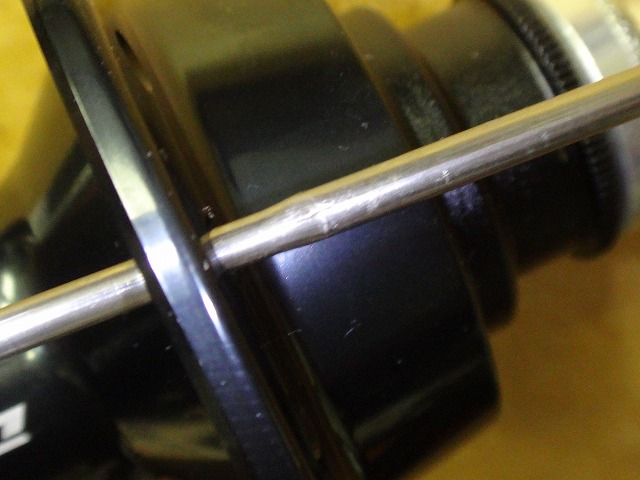
From 7700 onward, Dura-Ace hubs won't accept 13g-base spokes.
This blog has everything, huh?
The image shows a 9000 hub;
the lower image is just before inserting the 13g butted section.
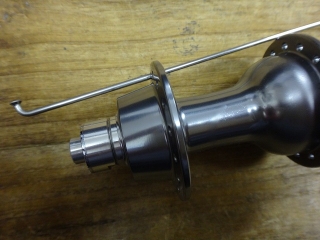
This is a 7800 hub.
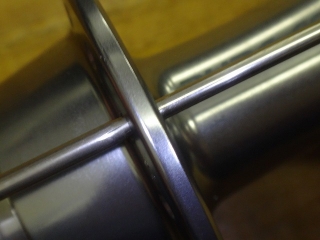
In the lower image, with the 13g butted section inserted,
you can see the spoke diameter differs inside and outside the flange.
This is specific to Dura-Ace hubs—
not all Shimano hubs reject 13g spokes.

It's built.
The rim can't go on here until after the 28th afternoon.
I'll add a note later.

The rotor-mount side (left) is CX Sprint.
CX-RAY would create too much diameter difference,
causing excessive tension, so I avoided it.
No cross-lacing. It's essentially not needed.

The right side with Strong (2.3–2.0mm single-butted)
is inpoke radial lacing.
Since it's not the brake caliper side,
I don't need to worry about spoke interference,
and with a cup-and-cone hub, any lateral play from inpoke radial
can be removed with bearing adjustment.
As it happened, this front wheel showed no play
once assembly was complete.
The bearing preload is lighter,
but that occurs with other lacing methods too.
Added note:

It's built.
Until the Kansai Cyclocross Sakaiura event,
I had to hide the fact that the rim is painted.
My partner's rear wheel is (→here)

Orange aluminum nipples don't exist in DT's lineup,
so I'm using Sapim nipples.
The reason I'm using 12mm instead of 14mm length
is a small act of defiance.

The left side is CX Sprint, technically 6-cross,

and the right side is Strong with inpoke radial lacing.
For 2:1 lacing rims,
the drilling pattern (right-right-left-right-right-left…)
indicates the intended lacing based on where the valve hole is drilled.

If the holes on both sides of the valve hole
are right and left respectively,
and you want to avoid the valve crossing through
the 2:1 spoke bundles,

you get XI (X-I) lacing.
In the image above, reading clockwise it's IX, but while it's called XI,
looking only at the holes adjacent to the valve,
they match normal drilling—a common pattern.
The valve could reasonably be one more hole clockwise,
but if it's two more holes clockwise,
the valve ends up in the final tangent cross, which looks bad.

On this rim, both holes adjacent to the valve
are on the multi-spoke side,
so what the rim indicates is

Ж (Zh) lacing.
I've made the multi-spoke side tangent 6-cross,
but this cannot be 4-cross.
The final crossing becomes acute, the wheel's properties
approach left-right radial, and the whole point
of opposite-diameter mixing diminishes.
The appearance also approaches that of a certain mass-produced wheel,
so you'd be forgiven for thinking "Why go through Ж lacing
just to make it 4-cross? Is your brain a Roval?"
If the tangent angle (the n in n-cross) were
such a trivial factor that spoke tension alone mattered,
then freewheel rears and disc-brake fronts could work
with left-right radial, but from experience,
that's definitely not how it works.
Whether you're trying to make the final crossing angle
on the tangent side as obtuse as possible
is the difference between CLX and Bora WTO.
So if the valve hole had been positioned to suggest
XI lacing instead,
I'd probably have done Ж anyway,
even if it meant the valve ending up inside the spoke bundle.
But since Tni—or Kinlin—isn't running Roval's brain,
it never came to that.

↑This is the Tni AL22W rim that's on Nomu Lab Wheel #8,
and it's technically a defect—one of only two found
among the dozens I've sourced over time.
The rim has 24 spoke holes,
but this is a spec deviation that couldn't happen except with 24H
(if anything else were possible, it'd be 36H,
but this rim doesn't have a 36H option).

Looking at the rim holes on the outer edge,
in the image above, the hole is offset upward.

The next hole over is also offset upward,

but the next one after that is offset downward.
That's right—this is a
"24H rim drilled for 2:1 lacing."

Looking at the inner edge holes
from the left in the image above,
they're offset "center, center, down,"
which corresponds to "right, right, left" if used for a rear wheel.
Looking more closely at the two holes on the right in the image above:

↑Like this

For some reason, I've taped the outer edge of the rim with masking tape.

↑This is a normal AL22W rim, where
the outer holes aren't offset—they're all centered,

and the inner holes alternate left-right.
In the image above, reading from the left: up, down, up, down—

and zooming in from the left to see up and down,
it looks like this.
I've already reported the 2:1 lacing rim mixed in to the distributor.
AL22W rims come in offset versions, but
based on their geometry, 2:1 lacing rims don't exist for them—or rather, can't be made—
so I don't think they can even be ordered that way.
This rim is apparently an AL22W-equivalent from someone other than Tni,
built as a 2:1 lacing version, that was ordered
either as rim alone or as a complete wheel,
and got mixed into stock by mistake.
The AL22W non-offset 24H for disc brakes
has no stock at the distributor
because inventory was bought out (※),
so if the distributor has alerted the rim maker,
getting any in the future will be extremely difficult.
※Why I can say "bought out" with certainty is unclear
As for the 2:1 lacing rim—I reported it
but
If I were to build a disc brake rear wheel with this rim,
unless the non-drive side is dished and uses tangent lacing,
it would be radial.
Roval has dishing, while Shimano (with phase control) and
Campagnolo Bora WTO don't.
If I add dished tangent on a rear wheel that has dishing,
the drive-side spokes become weirdly loose by comparison.
What I'm building this time isn't a personal bike,
but if it were mine, I'd only use the front brake even with disc,
so non-drive radial with 2:1 lacing is fine.
That's not why I avoided it, though—
this time I'm building the front wheel.
As I'll explain later,
the rim's hole pattern indicates,
or rather prescribes, not XI lacing but Ж lacing.
If I did XI, the appearance would be wrong.
The hub is Shimano HB-RS470, 32H.
I don't like using J-bend spokes with 2:1 lacing,
but since I'm using opposite-diameter mixed lacing
and putting Sapim Strong on the fewer-spoke side,
the risk of spoke breakage at the bend shouldn't be high.
Doesn't 2.3mm (13g) J-bend resist spoke breakage better than
2.0mm (14g) straight spokes?
I'm more worried about nipple shank failure.
From 7700 onward, Dura-Ace hubs won't accept 13g-base spokes.
This blog has everything, huh?
The image shows a 9000 hub;
the lower image is just before inserting the 13g butted section.
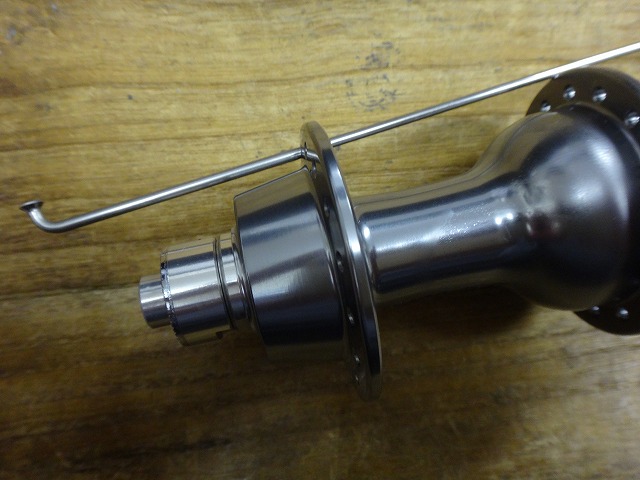
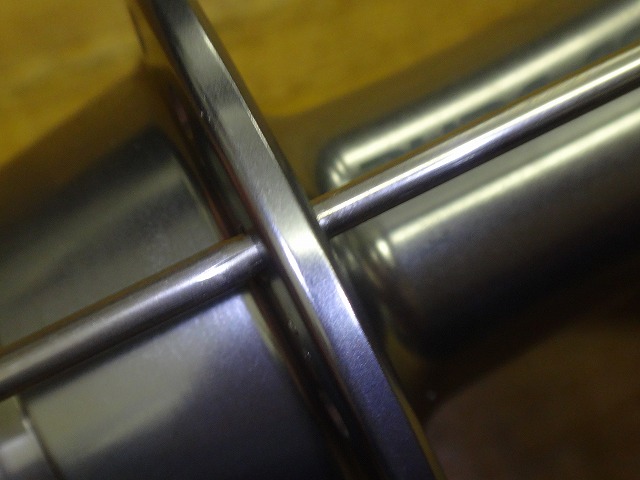
This is a 7800 hub.
In the lower image, with the 13g butted section inserted,
you can see the spoke diameter differs inside and outside the flange.
This is specific to Dura-Ace hubs—
not all Shimano hubs reject 13g spokes.

It's built.
The rim can't go on here until after the 28th afternoon.
I'll add a note later.

The rotor-mount side (left) is CX Sprint.
CX-RAY would create too much diameter difference,
causing excessive tension, so I avoided it.
No cross-lacing. It's essentially not needed.

The right side with Strong (2.3–2.0mm single-butted)
is inpoke radial lacing.
Since it's not the brake caliper side,
I don't need to worry about spoke interference,
and with a cup-and-cone hub, any lateral play from inpoke radial
can be removed with bearing adjustment.
As it happened, this front wheel showed no play
once assembly was complete.
The bearing preload is lighter,
but that occurs with other lacing methods too.
Added note:

It's built.
Until the Kansai Cyclocross Sakaiura event,
I had to hide the fact that the rim is painted.
My partner's rear wheel is (→here)

Orange aluminum nipples don't exist in DT's lineup,
so I'm using Sapim nipples.
The reason I'm using 12mm instead of 14mm length
is a small act of defiance.

The left side is CX Sprint, technically 6-cross,

and the right side is Strong with inpoke radial lacing.
For 2:1 lacing rims,
the drilling pattern (right-right-left-right-right-left…)
indicates the intended lacing based on where the valve hole is drilled.

If the holes on both sides of the valve hole
are right and left respectively,
and you want to avoid the valve crossing through
the 2:1 spoke bundles,

you get XI (X-I) lacing.
In the image above, reading clockwise it's IX, but while it's called XI,
looking only at the holes adjacent to the valve,
they match normal drilling—a common pattern.
The valve could reasonably be one more hole clockwise,
but if it's two more holes clockwise,
the valve ends up in the final tangent cross, which looks bad.

On this rim, both holes adjacent to the valve
are on the multi-spoke side,
so what the rim indicates is

Ж (Zh) lacing.
I've made the multi-spoke side tangent 6-cross,
but this cannot be 4-cross.
The final crossing becomes acute, the wheel's properties
approach left-right radial, and the whole point
of opposite-diameter mixing diminishes.
The appearance also approaches that of a certain mass-produced wheel,
so you'd be forgiven for thinking "Why go through Ж lacing
just to make it 4-cross? Is your brain a Roval?"
If the tangent angle (the n in n-cross) were
such a trivial factor that spoke tension alone mattered,
then freewheel rears and disc-brake fronts could work
with left-right radial, but from experience,
that's definitely not how it works.
Whether you're trying to make the final crossing angle
on the tangent side as obtuse as possible
is the difference between CLX and Bora WTO.
So if the valve hole had been positioned to suggest
XI lacing instead,
I'd probably have done Ж anyway,
even if it meant the valve ending up inside the spoke bundle.
But since Tni—or Kinlin—isn't running Roval's brain,
it never came to that.