A customer brought in a Hyperon for service.
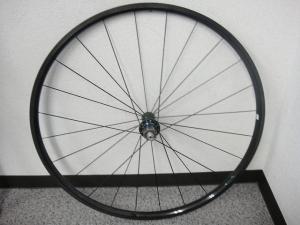
The stickers had started peeling, so they removed them,
which makes it look almost brand new.
The freewheel body sprocket grooves aren't dirty either, but
apparently it's been used for about 10,000 km.
The job was a trueness check and centering adjustment, but
there's almost no runout on either wheel (I thought maybe they'd already trued it before bringing it in),
though the rear rim was sitting slightly toward the freewheel side.
When it's off-center toward the freewheel side, you can either loosen the freewheel side and push the rim toward center,
or tighten the non-freewheel side and pull the rim toward center,
but unless there's something unusual, I basically go with the latter approach.
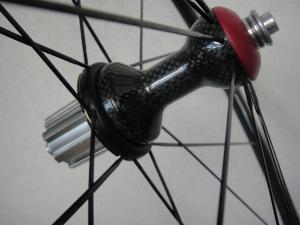
With non-freewheel side radial lacing, the spokes aren't slack to any significant degree. It's naturally looser than the freewheel side, of course.
With fairly decent high-low flanges (especially the small flange on the non-freewheel side is excellent),
and despite using different diameter spokes on each side,
the spoke tension is remarkably similar even accounting for that.
When I squeeze the spokes, using that subtle "balance line" you can feel,
the impression is more toward center than the rim appears visually.
I worked on another Hyperon recently on a different job,
and it had an offset rim.
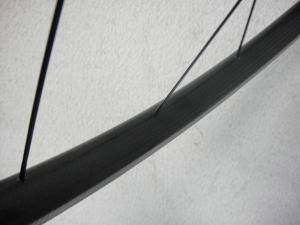
That's why there's so little left-right difference despite the non-freewheel side radial lacing.
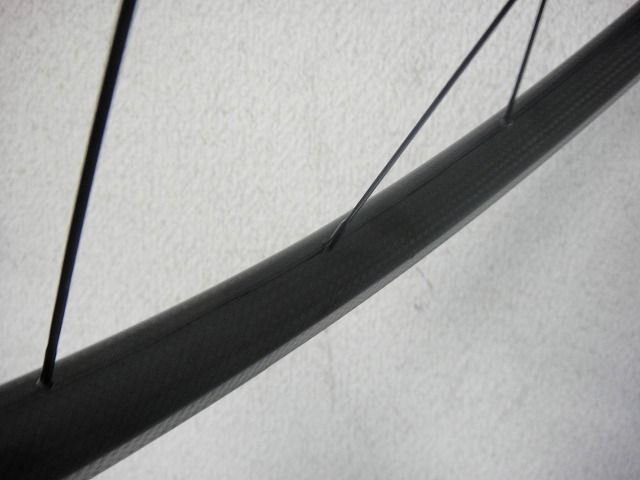
Especially impressive is how the spoke hole position on the non-freewheel side rim is positioned right at the edge. An offset rim adjusts the lateral width, so it directly affects dish measurement,
and there's no loss of flange width on the hub side — it's an excellent idea.
The drawbacks are that "at most you can only offset by half the rim width"
and "offset rims often end up heavier than non-offset rims".
This is an internal nipple offset rim,
which is advantageous for achieving greater offset amounts.
If you need to drill holes for the nipples (which are larger than spoke holes) in the rim,
you can't position the holes right at the rim edge like this.

The stickers had started peeling, so they removed them,
which makes it look almost brand new.
The freewheel body sprocket grooves aren't dirty either, but
apparently it's been used for about 10,000 km.
The job was a trueness check and centering adjustment, but
there's almost no runout on either wheel (I thought maybe they'd already trued it before bringing it in),
though the rear rim was sitting slightly toward the freewheel side.
When it's off-center toward the freewheel side, you can either loosen the freewheel side and push the rim toward center,
or tighten the non-freewheel side and pull the rim toward center,
but unless there's something unusual, I basically go with the latter approach.
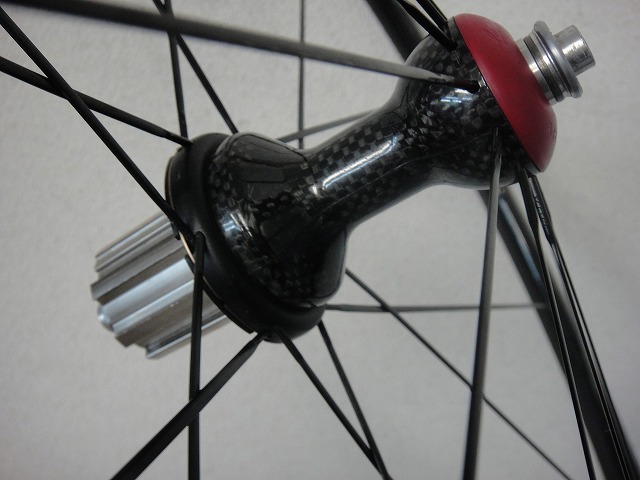
With non-freewheel side radial lacing, the spokes aren't slack to any significant degree. It's naturally looser than the freewheel side, of course.
With fairly decent high-low flanges (especially the small flange on the non-freewheel side is excellent),
and despite using different diameter spokes on each side,
the spoke tension is remarkably similar even accounting for that.
When I squeeze the spokes, using that subtle "balance line" you can feel,
the impression is more toward center than the rim appears visually.
I worked on another Hyperon recently on a different job,
and it had an offset rim.
That's why there's so little left-right difference despite the non-freewheel side radial lacing.
Especially impressive is how the spoke hole position on the non-freewheel side rim is positioned right at the edge. An offset rim adjusts the lateral width, so it directly affects dish measurement,
and there's no loss of flange width on the hub side — it's an excellent idea.
The drawbacks are that "at most you can only offset by half the rim width"
and "offset rims often end up heavier than non-offset rims".
This is an internal nipple offset rim,
which is advantageous for achieving greater offset amounts.
If you need to drill holes for the nipples (which are larger than spoke holes) in the rim,
you can't position the holes right at the rim edge like this.