A customer dropped off the front and rear wheels from a Vision Metron 40 tubular.

Starting with the front wheel.
It has a certain bike brand's name on it,
and while the cover (配慮) tried to hide it,
there's a sticker on the other side too
so it couldn't be fully covered.
At this point it's less like
"covers everything! (cover power!)" and more like
"you're a complete idiot! (you dumbass!)"

This spec itself wasn't some unofficial fan-made thing—
these wheels were officially released as-is.

There's still Miyata tubular tape (→here) remaining on the rim.
The customer owns multiple bikes from the additional sticker brand,
but for tubular wheels they run rim cement,
so this must've been acquired as a second owner or later.
They actually did ask for rim cement tire mounting.


The front wheel had no centerline offset and almost no wobble.
The image above is just the temporary centering before work,
and since it looked the same after, I didn't bother shooting it again.

Next, the rear wheel.

From DT's Aerolite with white and red painted spokes,
there's just one red spoke as a cosmetic spoke,
but DT specifies that when doing tangent lacing with white and red spokes,
do not braid the final crossing (don't let them touch).
Especially when the final crossing is braided with white or red spokes together,
the paint coat is thick but adhesion is weak,
so it cracks like eggshell.
This rear wheel is 2:1 laced, but
if you're going to put in a cosmetic spoke,
you'd think you'd just do radial lacing on the non-freehub side.
I guess since they didn't braid red spokes together,
technically they're not violating the rule.
There are examples of DT's complete wheels
that do violate this rule.
I'll post one in the next article or so.

There were spots where the spoke paint was chipped.
Judging from the direction and location, the rear derailleur pulley cage
when shifting to low gear made contact and chipped it.
In other words, this is the fault of the previous owner's wheel builder.
Vision was originally FSA's time trial bike parts brand,
and in its early days it was completely irrelevant to anyone
who only rode road bikes—purely TT-only equipment.
Aero bars, specialized brake levers for them,
saddles with especially thick forward cushioning for extreme forward positioning, etc.
Recently they've been releasing road bike components
that suit aero road bikes too.
They've put out integrated stem drop bars and such,
but that's not really Vision's original territory.
Easton had a ridiculously specced TT-specific wheel called the EC90TT.
Rim depth was 90mm.
Despite being 90mm deep, the 90 in the model name
refers to a grade tier above 70 or 50, so it's just a coincidence.
Spoke count was absurdly 12H front
and 16H rear,
and the most absurd part was
the front hub flange width being abnormally narrow.
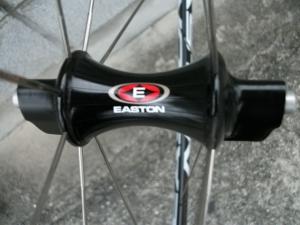
↑This one
It's a selfie.
Quoted from an old post so the size differs.
The left and right dropouts have a wing cross-section,
and when you tighten the quick release horizontally,
it locks in an aerodynamically beneficial shape.
Even with 90mm rim depth, having too few spokes
and a narrow front hub flange width means
you could feel flex when standing and pulling on the drops,
but as long as it was mounted on a TT or triathlon bike
clinging to aero bars,
the low lateral stiffness didn't matter much,
and the aerodynamic characteristics from having fewer spokes
and less lateral spoke spread seemed advantageous
in terms of the relevant factors in those specific conditions.
So my calling it "ridiculously specced" is really
more precisely about using a wheel specialized for TT bikes—
not road bikes—on a road bike, so
my criticism is somewhat off-base.
And Vision's rear hub specifically for TT bikes had flanges that were
"ridiculously dimensioned" narrow,
and when mounted on a road bike,
even light standing would easily cause spoke rub,
making it a laterally worst-case rear wheel.

↑That's that crappy hub!
... wait, I don't think so.
This hub is 2:1 laced, but
with equal spoke holes on both sides, I'm pulling out
an old TT-bike-only-era Vision hub.

↑This one here

Side by side, the crappy hub's issue isn't so much
the flange width narrowness as the prominent length of the left end.
Nowadays Vision is simply FSA's wheel brand
and aero drop bar brand,
not a TT-bike-parts-only brand anymore.


The rim was shifted abnormally to the right.
There was both axial and lateral wobble.

Multiple nipples were stripped,
and the wobble pattern was like someone with a blindfold
randomly fiddled with nipples.
It felt like someone tried to deal with something
and then couldn't get it back to a proper state.
The fact that no tire had been mounted with rim cement
makes it certain the current owner hasn't been using the wheel in this condition.


I eliminated both axial and lateral wobble and centered it.
It was work that was practically equivalent to building a wheel from scratch.

The cover abandoned its duty.

I removed the tubular tape
and mounted the tire with rim cement.
While waiting for the rim cement to dry,
another customer came in, and the cement dried too much,
so I applied another coat, which unexpectedly resulted in
an extra-solid bond bed.

Starting with the front wheel.
It has a certain bike brand's name on it,
and while the cover (配慮) tried to hide it,
there's a sticker on the other side too
so it couldn't be fully covered.
At this point it's less like
"covers everything! (cover power!)" and more like
"you're a complete idiot! (you dumbass!)"

This spec itself wasn't some unofficial fan-made thing—
these wheels were officially released as-is.

There's still Miyata tubular tape (→here) remaining on the rim.
The customer owns multiple bikes from the additional sticker brand,
but for tubular wheels they run rim cement,
so this must've been acquired as a second owner or later.
They actually did ask for rim cement tire mounting.


The front wheel had no centerline offset and almost no wobble.
The image above is just the temporary centering before work,
and since it looked the same after, I didn't bother shooting it again.

Next, the rear wheel.

From DT's Aerolite with white and red painted spokes,
there's just one red spoke as a cosmetic spoke,
but DT specifies that when doing tangent lacing with white and red spokes,
do not braid the final crossing (don't let them touch).
Especially when the final crossing is braided with white or red spokes together,
the paint coat is thick but adhesion is weak,
so it cracks like eggshell.
This rear wheel is 2:1 laced, but
if you're going to put in a cosmetic spoke,
you'd think you'd just do radial lacing on the non-freehub side.
I guess since they didn't braid red spokes together,
technically they're not violating the rule.
There are examples of DT's complete wheels
that do violate this rule.
I'll post one in the next article or so.

There were spots where the spoke paint was chipped.
Judging from the direction and location, the rear derailleur pulley cage
when shifting to low gear made contact and chipped it.
In other words, this is the fault of the previous owner's wheel builder.
Vision was originally FSA's time trial bike parts brand,
and in its early days it was completely irrelevant to anyone
who only rode road bikes—purely TT-only equipment.
Aero bars, specialized brake levers for them,
saddles with especially thick forward cushioning for extreme forward positioning, etc.
Recently they've been releasing road bike components
that suit aero road bikes too.
They've put out integrated stem drop bars and such,
but that's not really Vision's original territory.
Easton had a ridiculously specced TT-specific wheel called the EC90TT.
Rim depth was 90mm.
Despite being 90mm deep, the 90 in the model name
refers to a grade tier above 70 or 50, so it's just a coincidence.
Spoke count was absurdly 12H front
and 16H rear,
and the most absurd part was
the front hub flange width being abnormally narrow.
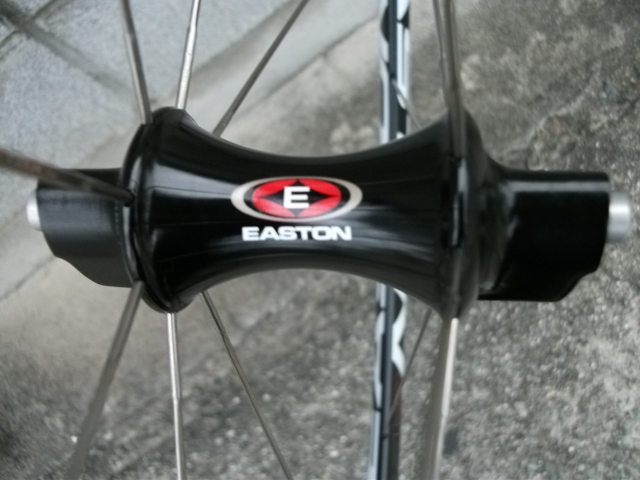
↑This one
It's a selfie.
Quoted from an old post so the size differs.
The left and right dropouts have a wing cross-section,
and when you tighten the quick release horizontally,
it locks in an aerodynamically beneficial shape.
Even with 90mm rim depth, having too few spokes
and a narrow front hub flange width means
you could feel flex when standing and pulling on the drops,
but as long as it was mounted on a TT or triathlon bike
clinging to aero bars,
the low lateral stiffness didn't matter much,
and the aerodynamic characteristics from having fewer spokes
and less lateral spoke spread seemed advantageous
in terms of the relevant factors in those specific conditions.
So my calling it "ridiculously specced" is really
more precisely about using a wheel specialized for TT bikes—
not road bikes—on a road bike, so
my criticism is somewhat off-base.
And Vision's rear hub specifically for TT bikes had flanges that were
"ridiculously dimensioned" narrow,
and when mounted on a road bike,
even light standing would easily cause spoke rub,
making it a laterally worst-case rear wheel.

↑That's that crappy hub!
... wait, I don't think so.
This hub is 2:1 laced, but
with equal spoke holes on both sides, I'm pulling out
an old TT-bike-only-era Vision hub.

↑This one here

Side by side, the crappy hub's issue isn't so much
the flange width narrowness as the prominent length of the left end.
Nowadays Vision is simply FSA's wheel brand
and aero drop bar brand,
not a TT-bike-parts-only brand anymore.


The rim was shifted abnormally to the right.
There was both axial and lateral wobble.

Multiple nipples were stripped,
and the wobble pattern was like someone with a blindfold
randomly fiddled with nipples.
It felt like someone tried to deal with something
and then couldn't get it back to a proper state.
The fact that no tire had been mounted with rim cement
makes it certain the current owner hasn't been using the wheel in this condition.


I eliminated both axial and lateral wobble and centered it.
It was work that was practically equivalent to building a wheel from scratch.

The cover abandoned its duty.

I removed the tubular tape
and mounted the tire with rim cement.
While waiting for the rim cement to dry,
another customer came in, and the cement dried too much,
so I applied another coat, which unexpectedly resulted in
an extra-solid bond bed.
Products Mentioned in This Article
* Amazon affiliate links — prices may vary
Original Japanese post: のむラボ日記 #7299