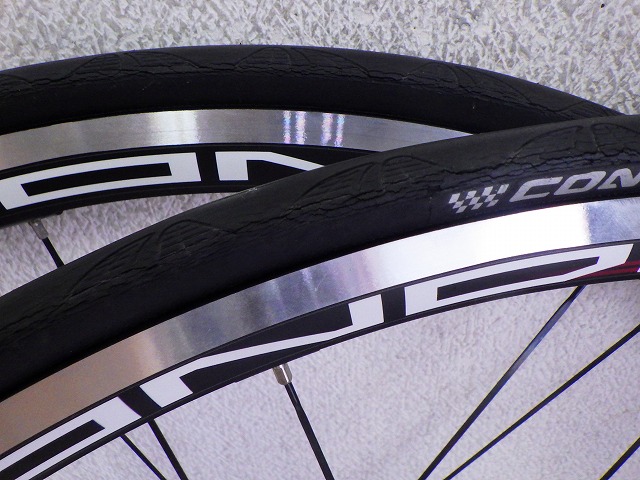
A customer brought in both wheels of a Zonda C15 for service.

Actually, they're from the same owner as the Bora 35 and 50 from the previous article.
The rims are C15, and the rear wheel became C17, but the claimed weight didn't change.
The reason is that the C15 Zonda uses asymmetric spoke lacing, with the freewheel side spokes having greater specific gravity.
When it became C17, the spoke lacing switched to symmetric to mask the rim weight, matching the non-freewheel side.
I personally think that with 2:1 lacing, the left and right should be "reversed" asymmetric—that is, making the non-freewheel side thicker, or keeping it symmetric altogether—but Campagnolo may have decided that thickening two spokes on the freewheel side gave the best engagement characteristics.
The Bora doesn't use this asymmetric lacing (perhaps because of the high rim).
Since the hub dimensions and the spoke specific gravity of the front wheel and rear wheel non-freewheel side are the same as the Bora's, wheels from this era of Zonda could be called "aluminum-rim Boras," and if I were told I could only live my cycling life with complete wheels during the rim brake era, I'd answer that just two would be enough: the Zonda C15 and Bora One 50 tubular (rim width doesn't matter, though narrow if I had to choose).
Shimano wheels wouldn't even be in consideration.
By the way, spokes for this Zonda are still available and we have them in stock.
For the Shimano and Mavic wheels that were released in the final year this Zonda was available, spare spokes cannot be obtained.
My dislike of unrepairable wheels is also why I recommend Campagnolo wheels.


This Zonda came from an acquaintance rather than a net auction, but with no brake marks and the cone locknut area (where dirt easily accumulates) being clean, it could pass as unused.
Since there was no abnormality in hub rotation and no sign of grease starvation, the customer wanted a full overhaul, but I judged it better not to touch it and deliberately didn't disassemble the hub.

The rear wheel naturally has its cone locknut on the left side, and when I aligned the front wheel accordingly so the hub body sticker faces straight up, the sticker orientations match up nicely.

The only thing that doesn't match is that the orange WARNING sticker is on the right side of the front wheel only.
There are three ways to fix this:
1. Don't worry about it
2. Rebuild with the rim flipped left-right
3. Remove the WARNING stickers from both wheels
I can handle options 2 and 3, but I did neither.

The Continental Grand Prix 4000 S II tires mounted on them were quite cracked.


Perfect center, virtually no runout, and I only had to adjust nipples in two spots during truing.

There are traces where the sprockets engaged on the freewheel body splines, but they're minimal.

I only added a bit of grease around the pawls on the freewheel body.

The rear tire shows less damage than the front, but there's cracking at the phase that was loaded during long storage.

The rest looked fine under no load, but

when I pinched it slightly with my fingers, it deformed like this, so both front and rear tires shouldn't be used.
I mentioned long storage earlier—hung Zondas are tensioned at just over 100 kgf, so even if perfectly unused and confirmed for center before being set aside, the tension will still be pulled by the spokes, meaning the rear wheel with dish runout will have its rim shift slightly toward the side opposite the spoke angle, on the right side, a phenomenon likely observable within the first 5–10 years.
Of course, it happens faster if ridden.
So if there's center shift, it would be toward the freewheel side...


Contrary to my prediction, it shifted toward the non-freewheel side.

↑About this much
I could easily take this out by loosening the non-freewheel side, but ideally I'd prefer to tighten the freewheel side. Since there's also slight lateral runout, if I adjust with an emphasis on non-freewheel side tightening, thinking "truing will be complete but centering might not be,"


there's still a slight shift.

↑About this much
The initial state had slight lateral runout, but at this point there's no runout—just center shift. This is simply the limit of what you can accomplish when "truing while attempting centering," and the freewheel side can still be tightened further.


From the initial state, I avoided the option of loosening the non-freewheel side as much as possible (though sometimes truing necessitates it) and completed both truing and centering.

Actually, they're from the same owner as the Bora 35 and 50 from the previous article.
The rims are C15, and the rear wheel became C17, but the claimed weight didn't change.
The reason is that the C15 Zonda uses asymmetric spoke lacing, with the freewheel side spokes having greater specific gravity.
When it became C17, the spoke lacing switched to symmetric to mask the rim weight, matching the non-freewheel side.
I personally think that with 2:1 lacing, the left and right should be "reversed" asymmetric—that is, making the non-freewheel side thicker, or keeping it symmetric altogether—but Campagnolo may have decided that thickening two spokes on the freewheel side gave the best engagement characteristics.
The Bora doesn't use this asymmetric lacing (perhaps because of the high rim).
Since the hub dimensions and the spoke specific gravity of the front wheel and rear wheel non-freewheel side are the same as the Bora's, wheels from this era of Zonda could be called "aluminum-rim Boras," and if I were told I could only live my cycling life with complete wheels during the rim brake era, I'd answer that just two would be enough: the Zonda C15 and Bora One 50 tubular (rim width doesn't matter, though narrow if I had to choose).
Shimano wheels wouldn't even be in consideration.
By the way, spokes for this Zonda are still available and we have them in stock.
For the Shimano and Mavic wheels that were released in the final year this Zonda was available, spare spokes cannot be obtained.
My dislike of unrepairable wheels is also why I recommend Campagnolo wheels.

This Zonda came from an acquaintance rather than a net auction, but with no brake marks and the cone locknut area (where dirt easily accumulates) being clean, it could pass as unused.
Since there was no abnormality in hub rotation and no sign of grease starvation, the customer wanted a full overhaul, but I judged it better not to touch it and deliberately didn't disassemble the hub.

The rear wheel naturally has its cone locknut on the left side, and when I aligned the front wheel accordingly so the hub body sticker faces straight up, the sticker orientations match up nicely.

The only thing that doesn't match is that the orange WARNING sticker is on the right side of the front wheel only.
There are three ways to fix this:
1. Don't worry about it
2. Rebuild with the rim flipped left-right
3. Remove the WARNING stickers from both wheels
I can handle options 2 and 3, but I did neither.

The Continental Grand Prix 4000 S II tires mounted on them were quite cracked.


Perfect center, virtually no runout, and I only had to adjust nipples in two spots during truing.

There are traces where the sprockets engaged on the freewheel body splines, but they're minimal.

I only added a bit of grease around the pawls on the freewheel body.

The rear tire shows less damage than the front, but there's cracking at the phase that was loaded during long storage.

The rest looked fine under no load, but

when I pinched it slightly with my fingers, it deformed like this, so both front and rear tires shouldn't be used.
I mentioned long storage earlier—hung Zondas are tensioned at just over 100 kgf, so even if perfectly unused and confirmed for center before being set aside, the tension will still be pulled by the spokes, meaning the rear wheel with dish runout will have its rim shift slightly toward the side opposite the spoke angle, on the right side, a phenomenon likely observable within the first 5–10 years.
Of course, it happens faster if ridden.
So if there's center shift, it would be toward the freewheel side...


Contrary to my prediction, it shifted toward the non-freewheel side.

↑About this much
I could easily take this out by loosening the non-freewheel side, but ideally I'd prefer to tighten the freewheel side. Since there's also slight lateral runout, if I adjust with an emphasis on non-freewheel side tightening, thinking "truing will be complete but centering might not be,"


there's still a slight shift.

↑About this much
The initial state had slight lateral runout, but at this point there's no runout—just center shift. This is simply the limit of what you can accomplish when "truing while attempting centering," and the freewheel side can still be tightened further.


From the initial state, I avoided the option of loosening the non-freewheel side as much as possible (though sometimes truing necessitates it) and completed both truing and centering.