Shimano has announced the WH-R9370 as the wheel for the R9300-series Dura-Ace, ahead of the component release.
As rumored from the prototypes supplied to pro teams,
it's become a carbon spoke spec.
This time around, I'm not going to bother with meaningless info like "X grams lighter on front and rear wheels!" or rim weights that aren't publicly disclosed—I'll write about other things with my own take mixed in.
First, the cup bearing pressed into the hub shell has become user-replaceable.
Previously, the right cup was integrated with the ball bearing and hub shaft, and the left cup could be replaced as part of the left end nut assembly,
but this is the first time the cup itself has been available for replacement.
Strictly speaking, it's the *supply* of the cup that's new—
since the RS770 hub onwards, the cups pressed into the hub shell have clearly had a removable structure.
Since this is shared with the WH-R8170 hub as well,
when the WH-R8170-C36 first came out at our shop,
with the front wheel priced at ¥66,000 before tax (now ¥122,253—almost doubled!),
we sourced eight front wheels, rebuilt four of them into rear wheels with result spokes using Tani hubs,
and sold four front-and-rear pairs at a special price.
We used the front hub cups left over from that time for repairs,
but we've long since run out.
I used some on my personal front wheel too (→here),
but I wish I'd saved the rest to help someone else.
It's odd that the peak performance lifespan of a wheel should be determined by cup wear,
so I think Shimano should release cup spare parts for the R9270 and R8170 as well…
Also, even if they say "we're starting to supply cups,"
that just means a part number gets set up for spares—
whether there's actually ample inventory available without delay is another matter entirely.
Shimano's spare parts supply clearly deteriorated around the 7900-series era,
so based on their track record, I don't trust them one bit on this.
A comprehensive rundown of that is (→here)
As for the rim height lineup,
in addition to the traditional C36, C50, and C60,
they've added C99 for the front wheel only and a disc wheel for the rear only.
I don't know if C99 means a 99mm rim height.
It probably does, but the materials don't explicitly say,
so I won't make a definitive claim here.
The WH-9000 had (continuing the flow from WH-7900)
either a 35mm-high full-carbon tubular rim or
a 35mm-high aluminum-carbon hybrid clincher rim,
both called "C35,"
but when this became the WH-R9100,
the model name changed to "C40,"
the full-carbon tubular rim was switched to a 37mm-high rim,
and the aluminum-carbon hybrid clincher rim got only a cosmetic refresh—pure laziness.
In other words, despite being called C40,
neither was actually a 40mm-high rim,
and the clincher rim stayed at 35mm high as before.
Yet at the time, I saw shops writing things like
"The WH-R9100-C40-CL boosts battle power by raising rim height 5mm from the C35!"
So to avoid that kind of embarrassment,
I'm not yet definitively saying the C99 is a 99mm-high rim.

The WH-R9370 has an inner rim width of 23mm across all rim heights,
optimized for 28–30C tires.
By contrast, the outer rim width is adjusted precisely,
particularly for the C99, which has the extreme difference of something like Roval's Rapide CLX front wheel
(inner 21mm, outer 35mm).
Almost forgot to mention:
the tubular rim spec has been discontinued,
and only tubeless rims are offered.
On the previous WH-R9270,
the C50 and C60 had different spoke weight distributions,
changing the wheel's character that way.
That said, they weren't doing asymmetrical lacing—
both were symmetrically laced; it was just that the C60
used heavier spokes (by weight) than the C50.
Now that it's a carbon spoke spec,
I wondered how they'd differentiate C50 from C60,
and it turns out they went with varying spoke count—
a different number of spokes rather than spoke weight.

Before getting to that,
about the WH-R9370's carbon spokes:
from the images in the materials, I can see
VONOA laser-marked on the aluminum section at the hub-end of the spoke,
not even hidden (※), and they're adopting
two types of spokes—called Aero and Super Aero—
with different flattening proportions.
However, these aren't used for asymmetrical lacing;
rather, Aero is used on all front and rear wheels of C36, C50, and C60,
while Super Aero is used only on the C99 front wheel.
※On early batches of the WH-R9270,
the spoke head had the mac spoke brand mark stamped on it (CN spokes),
but they don't seem proud of that—
they quickly switched to unmarked specs (→here).
The reason Shimano wheel spokes rust in ways that defy what the price suggests,
even on higher tiers, is because they're using CN spokes
instead of Sapim or DT.

The WH-R9370 spoke hole count spec:
On the previous WH-R9270, both front and rear were 24H,
with the front wheel symmetrically laced (12+12H)
and the rear wheel Optibaled 2:1 (16+8H).
But from what I can see here,
on the WH-R9370, except for the C99,
both front and rear appear to be Optibaled.
Even the C60 24H rear wheel probably isn't 12+12H
but rather 16+8H.
What concerns me is that the C36 front wheel is 18H.
Oh no, Shimano's got that bad habit flaring up again.
This is my opinion, but even with carbon spokes,
a properly stiff front wheel's spoke count is limited to
20H (10+10H) or 21H (7+14H) at most.
If these were still the bulky-width spokes used in CADEX Ultra,
maybe—but these don't have that high a flattening ratio,
and with VONOA spokes (and I don't mean that kindly),
18H just seems…
In terms of magnitude, even if you bumped the WH-R9370-C36
from 18H to 21H, with carbon spokes' lower weight ratio,
the weight penalty would be small,
and comparing a 21H front wheel (if they existed) side-by-side with an 18H,
you'd probably never notice "the weight difference of three spokes!"
What you'd likely feel more is the aero difference of those three spokes.
But if someone had the sensitivity to notice aero differences of three spokes,
they absolutely couldn't miss the lateral stiffness difference of three spokes,
the flex in downhill corners.
Any way you look at it, weighing what you gain versus lose,
merit against demerit, going from 21H to 18H shouldn't have happened.
If 21H front and rear wheels with tangent lacing
(front-left/rear-right) and radial lacing
(front-right/rear-left) use the same spoke length or
close enough thread-run redundancy,

I'd want to buy a C50 front wheel and C36 rear wheel,
swap out the "rim + all spokes" and "hub,"
and build a front 21H C36 and rear 21H C50.
Without knowing the actual spoke length, I can't say if it's possible.
The only way this is likely doable is if the C50,
being the only model with matching spoke counts front-to-rear,
has the same or nearly identical spoke length
between tangent and radial lacing.
The rear hub freewheel body uses the Direct Engagement
adopted only on Dura-Ace hubs,
but it was originally first used on MTB XTR hubs (now also on XT hubs and wheels),
so "only on Dura-Ace" really means only on road components.
The freewheel body shown in the Direct Engagement explanation section
in the materials is MTB's Micro Spline,
so if R9300-series Dura-Ace becomes Micro Spline
and enables top 10T cassettes,
those who bought WH-R9370 now (in the R9200 era)
as innovators or early adopters should get a freewheel body swap
as a remedy, I think.
An example of non-remedy was (→here)
In the materials, the cup-and-cone bearing rotation torque
is listed as 30% smoother than cartridge bearing,
shown in a bar graph with heights of 7 and 10,
but the claims here bothered me quite a bit.
The conditions listed next to the graph state:
Through-axle tightening force: 5,000N
Vertical load from bike and rider weight: 500N
Pedaling thrust: 200N
*Sealing effect excluded
(quoted as-is).
First, what bothers me is they don't list the conditions
for the cartridge bearing side at all.
No mention of comparison to NTN steel-ball bearings,
or Ceramic Speed's ceramic-ball bearings,
nothing like that.
Second, it says sealing effect excluded.
Shimano hubs aren't universally over-spec on water resistance,
but for Dura-Ace road components specifically,
the labyrinth seal performance is so high
that it barely seeps during rain riding,
and the hub interior stays dry unless you bring a pressure washer nozzle close—
that's the level of water resistance.
On the flip side, when you spin the hub shaft by hand,
there's zero cloudiness and smooth rotation, yet there's a sluggish,
honey-stirring-with-a-spoon feel.
That's the sealing resistance, but claiming 30% smoother versus cartridge
while excluding sealing effect isn't fair by any measure.
You don't actually *use* a bearing without sealing effects,
so in real-world conditions, CULT bearings win hands down.
Lastly, it says through-axle tightening force: 5,000N—
is that a typo for 500N?
No wait, but they wrote "5,000N" with a comma, not "50000N"…
The kgf to N·m conversion is roughly
100 kgf = 980.655 N·m, and
1000 N·m = 101.972 kgf, so about 10x and 1/10x numerically,
but
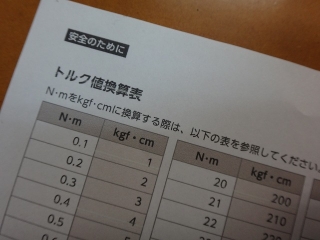
in Shimano's torque conversion table:

no matter where you look, kgf for N·m just appends a zero—
purely 10x. But if they're starting from 0.1 N·m,
shouldn't 50 N·m give around 510 kgf and 100 N·m around 1020 kgf
even accounting for significant-figure rounding?
Incidentally, 5000N in "Shimano style" would be 500 kgf,
but strictly it's 509.858 kgf, so the decimal 9.858 kgf
(96.674 N·m) is too large to ignore.
Most through-axles, when labeled,
list tightening torque around 9–10 N·m (often written as Nm, not N·m).
That's tightening torque, not what Shimano calls "tightening force,"
but even so, 5000N seems like it might be a typo—
or maybe not; I can't tell.
If it were cN·m (centinewton-meters), then
5000 cN·m = 50 N·m, which would make sense, but
I doubt they'd suddenly pull out such a minor unit.
Dunno.
Quick-release just "clamps the fork end or seat stay end really hard,"
but the lever's tightening torque itself
is around 10 N·m.
By contrast, the clamping force (using a different term here
than Shimano's "tightening force" to be precise)
is somewhere in the tens or hundreds of kg—I'm not sure which—
but strong enough to prevent the wheel falling off,
and can even crush hub bearings with over-tightening.
So with through-axles being far tighter than quick-release,
maybe through-axle tightening force: 5,000N is plausible… or not. Who knows.
The WH-R9370, compared to the previous WH-R9270 C36, C50, and C60
(which are comparable because they're the same rim height),
can save watts via aerodynamic performance at 48 km/h
in wind-tunnel testing of 2.2W, 1.9W, and 2.7W respectively.
In the material diagrams, the numbers are printed slightly larger, like 2.2W,
making the W look lowercase, but it's actually uppercase
(it has to be for correctness).
I don't have much interest in these numbers themselves,
but as a fun fact worth noting,
the 48 km/h condition exists because
wind-tunnel testing in the road bike industry
traditionally defaults to 30 mph.
Finally, on WH-R9370 pricing.
All figures below are tax-inclusive list prices.
The C36, C50, and C60, regardless of rim height,
are ¥198,847 for front wheels and ¥232,866 for rear wheels—
and amazingly, these are *exactly* the same price as the WH-R9270.
Considering newly developed rims,
hubs designed for VONOA spokes,
and spoke material differences, it feels like a price cut
(not that it's cheap).
For reference, the C99 front wheel is ¥276,396,
and the disc rear wheel is ¥526,216.
The WH-R8170 front wheel was initially (2022)
¥66,000 before tax, ¥72,600 after.
That was cheap enough that I'd have considered sourcing it just for the rim
(coincidentally the same as the rim alone from Nomulab Wheel #9),
but now, as I mentioned, it's
¥122,253 before tax, ¥134,478 after tax—
insanely expensive.
So maybe someday when I look back at this WH-R9370 price,
I'll think, "Ah, there was a time you could buy it for this,"
though I hope not.
As rumored from the prototypes supplied to pro teams,
it's become a carbon spoke spec.
This time around, I'm not going to bother with meaningless info like "X grams lighter on front and rear wheels!" or rim weights that aren't publicly disclosed—I'll write about other things with my own take mixed in.
First, the cup bearing pressed into the hub shell has become user-replaceable.
Previously, the right cup was integrated with the ball bearing and hub shaft, and the left cup could be replaced as part of the left end nut assembly,
but this is the first time the cup itself has been available for replacement.
Strictly speaking, it's the *supply* of the cup that's new—
since the RS770 hub onwards, the cups pressed into the hub shell have clearly had a removable structure.
Since this is shared with the WH-R8170 hub as well,
when the WH-R8170-C36 first came out at our shop,
with the front wheel priced at ¥66,000 before tax (now ¥122,253—almost doubled!),
we sourced eight front wheels, rebuilt four of them into rear wheels with result spokes using Tani hubs,
and sold four front-and-rear pairs at a special price.
We used the front hub cups left over from that time for repairs,
but we've long since run out.
I used some on my personal front wheel too (→here),
but I wish I'd saved the rest to help someone else.
It's odd that the peak performance lifespan of a wheel should be determined by cup wear,
so I think Shimano should release cup spare parts for the R9270 and R8170 as well…
Also, even if they say "we're starting to supply cups,"
that just means a part number gets set up for spares—
whether there's actually ample inventory available without delay is another matter entirely.
Shimano's spare parts supply clearly deteriorated around the 7900-series era,
so based on their track record, I don't trust them one bit on this.
A comprehensive rundown of that is (→here)
As for the rim height lineup,
in addition to the traditional C36, C50, and C60,
they've added C99 for the front wheel only and a disc wheel for the rear only.
I don't know if C99 means a 99mm rim height.
It probably does, but the materials don't explicitly say,
so I won't make a definitive claim here.
The WH-9000 had (continuing the flow from WH-7900)
either a 35mm-high full-carbon tubular rim or
a 35mm-high aluminum-carbon hybrid clincher rim,
both called "C35,"
but when this became the WH-R9100,
the model name changed to "C40,"
the full-carbon tubular rim was switched to a 37mm-high rim,
and the aluminum-carbon hybrid clincher rim got only a cosmetic refresh—pure laziness.
In other words, despite being called C40,
neither was actually a 40mm-high rim,
and the clincher rim stayed at 35mm high as before.
Yet at the time, I saw shops writing things like
"The WH-R9100-C40-CL boosts battle power by raising rim height 5mm from the C35!"
So to avoid that kind of embarrassment,
I'm not yet definitively saying the C99 is a 99mm-high rim.

The WH-R9370 has an inner rim width of 23mm across all rim heights,
optimized for 28–30C tires.
By contrast, the outer rim width is adjusted precisely,
particularly for the C99, which has the extreme difference of something like Roval's Rapide CLX front wheel
(inner 21mm, outer 35mm).
Almost forgot to mention:
the tubular rim spec has been discontinued,
and only tubeless rims are offered.
On the previous WH-R9270,
the C50 and C60 had different spoke weight distributions,
changing the wheel's character that way.
That said, they weren't doing asymmetrical lacing—
both were symmetrically laced; it was just that the C60
used heavier spokes (by weight) than the C50.
Now that it's a carbon spoke spec,
I wondered how they'd differentiate C50 from C60,
and it turns out they went with varying spoke count—
a different number of spokes rather than spoke weight.

Before getting to that,
about the WH-R9370's carbon spokes:
from the images in the materials, I can see
VONOA laser-marked on the aluminum section at the hub-end of the spoke,
not even hidden (※), and they're adopting
two types of spokes—called Aero and Super Aero—
with different flattening proportions.
However, these aren't used for asymmetrical lacing;
rather, Aero is used on all front and rear wheels of C36, C50, and C60,
while Super Aero is used only on the C99 front wheel.
※On early batches of the WH-R9270,
the spoke head had the mac spoke brand mark stamped on it (CN spokes),
but they don't seem proud of that—
they quickly switched to unmarked specs (→here).
The reason Shimano wheel spokes rust in ways that defy what the price suggests,
even on higher tiers, is because they're using CN spokes
instead of Sapim or DT.

The WH-R9370 spoke hole count spec:
On the previous WH-R9270, both front and rear were 24H,
with the front wheel symmetrically laced (12+12H)
and the rear wheel Optibaled 2:1 (16+8H).
But from what I can see here,
on the WH-R9370, except for the C99,
both front and rear appear to be Optibaled.
Even the C60 24H rear wheel probably isn't 12+12H
but rather 16+8H.
What concerns me is that the C36 front wheel is 18H.
Oh no, Shimano's got that bad habit flaring up again.
This is my opinion, but even with carbon spokes,
a properly stiff front wheel's spoke count is limited to
20H (10+10H) or 21H (7+14H) at most.
If these were still the bulky-width spokes used in CADEX Ultra,
maybe—but these don't have that high a flattening ratio,
and with VONOA spokes (and I don't mean that kindly),
18H just seems…
In terms of magnitude, even if you bumped the WH-R9370-C36
from 18H to 21H, with carbon spokes' lower weight ratio,
the weight penalty would be small,
and comparing a 21H front wheel (if they existed) side-by-side with an 18H,
you'd probably never notice "the weight difference of three spokes!"
What you'd likely feel more is the aero difference of those three spokes.
But if someone had the sensitivity to notice aero differences of three spokes,
they absolutely couldn't miss the lateral stiffness difference of three spokes,
the flex in downhill corners.
Any way you look at it, weighing what you gain versus lose,
merit against demerit, going from 21H to 18H shouldn't have happened.
If 21H front and rear wheels with tangent lacing
(front-left/rear-right) and radial lacing
(front-right/rear-left) use the same spoke length or
close enough thread-run redundancy,

I'd want to buy a C50 front wheel and C36 rear wheel,
swap out the "rim + all spokes" and "hub,"
and build a front 21H C36 and rear 21H C50.
Without knowing the actual spoke length, I can't say if it's possible.
The only way this is likely doable is if the C50,
being the only model with matching spoke counts front-to-rear,
has the same or nearly identical spoke length
between tangent and radial lacing.
The rear hub freewheel body uses the Direct Engagement
adopted only on Dura-Ace hubs,
but it was originally first used on MTB XTR hubs (now also on XT hubs and wheels),
so "only on Dura-Ace" really means only on road components.
The freewheel body shown in the Direct Engagement explanation section
in the materials is MTB's Micro Spline,
so if R9300-series Dura-Ace becomes Micro Spline
and enables top 10T cassettes,
those who bought WH-R9370 now (in the R9200 era)
as innovators or early adopters should get a freewheel body swap
as a remedy, I think.
An example of non-remedy was (→here)
In the materials, the cup-and-cone bearing rotation torque
is listed as 30% smoother than cartridge bearing,
shown in a bar graph with heights of 7 and 10,
but the claims here bothered me quite a bit.
The conditions listed next to the graph state:
Through-axle tightening force: 5,000N
Vertical load from bike and rider weight: 500N
Pedaling thrust: 200N
*Sealing effect excluded
(quoted as-is).
First, what bothers me is they don't list the conditions
for the cartridge bearing side at all.
No mention of comparison to NTN steel-ball bearings,
or Ceramic Speed's ceramic-ball bearings,
nothing like that.
Second, it says sealing effect excluded.
Shimano hubs aren't universally over-spec on water resistance,
but for Dura-Ace road components specifically,
the labyrinth seal performance is so high
that it barely seeps during rain riding,
and the hub interior stays dry unless you bring a pressure washer nozzle close—
that's the level of water resistance.
On the flip side, when you spin the hub shaft by hand,
there's zero cloudiness and smooth rotation, yet there's a sluggish,
honey-stirring-with-a-spoon feel.
That's the sealing resistance, but claiming 30% smoother versus cartridge
while excluding sealing effect isn't fair by any measure.
You don't actually *use* a bearing without sealing effects,
so in real-world conditions, CULT bearings win hands down.
Lastly, it says through-axle tightening force: 5,000N—
is that a typo for 500N?
No wait, but they wrote "5,000N" with a comma, not "50000N"…
The kgf to N·m conversion is roughly
100 kgf = 980.655 N·m, and
1000 N·m = 101.972 kgf, so about 10x and 1/10x numerically,
but
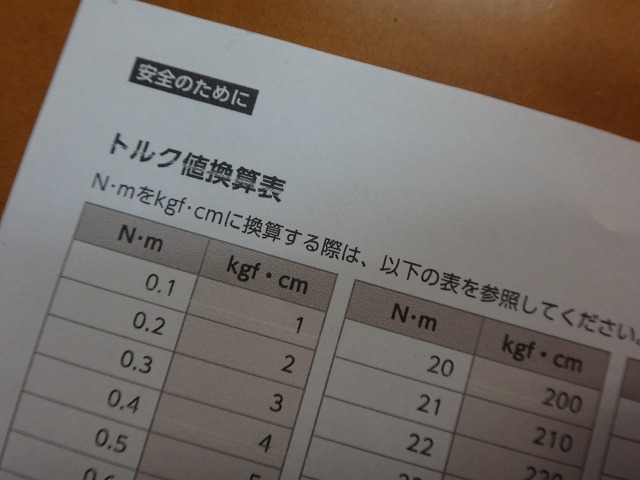
in Shimano's torque conversion table:
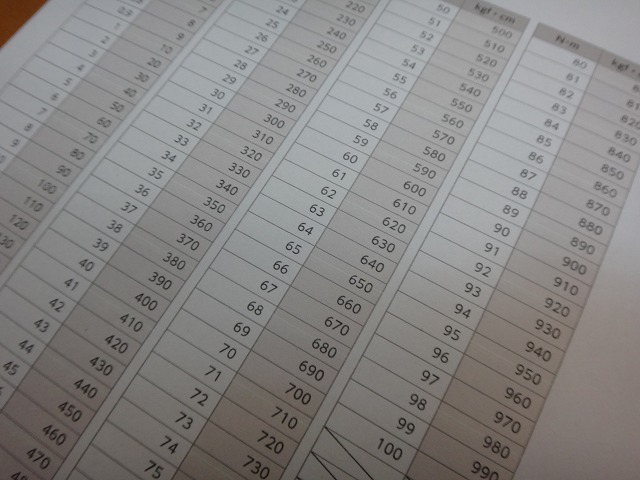
no matter where you look, kgf for N·m just appends a zero—
purely 10x. But if they're starting from 0.1 N·m,
shouldn't 50 N·m give around 510 kgf and 100 N·m around 1020 kgf
even accounting for significant-figure rounding?
Incidentally, 5000N in "Shimano style" would be 500 kgf,
but strictly it's 509.858 kgf, so the decimal 9.858 kgf
(96.674 N·m) is too large to ignore.
Most through-axles, when labeled,
list tightening torque around 9–10 N·m (often written as Nm, not N·m).
That's tightening torque, not what Shimano calls "tightening force,"
but even so, 5000N seems like it might be a typo—
or maybe not; I can't tell.
If it were cN·m (centinewton-meters), then
5000 cN·m = 50 N·m, which would make sense, but
I doubt they'd suddenly pull out such a minor unit.
Dunno.
Quick-release just "clamps the fork end or seat stay end really hard,"
but the lever's tightening torque itself
is around 10 N·m.
By contrast, the clamping force (using a different term here
than Shimano's "tightening force" to be precise)
is somewhere in the tens or hundreds of kg—I'm not sure which—
but strong enough to prevent the wheel falling off,
and can even crush hub bearings with over-tightening.
So with through-axles being far tighter than quick-release,
maybe through-axle tightening force: 5,000N is plausible… or not. Who knows.
The WH-R9370, compared to the previous WH-R9270 C36, C50, and C60
(which are comparable because they're the same rim height),
can save watts via aerodynamic performance at 48 km/h
in wind-tunnel testing of 2.2W, 1.9W, and 2.7W respectively.
In the material diagrams, the numbers are printed slightly larger, like 2.2W,
making the W look lowercase, but it's actually uppercase
(it has to be for correctness).
I don't have much interest in these numbers themselves,
but as a fun fact worth noting,
the 48 km/h condition exists because
wind-tunnel testing in the road bike industry
traditionally defaults to 30 mph.
Finally, on WH-R9370 pricing.
All figures below are tax-inclusive list prices.
The C36, C50, and C60, regardless of rim height,
are ¥198,847 for front wheels and ¥232,866 for rear wheels—
and amazingly, these are *exactly* the same price as the WH-R9270.
Considering newly developed rims,
hubs designed for VONOA spokes,
and spoke material differences, it feels like a price cut
For reference, the C99 front wheel is ¥276,396,
and the disc rear wheel is ¥526,216.
The WH-R8170 front wheel was initially (2022)
¥66,000 before tax, ¥72,600 after.
That was cheap enough that I'd have considered sourcing it just for the rim
(coincidentally the same as the rim alone from Nomulab Wheel #9),
but now, as I mentioned, it's
¥122,253 before tax, ¥134,478 after tax—
insanely expensive.
So maybe someday when I look back at this WH-R9370 price,
I'll think, "Ah, there was a time you could buy it for this,"
though I hope not.