A customer left an R-SYS (Mavic wheel) with me for service.
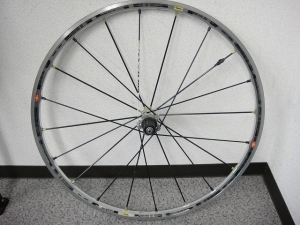
It's a first-generation R-SYS, but the specs are a bit different.
Apparently the rear derailleur got tangled up pretty badly, and all the spokes on the freewheel side were replaced. However, the shop that did the work claimed the original flat spokes were unobtainable (truth unknown),
so it's now got modern Ksyrium round spokes instead.
Ever since then it's been making strange noises when ridden, and the customer says it's not something you can just tolerate and ride through—it's basically unusable without being fixed,
so they brought it to my shop.
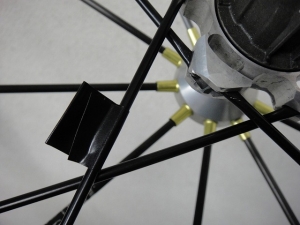
So I took a look at the freewheel-side spokes and they're obviously loose...
I put tape on them as a reference mark,
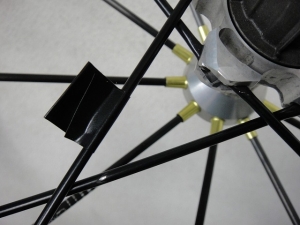
↑ Just giving them a light squeeze, but the freewheel side of an R-SYS shouldn't deflect nearly this much.
I almost thought they'd used Spinergy's Zylon fiber spokes.
I don't know which shop built this, but if they could source the spokes, they should know what the spoke tension of a stock R-SYS is supposed to be.
Building them this loose and handing it over like this just doesn't make sense.
Plus, they told the customer "the R-SYS is a wheel that's built loose," but the rim center had drifted 5mm toward the non-freewheel side.
This wheel wasn't even properly built to begin with.
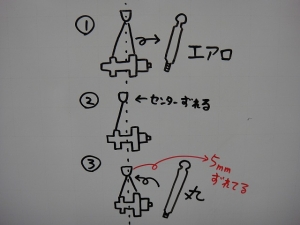
When you remove all the original spokes from the freewheel side, the rim shifts significantly toward the non-freewheel side.
Then you tension new spokes on the freewheel side, but because they're under-tensioned, the rim won't center properly.
The aero and round spokes have different shapes, but if you tension the new spokes enough to bring the rim to center, you'd get roughly back to the original wheel stiffness.
I'm not saying to over-tension them.
The problem is they haven't even reached the necessary minimum tension.
The center offset of about 5mm equals one-quarter of the rim width.
This is way beyond what's acceptable for a finished wheel.
Tensioning only the freewheel side is extremely difficult, so I loosened the non-freewheel side substantially first, tensioned the freewheel side, then re-tensioned the non-freewheel side back to proper specs to center everything.
It was basically like half-disassembling and rebuilding the wheel.
The fact that the freewheel side has round spokes isn't the problem.
The problem is it wasn't built properly.
The job I was asked to do was "eliminate the source of the noise"—not re-tension spokes.
I addressed all the likely noise culprits: hub bearing re-lubrication and ball-race adjustment, taking up play in the left endcap parts, and so on.
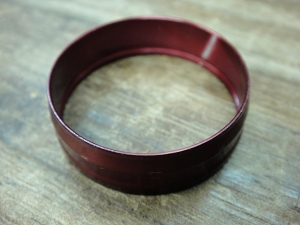
Since this is a first-generation R-SYS, it has the spoke ring spec from that year only—"without the anti-rotation plastic embedded in it."
I actually think the anti-rotation function on later R-SYS spoke rings is a downgrade, so I prefer this one.
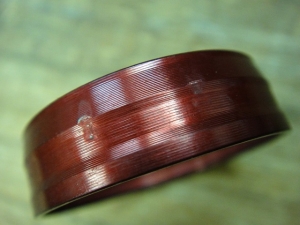
↑ If spoke tension is adequate, the carbon spoke head presses firmly against the ring, so it basically won't rotate from vibration.
In fact, there are no traces of lateral sliding wear on this spoke ring.
When you have anti-rotation features on the spoke ring, the contact point with the spoke head is always in the same spot, which I think is bad in the long run.
You apply a certain type of grease to the outer edge of this ring and press it onto the hub, and I offset the phase so the contact point would be on a part of the ring that hasn't worn.
Carbon spoke tension (strictly speaking, nipple tightening amount) above a certain threshold doesn't significantly affect the wheel's ride feel thanks to Mavic's so-called compression structure.
Maybe that shop came up with "the R-SYS is a wheel that's built loose" based on this, but first, build a wheel with proper centering before spouting off about it.
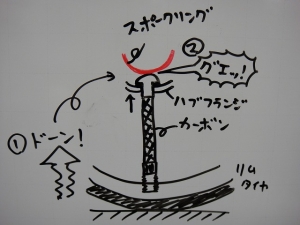
Regarding spoke tightening on this self-proclaimed compression structure: even if spoke tension above a threshold doesn't affect ride feel, it does affect hub-side noise.
Even though carbon spokes have virtually zero elongation, the buckling-direction stress changes how hard the spoke head presses on the spoke ring, even above that threshold.
(The amount of "Boom!" versus "Creak!" changes)
This is empirically clear.
I've seen many examples where tightening the spokes eliminated hub noise.
Especially the front wheel, where both sides have this structure—it's very noticeable.
The customer apparently came to my shop after reading several past R-SYS articles I've written on this blog. Whether we actually end up servicing it or not, perhaps this article will also help out some other R-SYS owners somewhere.
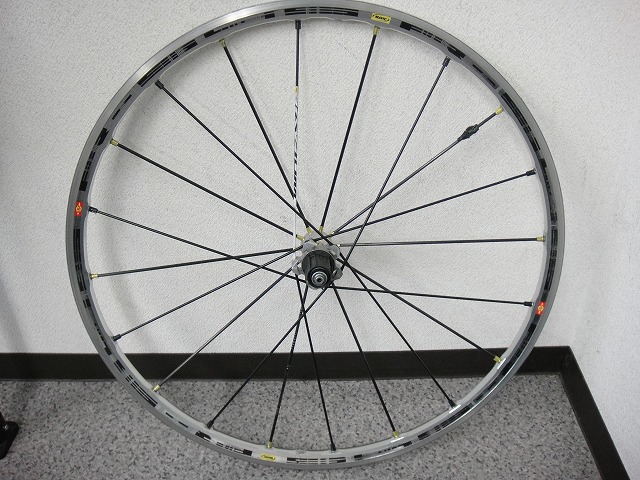
It's a first-generation R-SYS, but the specs are a bit different.
Apparently the rear derailleur got tangled up pretty badly, and all the spokes on the freewheel side were replaced. However, the shop that did the work claimed the original flat spokes were unobtainable (truth unknown),
so it's now got modern Ksyrium round spokes instead.
Ever since then it's been making strange noises when ridden, and the customer says it's not something you can just tolerate and ride through—it's basically unusable without being fixed,
so they brought it to my shop.

So I took a look at the freewheel-side spokes and they're obviously loose...
I put tape on them as a reference mark,
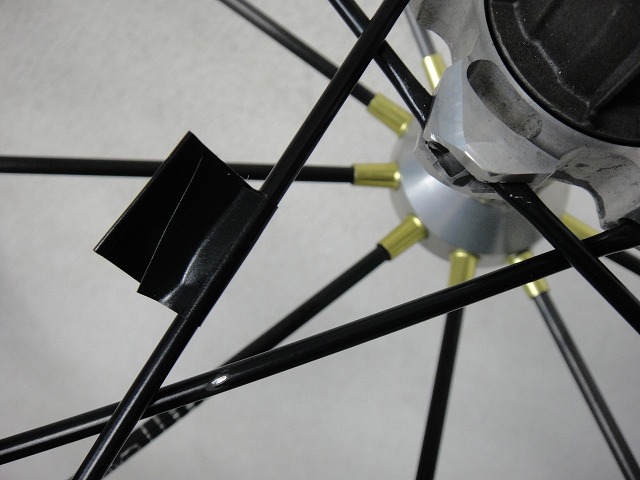
↑ Just giving them a light squeeze, but the freewheel side of an R-SYS shouldn't deflect nearly this much.
I almost thought they'd used Spinergy's Zylon fiber spokes.
I don't know which shop built this, but if they could source the spokes, they should know what the spoke tension of a stock R-SYS is supposed to be.
Building them this loose and handing it over like this just doesn't make sense.
Plus, they told the customer "the R-SYS is a wheel that's built loose," but the rim center had drifted 5mm toward the non-freewheel side.
This wheel wasn't even properly built to begin with.
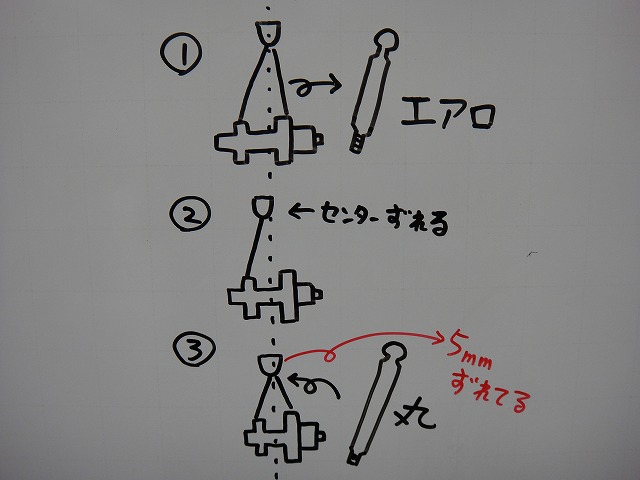
When you remove all the original spokes from the freewheel side, the rim shifts significantly toward the non-freewheel side.
Then you tension new spokes on the freewheel side, but because they're under-tensioned, the rim won't center properly.
The aero and round spokes have different shapes, but if you tension the new spokes enough to bring the rim to center, you'd get roughly back to the original wheel stiffness.
I'm not saying to over-tension them.
The problem is they haven't even reached the necessary minimum tension.
The center offset of about 5mm equals one-quarter of the rim width.
This is way beyond what's acceptable for a finished wheel.
Tensioning only the freewheel side is extremely difficult, so I loosened the non-freewheel side substantially first, tensioned the freewheel side, then re-tensioned the non-freewheel side back to proper specs to center everything.
It was basically like half-disassembling and rebuilding the wheel.
The fact that the freewheel side has round spokes isn't the problem.
The problem is it wasn't built properly.
The job I was asked to do was "eliminate the source of the noise"—not re-tension spokes.
I addressed all the likely noise culprits: hub bearing re-lubrication and ball-race adjustment, taking up play in the left endcap parts, and so on.

Since this is a first-generation R-SYS, it has the spoke ring spec from that year only—"without the anti-rotation plastic embedded in it."
I actually think the anti-rotation function on later R-SYS spoke rings is a downgrade, so I prefer this one.
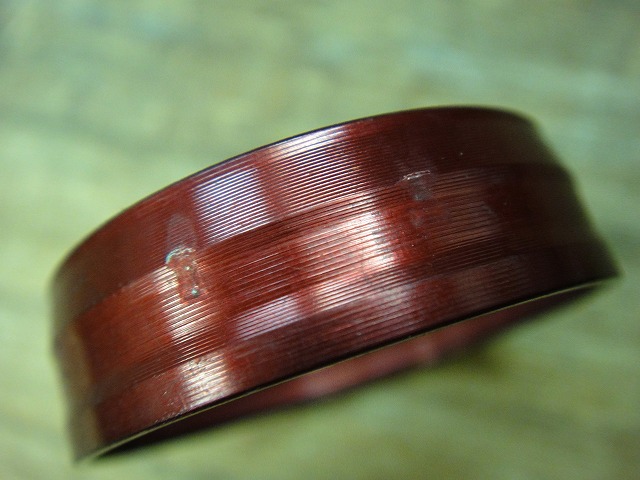
↑ If spoke tension is adequate, the carbon spoke head presses firmly against the ring, so it basically won't rotate from vibration.
In fact, there are no traces of lateral sliding wear on this spoke ring.
When you have anti-rotation features on the spoke ring, the contact point with the spoke head is always in the same spot, which I think is bad in the long run.
You apply a certain type of grease to the outer edge of this ring and press it onto the hub, and I offset the phase so the contact point would be on a part of the ring that hasn't worn.
Carbon spoke tension (strictly speaking, nipple tightening amount) above a certain threshold doesn't significantly affect the wheel's ride feel thanks to Mavic's so-called compression structure.
Maybe that shop came up with "the R-SYS is a wheel that's built loose" based on this, but first, build a wheel with proper centering before spouting off about it.
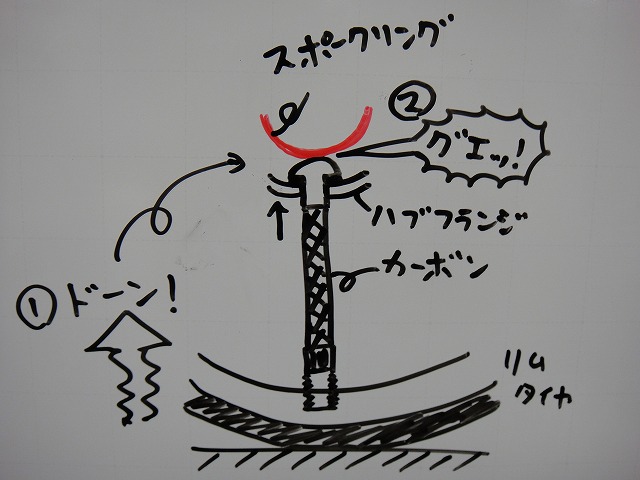
Regarding spoke tightening on this self-proclaimed compression structure: even if spoke tension above a threshold doesn't affect ride feel, it does affect hub-side noise.
Even though carbon spokes have virtually zero elongation, the buckling-direction stress changes how hard the spoke head presses on the spoke ring, even above that threshold.
(The amount of "Boom!" versus "Creak!" changes)
This is empirically clear.
I've seen many examples where tightening the spokes eliminated hub noise.
Especially the front wheel, where both sides have this structure—it's very noticeable.
The customer apparently came to my shop after reading several past R-SYS articles I've written on this blog. Whether we actually end up servicing it or not, perhaps this article will also help out some other R-SYS owners somewhere.