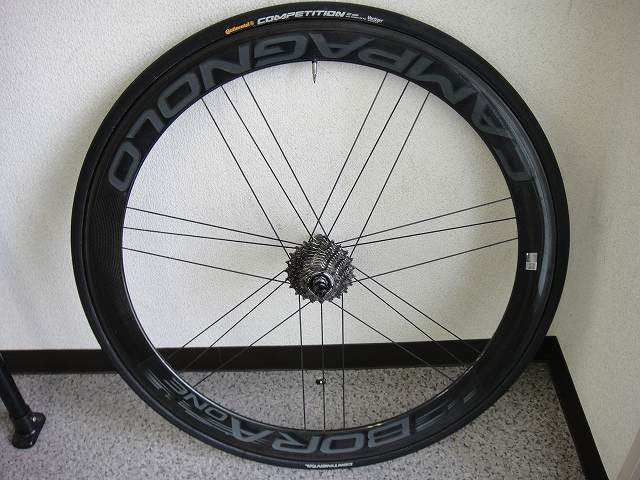
A customer dropped off a Bora One rear wheel with us.
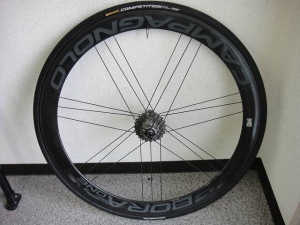
Apparently they got a Garmin speed/cadence sensor tangled up in it,
but the spokes looked fine.
The wheel had incredibly high spoke tension, so small "dents" in the spokes
get stretched back out and become hard to spot.
Because of that, I palpated the spokes pretty thoroughly,
but they were totally okay.
There was one spot with barely any contact, and since it had internal nipples,
I had to remove the tire to turn the nipple.
While I was at it, I checked the centering and found it was just slightly off,
but pretty much spot-on overall.
No play in the hub either, and the moment I picked up the wheel
I reflexively checked if the right endnut was loose—
and it wasn't.
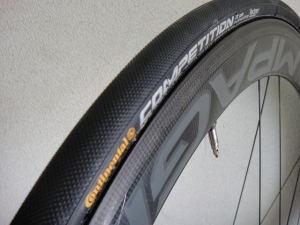
The tire was a Continental Competition 22, which I replaced with a new one of the same model.
Unlike the Competition 19, the 22 slides onto the rim right out of the box.
(At least when I do it. The inner diameter is still on the snug side.)
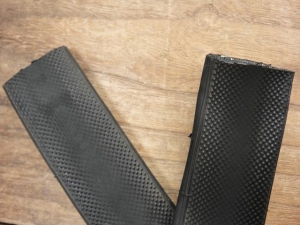
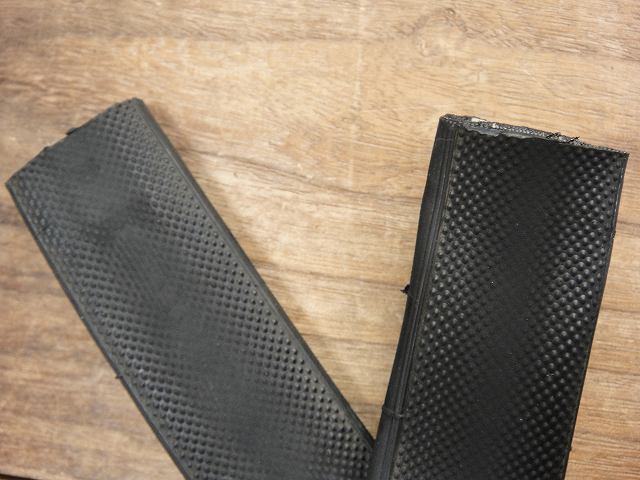
The customer said they didn't want the old tire,
so I made sure twice—"I'm throwing this away, okay?"—before I cut into it.
To be honest, if that were my own tire with this much wear, I'd still use it.
But it's the customer's tire and they said to dispose of it,
so I have to.
I'm a rim cement guy, so I can't use tires that still have tape on the base fabric,
but since I'm throwing this away, it doesn't matter.
Actually, at a shop I worked at before,
there was this not-very-bright staff member who would reuse tires customers threw away
and then brag to other customers (regulars) about his "spoils of war,"
and even after being told off he wouldn't listen,
so I got into the habit of cutting disposed tires with scissors.
Also, unrelated, but apparently an acquaintance of this wheel's owner
had a tubular tire glued down with tape at that same shop,
and someone forgot to peel off the release film across about half the rim,
so the tire didn't stick properly and they had a real rough time with it.
I don't know who did it, but seriously, die trying.
Cutting with scissors just needs to make it unusable,
so you don't actually need to cut all the way through, but
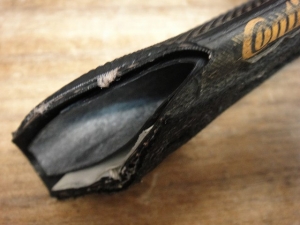
I cut it anyway so I could write about the internal structure.
Continental's race tires use butyl tube specs.
Unlike latex tubes, the advantage is air retention, but
butyl tubes are considered inferior to latex tubes in terms of flexible deformation inside the tire,
which is why high-end tubular tires rarely use them.
Yet despite that, this tire seems to have a higher cornering limit than most
(or really, almost all) other high-end tubular tires,
so the tread compound must be really something special.
For tubular tire repairs, you locate the puncture spot, cut the base fabric underneath it,
expose the stitching, unpick the stitching to get the tube out,
apply an ultra-thin patch (made by Maruni) for tubular repairs,
resew the tire base, and glue the fabric back. Done.
It sounds simple written out like that, but it's extremely difficult.
There's a repair kit from a company called VELOX (Velox)
but I can't really trust the rubber cement that comes with it.
It's better to use Maruni's dedicated patch and cement.
Let the cement dry well before applying the patch (important).
The thimble and needle are standard,
but the thread is a bit special—it's the perfect thickness for sewing tubulars,
so you could say the VELOX kit is really only worth buying for the thread.
The case comes in plastic or metal versions, and the plastic case is pretty rare.
As a specific quirk of this tire,
there's white fabric sewn on so the tube doesn't rub against the stitching.
This is tricky—trying to resew it while restoring it to original condition is basically impossible.
Also, Continental tire casings have something like wax applied,
making it extremely difficult to re-glue the base fabric.
Vittoria and others can be glued with rim cement,
but Continental can't.
For all these reasons, repairing a punctured Competition is incredibly difficult.
If you can repair one, you've earned your tubular repair license.
The company's Grand Prix 4000S tubular doesn't show the stitching even when you touch the base fabric.
That's because it has a very unusual design with the stitching on the tread side.
Also, TUFO tires are basically tubes that are press-fitted to the carcass,
so they're more like a "tube with a tread" than an actual tire.
These are structurally impossible to repair for a puncture.
Apparently they got a Garmin speed/cadence sensor tangled up in it,
but the spokes looked fine.
The wheel had incredibly high spoke tension, so small "dents" in the spokes
get stretched back out and become hard to spot.
Because of that, I palpated the spokes pretty thoroughly,
but they were totally okay.
There was one spot with barely any contact, and since it had internal nipples,
I had to remove the tire to turn the nipple.
While I was at it, I checked the centering and found it was just slightly off,
but pretty much spot-on overall.
No play in the hub either, and the moment I picked up the wheel
I reflexively checked if the right endnut was loose—
and it wasn't.

The tire was a Continental Competition 22, which I replaced with a new one of the same model.
Unlike the Competition 19, the 22 slides onto the rim right out of the box.
(At least when I do it. The inner diameter is still on the snug side.)
The customer said they didn't want the old tire,
so I made sure twice—"I'm throwing this away, okay?"—before I cut into it.
To be honest, if that were my own tire with this much wear, I'd still use it.
But it's the customer's tire and they said to dispose of it,
so I have to.
I'm a rim cement guy, so I can't use tires that still have tape on the base fabric,
but since I'm throwing this away, it doesn't matter.
Actually, at a shop I worked at before,
there was this not-very-bright staff member who would reuse tires customers threw away
and then brag to other customers (regulars) about his "spoils of war,"
and even after being told off he wouldn't listen,
so I got into the habit of cutting disposed tires with scissors.
Also, unrelated, but apparently an acquaintance of this wheel's owner
had a tubular tire glued down with tape at that same shop,
and someone forgot to peel off the release film across about half the rim,
so the tire didn't stick properly and they had a real rough time with it.
I don't know who did it, but seriously, die trying.
Cutting with scissors just needs to make it unusable,
so you don't actually need to cut all the way through, but

I cut it anyway so I could write about the internal structure.
Continental's race tires use butyl tube specs.
Unlike latex tubes, the advantage is air retention, but
butyl tubes are considered inferior to latex tubes in terms of flexible deformation inside the tire,
which is why high-end tubular tires rarely use them.
Yet despite that, this tire seems to have a higher cornering limit than most
(or really, almost all) other high-end tubular tires,
so the tread compound must be really something special.
For tubular tire repairs, you locate the puncture spot, cut the base fabric underneath it,
expose the stitching, unpick the stitching to get the tube out,
apply an ultra-thin patch (made by Maruni) for tubular repairs,
resew the tire base, and glue the fabric back. Done.
It sounds simple written out like that, but it's extremely difficult.
There's a repair kit from a company called VELOX (Velox)
but I can't really trust the rubber cement that comes with it.
It's better to use Maruni's dedicated patch and cement.
Let the cement dry well before applying the patch (important).
The thimble and needle are standard,
but the thread is a bit special—it's the perfect thickness for sewing tubulars,
so you could say the VELOX kit is really only worth buying for the thread.
The case comes in plastic or metal versions, and the plastic case is pretty rare.
As a specific quirk of this tire,
there's white fabric sewn on so the tube doesn't rub against the stitching.
This is tricky—trying to resew it while restoring it to original condition is basically impossible.
Also, Continental tire casings have something like wax applied,
making it extremely difficult to re-glue the base fabric.
Vittoria and others can be glued with rim cement,
but Continental can't.
For all these reasons, repairing a punctured Competition is incredibly difficult.
If you can repair one, you've earned your tubular repair license.
The company's Grand Prix 4000S tubular doesn't show the stitching even when you touch the base fabric.
That's because it has a very unusual design with the stitching on the tread side.
Also, TUFO tires are basically tubes that are press-fitted to the carcass,
so they're more like a "tube with a tread" than an actual tire.
These are structurally impossible to repair for a puncture.