A customer brought in a Cosmic Carbon SLR rear wheel for service.
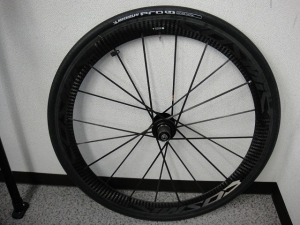
It's an ambitious design that's been discontinued—the inverted-V shaped carbon spokes connect directly between opposite sides of the rim, just grazing the flanges.
I can guess why it was discontinued, but I really love this wheel
and I regret parting with mine.
Overall it's not a "well-behaved" wheel,
but given the right usage and conditions, it's an exceptionally fast wheel.
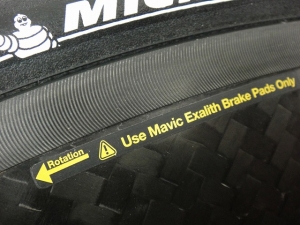
Since this is the second generation SLR, the rim side is in Exalith (original model) spec.
Being a rear wheel there's no confusion possible,
but the rim side orientation is manufacturer-specified.
Anyone who chuckles to themselves every time they see the Michelin Man
must have accidentally seen something they shouldn't have the other day.
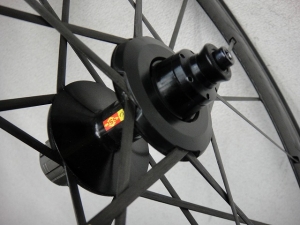
The reason for the service was "noise coming from the bike when leaning left."
Indeed, spoke tension had loosened.
From the customer's account of its history, it's clear the wheel wasn't in original condition.
I needed to increase tension on the non-drive side,
but unfortunately the wheel was also out of true (centered).
Since centering becomes harder as tension increases,
in cases like this I first increase the drive side rather than the non-drive side I want to tighten.
Then I increase the non-drive side only enough to recover the lost centering,
but a troublesome issue emerged.
As with normal wheels, the lateral rim movement per nipple rotation
is smaller on the drive side than the non-drive side.
This is because the spokes on the drive side hang more directly below the rim,
but with this wheel, for some reason tightening the non-drive side slightly
required considerably more tightening on the drive side.
As a result, I managed to get decent tension on the non-drive side while keeping it centered,
but the drive side likely won't tolerate major adjustments like this again.
The nipple threads have used up most of their adjustment range (though minor truing adjustments are still possible).
Also, the wheel had a non-original cartridge bearing that wasn't in great condition,
so I replaced the bearing as well.
The new bearing is also non-original but has a different seal design.
Though new, when I opened it the grease didn't look great,
so I replaced it with different grease and also adjusted the viscosity.
(This viscosity thing refers to how firm the grease is,
but this kanji doesn't come up in normal character conversion)
Like the R-SYS, non-steel spoke wheels
will show changes in pedaling stiffness and noise generation
from spoke tension adjustment (technically just nipple tightening).
Actually the customer didn't bring it in today,
but they contacted me saying the noise disappeared, so I'm writing this now.
The customer said "the pedaling feel became like a completely different bike,"
but sorry—I wasn't deliberately aiming for that. It's mainly a side effect of
tightening the drive-side nipples as part of the centering correction...
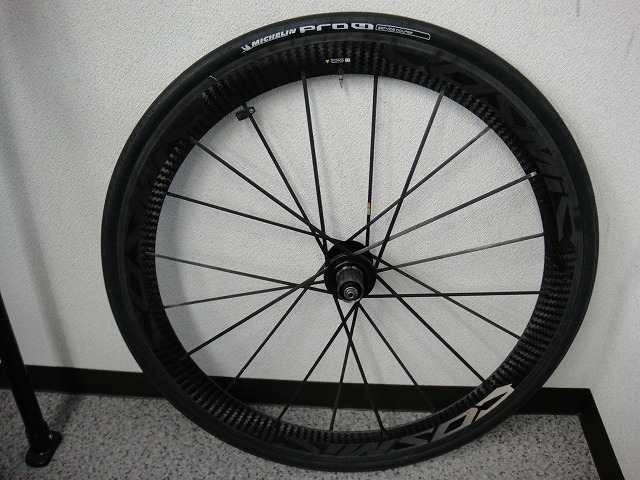
It's an ambitious design that's been discontinued—the inverted-V shaped carbon spokes connect directly between opposite sides of the rim, just grazing the flanges.
I can guess why it was discontinued, but I really love this wheel
and I regret parting with mine.
Overall it's not a "well-behaved" wheel,
but given the right usage and conditions, it's an exceptionally fast wheel.
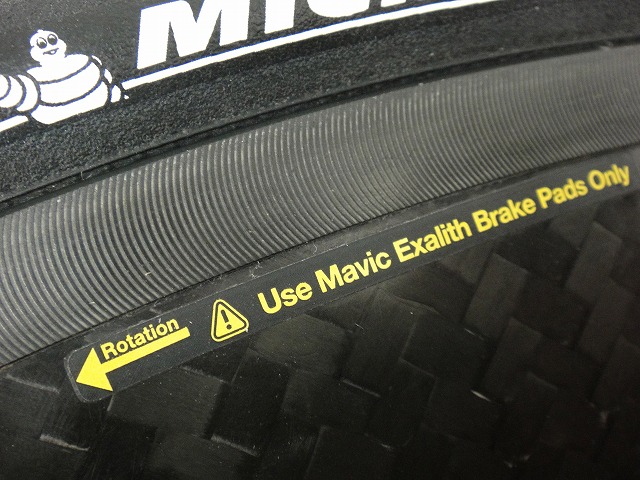
Since this is the second generation SLR, the rim side is in Exalith (original model) spec.
Being a rear wheel there's no confusion possible,
but the rim side orientation is manufacturer-specified.
Anyone who chuckles to themselves every time they see the Michelin Man
must have accidentally seen something they shouldn't have the other day.
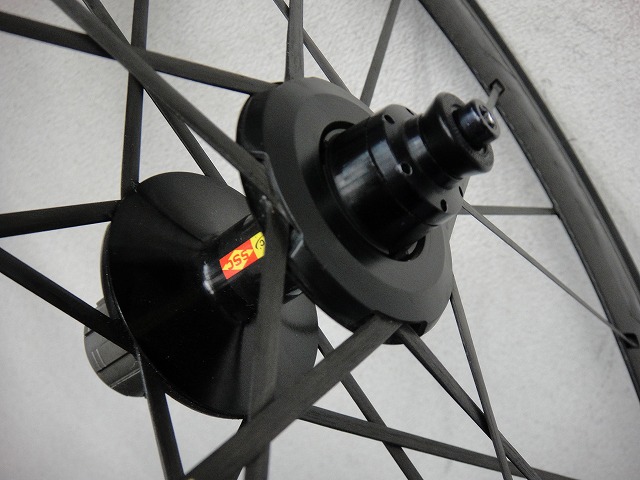
The reason for the service was "noise coming from the bike when leaning left."
Indeed, spoke tension had loosened.
From the customer's account of its history, it's clear the wheel wasn't in original condition.
I needed to increase tension on the non-drive side,
but unfortunately the wheel was also out of true (centered).
Since centering becomes harder as tension increases,
in cases like this I first increase the drive side rather than the non-drive side I want to tighten.
Then I increase the non-drive side only enough to recover the lost centering,
but a troublesome issue emerged.
As with normal wheels, the lateral rim movement per nipple rotation
is smaller on the drive side than the non-drive side.
This is because the spokes on the drive side hang more directly below the rim,
but with this wheel, for some reason tightening the non-drive side slightly
required considerably more tightening on the drive side.
As a result, I managed to get decent tension on the non-drive side while keeping it centered,
but the drive side likely won't tolerate major adjustments like this again.
The nipple threads have used up most of their adjustment range (though minor truing adjustments are still possible).
Also, the wheel had a non-original cartridge bearing that wasn't in great condition,
so I replaced the bearing as well.
The new bearing is also non-original but has a different seal design.
Though new, when I opened it the grease didn't look great,
so I replaced it with different grease and also adjusted the viscosity.
(This viscosity thing refers to how firm the grease is,
but this kanji doesn't come up in normal character conversion)
Like the R-SYS, non-steel spoke wheels
will show changes in pedaling stiffness and noise generation
from spoke tension adjustment (technically just nipple tightening).
Actually the customer didn't bring it in today,
but they contacted me saying the noise disappeared, so I'm writing this now.
The customer said "the pedaling feel became like a completely different bike,"
but sorry—I wasn't deliberately aiming for that. It's mainly a side effect of
tightening the drive-side nipples as part of the centering correction...