A customer brought in a WH-9000-C24 WO model for service.
Both front and rear had just the slightest centering drift,
but the kind that disappears naturally once you true them knowing which direction it's going.
The customer wanted me to take a look inside the hub,
so I opened it up to check, but found no issues.
Dura-Ace hubs have extremely smooth rotation.
What's really impressive isn't just the smoothness itself,
but how long that initial performance persists.
Given the price point, the ball grade (sphericity) probably isn't exceptionally high,
so I suspect there's careful engineering in the ball race finish and the contact angle with the balls.
That said, despite the smooth rotation, there is a heavy, sluggish quality to it—
like kneading honey—but that's unavoidable given the hub structure.
From the 7900 onward, Dura-Ace hubs adopted a mechanism with knurled (ridged) adjustment like the old "touring head" style,
where you manually align the knurls to eliminate play.
With this design, the ball bearing adjustment is easy to work on,
but you can only adjust the bearing preload in one-ridge increments.
Usually what happens is
you get to a point where there's no side play but the rotation feels a bit sluggish,
and loosening the knurl by one ridge causes the shaft to rattle side to side,
so you have to set it back to just one ridge tighter.
The first ridge where side play completely disappears becomes the best (or rather, least-bad) position.
Since one complete knurl rotation has 40 notches,
each notch represents 9° of rotation.
Anyone who's done ball bearing adjustment on classic hubs using two hub spanners
or adjusted Campagnolo hub bearings knows
that in the final fine-tuning, you'd never rotate the ball race by as much as 9° all at once.
But if you add too many notches, the ridges become too fine
and you get problems with slipping or stripping.
Rather than pursuing the ultimate in light rotation,
Dura-Ace hubs aim for a design where anyone can achieve the same result no matter who adjusts them.
Also, some of that sluggish rotation quality comes from robust sealing.
Chris King hubs are also cup-and-cone style with sluggish rotation,
but they spin lighter than Dura-Ace.
That said, when you open them up, you're struck by how flimsy the waterproofing seals are.
Because of their superior external structure and precision,
their waterproofing is among the best in hubs overall.
The high waterproofing performance and long-term maintenance of initial characteristics,
plus the easy adjustment to get the bearing preload in the ballpark,
are all good features, but
the tradeoff of "light rotation" is something I can't quite get past.
In pro racing environments, reliable hubs that don't cause problems
and are easy to repair are the first requirement, so I understand the reasoning...
About the latter—"easy to repair"—
that ties back to what I wrote recently about the WH-7800 hub where the rim nipple disappeared.
Just having "theoretically good performance" isn't enough.
With the classic 7700 hub, you can chase down ultimate light rotation,
but it requires appropriate experience and skill.
Especially tricky is the front hub with its stepped aluminum axle.
The HB-7710 is an essentially identical steel axle version.
The 7710 series is Dura-Ace track-oriented, so
there's no freehub body version for the rear,
but the front hub can be repurposed by converting to a hollow axle plus quick-release.
Since the rear hub isn't a freehub, it's not FH-7710 but rather
HB-7710-R in model designation.
Note that just because it starts with "HB-" doesn't mean it's a front hub.
By the way, the 7710 hub has small flanges, while the 7600 has large flanges.
The HB-7710-F, given the nature of track racing, has extremely high hub rotation performance
but has looser seals, requiring somewhat delicate handling.
If you understand that and accept that it only comes in 28, 32, and 36-hole versions,
then you can make an ultra-low-resistance-rotating Dura-Ace front hub.
Though it's essentially the same as the 7400 front hub from before the 7700,
taken to its ultimate adjustment.
If you put something like that in a pro road racing environment,
you'd immediately get worm holes and rust, so
the current Dura-Ace hub's sluggish rotation makes sense for a reason.
Still, if you can properly maintain it yourself,
the lower durability of such parts doesn't really become a problem.
As for which way to go, user opinions might vary,
but for manufacturers—especially big ones like Shimano—
durability is definitely the answer.
Small custom parts makers who understand their products are high-strung tools requiring careful handling
might prioritize sharp performance first instead.
Not always, but posts this long
usually contain risky content, so I'd normally cut it down,
but I'll run with this one today.
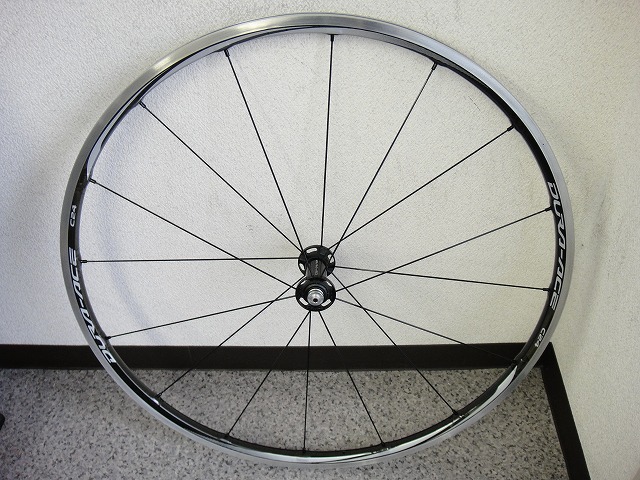
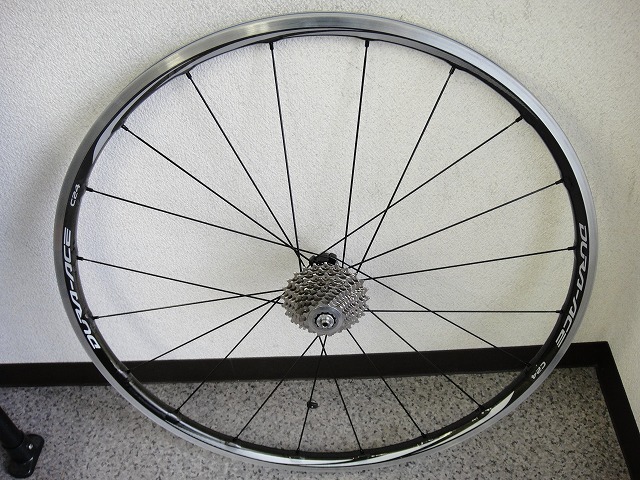
Both front and rear had just the slightest centering drift,
but the kind that disappears naturally once you true them knowing which direction it's going.
The customer wanted me to take a look inside the hub,
so I opened it up to check, but found no issues.
Dura-Ace hubs have extremely smooth rotation.
What's really impressive isn't just the smoothness itself,
but how long that initial performance persists.
Given the price point, the ball grade (sphericity) probably isn't exceptionally high,
so I suspect there's careful engineering in the ball race finish and the contact angle with the balls.
That said, despite the smooth rotation, there is a heavy, sluggish quality to it—
like kneading honey—but that's unavoidable given the hub structure.
From the 7900 onward, Dura-Ace hubs adopted a mechanism with knurled (ridged) adjustment like the old "touring head" style,
where you manually align the knurls to eliminate play.
With this design, the ball bearing adjustment is easy to work on,
but you can only adjust the bearing preload in one-ridge increments.
Usually what happens is
you get to a point where there's no side play but the rotation feels a bit sluggish,
and loosening the knurl by one ridge causes the shaft to rattle side to side,
so you have to set it back to just one ridge tighter.
The first ridge where side play completely disappears becomes the best (or rather, least-bad) position.
Since one complete knurl rotation has 40 notches,
each notch represents 9° of rotation.
Anyone who's done ball bearing adjustment on classic hubs using two hub spanners
or adjusted Campagnolo hub bearings knows
that in the final fine-tuning, you'd never rotate the ball race by as much as 9° all at once.
But if you add too many notches, the ridges become too fine
and you get problems with slipping or stripping.
Rather than pursuing the ultimate in light rotation,
Dura-Ace hubs aim for a design where anyone can achieve the same result no matter who adjusts them.
Also, some of that sluggish rotation quality comes from robust sealing.
Chris King hubs are also cup-and-cone style with sluggish rotation,
but they spin lighter than Dura-Ace.
That said, when you open them up, you're struck by how flimsy the waterproofing seals are.
Because of their superior external structure and precision,
their waterproofing is among the best in hubs overall.
The high waterproofing performance and long-term maintenance of initial characteristics,
plus the easy adjustment to get the bearing preload in the ballpark,
are all good features, but
the tradeoff of "light rotation" is something I can't quite get past.
In pro racing environments, reliable hubs that don't cause problems
and are easy to repair are the first requirement, so I understand the reasoning...
About the latter—"easy to repair"—
that ties back to what I wrote recently about the WH-7800 hub where the rim nipple disappeared.
Just having "theoretically good performance" isn't enough.
With the classic 7700 hub, you can chase down ultimate light rotation,
but it requires appropriate experience and skill.
Especially tricky is the front hub with its stepped aluminum axle.
The HB-7710 is an essentially identical steel axle version.
The 7710 series is Dura-Ace track-oriented, so
there's no freehub body version for the rear,
but the front hub can be repurposed by converting to a hollow axle plus quick-release.
Since the rear hub isn't a freehub, it's not FH-7710 but rather
HB-7710-R in model designation.
Note that just because it starts with "HB-" doesn't mean it's a front hub.
By the way, the 7710 hub has small flanges, while the 7600 has large flanges.
The HB-7710-F, given the nature of track racing, has extremely high hub rotation performance
but has looser seals, requiring somewhat delicate handling.
If you understand that and accept that it only comes in 28, 32, and 36-hole versions,
then you can make an ultra-low-resistance-rotating Dura-Ace front hub.
Though it's essentially the same as the 7400 front hub from before the 7700,
taken to its ultimate adjustment.
If you put something like that in a pro road racing environment,
you'd immediately get worm holes and rust, so
the current Dura-Ace hub's sluggish rotation makes sense for a reason.
Still, if you can properly maintain it yourself,
the lower durability of such parts doesn't really become a problem.
As for which way to go, user opinions might vary,
but for manufacturers—especially big ones like Shimano—
durability is definitely the answer.
Small custom parts makers who understand their products are high-strung tools requiring careful handling
might prioritize sharp performance first instead.
Not always, but posts this long
usually contain risky content, so I'd normally cut it down,
but I'll run with this one today.