Continental's Giro tubular tires have come back in stock.
Or rather, I confirmed they were back at the distributor
so I nervously ordered a small quantity.

My prediction that the specs might change due to the long stock shortage turned out to be correct.
The Japanese distributor's stock has white lettering/orange label with a non-removable valve core design,
but over the past year or so, customers have been bringing in tires purchased from who-knows-where
with silver lettering and a removable valve core design.
This isn't a case of two different specs existing—
the former is simply the old spec and the latter is the new spec.
It seems the reason the switch to new specs hasn't happened is just because
the Japanese distributor has a large inventory of the old spec.
I did wonder if this might be due to a distributor-specific order (Japan-exclusive specs, etc.),
but the product number on the box is the same for both old and new versions, so that's not it.
Product numbers change if there's any difference in sidewall color or tire width.
With the Giro, only the amber sidewall/23C spec exists,
but ideally the product number should change depending on whether the valve core is removable or not.
However, since this is a complete transition rather than a concurrent sale, they kept the same product number.
Speaking of which, regarding this article I wrote before (→here)
I received this comment:
"At the bike shop I frequent, the owner told me that tires bought from overseas online retailers
are made with different compositions tailored to that country's asphalt ingredients—
something about limestone or whatever—so domestic tires last longer.
Is that really true?
He also said the reason he doesn't carry Continental tires is because
they start off good but degrade quickly and lose performance,
but honestly, I can't wrap my head around either of these claims based on my actual experience.
The Panaracer Tourkinist I bought from that shop
I'm replacing about once every six months anyway."
As far as sports bike tires go,
I've never heard of the same model being manufactured at two or more different locations,
and while there might be different versions for dry vs. wet conditions,
I've never heard of a tire specifically made for "Japanese road surfaces" for example.
Even if a tire claimed to be made that way,
if there's no separate version for "European road surfaces,"
then they're not really making different versions.
So I'd say he was either just making excuses for not carrying Continental,
or he simply wanted to sell the Panaracer in front of him.
The reason our shop decided to carry Continental was
because about 80% of the WO (wire-on) wheels customers bring in
are fitted with Grand Prix 4000S tires.
I mean 80% have the specific model "Grand Prix 4000S"
rather than just "Continental" in general.
The widths were about 70% 23C and 30% 25C, but recently we see more 25C.
(This is partly because our customers tend to be racing-oriented)
The customer from the previous article also
specifically switched from the tires that came stock on the wheelset
to Grand Prix 4000S,
and when we're trying to capture this replacement demand,
just stocking Grand Prix 4000S can practically cover 80% of it,
so not carrying them would be a missed opportunity.
On the customer side too,
after trying various brands like Panaracer, Vittoria, Schwalbe, and Michelin,
they've settled on the Grand Prix 4000S through their own experience,
and as a result, "about 80% of the WO wheels brought to our shop come with Grand Prix 4000S,"
so it's not me saying Continental is good—it's the customers.

Oops, I got way off track there.
It's the "Grand Prix 4000S (and 4000S II)" that are good.
Writing it that way makes it sound like the Giro isn't particularly good though.
Most of Continental's tubular tires are made in Germany,
but the Giro is manufactured in Thailand.
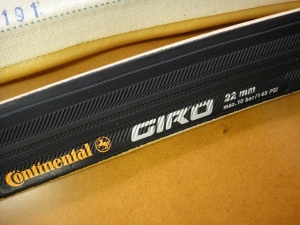
It's got the new label now.
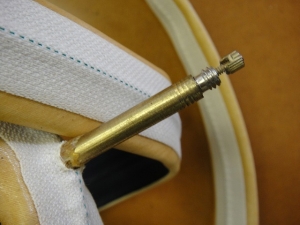
The valve core is now removable.
Being able to use an adapter valve is really a lifesaver.
The amber sidewall seems to be avoided except on rims with a classic look,
but the new spec Giro is
recommended as an affordable way to keep a spare tubular tire
that already has a long valve stem.
Or rather, I confirmed they were back at the distributor
so I nervously ordered a small quantity.
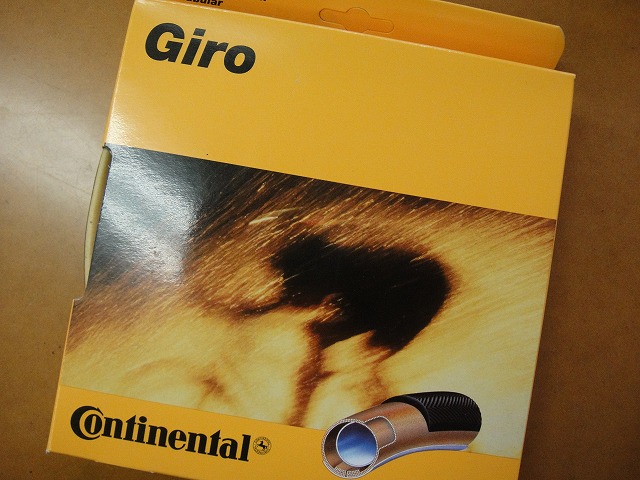
My prediction that the specs might change due to the long stock shortage turned out to be correct.
The Japanese distributor's stock has white lettering/orange label with a non-removable valve core design,
but over the past year or so, customers have been bringing in tires purchased from who-knows-where
with silver lettering and a removable valve core design.
This isn't a case of two different specs existing—
the former is simply the old spec and the latter is the new spec.
It seems the reason the switch to new specs hasn't happened is just because
the Japanese distributor has a large inventory of the old spec.
I did wonder if this might be due to a distributor-specific order (Japan-exclusive specs, etc.),
but the product number on the box is the same for both old and new versions, so that's not it.
Product numbers change if there's any difference in sidewall color or tire width.
With the Giro, only the amber sidewall/23C spec exists,
but ideally the product number should change depending on whether the valve core is removable or not.
However, since this is a complete transition rather than a concurrent sale, they kept the same product number.
Speaking of which, regarding this article I wrote before (→here)
I received this comment:
"At the bike shop I frequent, the owner told me that tires bought from overseas online retailers
are made with different compositions tailored to that country's asphalt ingredients—
something about limestone or whatever—so domestic tires last longer.
Is that really true?
He also said the reason he doesn't carry Continental tires is because
they start off good but degrade quickly and lose performance,
but honestly, I can't wrap my head around either of these claims based on my actual experience.
The Panaracer Tourkinist I bought from that shop
I'm replacing about once every six months anyway."
As far as sports bike tires go,
I've never heard of the same model being manufactured at two or more different locations,
and while there might be different versions for dry vs. wet conditions,
I've never heard of a tire specifically made for "Japanese road surfaces" for example.
Even if a tire claimed to be made that way,
if there's no separate version for "European road surfaces,"
then they're not really making different versions.
So I'd say he was either just making excuses for not carrying Continental,
or he simply wanted to sell the Panaracer in front of him.
The reason our shop decided to carry Continental was
because about 80% of the WO (wire-on) wheels customers bring in
are fitted with Grand Prix 4000S tires.
I mean 80% have the specific model "Grand Prix 4000S"
rather than just "Continental" in general.
The widths were about 70% 23C and 30% 25C, but recently we see more 25C.
(This is partly because our customers tend to be racing-oriented)
The customer from the previous article also
specifically switched from the tires that came stock on the wheelset
to Grand Prix 4000S,
and when we're trying to capture this replacement demand,
just stocking Grand Prix 4000S can practically cover 80% of it,
so not carrying them would be a missed opportunity.
On the customer side too,
after trying various brands like Panaracer, Vittoria, Schwalbe, and Michelin,
they've settled on the Grand Prix 4000S through their own experience,
and as a result, "about 80% of the WO wheels brought to our shop come with Grand Prix 4000S,"
so it's not me saying Continental is good—it's the customers.

Oops, I got way off track there.
It's the "Grand Prix 4000S (and 4000S II)" that are good.
Writing it that way makes it sound like the Giro isn't particularly good though.
Most of Continental's tubular tires are made in Germany,
but the Giro is manufactured in Thailand.
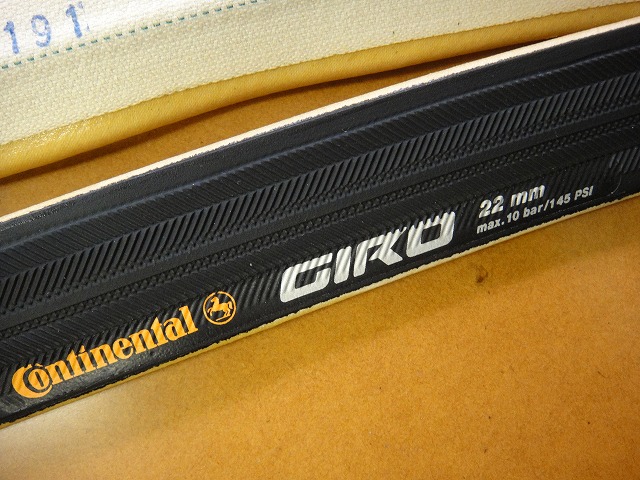
It's got the new label now.

The valve core is now removable.
Being able to use an adapter valve is really a lifesaver.
The amber sidewall seems to be avoided except on rims with a classic look,
but the new spec Giro is
recommended as an affordable way to keep a spare tubular tire
that already has a long valve stem.