A customer brought in a WH-RS80 for service.

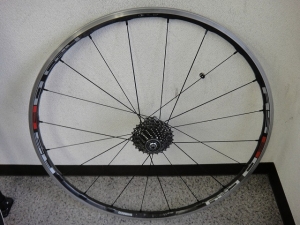
The rear wheel just needed some minor centering and truing—no real issues there.
The problem was the front wheel. It had just been trued at another shop,
but the centering was completely off.
We're talking way beyond manufacturer shipping standards.
There was also significant radial runout.
At its worst, the rim was warped inward by about a third of the brake zone's vertical width,
which put us right at the edge of whether we could even properly set the brake shoes.
You could see the problem just by spinning the wheel without it on a truing stand.
(The front wheel wobbles all over the place as it rotates)
This is the result of "obsessing over lateral runout correction alone".
I sometimes get requests from amateurs saying "I was truing and now it's in some weird condition, can you fix it?"
This is exactly that kind of situation.
I thought to myself, "Yeah, this person's never actually built a wheel properly."
There's barely any difference between
"fine-tuning minor runout near the end of wheel building" and
"truing an older wheel that has some runout".
(Of course, in the latter case there's the possibility of rim bending, warping, or denting from age)
Whether you're truing or building wheels, the work is fundamentally the same—removing runout
to the builder's acceptable tolerance threshold within the material's (mainly the rim's) precision limits.
Sometimes you hear people say "I can true wheels but I can't build them"—
frankly, that's impossible.
If someone can't build wheels properly, they can't do a proper truing either.
This case proves it—there's abnormal radial runout coming directly from the truing work.
The lateral runout got corrected reasonably well, but even that tolerance was set low.
The centering was off too, and it's a mistake not to check after doing major truing work (it usually shifts).
What really bothers me about this situation is something I'm always saying:
"The customer paid labor twice".
Based on what I heard from the customer,
they either didn't ride it after getting it back, or rode it once at most.
It's basically wheel-hopping between shops.
I understand there was some defect in the rim from age and use.
I couldn't get it to "like new" either this time.
But I got it to a point where no runout could be detected anywhere except the defect area,
which is significantly better than when they brought it in.
I also showed the customer how the rim was rattling against the centering gauge before,
and now it clicks into place perfectly.
If you're reading this—and I think you probably are—
please keep improving your craft (sorry for the top-down tone).
This work quality isn't worth the labor charge you collected.
I won't go into specifics because I don't want to single you out,
but I'm well aware that the shop environment you're working in is broken.
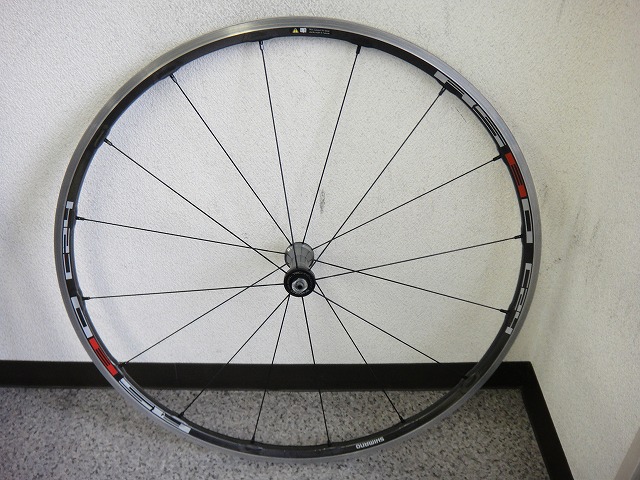

The rear wheel just needed some minor centering and truing—no real issues there.
The problem was the front wheel. It had just been trued at another shop,
but the centering was completely off.
We're talking way beyond manufacturer shipping standards.
There was also significant radial runout.
At its worst, the rim was warped inward by about a third of the brake zone's vertical width,
which put us right at the edge of whether we could even properly set the brake shoes.
You could see the problem just by spinning the wheel without it on a truing stand.
(The front wheel wobbles all over the place as it rotates)
This is the result of "obsessing over lateral runout correction alone".
I sometimes get requests from amateurs saying "I was truing and now it's in some weird condition, can you fix it?"
This is exactly that kind of situation.
I thought to myself, "Yeah, this person's never actually built a wheel properly."
There's barely any difference between
"fine-tuning minor runout near the end of wheel building" and
"truing an older wheel that has some runout".
(Of course, in the latter case there's the possibility of rim bending, warping, or denting from age)
Whether you're truing or building wheels, the work is fundamentally the same—removing runout
to the builder's acceptable tolerance threshold within the material's (mainly the rim's) precision limits.
Sometimes you hear people say "I can true wheels but I can't build them"—
frankly, that's impossible.
If someone can't build wheels properly, they can't do a proper truing either.
This case proves it—there's abnormal radial runout coming directly from the truing work.
The lateral runout got corrected reasonably well, but even that tolerance was set low.
The centering was off too, and it's a mistake not to check after doing major truing work (it usually shifts).
What really bothers me about this situation is something I'm always saying:
"The customer paid labor twice".
Based on what I heard from the customer,
they either didn't ride it after getting it back, or rode it once at most.
It's basically wheel-hopping between shops.
I understand there was some defect in the rim from age and use.
I couldn't get it to "like new" either this time.
But I got it to a point where no runout could be detected anywhere except the defect area,
which is significantly better than when they brought it in.
I also showed the customer how the rim was rattling against the centering gauge before,
and now it clicks into place perfectly.
If you're reading this—and I think you probably are—
please keep improving your craft (sorry for the top-down tone).
This work quality isn't worth the labor charge you collected.
I won't go into specifics because I don't want to single you out,
but I'm well aware that the shop environment you're working in is broken.