Another wheel day (and so on).

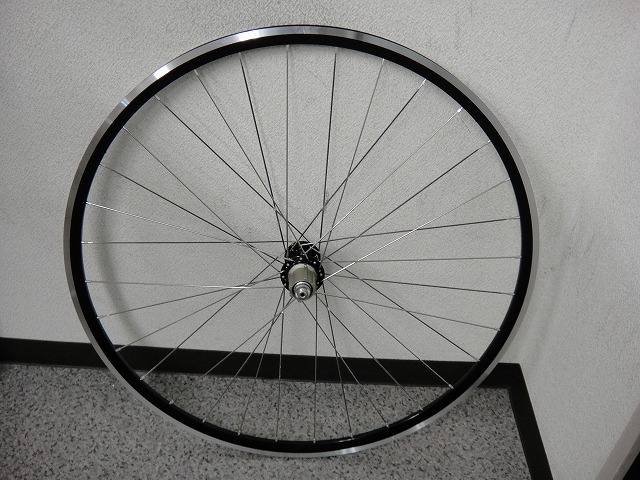
I built the rear wheel for Nomu Lab Wheel #5.
It's 32H.
Based on the customer's desired specifications and intended use,
they wanted the spoke tension to be quite firm,
so I tensioned it a bit higher than usual.
My philosophy on wheelbuilding is this:
"The total spoke tension distributed between the hub and rim
is shared among all the spokes based on spoke count."
For example, if the total spoke tension is 360,
a 36H wheel would have 10 tension per spoke,
24H would be 15 per spoke,
and 12H would be 30 per spoke.
For front wheels, I divide the total tension by all spokes as described,
but for rear wheels, I divide all the tension on the drive side by the number of drive-side spokes,
and all the tension on the non-drive side by the number of non-drive spokes.
(This approach is necessary for asymmetric spoke count builds)
On this blog,
the number that appears when I measure spoke tension with a meter is "first spoke tension,"
and the number I get by converting that into a reference table is
"second spoke tension" (←this is spoke tension in the general sense),
but the conversion curve from first to second tension is not a straight line—it's curved,
so even if spoke count is cut in half,
the second spoke tension doesn't simply double.
However, the fewer spokes there are,
the higher the per-spoke tension needs to be to achieve a given stiffness,
so roughly speaking, the fewer spokes you have,
the higher the tension needs to be,
and the opposite is equally true.
Earlier I mentioned that
when I divide the total spoke tension by the number of spokes,
I wanted to quantify exactly how much to increase or decrease tension
depending on spoke count differences.
This was the spark for the concept of "third spoke tension,"
but I can't write about that here.
Anyway, since this rear wheel is 32H,
compared to the typical 24H wheels I build,
it works out right to tension it slightly less firm.
(If you take this logic to its conclusion,
a rim's stated maximum spoke tension would need to be specified per hole count.)
So what did I actually do today?
"I tensioned a 32H rim using the tension I'd normally use for 24H."
I have confidence from experience that it's fine,
but with an unfamiliar rim, I wouldn't do something like this.
Where I'd normally use total 360 tension for 24H—
giving 15 tension per spoke—
I kept it at 15 tension per spoke and did 32H instead,
which comes out to total 480 tension.
(※For rear wheels that's roughly right side 18 and left side 12.)
Normally I'm conscious of total 360 tension, and for 32H I'd build it at 11.25 per spoke.
I want to quantify this "total" figure,
but if I could hit my target precisely, I'd have it figured out well enough to write about the third spoke tension stuff here too...
Just think of it as using a ballpark guideline that I keep in mind.
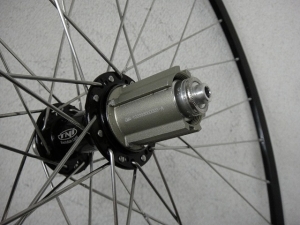
The spokes are semi-competition grade, built in a 48-cross pattern with tie wires.
The freebody is Campagnolo.
Edit:
I said it was 46-cross, but it's actually 48-cross. Sorry about that.
For very shallow rims (like the Ambrosio Chrono 20 in current production),
sometimes I can't get long enough spokes, so I give up on 8-spoke drive-side builds,
but with the XR200 rim, on almost all hubs—as long as it's not an old PowerTap hub—
32H 8-spoke builds are possible.
I built the rear wheel for Nomu Lab Wheel #5.
It's 32H.
Based on the customer's desired specifications and intended use,
they wanted the spoke tension to be quite firm,
so I tensioned it a bit higher than usual.
My philosophy on wheelbuilding is this:
"The total spoke tension distributed between the hub and rim
is shared among all the spokes based on spoke count."
For example, if the total spoke tension is 360,
a 36H wheel would have 10 tension per spoke,
24H would be 15 per spoke,
and 12H would be 30 per spoke.
For front wheels, I divide the total tension by all spokes as described,
but for rear wheels, I divide all the tension on the drive side by the number of drive-side spokes,
and all the tension on the non-drive side by the number of non-drive spokes.
(This approach is necessary for asymmetric spoke count builds)
On this blog,
the number that appears when I measure spoke tension with a meter is "first spoke tension,"
and the number I get by converting that into a reference table is
"second spoke tension" (←this is spoke tension in the general sense),
but the conversion curve from first to second tension is not a straight line—it's curved,
so even if spoke count is cut in half,
the second spoke tension doesn't simply double.
However, the fewer spokes there are,
the higher the per-spoke tension needs to be to achieve a given stiffness,
so roughly speaking, the fewer spokes you have,
the higher the tension needs to be,
and the opposite is equally true.
Earlier I mentioned that
when I divide the total spoke tension by the number of spokes,
I wanted to quantify exactly how much to increase or decrease tension
depending on spoke count differences.
This was the spark for the concept of "third spoke tension,"
but I can't write about that here.
Anyway, since this rear wheel is 32H,
compared to the typical 24H wheels I build,
it works out right to tension it slightly less firm.
(If you take this logic to its conclusion,
a rim's stated maximum spoke tension would need to be specified per hole count.)
So what did I actually do today?
"I tensioned a 32H rim using the tension I'd normally use for 24H."
I have confidence from experience that it's fine,
but with an unfamiliar rim, I wouldn't do something like this.
Where I'd normally use total 360 tension for 24H—
giving 15 tension per spoke—
I kept it at 15 tension per spoke and did 32H instead,
which comes out to total 480 tension.
(※For rear wheels that's roughly right side 18 and left side 12.)
Normally I'm conscious of total 360 tension, and for 32H I'd build it at 11.25 per spoke.
I want to quantify this "total" figure,
but if I could hit my target precisely, I'd have it figured out well enough to write about the third spoke tension stuff here too...
Just think of it as using a ballpark guideline that I keep in mind.
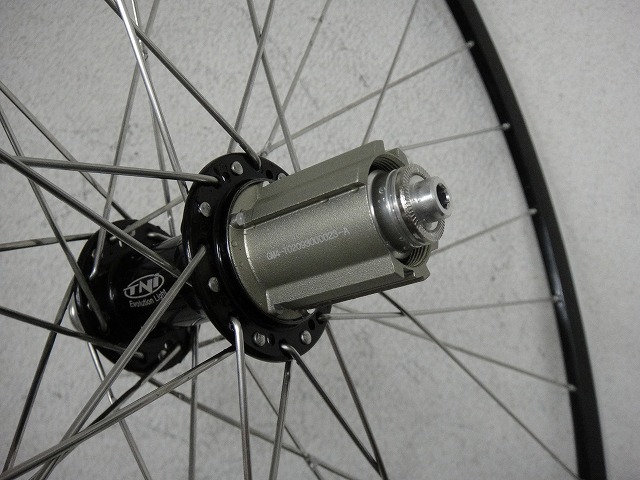
The spokes are semi-competition grade, built in a 48-cross pattern with tie wires.
The freebody is Campagnolo.
Edit:
I said it was 46-cross, but it's actually 48-cross. Sorry about that.
For very shallow rims (like the Ambrosio Chrono 20 in current production),
sometimes I can't get long enough spokes, so I give up on 8-spoke drive-side builds,
but with the XR200 rim, on almost all hubs—as long as it's not an old PowerTap hub—
32H 8-spoke builds are possible.