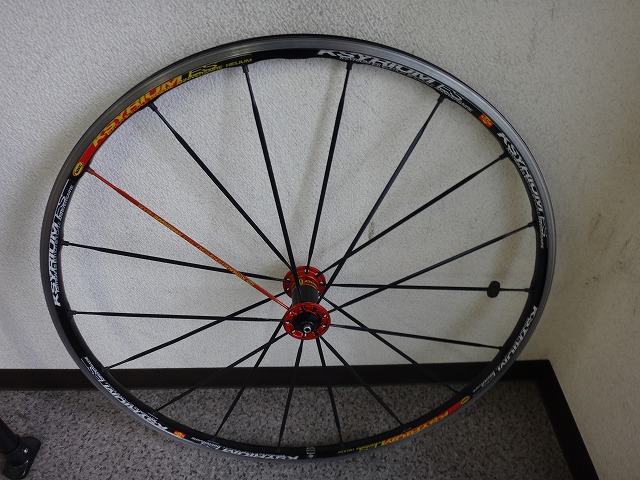
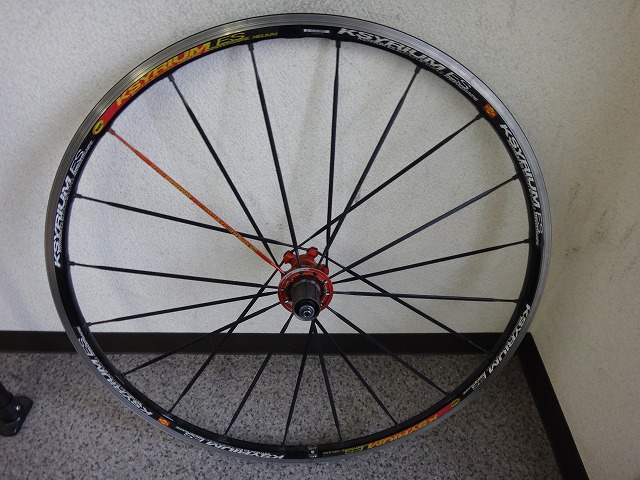
I received a Ksyrium Edition Special from a customer for service.
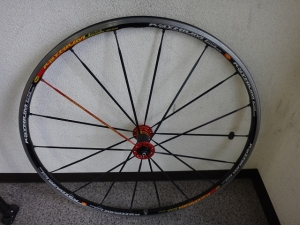
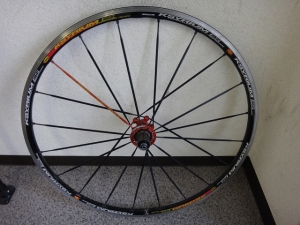
They're requesting an overhaul and truing work.
The world's first factory-built wheel wasn't
Mavic's "Helium" that came out in 1996...but
it's certainly true that the Helium was the explosive bestseller that became the catalyst for factory-built wheels to become commonplace.
The Ksyrium ES is a model that came out in 2006
to commemorate the 10th anniversary of Helium (Mavic's factory-built wheel business).
Which means, although I don't know exactly when this one started being used,
there's a possibility it's been in service for around 9 years.
While the rim's braking surface is still quite usable,
you can see the beginning of round wear from braking.
The red paint on the hub (doesn't look like anodizing) is also chipped in places.
Since the customer requested an overhaul, regardless of condition
I'll need to disassemble it, but if just greasing will suffice,
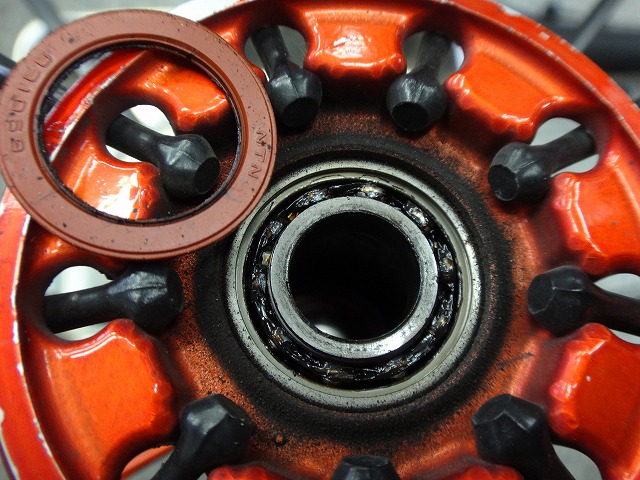
there's no need to remove the bearings, so I started by just peeling back the seals.
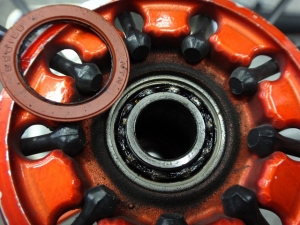
Wow, fantastic. Despite appearances, they're completely undamaged.
After cleaning and greasing, the rotation came back like new.
I asked the customer, and they've never replaced the bearings.
(NTN 6901LU bearings are installed—
these are what Mavic commonly uses)
Some people say Mavic cartridge bearings feel heavy in rotation, but that's only natural.
It's just a result of Mavic weighing slight gains in rolling resistance against waterproof and dustproof performance—
choosing contact-type seals as their conclusion.
If that bothers you, you can always swap them out.
I can't say this with certainty or proof, but if these had non-contact seals instead,
they would probably be damaged by now and need replacement.
There's a strange disconnect between the overall sense of rugged, heavy use
that radiates from the wheel and the actual condition of the bearings.
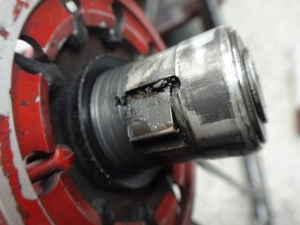
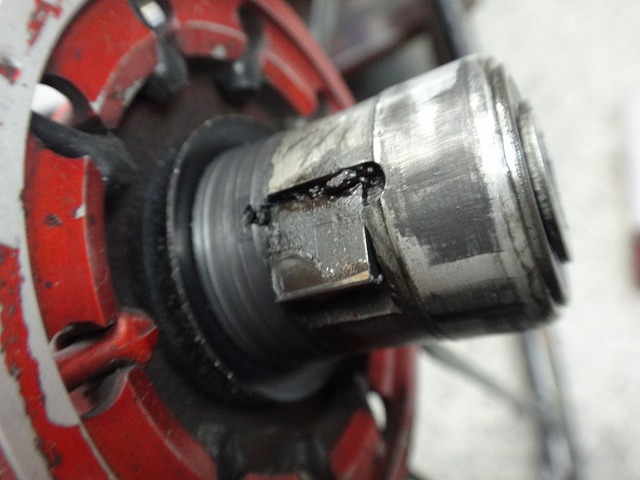
Where the freewheel body and hub shell overlap,
dust and sand got caught and spun around
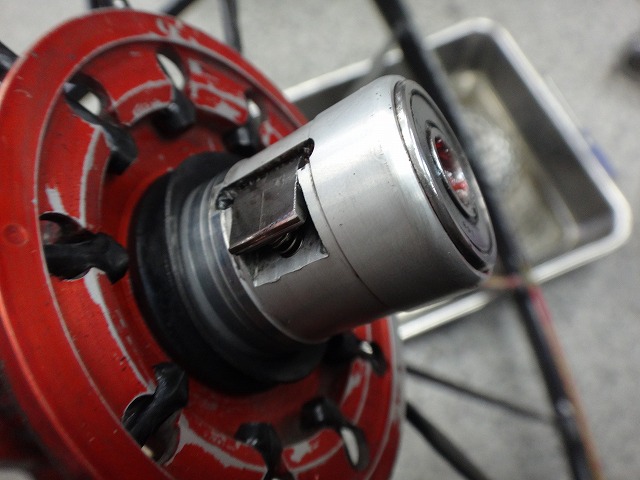
creating what looked like scuffing damage, but...
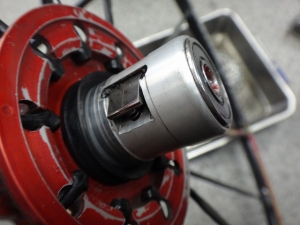
there wasn't. It just looked that way.
(There is a little on the inside)
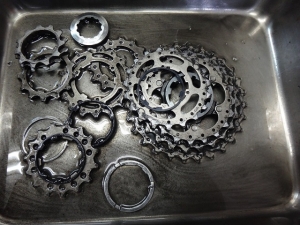
↑Most of the dirt that fell into the tray was
external oil residue and such, not from inside the hub.
This time I used
the cheaper parts cleaner I mentioned in a recent post.
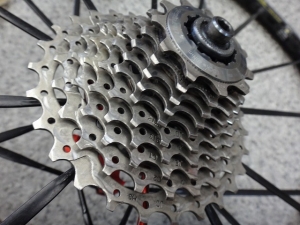
I did my best cleaning the sprocket as far as possible,
but since there's notable wear, I couldn't get it looking like new.
When I checked the centering beforehand, it was only slightly off front and rear,
so as I trued in the corrective direction, it naturally came back into true.
They're requesting an overhaul and truing work.
The world's first factory-built wheel wasn't
Mavic's "Helium" that came out in 1996...but
it's certainly true that the Helium was the explosive bestseller that became the catalyst for factory-built wheels to become commonplace.
The Ksyrium ES is a model that came out in 2006
to commemorate the 10th anniversary of Helium (Mavic's factory-built wheel business).
Which means, although I don't know exactly when this one started being used,
there's a possibility it's been in service for around 9 years.
While the rim's braking surface is still quite usable,
you can see the beginning of round wear from braking.
The red paint on the hub (doesn't look like anodizing) is also chipped in places.
Since the customer requested an overhaul, regardless of condition
I'll need to disassemble it, but if just greasing will suffice,
there's no need to remove the bearings, so I started by just peeling back the seals.
Wow, fantastic. Despite appearances, they're completely undamaged.
After cleaning and greasing, the rotation came back like new.
I asked the customer, and they've never replaced the bearings.
(NTN 6901LU bearings are installed—
these are what Mavic commonly uses)
Some people say Mavic cartridge bearings feel heavy in rotation, but that's only natural.
It's just a result of Mavic weighing slight gains in rolling resistance against waterproof and dustproof performance—
choosing contact-type seals as their conclusion.
If that bothers you, you can always swap them out.
I can't say this with certainty or proof, but if these had non-contact seals instead,
they would probably be damaged by now and need replacement.
There's a strange disconnect between the overall sense of rugged, heavy use
that radiates from the wheel and the actual condition of the bearings.
Where the freewheel body and hub shell overlap,
dust and sand got caught and spun around
creating what looked like scuffing damage, but...
there wasn't. It just looked that way.
(There is a little on the inside)
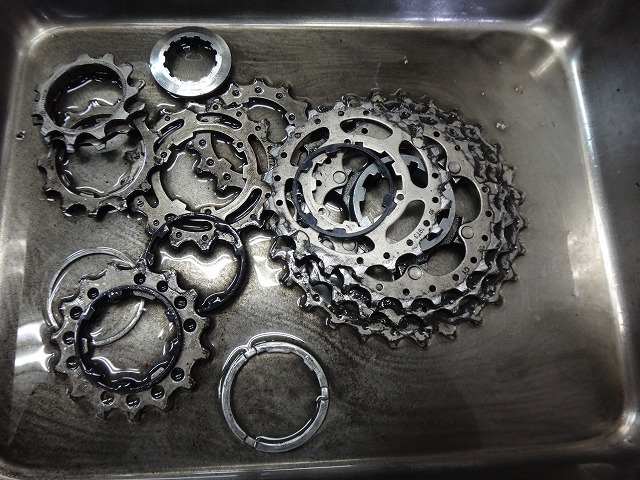
↑Most of the dirt that fell into the tray was
external oil residue and such, not from inside the hub.
This time I used
the cheaper parts cleaner I mentioned in a recent post.

I did my best cleaning the sprocket as far as possible,
but since there's notable wear, I couldn't get it looking like new.
When I checked the centering beforehand, it was only slightly off front and rear,
so as I trued in the corrective direction, it naturally came back into true.