Another wheel day (and so on).
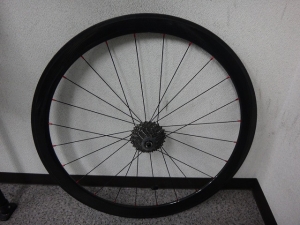
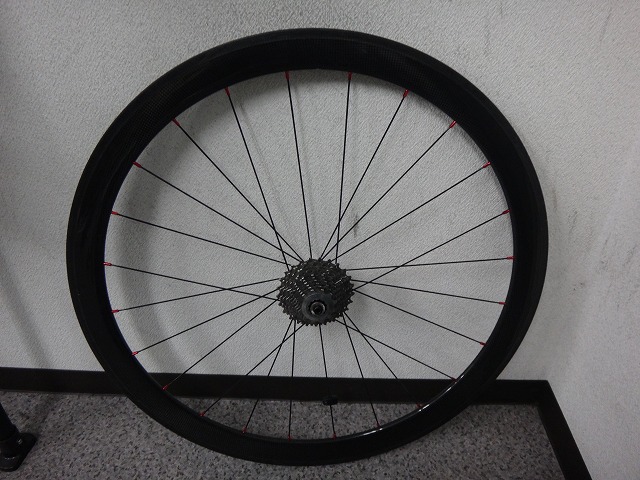
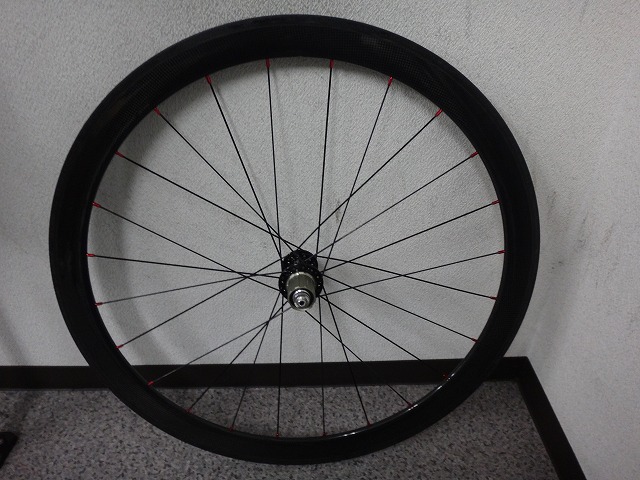
I received a 44mm high rim rear wheel from a customer.
The ride felt sloppy, so they wanted me to rebuild it with a tighter feel.
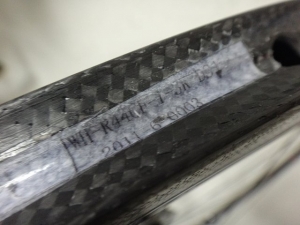
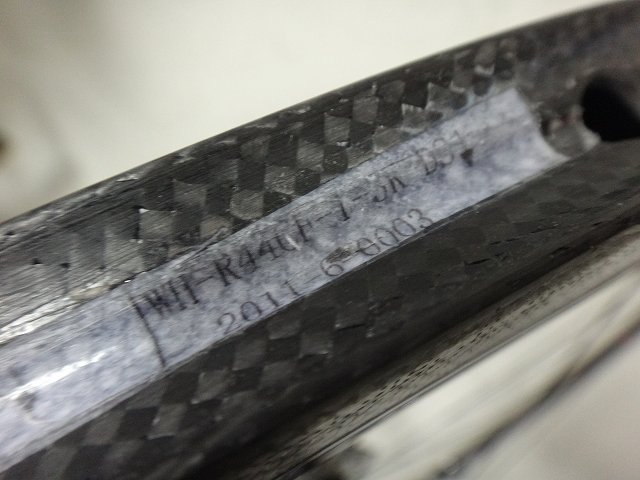
On the rim's outer label it says "WH-R44CF-T-3K DS↓", which means
"44mm high road carbon fiber tubular rim,
3K weave cosmetic carbon, build with drive side in the direction of the arrow."
It's from the same manufacturer as Planet X and stuff like that.
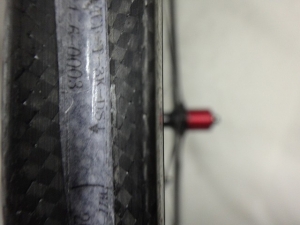
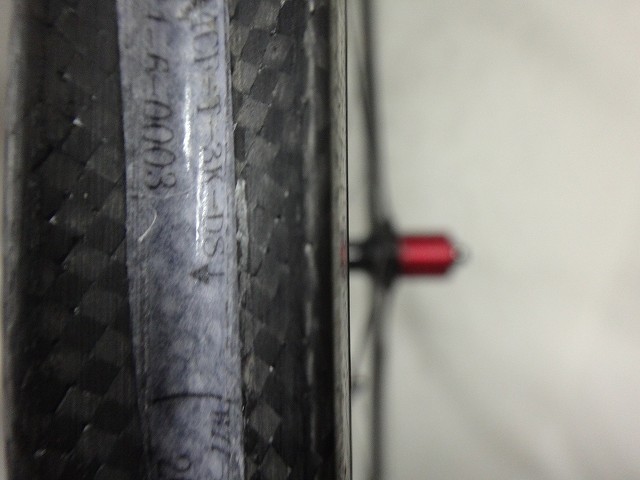
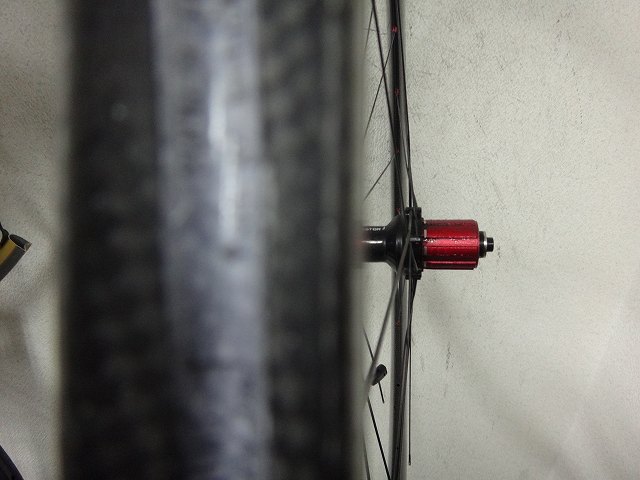
By the way, regarding the drive side specification,
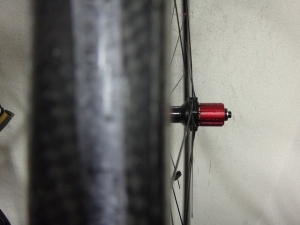
it was wrong before the rebuild.
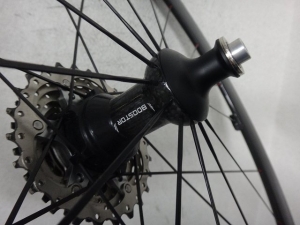
The hub is equivalent to a 40-hole design with straight spokes,
and it's a carbon-aluminum hybrid.
The right flange section is completely aluminum,
so the seam is finished with a black paint gradient.
On aluminum-lugged carbon frames where the joint is finished flush with the tubes,
and on carbon forks with aluminum crown sections,
this kind of painting job is commonly done to make it look all-carbon.
Making it entirely carbon would be impossible given the right flange geometry,
so this is what they did instead.
Wheels with non-drive-side radial spoking are almost invariably sloppy
(2:1 spoke patterns barely work,
and actually 2:1 spokes should never use tangent spoking on the non-drive side),
but this one isn't even tensioned well on the drive side, so it's hopeless.
When using equal spoke count on both sides with non-drive-side radial spoking,
the drive side needs ultra-high tension.
The non-drive side's spoke tension doesn't follow the drive side's very well, so
to get the non-drive side spokes to tension properly anyway, you need
・a rim design that can handle it
・straight spokes
These two are absolutely essential conditions.
Old Campagnolo 12-16H rear wheels fall into this category.
Steel-spoked Cosmic Carbon does too,
but since it's a carbon fairing over a low-profile rim with similar inner diameter to Open Pro,
it can't meet the "shorter spokes" condition, which is extremely effective
at limiting spoke deflection,
so the non-drive-side tension is somewhat on the low side.
They compensate for this by using larger spoke cross-section and 13-gauge thickness instead.
The "ultra-high tension" I wrote in red earlier—
150 kgf isn't even enough, so it's impossible without a rim specifically designed for it.
Even nipple-less spokes won't work,
so non-drive-side radial spoking isn't good for hand-built wheels.
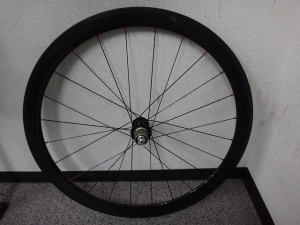
Done.
The spokes before the rebuild were Pillar square aero on both sides,
thicker and squarer than CX-RAY, so definitely higher spoke weight ratio.
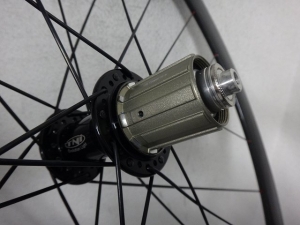
After the rebuild: 24H semi-comp 2-cross spoking.
I didn't write "24H" before the rebuild because
in my definition, "H (holes)" means the number of points where spokes exit at the hub flange base.
The pre-rebuild hub had 12 drive-side spokes coming out of 6 points,
so by my definition that's 6H.
Writing that as "18H total" would get confusing, so I avoided it.
Maybe "24H equivalent" or "24-spoke" would be the clearer way to express it.
I say "my definition" because with the pre-rebuild hub's drive side,
I use it as a 6H hub flange in the spoke length calculation formula.
Anyway, when I built it, I realized
this rim is extremely difficult to get spoke tension on.
You feel it while building. Honestly, I was pretty nervous about it.
If only the nipples had been internal, I could've tensioned it a bit more.
This is specific to this particular rim—
not all rims from the same manufacturer are like this.
That said, it's tensioned way better than before the rebuild.
But I couldn't get it to where I'd go "heh heh" (satisfied).
I will do spoke lacing. It's actually essential to limit non-drive-side spoke deflection.
The reason I haven't is I keep thinking I want to increase tension another quarter turn,
but I'm nervous and can't bring myself to do it.

↑Red aluminum nipples, but these are the same ones as before the rebuild.
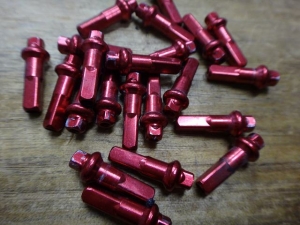
I normally don't reuse aluminum nipples,
but these have a design where you can grip them from the outside with a tool, so I reused them.
I received a 44mm high rim rear wheel from a customer.
The ride felt sloppy, so they wanted me to rebuild it with a tighter feel.
On the rim's outer label it says "WH-R44CF-T-3K DS↓", which means
"44mm high road carbon fiber tubular rim,
3K weave cosmetic carbon, build with drive side in the direction of the arrow."
It's from the same manufacturer as Planet X and stuff like that.
By the way, regarding the drive side specification,
it was wrong before the rebuild.

The hub is equivalent to a 40-hole design with straight spokes,
and it's a carbon-aluminum hybrid.
The right flange section is completely aluminum,
so the seam is finished with a black paint gradient.
On aluminum-lugged carbon frames where the joint is finished flush with the tubes,
and on carbon forks with aluminum crown sections,
this kind of painting job is commonly done to make it look all-carbon.
Making it entirely carbon would be impossible given the right flange geometry,
so this is what they did instead.
Wheels with non-drive-side radial spoking are almost invariably sloppy
(2:1 spoke patterns barely work,
and actually 2:1 spokes should never use tangent spoking on the non-drive side),
but this one isn't even tensioned well on the drive side, so it's hopeless.
When using equal spoke count on both sides with non-drive-side radial spoking,
the drive side needs ultra-high tension.
The non-drive side's spoke tension doesn't follow the drive side's very well, so
to get the non-drive side spokes to tension properly anyway, you need
・a rim design that can handle it
・straight spokes
These two are absolutely essential conditions.
Old Campagnolo 12-16H rear wheels fall into this category.
Steel-spoked Cosmic Carbon does too,
but since it's a carbon fairing over a low-profile rim with similar inner diameter to Open Pro,
it can't meet the "shorter spokes" condition, which is extremely effective
at limiting spoke deflection,
so the non-drive-side tension is somewhat on the low side.
They compensate for this by using larger spoke cross-section and 13-gauge thickness instead.
The "ultra-high tension" I wrote in red earlier—
150 kgf isn't even enough, so it's impossible without a rim specifically designed for it.
Even nipple-less spokes won't work,
so non-drive-side radial spoking isn't good for hand-built wheels.
Done.
The spokes before the rebuild were Pillar square aero on both sides,
thicker and squarer than CX-RAY, so definitely higher spoke weight ratio.
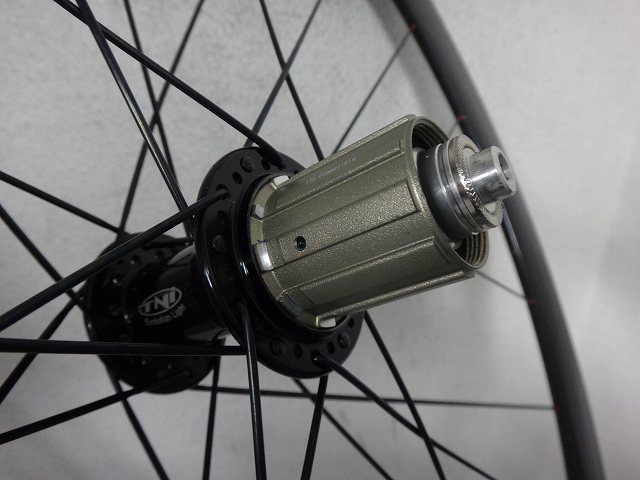
After the rebuild: 24H semi-comp 2-cross spoking.
I didn't write "24H" before the rebuild because
in my definition, "H (holes)" means the number of points where spokes exit at the hub flange base.
The pre-rebuild hub had 12 drive-side spokes coming out of 6 points,
so by my definition that's 6H.
Writing that as "18H total" would get confusing, so I avoided it.
Maybe "24H equivalent" or "24-spoke" would be the clearer way to express it.
I say "my definition" because with the pre-rebuild hub's drive side,
I use it as a 6H hub flange in the spoke length calculation formula.
Anyway, when I built it, I realized
this rim is extremely difficult to get spoke tension on.
You feel it while building. Honestly, I was pretty nervous about it.
If only the nipples had been internal, I could've tensioned it a bit more.
This is specific to this particular rim—
not all rims from the same manufacturer are like this.
That said, it's tensioned way better than before the rebuild.
But I couldn't get it to where I'd go "heh heh" (satisfied).
I will do spoke lacing. It's actually essential to limit non-drive-side spoke deflection.
The reason I haven't is I keep thinking I want to increase tension another quarter turn,
but I'm nervous and can't bring myself to do it.
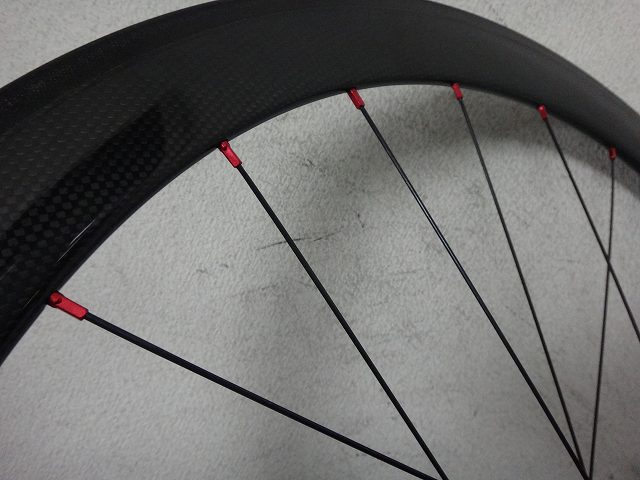
↑Red aluminum nipples, but these are the same ones as before the rebuild.
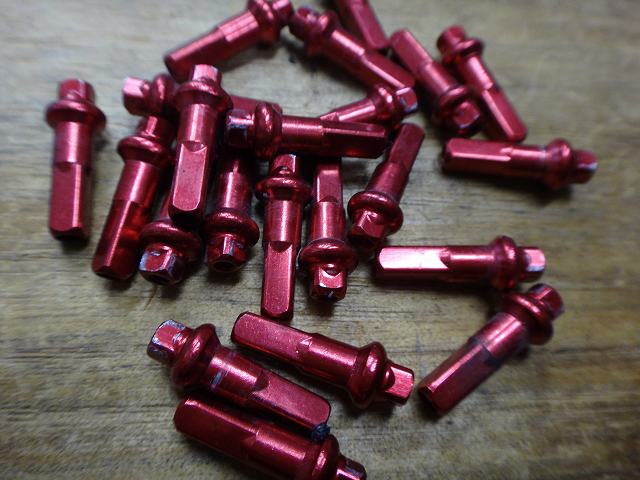
I normally don't reuse aluminum nipples,
but these have a design where you can grip them from the outside with a tool, so I reused them.