I'm going to write about how a rotating slide rule is extremely useful for comparing gear ratios.
But first.
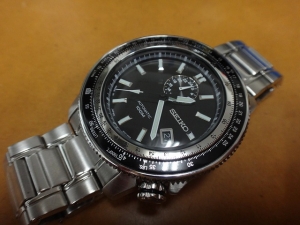
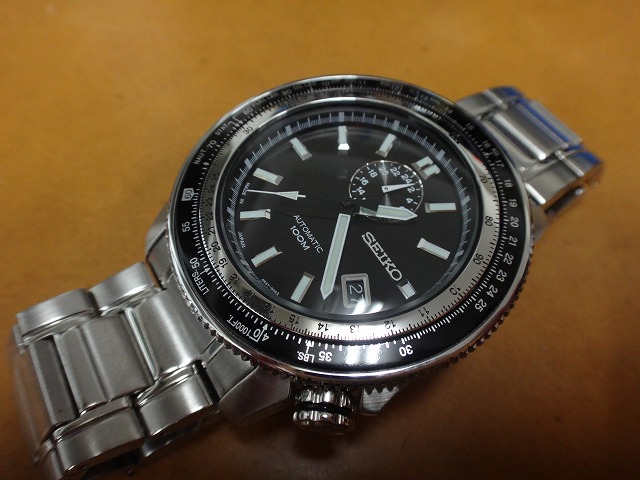
This is a mechanical watch from one of the re-imported Seiko brands called "Superior" that I own.
The date window is fine enough, but 45mm is a bit large.
The case diameter is 43mm, but since the bezel diameter is 45mm, it has a 45mm appearance.
If only it were 2mm smaller...
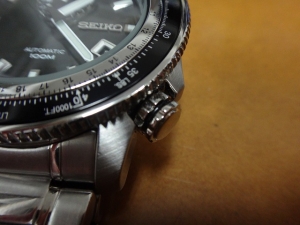
A fairly large crown is positioned at 4 o'clock.
It's not screw-down, and if you operate it without pulling it out, you can hand-wind the mainspring.
Since it's automatic, hand-winding isn't necessary with regular use, but it's convenient that you can just turn it when you do need to hand-wind.
Pulling it out once allows you to change the date, and pulling it out twice stops the seconds hand and allows you to adjust the time.
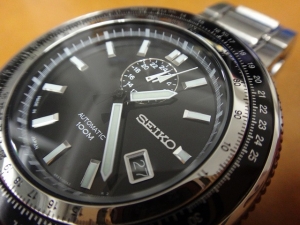
I don't particularly like 24-hour displays, but with a mechanical watch with a date, it's handy when the watch has stopped.
Being able to quickly tell whether it's 11 o'clock or 23 o'clock makes it easier to set the date correctly.
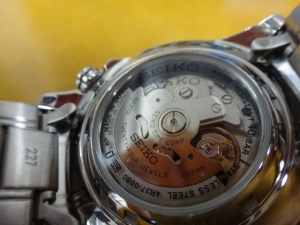
Skeleton caseback.
There's a U-shaped magnet marking, and while it's not enhanced magnetic resistance, perhaps it does have some anti-magnetic properties. With a skeleton back, though, it's questionable.
The movement is a 4R37 with 6 beats per second.
The seconds hand doesn't move smoothly—there's a ticking sensation—but I like that character to it.
The accuracy is what you'd expect, so I don't worry about it.
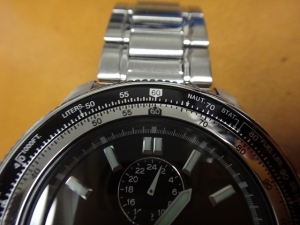
That covers the watch itself.
Now for the main topic: the rotating slide rule.
The case (hereafter "inner") and bezel (hereafter "outer") each have scales, giving it the functionality of a slide rule.
The inner scale is fixed, while the outer scale can be rotated freely.
This allows for multiplication, division, kilometers to miles conversion, liters to gallons conversion, and much more. But what's particularly convenient is that for multiplication and division, you can read approximate values off the scales at a glance.
I suppose this would be unnecessary for anyone skilled with an abacus, but let me actually try a two-digit multiplication.
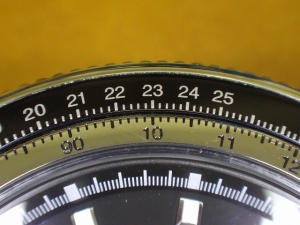
Let me calculate 23 × 17.
First, I align 23 on the outer scale with the 10 position on the inner scale.
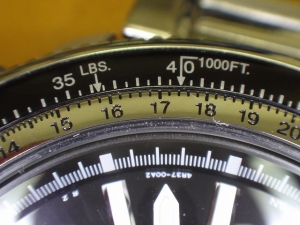
Then, looking at the 17 position on the inner scale from there, the outer scale points to around 39.
Depending on the magnitude of the digits, this 39 could be the answer multiplied by 10, 100, divided by 10, or something else.
This requires a bit of thought, but in this case we can tell it's around 390.
The actual answer is 391, and like an analog clock, the feature is that you can tell the approximate magnitude at a glance.
If you can read it as 3.9 for 2.3 × 1.7, or about 39 for 23 × 1.7, you'll find this quite useful.

Next let me calculate 37 × 19.
Similarly to before, I align 37 on the outer scale with the 10 position on the inner scale...
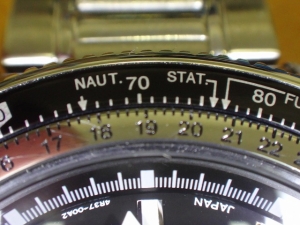
Then, looking at the 19 position on the inner scale, the outer scale shows a point between 700 and 710.
The actual answer is 703, so the scale position is quite accurate.
End of Part 1
The reason I split this into parts is that due to the nature of this blog, I can't attach more than one category to a single article.
But first.
This is a mechanical watch from one of the re-imported Seiko brands called "Superior" that I own.
The date window is fine enough, but 45mm is a bit large.
The case diameter is 43mm, but since the bezel diameter is 45mm, it has a 45mm appearance.
If only it were 2mm smaller...
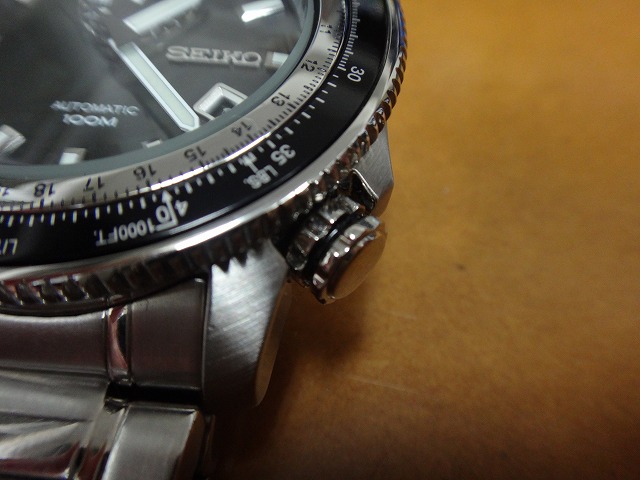
A fairly large crown is positioned at 4 o'clock.
It's not screw-down, and if you operate it without pulling it out, you can hand-wind the mainspring.
Since it's automatic, hand-winding isn't necessary with regular use, but it's convenient that you can just turn it when you do need to hand-wind.
Pulling it out once allows you to change the date, and pulling it out twice stops the seconds hand and allows you to adjust the time.
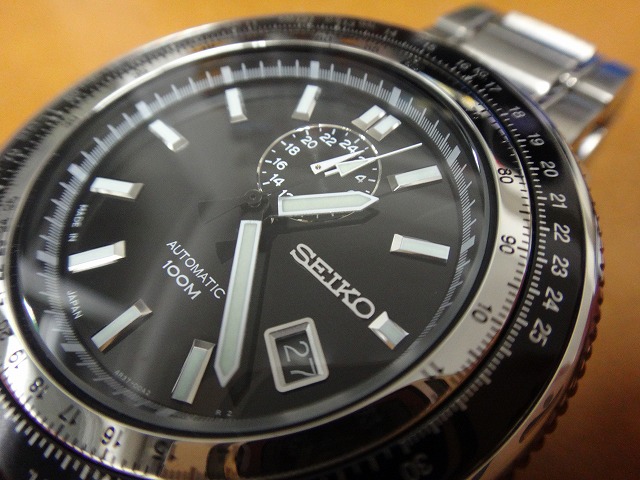
I don't particularly like 24-hour displays, but with a mechanical watch with a date, it's handy when the watch has stopped.
Being able to quickly tell whether it's 11 o'clock or 23 o'clock makes it easier to set the date correctly.
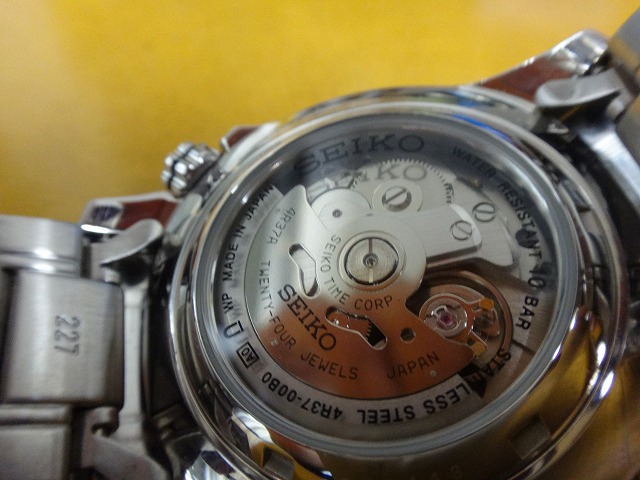
Skeleton caseback.
There's a U-shaped magnet marking, and while it's not enhanced magnetic resistance, perhaps it does have some anti-magnetic properties. With a skeleton back, though, it's questionable.
The movement is a 4R37 with 6 beats per second.
The seconds hand doesn't move smoothly—there's a ticking sensation—but I like that character to it.
The accuracy is what you'd expect, so I don't worry about it.

That covers the watch itself.
Now for the main topic: the rotating slide rule.
The case (hereafter "inner") and bezel (hereafter "outer") each have scales, giving it the functionality of a slide rule.
The inner scale is fixed, while the outer scale can be rotated freely.
This allows for multiplication, division, kilometers to miles conversion, liters to gallons conversion, and much more. But what's particularly convenient is that for multiplication and division, you can read approximate values off the scales at a glance.
I suppose this would be unnecessary for anyone skilled with an abacus, but let me actually try a two-digit multiplication.
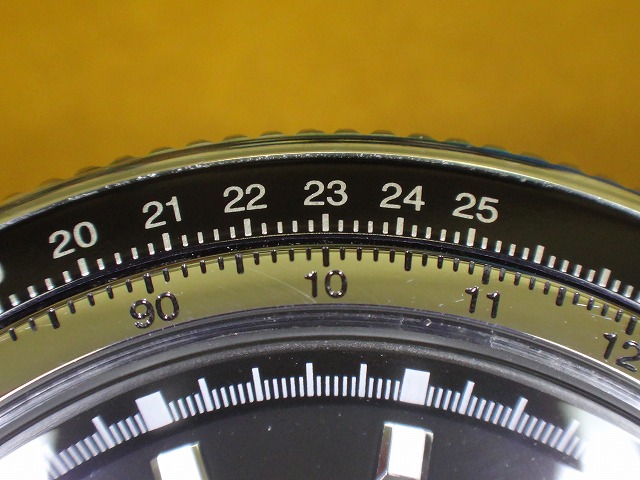
Let me calculate 23 × 17.
First, I align 23 on the outer scale with the 10 position on the inner scale.
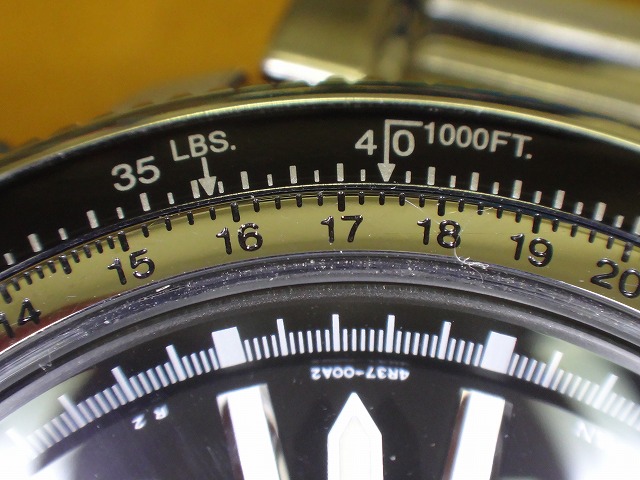
Then, looking at the 17 position on the inner scale from there, the outer scale points to around 39.
Depending on the magnitude of the digits, this 39 could be the answer multiplied by 10, 100, divided by 10, or something else.
This requires a bit of thought, but in this case we can tell it's around 390.
The actual answer is 391, and like an analog clock, the feature is that you can tell the approximate magnitude at a glance.
If you can read it as 3.9 for 2.3 × 1.7, or about 39 for 23 × 1.7, you'll find this quite useful.
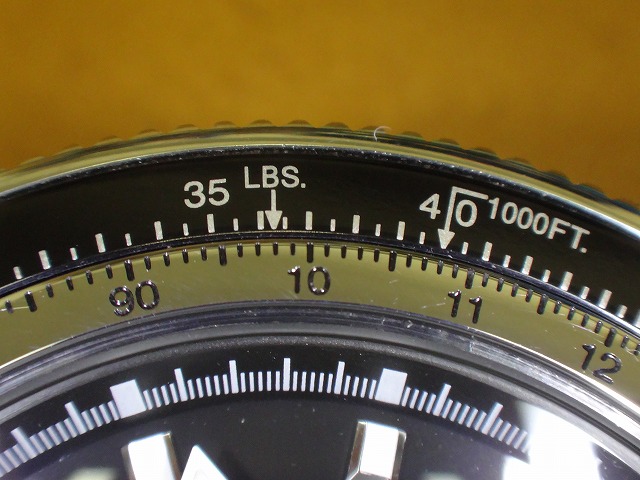
Next let me calculate 37 × 19.
Similarly to before, I align 37 on the outer scale with the 10 position on the inner scale...
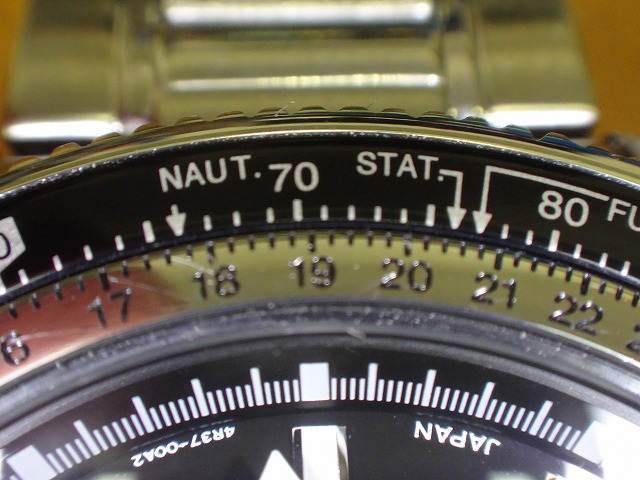
Then, looking at the 19 position on the inner scale, the outer scale shows a point between 700 and 710.
The actual answer is 703, so the scale position is quite accurate.
End of Part 1
The reason I split this into parts is that due to the nature of this blog, I can't attach more than one category to a single article.