The other day I wrote about Fostex, an audio brand,
and received some comments recommending headphones and such in relation to that.
First, about KOSS's KSC75
"The sound quality has nothing particularly noteworthy, but the fit is good," I was told.
Ah, that's the one where they cut off the PortaPro headband and made it an ear-hook style!
↑I'm writing roughly but I think I'm pretty much on the mark.
Since it's open-back, you can't use it on the train, but it seems OK for running.
The SportaPro (the naming is brilliant), a derivative model of the PortaPro,
is also open-back, and seeing things like that
I get the sense that in foreign countries they're
more tolerant of headphone sound leakage than in Japan.
About AKG's K412P
I received a comment saying "Boosting the mid-bass to artificially enhance the low end can't be called high-fidelity, but..."
However, since the resulting sound created by boosting certain frequency ranges
becomes the headphone's character, the fit and sound preference matter more than
the price being high or low, so there's really no saying.
This is also why my collection of headphones keeps growing.
I looked up the K412P for the first time, and it's similar to Sennheiser's PX100.
The successor model is the PX-100 II, and despite its shabby appearance
the sound is quite good. However, the foam on the demo units at stores
is invariably torn, so it might have low durability.
I think there's no problem if you handle it carefully personally, but...
To the person who commented "I got the SRH840."
Sorry for leaving the hub and rim you sent me as-is.
I was thinking of buying the SRH440 too (I listened to it over and over),
but the headband has a point-contact at the crown of the head so I decided against it.
The sound is monitor-like and good. Or rather, it's officially a monitor headphone.
I dislike coiled cords, but since it's recableable there's no problem.
What's mysterious to me is that headphone ear pads seem to follow an unwritten law
where "open-back uses velour fabric and closed-back uses synthetic leather."
Most headphones follow this rule, but
the SRH940 is closed-back with velour pads.
As for me, I'm not particular about the feel of synthetic leather,
but velour fabric can be a hit or miss.
Sometimes it feels itchy and uncomfortable.
Also, unrelated to that, 10 months ago I received
a comment saying "I want the SRH1840." That does look like the HD650, doesn't it?
If I were buying something for around 50,000 yen, it would be a tough choice between that and Philips' X1.
I received a comment asking "Have you auditioned the NW-ZX1?"
I did audition it. The headphones connected were the MDR-1R MK2.
The sound has a lot of spaciousness, very nice.
It might sound better than some half-hearted stationary setups.
Walkman keeps saying "the best sound quality yet" every time, but
this time the words ring true.
Since I believe "portable audio achieves its goal the moment you take music outside,"
I'm satisfied with my iPod touch for now (well, sort of lying).
If the day comes when I can spend 70,000 yen on a Walkman,
I might buy one. 70,000 yen sounds expensive, but Sony's portable amp PHA-2 costs just under 50,000 yen,
so if you consider a model that doesn't need that, it's not necessarily expensive.
The subject changes a bit here, but
I've never owned a sports compact bike.
Why? Because I can see clearly that I'd end up spending a fortune
swapping out parts for expensive ones.
I'd put Record or Dura-Ace cranks on, and
I'd get new wheels too (actually, I can build bicycle wheels myself).
Hi-Res portable audio is the same thing.
If I buy the HiFiMAN HM-901 or Sony NW-ZX1
it won't end there—I'd inevitably get my hands on IEMs like
the SE535, UE900, and IE800.
Because I know that, I'm just pretending "I'm fine with my iPod."
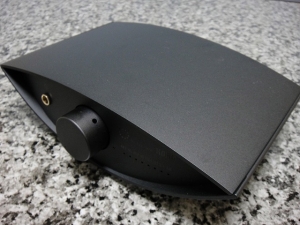
Suddenly, I bought Korg's USB-DAC amplifier
DS-DAC-100.
I just couldn't resist.
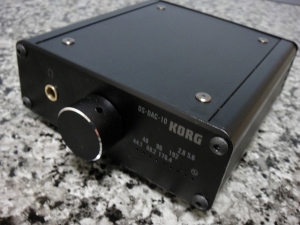
I also have the DS-DAC-10.
Frankly, it's wasteful spending.
These two have the same internal DAC chip, so.
(There might be differences in other parts though)
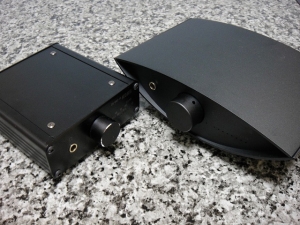
From the photos I thought the knobs on the 10 and 100 were the same size,
but I was surprised by how big the 100's knobs actually are.
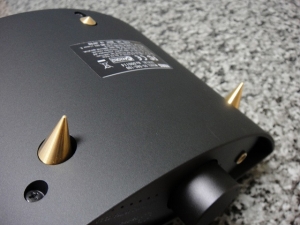
It has three feet, but if you drag it across a table or stand like this,
it'll definitely get scratched.

It comes with insulator-type foot pads.
The bottom is rubber so you can drag it on these,
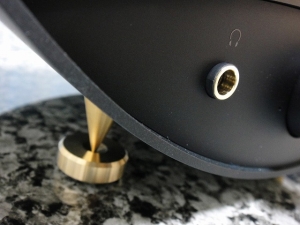
but lifting and moving it is a bit of a hassle.
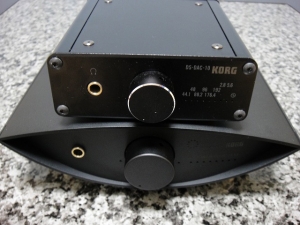
The front panel has stereo standard phone plug output,
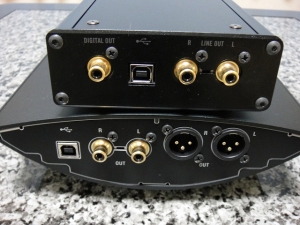
and the back has USB port and RCA output, plus
the 10 has digital output while the 100 has XLR output.
I'm not planning to go with balanced cables for now, so
I don't use the XLR output.
As for the actual sound, I can't quite put it into words, but the 100 seems to have slightly
more "punch," like the sound is a bit stronger.
The difference is so subtle that unless I'm using my usual headphones and listening to my usual song,
I probably couldn't tell if it's the 10 or 100.
The overall sound character is the same.
The USB-DAC operates on "USB bus power only,"
but in Ratoc's case you can also supply external power via AC adapter.
Fostex's HP-A3 and A4, and Korg's DS-DAC-10 and 100
only have USB input, so you can't add external power.
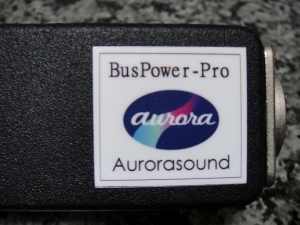
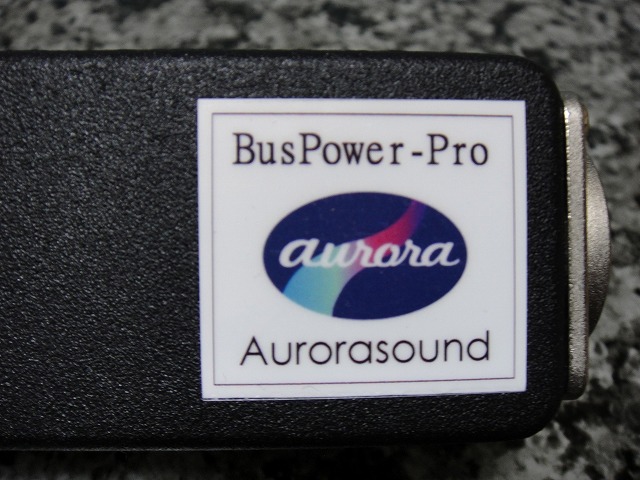
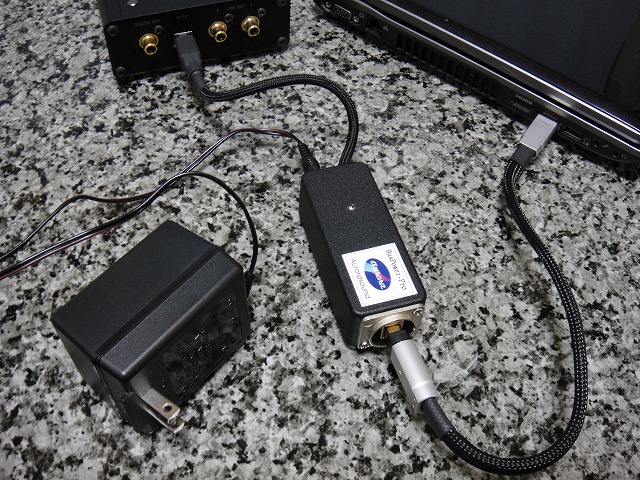
But I bought a product called BuspawerPro by Aurora Sound that makes this possible.
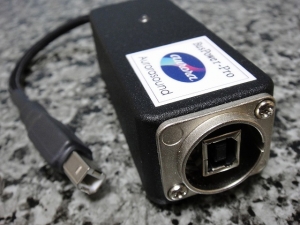
After using it for about a night, when I inserted the USB cable into this,
I noticed something: when you plug it into a USB port and it gets recognized,
the unit's lamp lights up even without being connected to power.
It has a built-in capacitor, but I thought if the USB cable coming out of BuspawerPro
plugged into BuspawerPro itself could enable "power generation,"
the world's energy problems might be solved all at once, but no luck.
The laws of conservation of energy can't be overcome, and the lamp dimly
and sadly went out.
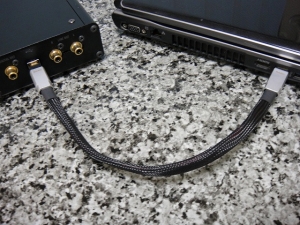
Joking aside,
from the state in the image above
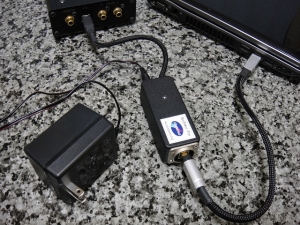
you set it up like this to use.
Normally when you connect a PC to the USB-DAC, the USB-DAC's lamp lights up,
but if you put BuspawerPro in between, it doesn't.
While being supplied power from the AC adapter, the USB-DAC stays in operation mode the whole time.
This means you can get a large current from a nearly noise-free power source.
So did the sound quality change with external power? Honestly, I couldn't tell.
Just because I can't tell doesn't mean I should decide "there's no change."
"I couldn't tell" is my answer for now.
My principle is "keep wiring short and simple," so if I can't hear a difference,
it might actually be better not to put BuspawerPro in between.
That said, putting aside speakers, headphones are such low-power devices that
(unless the impedance is really high) you can drive them even from an iPod's built-in battery,
so USB power might be sufficient for headphone amplification.
Also, both the HP-A3 and DS-DAC-100
claim to regenerate power, so
with these products there's probably not much point in using BuspawerPro.
This time, by buying the DS-DAC-100, I learned something.
More surprising than "even amplifiers from the same maker with almost identical internal parts sound different"
or things like that, was something else.
Santa doesn't exist!
↑This is the title's "truth at 30 years."
and received some comments recommending headphones and such in relation to that.
First, about KOSS's KSC75
"The sound quality has nothing particularly noteworthy, but the fit is good," I was told.
Ah, that's the one where they cut off the PortaPro headband and made it an ear-hook style!
↑I'm writing roughly but I think I'm pretty much on the mark.
Since it's open-back, you can't use it on the train, but it seems OK for running.
The SportaPro (the naming is brilliant), a derivative model of the PortaPro,
is also open-back, and seeing things like that
I get the sense that in foreign countries they're
more tolerant of headphone sound leakage than in Japan.
About AKG's K412P
I received a comment saying "Boosting the mid-bass to artificially enhance the low end can't be called high-fidelity, but..."
However, since the resulting sound created by boosting certain frequency ranges
becomes the headphone's character, the fit and sound preference matter more than
the price being high or low, so there's really no saying.
This is also why my collection of headphones keeps growing.
I looked up the K412P for the first time, and it's similar to Sennheiser's PX100.
The successor model is the PX-100 II, and despite its shabby appearance
the sound is quite good. However, the foam on the demo units at stores
is invariably torn, so it might have low durability.
I think there's no problem if you handle it carefully personally, but...
To the person who commented "I got the SRH840."
Sorry for leaving the hub and rim you sent me as-is.
I was thinking of buying the SRH440 too (I listened to it over and over),
but the headband has a point-contact at the crown of the head so I decided against it.
The sound is monitor-like and good. Or rather, it's officially a monitor headphone.
I dislike coiled cords, but since it's recableable there's no problem.
What's mysterious to me is that headphone ear pads seem to follow an unwritten law
where "open-back uses velour fabric and closed-back uses synthetic leather."
Most headphones follow this rule, but
the SRH940 is closed-back with velour pads.
As for me, I'm not particular about the feel of synthetic leather,
but velour fabric can be a hit or miss.
Sometimes it feels itchy and uncomfortable.
Also, unrelated to that, 10 months ago I received
a comment saying "I want the SRH1840." That does look like the HD650, doesn't it?
If I were buying something for around 50,000 yen, it would be a tough choice between that and Philips' X1.
I received a comment asking "Have you auditioned the NW-ZX1?"
I did audition it. The headphones connected were the MDR-1R MK2.
The sound has a lot of spaciousness, very nice.
It might sound better than some half-hearted stationary setups.
Walkman keeps saying "the best sound quality yet" every time, but
this time the words ring true.
Since I believe "portable audio achieves its goal the moment you take music outside,"
I'm satisfied with my iPod touch for now (well, sort of lying).
If the day comes when I can spend 70,000 yen on a Walkman,
I might buy one. 70,000 yen sounds expensive, but Sony's portable amp PHA-2 costs just under 50,000 yen,
so if you consider a model that doesn't need that, it's not necessarily expensive.
The subject changes a bit here, but
I've never owned a sports compact bike.
Why? Because I can see clearly that I'd end up spending a fortune
swapping out parts for expensive ones.
I'd put Record or Dura-Ace cranks on, and
I'd get new wheels too (actually, I can build bicycle wheels myself).
Hi-Res portable audio is the same thing.
If I buy the HiFiMAN HM-901 or Sony NW-ZX1
it won't end there—I'd inevitably get my hands on IEMs like
the SE535, UE900, and IE800.
Because I know that, I'm just pretending "I'm fine with my iPod."
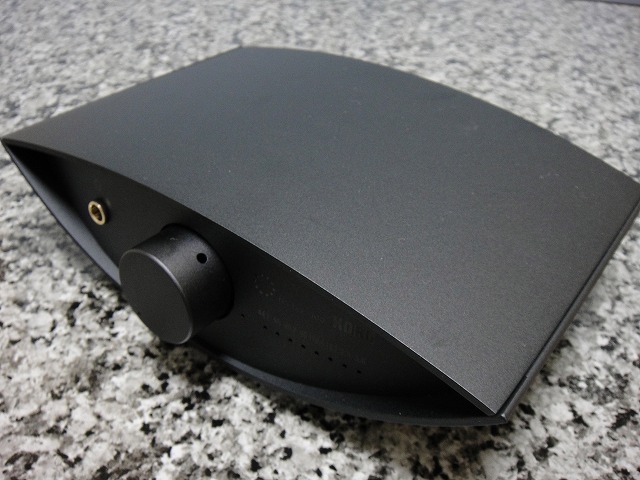
Suddenly, I bought Korg's USB-DAC amplifier
DS-DAC-100.
I just couldn't resist.
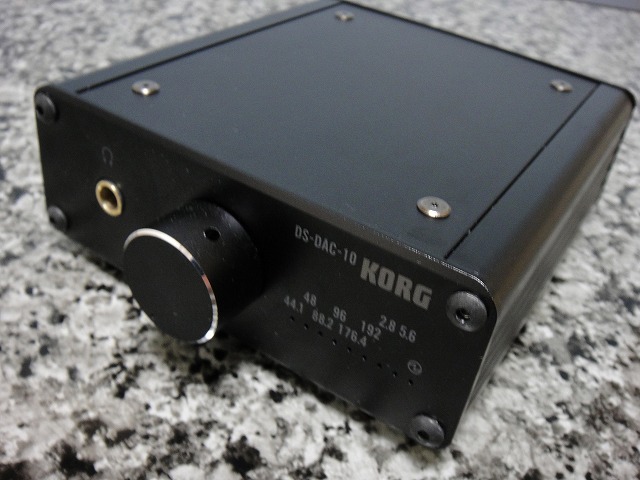
I also have the DS-DAC-10.
Frankly, it's wasteful spending.
These two have the same internal DAC chip, so.
(There might be differences in other parts though)
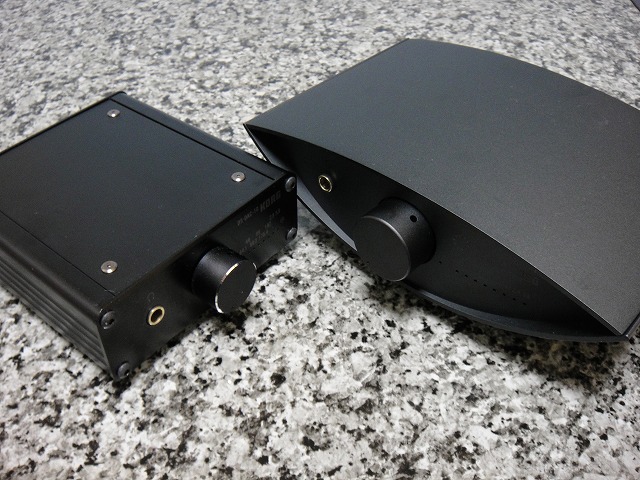
From the photos I thought the knobs on the 10 and 100 were the same size,
but I was surprised by how big the 100's knobs actually are.
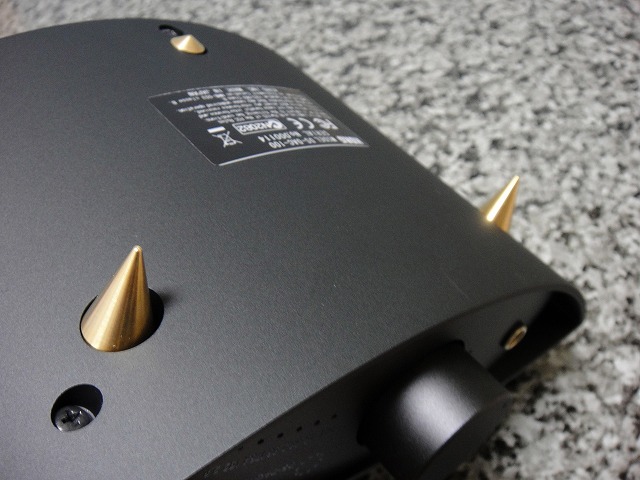
It has three feet, but if you drag it across a table or stand like this,
it'll definitely get scratched.

It comes with insulator-type foot pads.
The bottom is rubber so you can drag it on these,
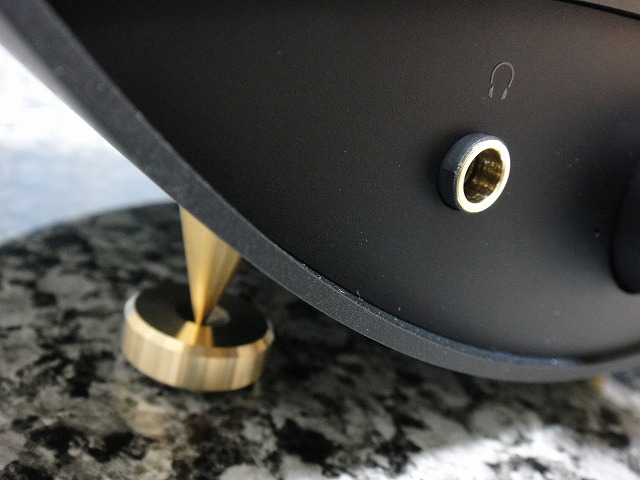
but lifting and moving it is a bit of a hassle.

The front panel has stereo standard phone plug output,
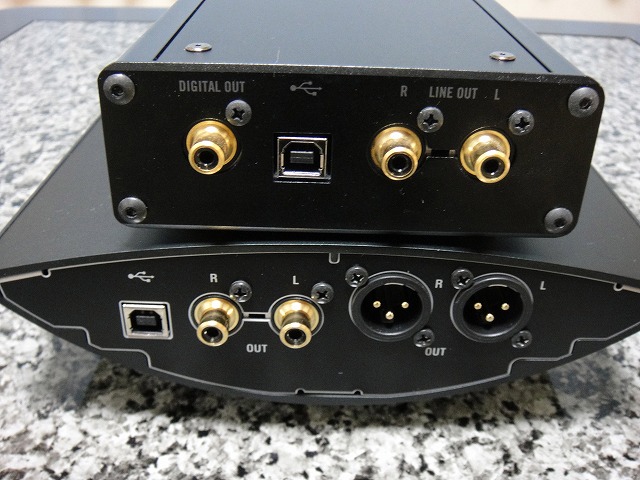
and the back has USB port and RCA output, plus
the 10 has digital output while the 100 has XLR output.
I'm not planning to go with balanced cables for now, so
I don't use the XLR output.
As for the actual sound, I can't quite put it into words, but the 100 seems to have slightly
more "punch," like the sound is a bit stronger.
The difference is so subtle that unless I'm using my usual headphones and listening to my usual song,
I probably couldn't tell if it's the 10 or 100.
The overall sound character is the same.
The USB-DAC operates on "USB bus power only,"
but in Ratoc's case you can also supply external power via AC adapter.
Fostex's HP-A3 and A4, and Korg's DS-DAC-10 and 100
only have USB input, so you can't add external power.
But I bought a product called BuspawerPro by Aurora Sound that makes this possible.
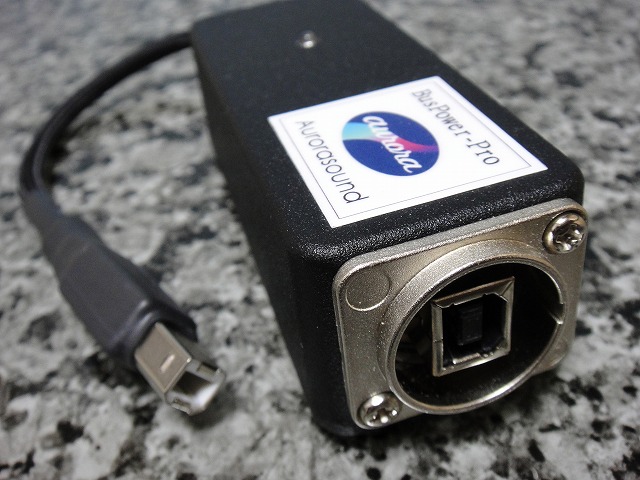
After using it for about a night, when I inserted the USB cable into this,
I noticed something: when you plug it into a USB port and it gets recognized,
the unit's lamp lights up even without being connected to power.
It has a built-in capacitor, but I thought if the USB cable coming out of BuspawerPro
plugged into BuspawerPro itself could enable "power generation,"
the world's energy problems might be solved all at once, but no luck.
The laws of conservation of energy can't be overcome, and the lamp dimly
and sadly went out.
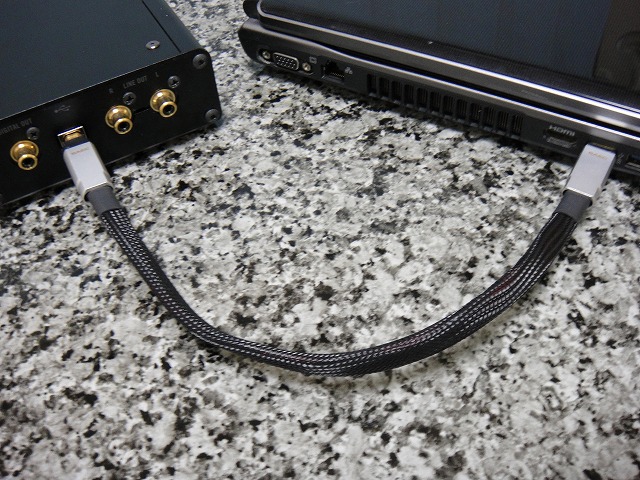
Joking aside,
from the state in the image above
you set it up like this to use.
Normally when you connect a PC to the USB-DAC, the USB-DAC's lamp lights up,
but if you put BuspawerPro in between, it doesn't.
While being supplied power from the AC adapter, the USB-DAC stays in operation mode the whole time.
This means you can get a large current from a nearly noise-free power source.
So did the sound quality change with external power? Honestly, I couldn't tell.
Just because I can't tell doesn't mean I should decide "there's no change."
"I couldn't tell" is my answer for now.
My principle is "keep wiring short and simple," so if I can't hear a difference,
it might actually be better not to put BuspawerPro in between.
That said, putting aside speakers, headphones are such low-power devices that
(unless the impedance is really high) you can drive them even from an iPod's built-in battery,
so USB power might be sufficient for headphone amplification.
Also, both the HP-A3 and DS-DAC-100
claim to regenerate power, so
with these products there's probably not much point in using BuspawerPro.
This time, by buying the DS-DAC-100, I learned something.
More surprising than "even amplifiers from the same maker with almost identical internal parts sound different"
or things like that, was something else.
Santa doesn't exist!
↑This is the title's "truth at 30 years."