A customer brought in a Ksyrium SLS for me to work on.

Just the rear wheel.
They brought it in for an inspection before an upcoming race.
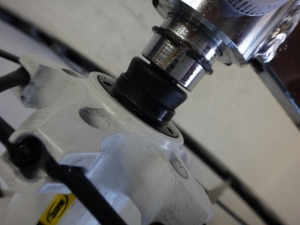
↑That's Mavic for you—this kind of quality is standard.
Easily over a paper's thickness in runout, but tight enough that a one-yen coin won't fit.
The reason I apply a dishing gauge before starting work
is to get the information I need to perform lateral truing while centering the rim.
If I were just doing a quick retensioning, I'd tighten the freewheel side.
But when taking out the lateral runout scattered around the wheel,
retensioning on the non-freewheel side turned out to be more convenient in most spots,
so the center deviation actually increased to about twice what's shown in that first image.
By the end though, it was dialed in perfectly.
The aluminum or carbon spokes on Ksyrium and R-SYS wheels
have coarse nipple threads,
so even small adjustments move the rim quite a bit.

Just the rear wheel.
They brought it in for an inspection before an upcoming race.

↑That's Mavic for you—this kind of quality is standard.
Easily over a paper's thickness in runout, but tight enough that a one-yen coin won't fit.
The reason I apply a dishing gauge before starting work
is to get the information I need to perform lateral truing while centering the rim.
If I were just doing a quick retensioning, I'd tighten the freewheel side.
But when taking out the lateral runout scattered around the wheel,
retensioning on the non-freewheel side turned out to be more convenient in most spots,
so the center deviation actually increased to about twice what's shown in that first image.
By the end though, it was dialed in perfectly.
The aluminum or carbon spokes on Ksyrium and R-SYS wheels
have coarse nipple threads,
so even small adjustments move the rim quite a bit.