A customer dropped off a Red Metal 29 with me.
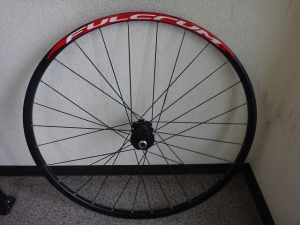
The front wheel has some stickers partially peeled off by the customer.
Since these stickers cover the entire rim side,
they interfere with the truing work and cause problems.
I managed to deal with it though.
Road bikes use a 700C size,
and it's called that because when you mount a tire on a 622C rim and inflate it,
the outside diameter becomes approximately 700C (since 1C = 1mm, so 700mm).
(In reality, the tire width that would actually be 700C is around 28C)
The 29-inch size is called that because
when you mount an MTB tire on the same 622C rim,
the outside diameter including the tire becomes approximately 29 inches.
Basically, it's a spec where you mount off-road tires on a wider 700C rim.
With WO rims, some have width markings at the bead hook section
(not the rim width itself),
and for road bike rims, around 15C is standard,
but this rim is 19C wide, so it's marked "622×19C" on the rim.
The Fulcrum Racing Zero Carbon I worked on the other day was marked 622×17C,
so these newer wide road bike rims
fall somewhere between the existing road bike width and cross-country MTB width.
Scary stuff.
Anyway, the front wheel just needed minor truing.
I adjusted the hub bearing play and just looked inside a bit
without doing a full regreasing.
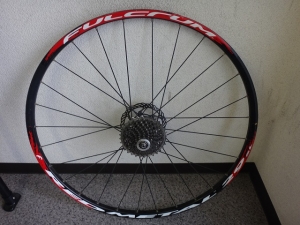
The rear wheel was quite a challenge.
There was center-line deviation of about the width of a one-yen coin, and considerable lateral runout.
One spot stands out, but there are plenty of small irregularities throughout.
Plus, the customer mentioned that the rim's bead hook had a dent.
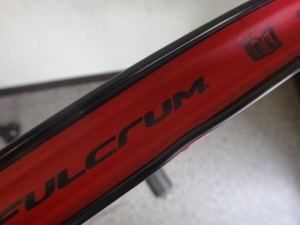
↑Right here.
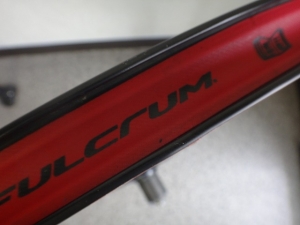
Almost fixed.
What looks like a bulge is just peeling sticker.
I got it to the point where you can't feel either the dent or the bulge when you touch it with your finger.
From there I continued truing methodically, but...

↑This spot also has a faint dent.
This is a place where I thought "something's off" while truing.
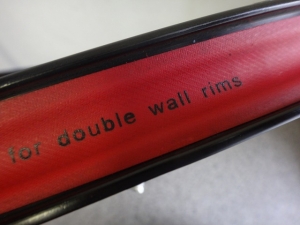
Fixed.
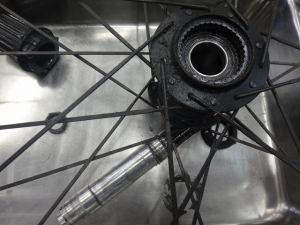
Though the timeline is a bit jumbled, I disassembled the rear hub.
It's not a cup-and-cone style but uses cartridge bearings.
The free side bearing rotation was slightly gritty,
so I addressed it with regreasing.

The rear wheel ended up needing a wash in the end.
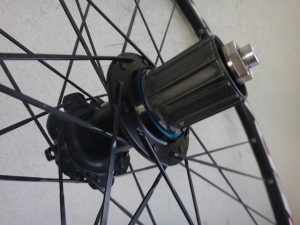
This wheel's owner can handle some basic wheel work,
but brought this one in to us anyway.
Before I started, I also thought the rim itself had warping,
aside from the bead hook dents,
but I was surprised at how cleanly I was able to straighten it out.
The lateral runout is now less than the thickness of the sticker.
Since it's a Fulcrum rear wheel, the fact that it doesn't have 2:1 spokes also helped.
It seemed odd that a customer capable of doing some wheel work
would bring in something in such rough condition,
but it turns out this wheel had been lent to someone else
who used it hard for commuting or school rides.
Now that I think about it, the dirt and sprocket wear definitely matched that story.


The front wheel has some stickers partially peeled off by the customer.
Since these stickers cover the entire rim side,
they interfere with the truing work and cause problems.
I managed to deal with it though.
Road bikes use a 700C size,
and it's called that because when you mount a tire on a 622C rim and inflate it,
the outside diameter becomes approximately 700C (since 1C = 1mm, so 700mm).
(In reality, the tire width that would actually be 700C is around 28C)
The 29-inch size is called that because
when you mount an MTB tire on the same 622C rim,
the outside diameter including the tire becomes approximately 29 inches.
Basically, it's a spec where you mount off-road tires on a wider 700C rim.
With WO rims, some have width markings at the bead hook section
(not the rim width itself),
and for road bike rims, around 15C is standard,
but this rim is 19C wide, so it's marked "622×19C" on the rim.
The Fulcrum Racing Zero Carbon I worked on the other day was marked 622×17C,
so these newer wide road bike rims
fall somewhere between the existing road bike width and cross-country MTB width.
Scary stuff.
Anyway, the front wheel just needed minor truing.
I adjusted the hub bearing play and just looked inside a bit
without doing a full regreasing.
The rear wheel was quite a challenge.
There was center-line deviation of about the width of a one-yen coin, and considerable lateral runout.
One spot stands out, but there are plenty of small irregularities throughout.
Plus, the customer mentioned that the rim's bead hook had a dent.
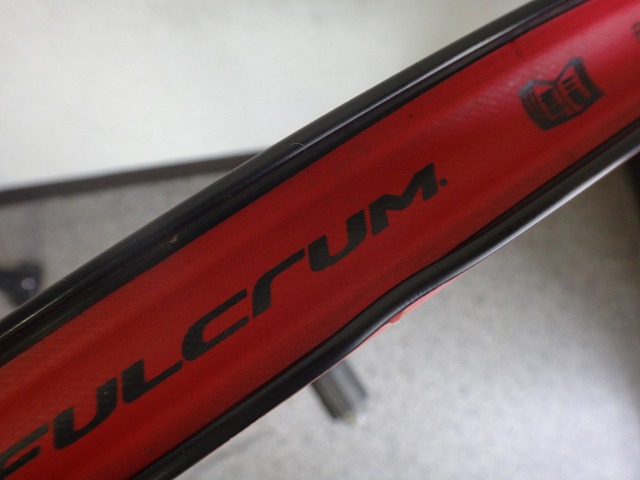
↑Right here.

Almost fixed.
What looks like a bulge is just peeling sticker.
I got it to the point where you can't feel either the dent or the bulge when you touch it with your finger.
From there I continued truing methodically, but...
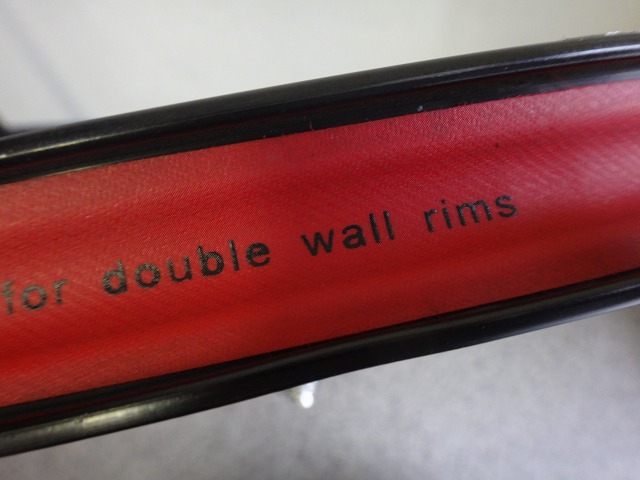
↑This spot also has a faint dent.
This is a place where I thought "something's off" while truing.

Fixed.

Though the timeline is a bit jumbled, I disassembled the rear hub.
It's not a cup-and-cone style but uses cartridge bearings.
The free side bearing rotation was slightly gritty,
so I addressed it with regreasing.
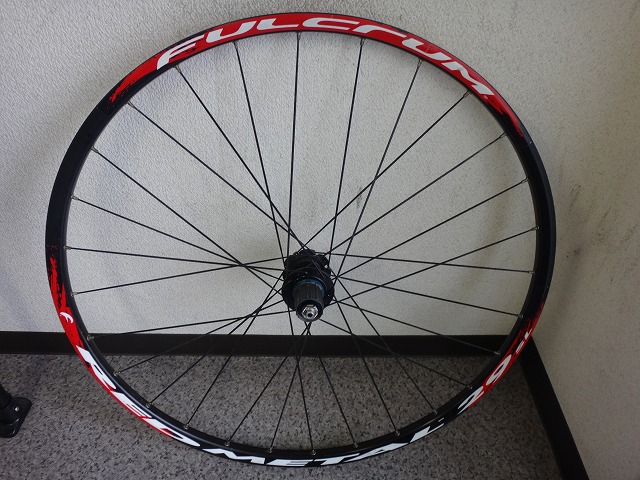
The rear wheel ended up needing a wash in the end.

This wheel's owner can handle some basic wheel work,
but brought this one in to us anyway.
Before I started, I also thought the rim itself had warping,
aside from the bead hook dents,
but I was surprised at how cleanly I was able to straighten it out.
The lateral runout is now less than the thickness of the sticker.
Since it's a Fulcrum rear wheel, the fact that it doesn't have 2:1 spokes also helped.
It seemed odd that a customer capable of doing some wheel work
would bring in something in such rough condition,
but it turns out this wheel had been lent to someone else
who used it hard for commuting or school rides.
Now that I think about it, the dirt and sprocket wear definitely matched that story.