Another wheel day (and so on).
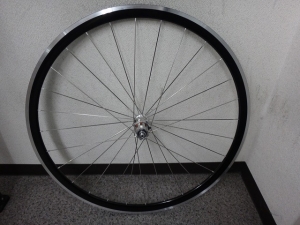
I built Nomu Lab Wheel #1 using a ZIPP rear hub.
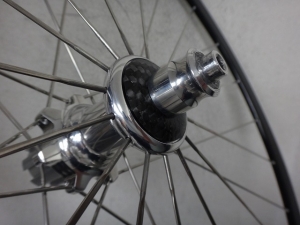
It's equivalent to a 28H 40-spoke lacing pattern.
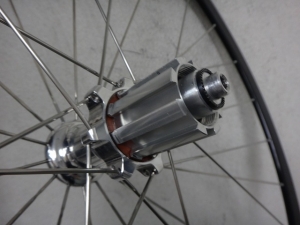
On the freewheel side I used Sapim Leader straight spokes (2.0mm plain),
and on the non-freewheel side I used Sapim CX-RAY.
The straight spokes on the freewheel side are Sapim Race (2.0–1.8–2.0mm butted), and since they're consistently available in certain lengths, I could have built it as a "half-race" combination of Race and CX-RAY. However, since the non-freewheel side is radially laced, I wanted to get whatever benefit I could from using different-diameter spokes on each side, so I went with 2.0mm plain on the freewheel side.
Leader straight spokes come in a 310mm threadless version, so any length shorter than that can be obtained as plain spokes as needed.
Race straight spokes come threaded from 302mm down to 288mm in standard supply, but they're cuttable by about minus 8mm, so around 280mm becomes usable. When you have Race straight spokes in this length range, they're perfect for repairs on bikes like E○ton's EA9○, and I've been helped out many times by this.
CX-RAY straight spokes come threadless and have a repair spoke version with a long plain section on the rim side. The specifications are as (→here).
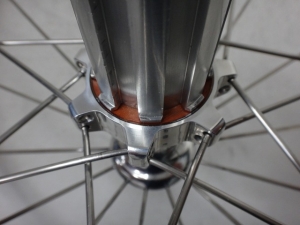
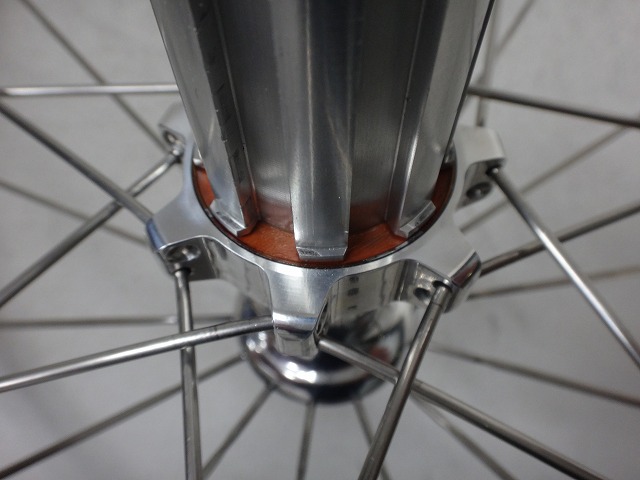
↑Looking at the freewheel-side flange, by my own definition,
"H (holes) is the number of holes where spoke heads fit," so
this is 7H, not 14H.
The reason I have to define it that way is because I treat it as 7H in the spoke-length calculation formula.
But if I were to write it as freewheel side 7H + non-freewheel side 14H for a total of 21H, that gets confusing, so I just wrote 28H at the beginning, following the normal spoke count.
~Tangent~
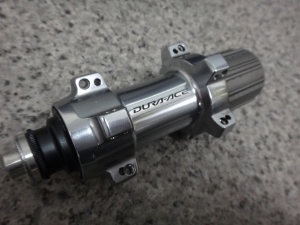
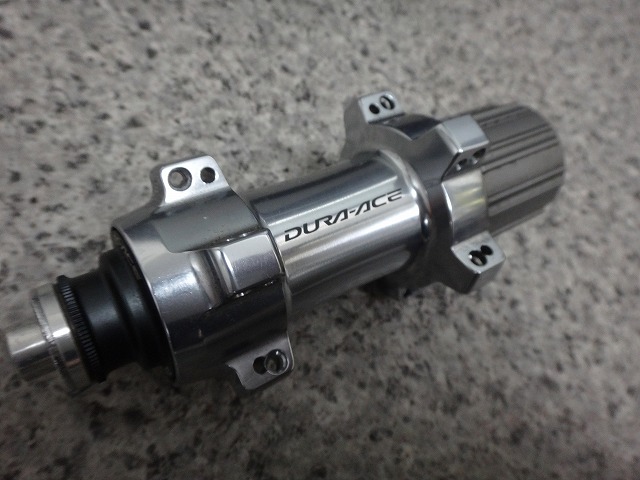
↑For example, this 7900 complete hub is 5H on each side.

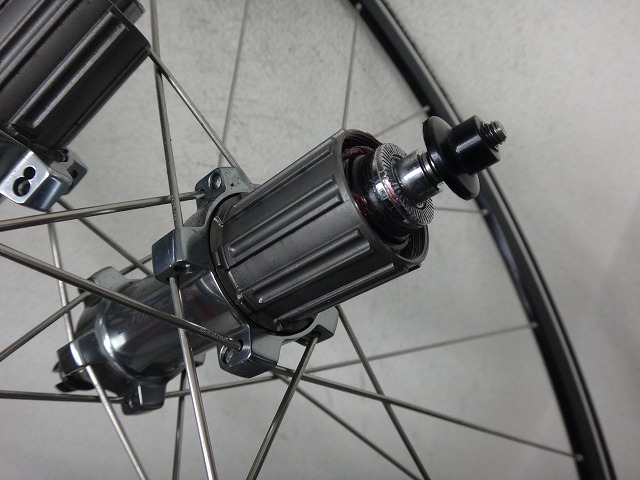
↑The evil Nomu Lab Wheel #5.
~End tangent~

This time the non-freewheel side length came out to just over 270mm.
CX-RAY straight spokes can be cut from 310mm down to 270mm, and from 270mm down to 240mm, so for just-over-270mm, you're cutting almost all the plain section from the 310mm CX-RAY.
Since this wheel's customer is fussy about the length of the rim-side plain section, I included the photo.
With this rear wheel, the different-diameter lacing is clearly working—the non-freewheel side is pulled quite tight. That's what you get with spokes in a 100:65 weight ratio. This rear hub doesn't look particularly high-low flange, but the spoke head position on the non-freewheel side is positioned quite far inboard, making it effectively a small flange, so it's actually a decent high-low flange. This definitely relates to why the non-freewheel side pulled so nicely. I knew that even with Hyperon's freewheel side as plain spokes you'd get similar results, but it's been a while since I've gotten nice numbers. Heh.
So you'd think I should just keep using 100:65 spokes with the 40-spoke lacing going forward, but this time I only did radial lacing on the non-freewheel side because of the hub's constraints. Considering torsional resistance and spoke feel, with butted spokes the non-freewheel side can only be tangentially laced. I came to this conclusion years ago, but until recently CX-RAY straight spokes weren't really available, so I didn't get many chances to try it except with Hyperons and Heliums where I'd substituted plain spokes on the freewheel side. If I could stock CX-RAY straight spokes in quantities that gave me no worry about availability, there are wheels I personally want to build. But I'm not putting those here.

I built Nomu Lab Wheel #1 using a ZIPP rear hub.

It's equivalent to a 28H 40-spoke lacing pattern.

On the freewheel side I used Sapim Leader straight spokes (2.0mm plain),
and on the non-freewheel side I used Sapim CX-RAY.
The straight spokes on the freewheel side are Sapim Race (2.0–1.8–2.0mm butted), and since they're consistently available in certain lengths, I could have built it as a "half-race" combination of Race and CX-RAY. However, since the non-freewheel side is radially laced, I wanted to get whatever benefit I could from using different-diameter spokes on each side, so I went with 2.0mm plain on the freewheel side.
Leader straight spokes come in a 310mm threadless version, so any length shorter than that can be obtained as plain spokes as needed.
Race straight spokes come threaded from 302mm down to 288mm in standard supply, but they're cuttable by about minus 8mm, so around 280mm becomes usable. When you have Race straight spokes in this length range, they're perfect for repairs on bikes like E○ton's EA9○, and I've been helped out many times by this.
CX-RAY straight spokes come threadless and have a repair spoke version with a long plain section on the rim side. The specifications are as (→here).
↑Looking at the freewheel-side flange, by my own definition,
"H (holes) is the number of holes where spoke heads fit," so
this is 7H, not 14H.
The reason I have to define it that way is because I treat it as 7H in the spoke-length calculation formula.
But if I were to write it as freewheel side 7H + non-freewheel side 14H for a total of 21H, that gets confusing, so I just wrote 28H at the beginning, following the normal spoke count.
~Tangent~
↑For example, this 7900 complete hub is 5H on each side.
↑The evil Nomu Lab Wheel #5.
~End tangent~
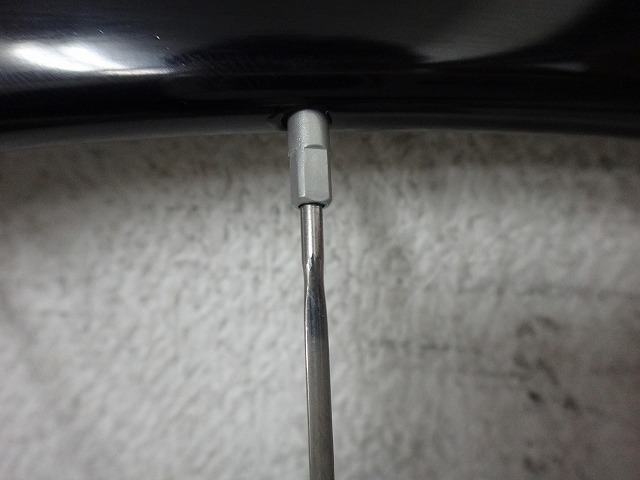
This time the non-freewheel side length came out to just over 270mm.
CX-RAY straight spokes can be cut from 310mm down to 270mm, and from 270mm down to 240mm, so for just-over-270mm, you're cutting almost all the plain section from the 310mm CX-RAY.
Since this wheel's customer is fussy about the length of the rim-side plain section, I included the photo.
With this rear wheel, the different-diameter lacing is clearly working—the non-freewheel side is pulled quite tight. That's what you get with spokes in a 100:65 weight ratio. This rear hub doesn't look particularly high-low flange, but the spoke head position on the non-freewheel side is positioned quite far inboard, making it effectively a small flange, so it's actually a decent high-low flange. This definitely relates to why the non-freewheel side pulled so nicely. I knew that even with Hyperon's freewheel side as plain spokes you'd get similar results, but it's been a while since I've gotten nice numbers. Heh.
So you'd think I should just keep using 100:65 spokes with the 40-spoke lacing going forward, but this time I only did radial lacing on the non-freewheel side because of the hub's constraints. Considering torsional resistance and spoke feel, with butted spokes the non-freewheel side can only be tangentially laced. I came to this conclusion years ago, but until recently CX-RAY straight spokes weren't really available, so I didn't get many chances to try it except with Hyperons and Heliums where I'd substituted plain spokes on the freewheel side. If I could stock CX-RAY straight spokes in quantities that gave me no worry about availability, there are wheels I personally want to build. But I'm not putting those here.