In the previous post, I mentioned using Sapim's CX-RAY straight spoke version for the Reynolds wheel rebuild,
and this is something Tri Sports (トライスポーツ) recently started carrying.
It's a huge help.
However, there are some differences from standard spokes, so let me explain those.

↑Here's the actual product,

The hub side has a straight-pull head.

But the rim side has no threads,
so you need to cut it to the desired length and form the threads yourself.
This design assumes you own a spoke cutter.
Standard CX-RAY can be cut a maximum of about 8mm
(my rule is to limit it to 6mm cuts),
but this spoke is designed for repair use,
so it can be cut even more than that.
The available lengths are 310, 270, 240, and 210mm—four types.
The 210mm can be cut up to 20mm,
270mm and 240mm can be cut up to 30mm,
and 310mm can be cut up to 40mm,
so with these four spoke types you can cover
190–210mm, 210–240mm, 240–270mm, and 270–310mm lengths.
This special CX-RAY comes in silver and black,
and Tri Sports carries the Race (Competition equivalent) straight spoke version in silver and
the Leader (Champion equivalent) straight spoke version in silver,
so if you want silver spokes, wheel building flexibility with straight-pull hubs
has become quite high.
Actually, there are several wheel orders pending at my shop
that couldn't be built because CX-RAY straight spokes weren't available.
I'll get to them eventually, so please bear with me.
I should mention this upfront, since someone will probably ask if DT or PowerTap straight-pull hubs
can now be used for wheel building with these.
Front hubs are simple—you just do radial lacing and tension up—
but rear hubs in most cases can only have spokes laced in 4-4 or 4-0 patterns,
severely limiting options.
This lack of flexibility is a fatal problem. In most cases, you'd get a better result
with a hub that lets you do asymmetrical left-right mixed lacing with J-bend spokes
rather than pursuing a straight-pull design.
So if you're chasing actual wheel performance, I don't think
there's a real advantage to straight-pull hubs.
Special designs like Ksyrium Elite or Zonda are a different story, though.
(It's true that straight-pull reduces spoke breakage risk at the bend.)
For example, even if a 24-spoke 4-4 rear wheel with J-bend spokes
maxes out at 120 kgf tension on the freewheel side,
while straight-pull reaches 140 kgf,
if the correction level on the opposite side is poor, it doesn't mean much.
This is proven by the fact that when I rebuilt completed wheels originally designed for Shimano 10-speed freehubs
onto 11-speed hubs using hand-laced 4-6 lacing
(actually the semi-competition thing matters more, but...)
customers almost always say it feels stiffer than before the rebuild.
Even if spoke deflection increases slightly on the freewheel side,
if it decreases dramatically on the opposite side, the wheel becomes stiffer overall.

Also, if a single replacement spoke with an unusually long plain section
gets mixed in, some might say it looks ugly.
When spokes of different weight are mixed in,
vertical wobble can develop and loosening becomes more likely.
Though the latter mainly happens when a spoke is lighter (thinner) than its neighbors—
and if the surrounding spokes are CX-RAY, there's basically
no spoke lighter than that.
Since these are repair spokes, if the cut length is short,
this situation is unavoidable.
If it bothers you, order genuine spokes
or replace all spokes on one side.
Even if you replace all spokes on one side, the "long plain section" issue
won't go away completely.
With these spokes available, repairs on Z〇P and I〇ston wheels
have become much easier.
What we did before was
cut and repurpose spokes of equivalent weight to CX-RAY
from spare spokes in completed wheel sets.
I have no reason to take complaints from manufacturers or distributors
(not all, but some) about this.
They sell finished wheel sets but provide terrible spoke supply—or none at all—
so who are they to complain?

That said, I can't deny the spoke weight differs from standard CX-RAY.
I'll measure it to verify.
The image above shows 310mm × 50 spokes weighing 270.1g.
It's an odd number of 50 because my scale's capacity is only 300g.
A scale that reads to 0.1g gives more reliable data with fewer spokes.
For spoke weight calculations, I ignore
the weight of spoke heads and how the butted section's length relates to total spoke length
based on spoke length differences.
I've written this many times before, but for 700C rims,
the difference in spoke weight between ~240mm spokes used on 80mm-high rims
and ~300mm spokes for low-profile rims
caused by butting differences is not significant.
Think of it as a number that's reliable enough for practical purposes
even if you ignore water evaporation or pulley friction.
My calculation puts CX-RAY at 64.5%,
derived from a massive number of CX-RAY spokes of various lengths.
Sapim's manufacturer site lists 260mm × 64 spokes at 272g,
which calculates to 63.6%.
In practice (even 260mm × 64), you'd rarely see 63% range.
From the image above, ignoring spoke head weight,
310mm × 50 spokes equal the weight of one 15,500mm spoke.
Per millimeter that's 0.01742588...g,
and if we use 0.025g per millimeter for 2.0mm plain spokes,
the uncut straight-pull repair CX-RAY 310mm spoke weight ratio works out to about 67.8%.
Given the reality of wheels using straight spokes,
you rarely see 310mm, let alone 300mm.
Starting at 67.8% and getting closer to 64.5% the more you cut,
a single repair CX-RAY mixed in causes no tension balance issues.
You can order standard butted-start straight-pull CX-RAY
at specified lengths, but lead time is several months,
so unless you have strong preferences,
repair CX-RAY should be fine.
and this is something Tri Sports (トライスポーツ) recently started carrying.
It's a huge help.
However, there are some differences from standard spokes, so let me explain those.
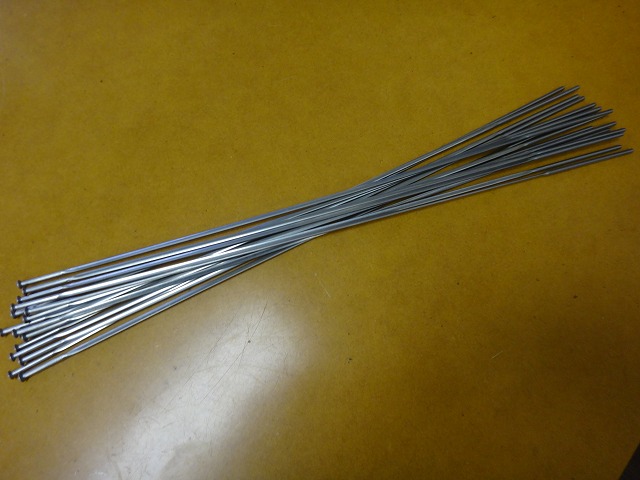
↑Here's the actual product,
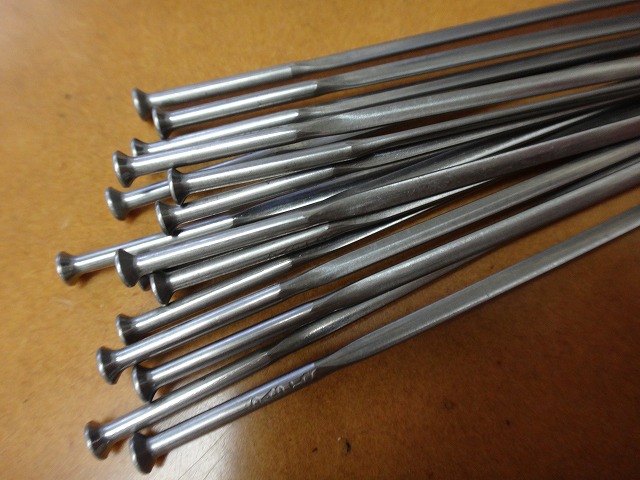
The hub side has a straight-pull head.
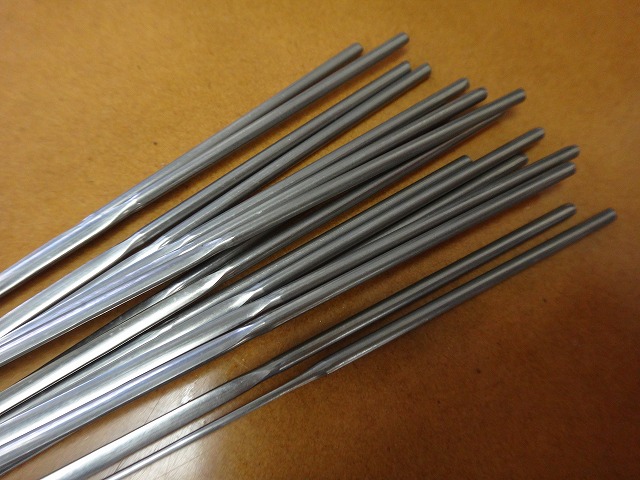
But the rim side has no threads,
so you need to cut it to the desired length and form the threads yourself.
This design assumes you own a spoke cutter.
Standard CX-RAY can be cut a maximum of about 8mm
(my rule is to limit it to 6mm cuts),
but this spoke is designed for repair use,
so it can be cut even more than that.
The available lengths are 310, 270, 240, and 210mm—four types.
The 210mm can be cut up to 20mm,
270mm and 240mm can be cut up to 30mm,
and 310mm can be cut up to 40mm,
so with these four spoke types you can cover
190–210mm, 210–240mm, 240–270mm, and 270–310mm lengths.
This special CX-RAY comes in silver and black,
and Tri Sports carries the Race (Competition equivalent) straight spoke version in silver and
the Leader (Champion equivalent) straight spoke version in silver,
so if you want silver spokes, wheel building flexibility with straight-pull hubs
has become quite high.
Actually, there are several wheel orders pending at my shop
that couldn't be built because CX-RAY straight spokes weren't available.
I'll get to them eventually, so please bear with me.
I should mention this upfront, since someone will probably ask if DT or PowerTap straight-pull hubs
can now be used for wheel building with these.
Front hubs are simple—you just do radial lacing and tension up—
but rear hubs in most cases can only have spokes laced in 4-4 or 4-0 patterns,
severely limiting options.
This lack of flexibility is a fatal problem. In most cases, you'd get a better result
with a hub that lets you do asymmetrical left-right mixed lacing with J-bend spokes
rather than pursuing a straight-pull design.
So if you're chasing actual wheel performance, I don't think
there's a real advantage to straight-pull hubs.
Special designs like Ksyrium Elite or Zonda are a different story, though.
(It's true that straight-pull reduces spoke breakage risk at the bend.)
For example, even if a 24-spoke 4-4 rear wheel with J-bend spokes
maxes out at 120 kgf tension on the freewheel side,
while straight-pull reaches 140 kgf,
if the correction level on the opposite side is poor, it doesn't mean much.
This is proven by the fact that when I rebuilt completed wheels originally designed for Shimano 10-speed freehubs
onto 11-speed hubs using hand-laced 4-6 lacing
(actually the semi-competition thing matters more, but...)
customers almost always say it feels stiffer than before the rebuild.
Even if spoke deflection increases slightly on the freewheel side,
if it decreases dramatically on the opposite side, the wheel becomes stiffer overall.
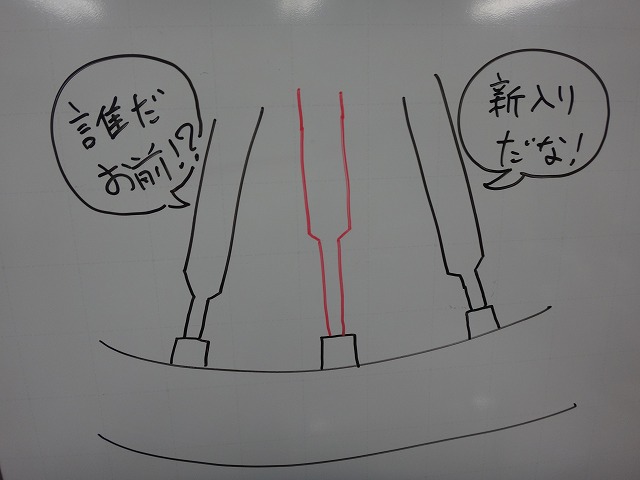
Also, if a single replacement spoke with an unusually long plain section
gets mixed in, some might say it looks ugly.
When spokes of different weight are mixed in,
vertical wobble can develop and loosening becomes more likely.
Though the latter mainly happens when a spoke is lighter (thinner) than its neighbors—
and if the surrounding spokes are CX-RAY, there's basically
no spoke lighter than that.
Since these are repair spokes, if the cut length is short,
this situation is unavoidable.
If it bothers you, order genuine spokes
or replace all spokes on one side.
Even if you replace all spokes on one side, the "long plain section" issue
won't go away completely.
With these spokes available, repairs on Z〇P and I〇ston wheels
have become much easier.
What we did before was
cut and repurpose spokes of equivalent weight to CX-RAY
from spare spokes in completed wheel sets.
I have no reason to take complaints from manufacturers or distributors
(not all, but some) about this.
They sell finished wheel sets but provide terrible spoke supply—or none at all—
so who are they to complain?

That said, I can't deny the spoke weight differs from standard CX-RAY.
I'll measure it to verify.
The image above shows 310mm × 50 spokes weighing 270.1g.
It's an odd number of 50 because my scale's capacity is only 300g.
A scale that reads to 0.1g gives more reliable data with fewer spokes.
For spoke weight calculations, I ignore
the weight of spoke heads and how the butted section's length relates to total spoke length
based on spoke length differences.
I've written this many times before, but for 700C rims,
the difference in spoke weight between ~240mm spokes used on 80mm-high rims
and ~300mm spokes for low-profile rims
caused by butting differences is not significant.
Think of it as a number that's reliable enough for practical purposes
even if you ignore water evaporation or pulley friction.
My calculation puts CX-RAY at 64.5%,
derived from a massive number of CX-RAY spokes of various lengths.
Sapim's manufacturer site lists 260mm × 64 spokes at 272g,
which calculates to 63.6%.
In practice (even 260mm × 64), you'd rarely see 63% range.
From the image above, ignoring spoke head weight,
310mm × 50 spokes equal the weight of one 15,500mm spoke.
Per millimeter that's 0.01742588...g,
and if we use 0.025g per millimeter for 2.0mm plain spokes,
the uncut straight-pull repair CX-RAY 310mm spoke weight ratio works out to about 67.8%.
Given the reality of wheels using straight spokes,
you rarely see 310mm, let alone 300mm.
Starting at 67.8% and getting closer to 64.5% the more you cut,
a single repair CX-RAY mixed in causes no tension balance issues.
You can order standard butted-start straight-pull CX-RAY
at specified lengths, but lead time is several months,
so unless you have strong preferences,
repair CX-RAY should be fine.