A customer brought in a Rolf Prima Vigor Alpha for me to work on.
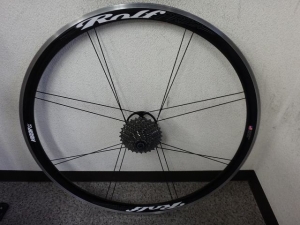
Apparently when they first bought it, the wheel center was way off,
but they had the shop that sold it adjust it for them.
The reason they only brought the rear wheel is
that there's a persistent noise coming from the spoke crossing on the non-freewheel side.
The importer's website does list
the cause and solution for this,
but there are several points I find hard to believe.
First, it says "this happens only after considerable mileage,"
but this phenomenon can occur even on brand new wheels.
Next, the cause is listed as "fine dust entering the spoke crossing,"
but the noise still comes from crossings even after cleaning and degreasing,
so that's not the real cause.
They cite "large spoke crossing angles" as a reason for the noise tendency,
but that's barely relevant either.
Even with extremely small spoke angles
(like barely overlapping chopsticks tips),
I think you'd still get noise.
As for causes not mentioned on the site:
First, the fact that these are black spokes makes a big difference.
Compared to silver spokes under identical conditions,
the presence and amount of noise changes quite a bit.
Second, these spokes are Sapim CX-RAY,
and the CX-RAY has an elliptical cross-section—an "elliptic aero" profile.
(DT's Aerolite is similar.)
When elliptic aero spokes cross each other, contact is almost line-to-line,
which makes noise more likely to occur.
If wider, flatter "square aero" spokes crossed instead,
contact would be surface-to-surface, and noise wouldn't happen much.
Mavic's Ksyrium Elite uses a final cross that's woven,
and even the cross below it makes contact,
but I've never heard of noise issues with them. That's because they're quite square aero.
(Silver spokes are probably used partly to avoid noise.)
The solution the site proposes is "oil the crossing,"
but that only works for a very short time.
If it still makes noise after that, they suggest having the shop that sold it
check the spoke tension for dropout,
but noise still occurs even with properly tensioned spokes.
This one's no exception.
By the way, the wheel center that supposedly was corrected—
before I did the truing that followed,
I checked and found measurable offset on the gauge,
so I made some minor adjustments myself.
I actually know a method that solves this problem with pretty high reliability,
but I can't perform it.
Because it requires a certain part that's impossible to obtain.

↑This is it.
It's a specialized washer that goes in the spoke crossing
on Shimano 7700-series 16H complete wheels, but it was discontinued long ago.
By the way, the image is borrowed from the internet—
I don't actually own one of these.
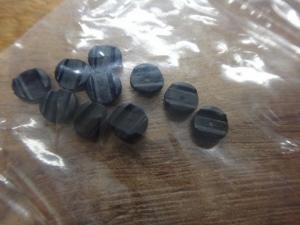
One set has 10 pieces.
I told the customer, "If you could somehow get these parts and oil them too,
the noise would probably go away,
but we don't have any in stock, sorry,"
when by chance a mysterious 2-meter-tall man in a trench coat
wearing an iron mask passed by,
pulled out some oiled paper from his coat pocket, and said, "Would you like these?"
and handed me 4 of them. Well, that was fortunate.
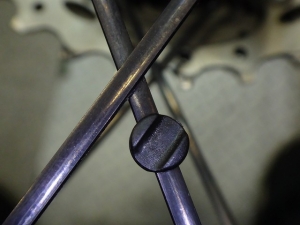
I placed it on the spoke to match the groove cut into the washer.
The angle seems to line up with the other side.
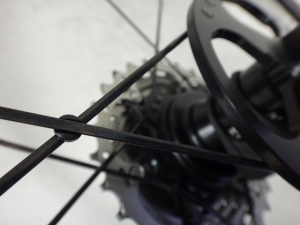
Installed.
The Shimano 7700-series wheel crossing is equivalent to JIS lacing.
One reason for this is that if it were equivalent to Italian lacing,
you'd need another washer that's the mirror image of this one.
If the grooves cut into the washer crossed at 90°,
that wouldn't be necessary, but in reality, as in the previous image,
there's about a 45° angle difference.
This time it happened to fit right into the crossing,
but if the non-freewheel side crossing were oriented differently, this washer wouldn't work.
In that case, I would've done a partial disassembly
and re-laced it to a crossing where the washer could be used.
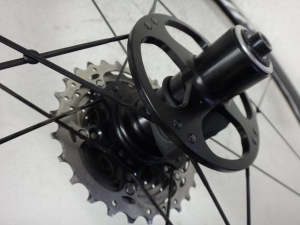
This rear wheel is 16H, and with a 16H rear wheel,
you need to tension each spoke quite a bit
to avoid creating a dangerously flexy wheel.
With a normal 16H rear wheel, even the non-freewheel side should be able to
achieve virtually zero spoke deflection,
and in fact, it has to—it's dangerous otherwise.
This Vigor's non-freewheel side is loose for a 16H rear wheel.
Part of that's due to it having a low-flange rear hub, but
the cassette body offset also plays a role.
When building a rear wheel with a bent-neck spoke, all inpoke or all outpoke in a 1-cross,
the freewheel side uses outpoke lacing throughout to avoid interference
between the rear derailleur and spokes during low gear shifting.
The non-freewheel side uses inpoke lacing throughout to achieve a wider effective flange width.
For example, HED's Aiolus 16H rear wheel is built that way.
But why can Rolf Prima do inpoke lacing on the freewheel side?
Because the freewheel body spline's butt end is positioned
away from the right flange.
In other words, the right flange sits closer to the wheel center.
This creates an extremely tight cassette offset, and
in my assessment, "even with an offset rim,
it would exceed the left-right difference of an ordinary wheel,"
but they're building it with a non-offset rim and a low-flange hub,
so "for a 16H rear wheel,"
the non-freewheel side can't be tensioned as much as ideal.
(The freewheel side is tensioned abnormally high, so even if the compliance is tight,
the non-freewheel side also has considerable tension,
and as a wheel, it's stiffer than your average hand-built one.)
I'm being a bit harsh and pontificating here, but
I actually think the Rolf Prima is an interesting wheel.
Even from people who own them, I've never heard anything bad. Just so you know.
I did this work about a week ago,
and four days ago I got a comment from this wheel's customer:
"Thanks for helping with the Rolf spoke noise the other day.
I went for a ride right after getting home and unfortunately heard noise,
but when I oiled the plastic part you installed, it stopped♪
Before, when it was spokes rubbing on each other, oiling didn't help,
so now I can enjoy riding it again!!!
Thank you so much!!!"
...Well, that's the original text exactly (except for line breaks).
No personal info, so I just wholesale copied and pasted it.
Sorry about that.
So it looks like the washer + oil really does eliminate the noise.
The customer said oiling didn't work when spokes were in direct contact,
but even if it did, the duration would be longer with the washer.
This was exactly the same with older Rolf wheels—it's clear from experience.
That's why this approach came to mind right away,
but sadly, since our shop doesn't stock the dedicated washers,
I won't be able to use this method again in the future(covering my bases).
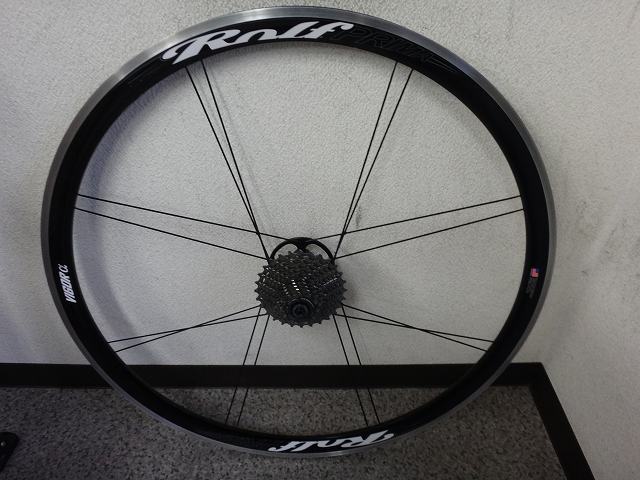
Apparently when they first bought it, the wheel center was way off,
but they had the shop that sold it adjust it for them.
The reason they only brought the rear wheel is
that there's a persistent noise coming from the spoke crossing on the non-freewheel side.
The importer's website does list
the cause and solution for this,
but there are several points I find hard to believe.
First, it says "this happens only after considerable mileage,"
but this phenomenon can occur even on brand new wheels.
Next, the cause is listed as "fine dust entering the spoke crossing,"
but the noise still comes from crossings even after cleaning and degreasing,
so that's not the real cause.
They cite "large spoke crossing angles" as a reason for the noise tendency,
but that's barely relevant either.
Even with extremely small spoke angles
(like barely overlapping chopsticks tips),
I think you'd still get noise.
As for causes not mentioned on the site:
First, the fact that these are black spokes makes a big difference.
Compared to silver spokes under identical conditions,
the presence and amount of noise changes quite a bit.
Second, these spokes are Sapim CX-RAY,
and the CX-RAY has an elliptical cross-section—an "elliptic aero" profile.
(DT's Aerolite is similar.)
When elliptic aero spokes cross each other, contact is almost line-to-line,
which makes noise more likely to occur.
If wider, flatter "square aero" spokes crossed instead,
contact would be surface-to-surface, and noise wouldn't happen much.
Mavic's Ksyrium Elite uses a final cross that's woven,
and even the cross below it makes contact,
but I've never heard of noise issues with them. That's because they're quite square aero.
(Silver spokes are probably used partly to avoid noise.)
The solution the site proposes is "oil the crossing,"
but that only works for a very short time.
If it still makes noise after that, they suggest having the shop that sold it
check the spoke tension for dropout,
but noise still occurs even with properly tensioned spokes.
This one's no exception.
By the way, the wheel center that supposedly was corrected—
before I did the truing that followed,
I checked and found measurable offset on the gauge,
so I made some minor adjustments myself.
I actually know a method that solves this problem with pretty high reliability,
but I can't perform it.
Because it requires a certain part that's impossible to obtain.
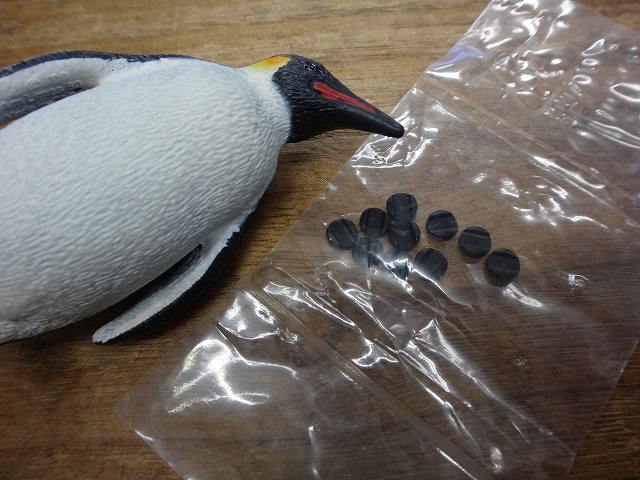
↑This is it.
It's a specialized washer that goes in the spoke crossing
on Shimano 7700-series 16H complete wheels, but it was discontinued long ago.
By the way, the image is borrowed from the internet—
I don't actually own one of these.
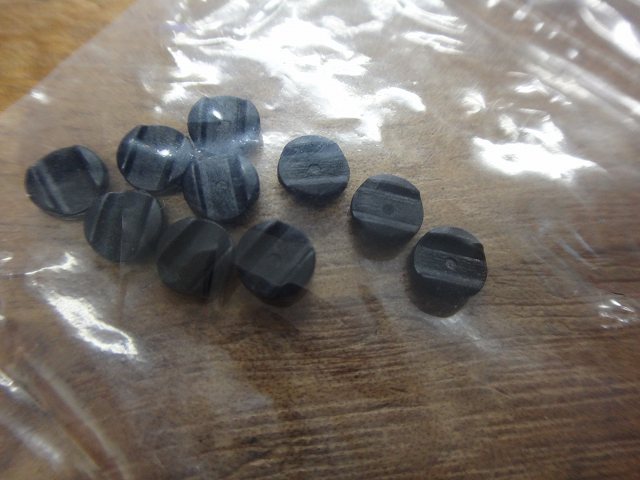
One set has 10 pieces.
I told the customer, "If you could somehow get these parts and oil them too,
the noise would probably go away,
but we don't have any in stock, sorry,"
when by chance a mysterious 2-meter-tall man in a trench coat
wearing an iron mask passed by,
pulled out some oiled paper from his coat pocket, and said, "Would you like these?"
and handed me 4 of them. Well, that was fortunate.
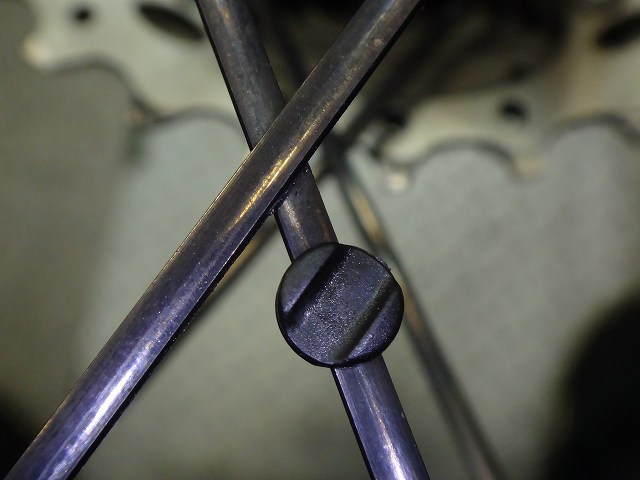
I placed it on the spoke to match the groove cut into the washer.
The angle seems to line up with the other side.
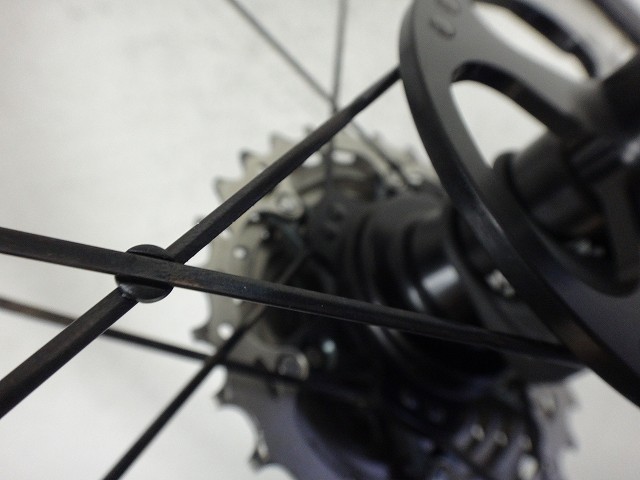
Installed.
The Shimano 7700-series wheel crossing is equivalent to JIS lacing.
One reason for this is that if it were equivalent to Italian lacing,
you'd need another washer that's the mirror image of this one.
If the grooves cut into the washer crossed at 90°,
that wouldn't be necessary, but in reality, as in the previous image,
there's about a 45° angle difference.
This time it happened to fit right into the crossing,
but if the non-freewheel side crossing were oriented differently, this washer wouldn't work.
In that case, I would've done a partial disassembly
and re-laced it to a crossing where the washer could be used.

This rear wheel is 16H, and with a 16H rear wheel,
you need to tension each spoke quite a bit
to avoid creating a dangerously flexy wheel.
With a normal 16H rear wheel, even the non-freewheel side should be able to
achieve virtually zero spoke deflection,
and in fact, it has to—it's dangerous otherwise.
This Vigor's non-freewheel side is loose for a 16H rear wheel.
Part of that's due to it having a low-flange rear hub, but
the cassette body offset also plays a role.
When building a rear wheel with a bent-neck spoke, all inpoke or all outpoke in a 1-cross,
the freewheel side uses outpoke lacing throughout to avoid interference
between the rear derailleur and spokes during low gear shifting.
The non-freewheel side uses inpoke lacing throughout to achieve a wider effective flange width.
For example, HED's Aiolus 16H rear wheel is built that way.
But why can Rolf Prima do inpoke lacing on the freewheel side?
Because the freewheel body spline's butt end is positioned
away from the right flange.
In other words, the right flange sits closer to the wheel center.
This creates an extremely tight cassette offset, and
in my assessment, "even with an offset rim,
it would exceed the left-right difference of an ordinary wheel,"
but they're building it with a non-offset rim and a low-flange hub,
so "for a 16H rear wheel,"
the non-freewheel side can't be tensioned as much as ideal.
(The freewheel side is tensioned abnormally high, so even if the compliance is tight,
the non-freewheel side also has considerable tension,
and as a wheel, it's stiffer than your average hand-built one.)
I'm being a bit harsh and pontificating here, but
I actually think the Rolf Prima is an interesting wheel.
Even from people who own them, I've never heard anything bad. Just so you know.
I did this work about a week ago,
and four days ago I got a comment from this wheel's customer:
"Thanks for helping with the Rolf spoke noise the other day.
I went for a ride right after getting home and unfortunately heard noise,
but when I oiled the plastic part you installed, it stopped♪
Before, when it was spokes rubbing on each other, oiling didn't help,
so now I can enjoy riding it again!!!
Thank you so much!!!"
...Well, that's the original text exactly (except for line breaks).
No personal info, so I just wholesale copied and pasted it.
Sorry about that.
So it looks like the washer + oil really does eliminate the noise.
The customer said oiling didn't work when spokes were in direct contact,
but even if it did, the duration would be longer with the washer.
This was exactly the same with older Rolf wheels—it's clear from experience.
That's why this approach came to mind right away,
but sadly, since our shop doesn't stock the dedicated washers,
I won't be able to use this method again in the future