Today's work doesn't quite fit the "wheel (and so on)" category.
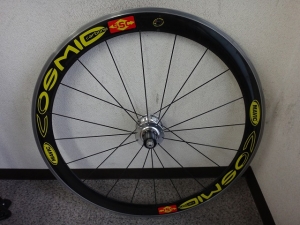
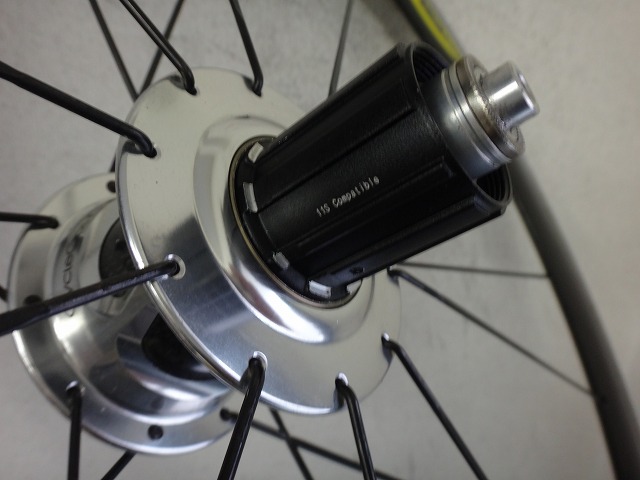
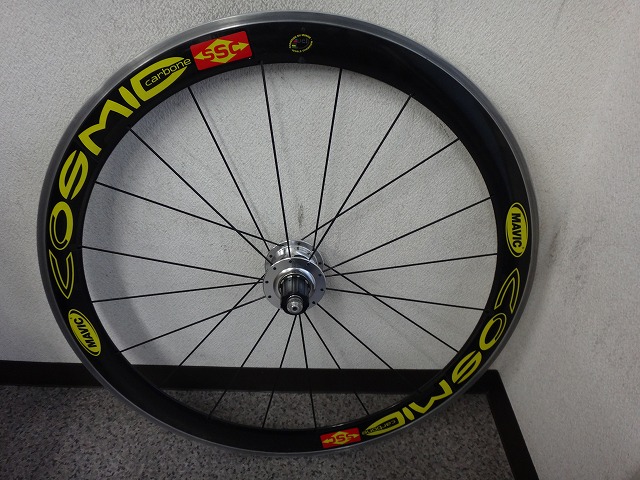
I received a Cosmic Carbon PowerTap wheel on consignment from a customer.
The hub is an SL+ 20H, but
they didn't just throw this together using a rim they had lying around—
this was an official spec that actually appeared in the catalog back then.
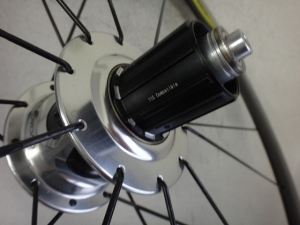
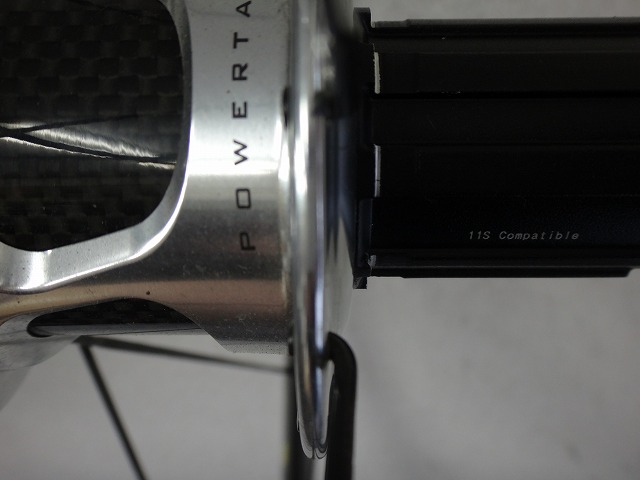
When they swapped in a Shimano 11-speed freehub body that didn't exist back then,
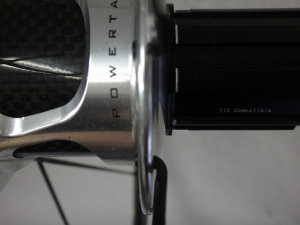
the sprockets started interfering with the spokes on the freehub side.
So they brought it in asking me to rebuild it as all-outpoke on the freehub side.
PowerTap hubs fundamentally prohibit radial lacing.
They require at least 1x crossing on both flanges,
though apparently the freehub side alone is just barely acceptable in unavoidable circumstances (※).
※I don't think this is in the manual, but
I learned about it from the distributor.
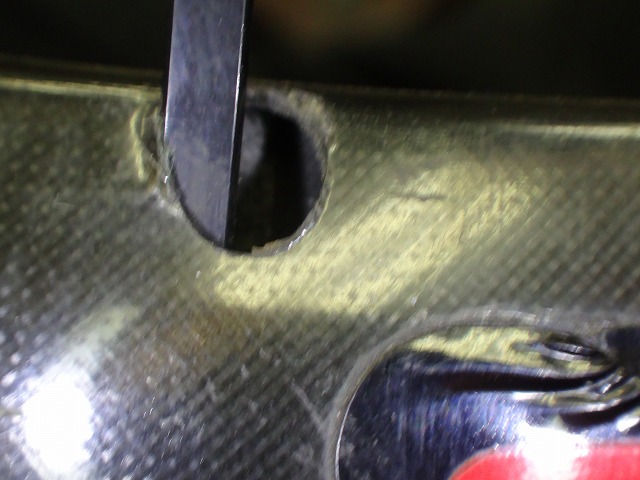
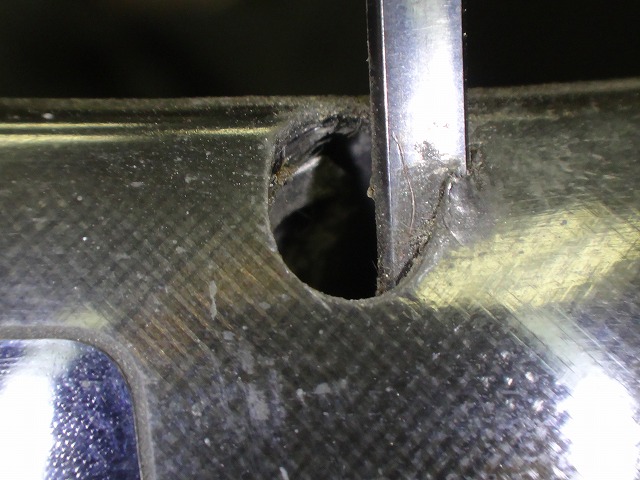
←This way
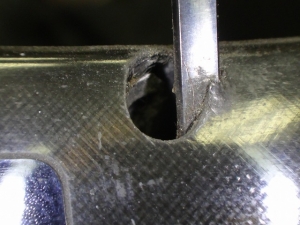
That way→
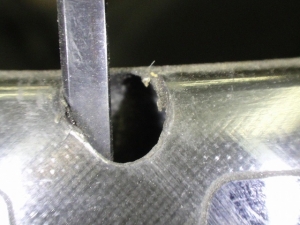
←This way
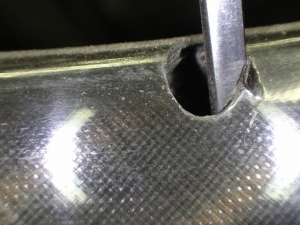
That way→
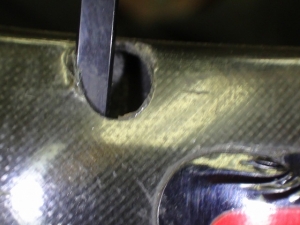
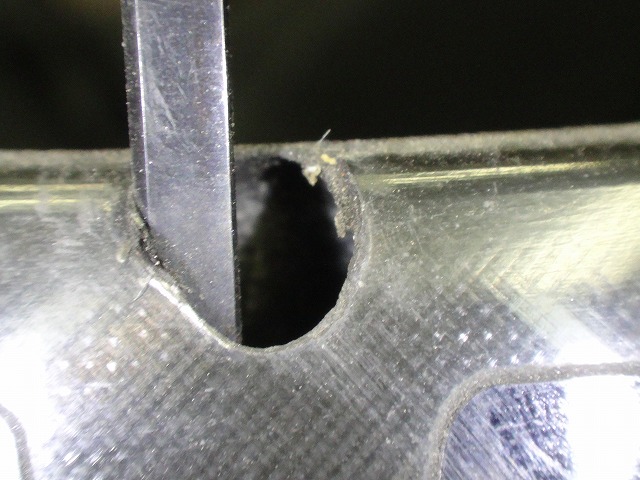
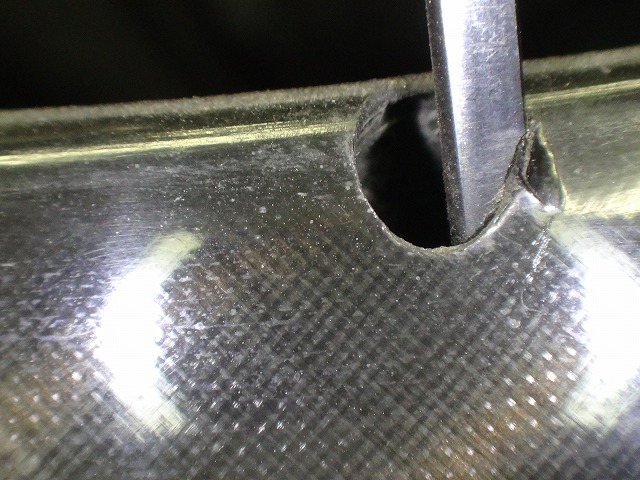
The carbon hood has holes designed to match the spoke trajectory
when using tangent lacing with Cosmic Carbon's original hub.
With radial lacing, when you look at the spoke trajectory from the side,
it's the same regardless of flange diameter,
so this interference is unavoidable even if the flange size changes.
When using Cosmic Carbon rims with aftermarket hubs laced 4-cross,
spokes often dig into the hood holes,
and even in the original configuration, while not necessarily digging in,
the spoke sometimes contacts the hood hole edge.
These holes are pretty crude, honestly.
Since the Cosmic Carbon SL, the width of the aero spoke's flattened section expanded a bit,
so the hood holes got bigger to match,
but this is from an earlier model (the rim has a label saying October 2002).

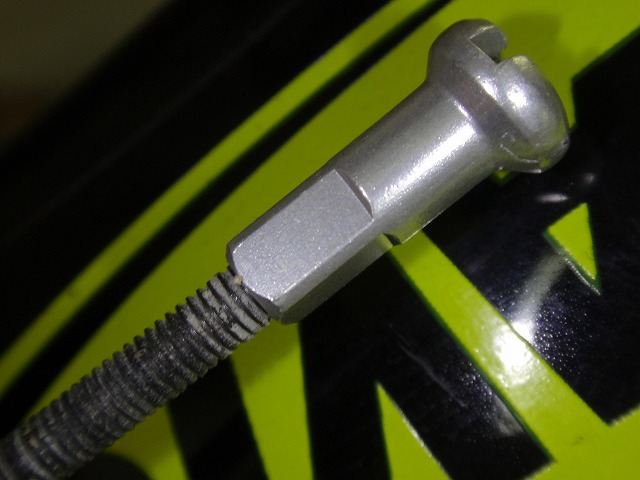
Being a proper Mavic spec, they used fairly specialized spokes.
Cosmic Carbon spokes are butted, flattened 13-gauge spokes,
so the nipples are 13-gauge as well
(and even more specifically, internal-threaded nipples that you tighten with a hex key from the rim's outer edge).
This wheel's spokes have the additional feature of being bent-neck design—
extremely specialized spokes that have no generic equivalent.
You'll find 13-gauge spokes on cargo bikes and old utility bikes (like tofu-seller bikes),
but not aero versions or internal-threaded nipples for those applications.
In the photo above I'm trying to fit them into 14-gauge nipples, but
they only sink into the serrated edge pocket—there's not even one thread engaged.
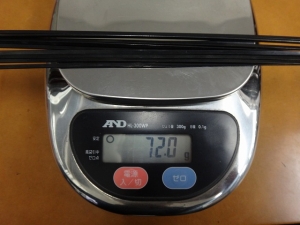
I weighed the 10 freehub-side spokes on a scale with 0.1g precision.
Weighing just one spoke and getting 7.2g would be inaccurate for estimating spoke density,
but weighing 10 spokes on a 0.1g scale gives quite accurate results.
These spokes measured 269mm, so
in terms of spoke density: "one 2690mm spoke would weigh 72.0g,"
meaning per-mm weight is 0.026765... g.
Spoke density at 100% is defined as
"1mm length of 2.0mm plain gauge weighs 0.0257g,"
so this spoke's density works out to 104.143...%.
Call it about 104%.
Lighter than I expected.
I think this is because the PowerTap hub flanges don't have slots cut for flattened spokes,
so they couldn't make the aero spokes as dramatically flat as usual.
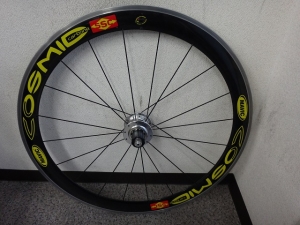
Done.
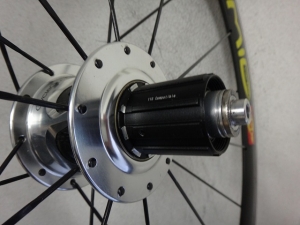
Not that it matters, but since I didn't completely disassemble the wheel,
I don't meet the criteria I arbitrarily set for "wheel (and so on)".
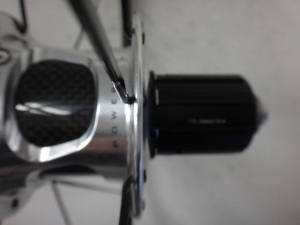
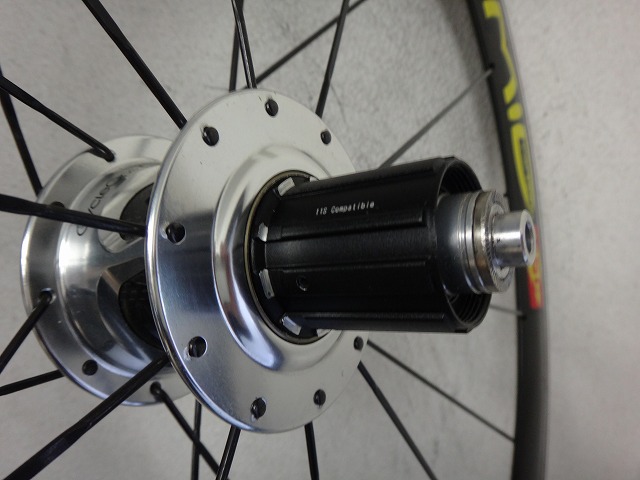
↑Apart from the spoke heads, absolutely nothing protrudes beyond the hub flanges,
so there shouldn't be any interference issues.
Similar jobs I've done include
converting a Bontrager PowerTap hub wheel to all-outpoke (→here),
and solving the interference problem with Campagnolo 11-speed that didn't exist
when the first R-SYS came out (→here).
I didn't write about the R-SYS job at the time, but
the flange sidewalls were thick, so
I ground them down to a point where they wouldn't interfere with the sprocket.
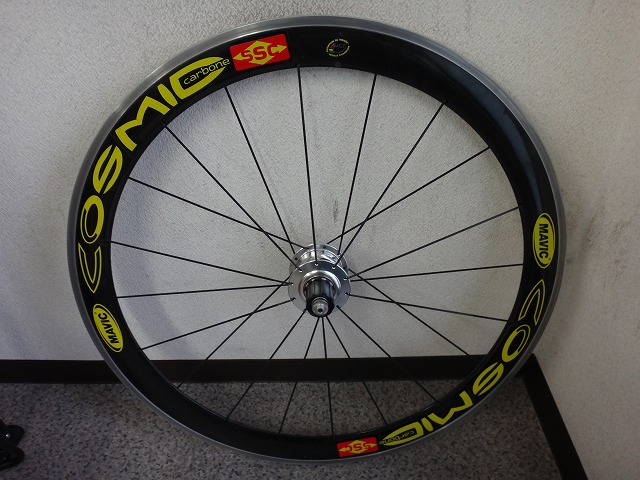
I received a Cosmic Carbon PowerTap wheel on consignment from a customer.
The hub is an SL+ 20H, but
they didn't just throw this together using a rim they had lying around—
this was an official spec that actually appeared in the catalog back then.
When they swapped in a Shimano 11-speed freehub body that didn't exist back then,
the sprockets started interfering with the spokes on the freehub side.
So they brought it in asking me to rebuild it as all-outpoke on the freehub side.
PowerTap hubs fundamentally prohibit radial lacing.
They require at least 1x crossing on both flanges,
though apparently the freehub side alone is just barely acceptable in unavoidable circumstances (※).
※I don't think this is in the manual, but
I learned about it from the distributor.
←This way
That way→
←This way
That way→
The carbon hood has holes designed to match the spoke trajectory
when using tangent lacing with Cosmic Carbon's original hub.
With radial lacing, when you look at the spoke trajectory from the side,
it's the same regardless of flange diameter,
so this interference is unavoidable even if the flange size changes.
When using Cosmic Carbon rims with aftermarket hubs laced 4-cross,
spokes often dig into the hood holes,
and even in the original configuration, while not necessarily digging in,
the spoke sometimes contacts the hood hole edge.
These holes are pretty crude, honestly.
Since the Cosmic Carbon SL, the width of the aero spoke's flattened section expanded a bit,
so the hood holes got bigger to match,
but this is from an earlier model (the rim has a label saying October 2002).
Being a proper Mavic spec, they used fairly specialized spokes.
Cosmic Carbon spokes are butted, flattened 13-gauge spokes,
so the nipples are 13-gauge as well
(and even more specifically, internal-threaded nipples that you tighten with a hex key from the rim's outer edge).
This wheel's spokes have the additional feature of being bent-neck design—
extremely specialized spokes that have no generic equivalent.
You'll find 13-gauge spokes on cargo bikes and old utility bikes (like tofu-seller bikes),
but not aero versions or internal-threaded nipples for those applications.
In the photo above I'm trying to fit them into 14-gauge nipples, but
they only sink into the serrated edge pocket—there's not even one thread engaged.

I weighed the 10 freehub-side spokes on a scale with 0.1g precision.
Weighing just one spoke and getting 7.2g would be inaccurate for estimating spoke density,
but weighing 10 spokes on a 0.1g scale gives quite accurate results.
These spokes measured 269mm, so
in terms of spoke density: "one 2690mm spoke would weigh 72.0g,"
meaning per-mm weight is 0.026765... g.
Spoke density at 100% is defined as
"1mm length of 2.0mm plain gauge weighs 0.0257g,"
so this spoke's density works out to 104.143...%.
Call it about 104%.
Lighter than I expected.
I think this is because the PowerTap hub flanges don't have slots cut for flattened spokes,
so they couldn't make the aero spokes as dramatically flat as usual.
Done.
Not that it matters, but since I didn't completely disassemble the wheel,
I don't meet the criteria I arbitrarily set for "wheel (and so on)".

↑Apart from the spoke heads, absolutely nothing protrudes beyond the hub flanges,
so there shouldn't be any interference issues.
Similar jobs I've done include
converting a Bontrager PowerTap hub wheel to all-outpoke (→here),
and solving the interference problem with Campagnolo 11-speed that didn't exist
when the first R-SYS came out (→here).
I didn't write about the R-SYS job at the time, but
the flange sidewalls were thick, so
I ground them down to a point where they wouldn't interfere with the sprocket.