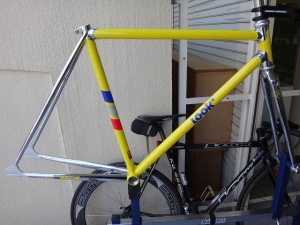
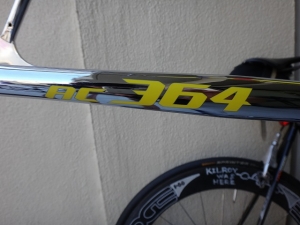
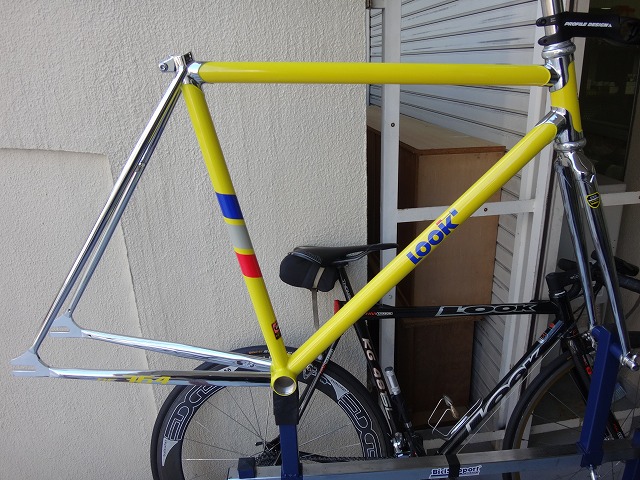
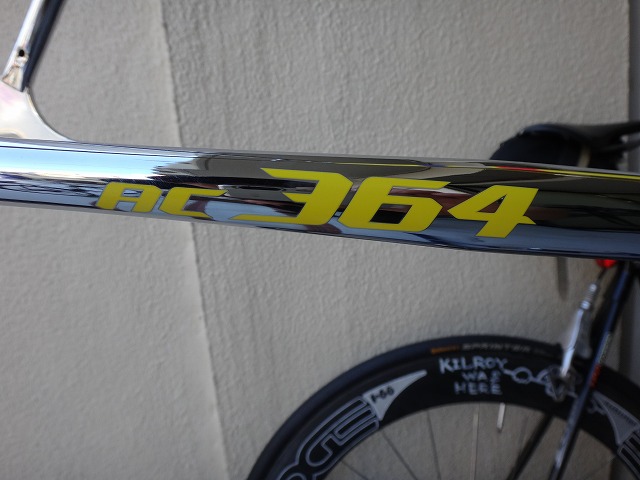
I bought a LOOK AC364 fixed-gear frame.
Back when pedal part numbers started with PP~ and frame part numbers started with KG~,
LOOK's numbering system was pretty consistent—
the digits after KG could tell you the frame's era, grade, material, and manufacturing method pretty accurately.
But that system disappeared after the KG481 (the frame in the back),
and from around the flagship 585 model onward,
it became more like "bigger numbers are kind of cooler."
With the KG481,
the hundreds digit (4) indicated the era,
going 181→281→381i→481.
The "i" in 381i was adopted when they switched to an integrated headset,
but honestly, the real reason was probably just that lowercase "i" was trendy back then
thanks to the iMac influence—pretty frivolous reasoning, really.
The tens digit (8) indicates the grade.
In fact, the lower models under 481 are the 461 and 451.
As a pure step-down from the 481 line,
I'd say it's the 451 rather than 461
(since it uses external lugs and the seatpost diameter is 25.0mm).
The ones digit (1) refers to material and construction method—carbon tubes with aluminum lugs.
If it's carbon monocoque, it becomes a 6, so the carbon monocoque line's progression goes
186→286→386i→486.
Actually, the 585 barely follows this rule too.
4→next is 5
8→same grade→8
1→carbon lugs is 5→5
After the 585, both the 595 (tens digit increased) and 586 (ones digit increased) are sold simultaneously,
but both are treated as flagship models.
The 595 is only 30,000 yen more expensive,
but the 586 is 100g lighter in frame weight.
Flat-ground response favors the 595, while climbing favors the 586, I'd say.
The 586 has no connection systematically to the 486,
so from around here the model numbers start losing their meaning.
As for LOOK's fixed-gear frames,
the aluminum AL464P came out in 2011,
the chromoly AC364 in 2015,
and the carbon CR564P in 2016.
Only the AC364 lacks the "P" suffix, but anyway,
364 is chromoly, 464 is aluminum, 564 is carbon,
and the ending 64 means fixed-gear model—it's kind of a pattern.
But these have nothing to do with the old system.
Actually, there was an AL464P model from 2002 as well,
but that was aluminum front triangle with carbon rear—you really feel the era difference.
Only the ○96 lineup with 96 at the end still follows the old rules,
for monocoque TT or triathlon or championship-spec fixed-gear frames,
so you can trace it back from 796→596→496→396→296→196 to the present.
The 296 and 286, 196 and 186, both have that TT frame shape,
but the 386i and 486 aren't as flat as the 396 and 496.
The ○86 line seems to have branched into aero road rather than TT bikes.
Though as I mentioned, the 586 isn't part of the ○86 system.
Also, there was a legendary two-digit frame called the KG96,
but it's not the predecessor to the KG196.
I said bigger numbers are somehow cooler, but that's really just "somehow."
Following that logic would make the 986 rigid MTB frame and 996 suspension frame cooler,
so clearly it doesn't hold up.
While researching, I found that the 26" 986 also has a 27.5" version (987) and a 29" version (989).
It seems the ones digit on MTB frames now indicates
the wheel size.
The reason I bought the 364 this time was because it has that rare horizontal top tube design.
I never thought I'd buy another LOOK frame with a horizontal top tube.
The frame color is retro-minded, and the tubes are Tange,
so I figured it was a Japan-exclusive model designed to hook guys like me...
but it's actually a global model available on their home site too.
It's in the "Urban" category rather than "Track," so it's classified as a street-oriented fixed-gear,
and can accommodate caliper brakes on both front and rear.
There are no bottle cage bosses at all (I'd want at least one even for a roller-trainer-only bike),
but that can be solved by adding rivnut bosses, so no problem there.
↑The fact I'm writing this kind of thing is kind of a problem in itself.
It's not headphones or a wristwatch, but it surprised me
that I could have this fresh, excited feeling about a bicycle purchase again.
Thinking about parts and all the options—it's genuinely fun.
Back when pedal part numbers started with PP~ and frame part numbers started with KG~,
LOOK's numbering system was pretty consistent—
the digits after KG could tell you the frame's era, grade, material, and manufacturing method pretty accurately.
But that system disappeared after the KG481 (the frame in the back),
and from around the flagship 585 model onward,
it became more like "bigger numbers are kind of cooler."
With the KG481,
the hundreds digit (4) indicated the era,
going 181→281→381i→481.
The "i" in 381i was adopted when they switched to an integrated headset,
but honestly, the real reason was probably just that lowercase "i" was trendy back then
thanks to the iMac influence—pretty frivolous reasoning, really.
The tens digit (8) indicates the grade.
In fact, the lower models under 481 are the 461 and 451.
As a pure step-down from the 481 line,
I'd say it's the 451 rather than 461
(since it uses external lugs and the seatpost diameter is 25.0mm).
The ones digit (1) refers to material and construction method—carbon tubes with aluminum lugs.
If it's carbon monocoque, it becomes a 6, so the carbon monocoque line's progression goes
186→286→386i→486.
Actually, the 585 barely follows this rule too.
4→next is 5
8→same grade→8
1→carbon lugs is 5→5
After the 585, both the 595 (tens digit increased) and 586 (ones digit increased) are sold simultaneously,
but both are treated as flagship models.
The 595 is only 30,000 yen more expensive,
but the 586 is 100g lighter in frame weight.
Flat-ground response favors the 595, while climbing favors the 586, I'd say.
The 586 has no connection systematically to the 486,
so from around here the model numbers start losing their meaning.
As for LOOK's fixed-gear frames,
the aluminum AL464P came out in 2011,
the chromoly AC364 in 2015,
and the carbon CR564P in 2016.
Only the AC364 lacks the "P" suffix, but anyway,
364 is chromoly, 464 is aluminum, 564 is carbon,
and the ending 64 means fixed-gear model—it's kind of a pattern.
But these have nothing to do with the old system.
Actually, there was an AL464P model from 2002 as well,
but that was aluminum front triangle with carbon rear—you really feel the era difference.
Only the ○96 lineup with 96 at the end still follows the old rules,
for monocoque TT or triathlon or championship-spec fixed-gear frames,
so you can trace it back from 796→596→496→396→296→196 to the present.
The 296 and 286, 196 and 186, both have that TT frame shape,
but the 386i and 486 aren't as flat as the 396 and 496.
The ○86 line seems to have branched into aero road rather than TT bikes.
Though as I mentioned, the 586 isn't part of the ○86 system.
Also, there was a legendary two-digit frame called the KG96,
but it's not the predecessor to the KG196.
I said bigger numbers are somehow cooler, but that's really just "somehow."
Following that logic would make the 986 rigid MTB frame and 996 suspension frame cooler,
so clearly it doesn't hold up.
While researching, I found that the 26" 986 also has a 27.5" version (987) and a 29" version (989).
It seems the ones digit on MTB frames now indicates
the wheel size.
The reason I bought the 364 this time was because it has that rare horizontal top tube design.
I never thought I'd buy another LOOK frame with a horizontal top tube.
The frame color is retro-minded, and the tubes are Tange,
so I figured it was a Japan-exclusive model designed to hook guys like me...
but it's actually a global model available on their home site too.
It's in the "Urban" category rather than "Track," so it's classified as a street-oriented fixed-gear,
and can accommodate caliper brakes on both front and rear.
There are no bottle cage bosses at all (I'd want at least one even for a roller-trainer-only bike),
but that can be solved by adding rivnut bosses, so no problem there.
↑The fact I'm writing this kind of thing is kind of a problem in itself.
It's not headphones or a wristwatch, but it surprised me
that I could have this fresh, excited feeling about a bicycle purchase again.
Thinking about parts and all the options—it's genuinely fun.