Wheels again today (and so on).
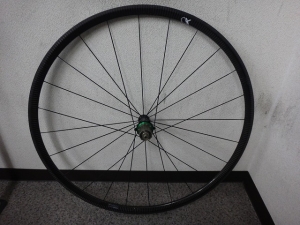
A customer brought in an AX Lightness rear wheel.
This is a separate project from the ultra-lightweight rim rebuild we did the other day,
but the story continues from there.
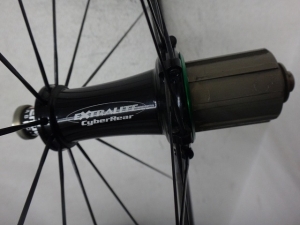
ExtraLight's "Cyber Rear" rear hub.
The ExtraLight hub from the other day was the Ultra grade,
but checking the manufacturer's website, it seems to have been discontinued.
The current road models use the Cyber grade,
and MTB models use the Hyper grade.
The Cyber front hub is marked as "Cyber Front,"
so there's no confusion with front and rear designations.
Even without it marked, there's no mistake.
So this one is also marked as "Cyber Rear."
Getting even more detailed, if it's a bent-spoke design it gets SL,
and if it's a straight-spoke design it gets SP at the end,
so the official name for this one is Cyber Rear SP.
Also, there's an HD model for front hubs only, where the hub body is wider than the SL
(presumably to accommodate larger diameter bearings),
and HD stands for Heavy Duty.
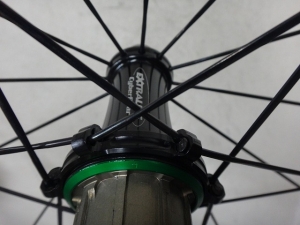
The spokes are DT black Aero Lite straight spokes on both sides,
laced in a pattern equivalent to 4/0 reverse Italian.
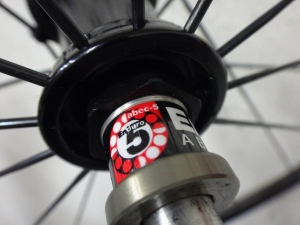
It says "Enduro brand ABEC-5 standard steel ball bearings,"
but on the Ultra Hub, it was marked as CERAMIC.
It seems the current ExtraLight hubs don't have any with ceramic bearings.
The bearing adjustment uses a hex nut,
but on the Ultra Hub it was a grooved round nut instead.
Imagine "a grooved round nut like on a French valve, just larger,"
adjusted by hand and not even locked with a locknut.
Most Mavic hubs use a cone wrench for adjustment,
but this is similar, just hand-adjusted.
The reason the rear wheel was brought in is the customer wanted it built with different spoke counts and patterns on each side
for a stiffer ride.
When you squeeze the spokes from the side of the wheel between both hands with force,
the spokes flex and bend.
I know that actual riding doesn't apply that exact stress,
but the deflection at that moment definitely relates
to how easily brake rub occurs and the perceived lateral stiffness.
As I told the customer, most of the spoke deformation was on the non-drive side.
Depending on the rider's weight, riding style, and brake-to-rim clearance,
this wheel could potentially rub only on the left side during actual riding.
I happened to have a Nomu Lab Wheel No. 5 rear wheel in the shop,
and when the customer squeezed its spokes the same way,
compared to the AX Lightness rear wheel it was "rock solid"—
the difference was that dramatic.
In other words, if the AX Lightness rim would allow spoke tension
comparable to an XR200 rim,
then we could build a wheel that's the Nomu Lab Wheel No. 5 with the rim
swapped out for an AX Lightness rim.
Having the wheel brought in helped a lot.
We could measure the original spoke tension before disassembly.
By the way, even before this rebuild, the drive side was already at its limit.
Under the condition of all Aero Lite 4/0 lacing, it's tensioned as high as possible,
and I think everything was done right.

It's done.
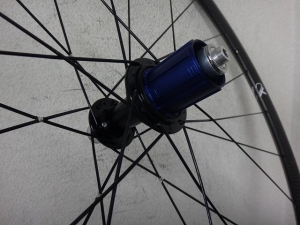
Leaf Hub 24H, black semi-compete 4/6 laced with reinforcement ring.
Lateral stiffness is definitely improved over the previous build.
However, I need to note that it's a weight increase as well.
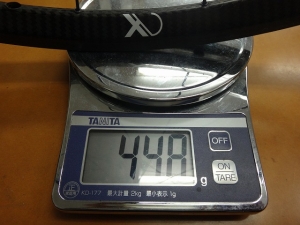
↑Before rebuild
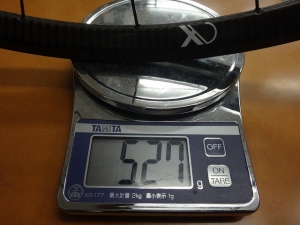
↑After rebuild
This 79g increase—even though the rim weight hasn't changed at all—
means the wheel overall is definitely heavier.
From my perspective, considering the factors that affect race performance,
I'm confident the wheel's performance improved over the previous build,
but it's not my decision to make—it's the rider's (the customer's).
If they decide the previous version was better,
I'll rebuild it back to the original spec, so just let me know.
What? Rim weight?
I know it, so why do I have to tell you? ←Wow, this guy's got a terrible attitude.
Sorry for the wait!
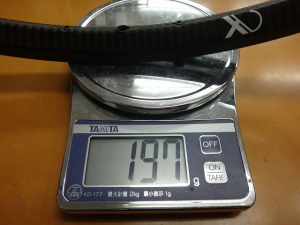
Please take a look at this image!
↑Stop it already!!
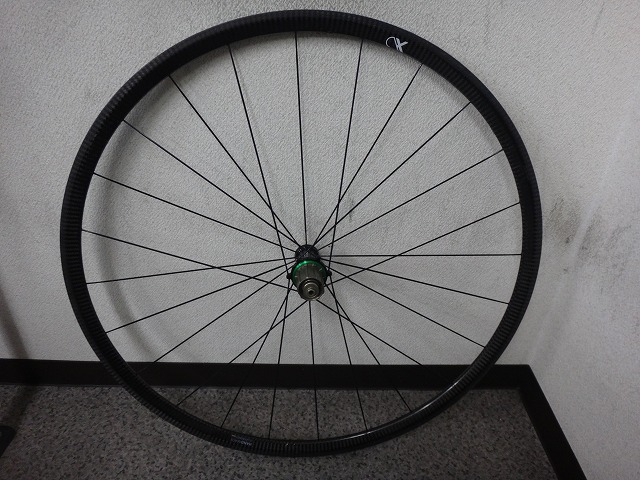
A customer brought in an AX Lightness rear wheel.
This is a separate project from the ultra-lightweight rim rebuild we did the other day,
but the story continues from there.
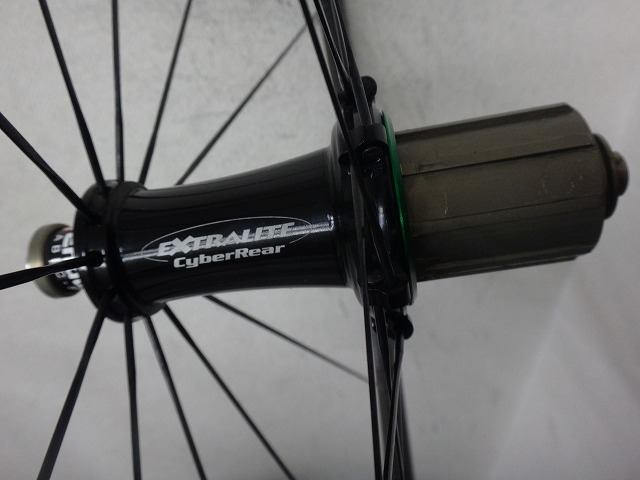
ExtraLight's "Cyber Rear" rear hub.
The ExtraLight hub from the other day was the Ultra grade,
but checking the manufacturer's website, it seems to have been discontinued.
The current road models use the Cyber grade,
and MTB models use the Hyper grade.
The Cyber front hub is marked as "Cyber Front,"
so there's no confusion with front and rear designations.
Even without it marked, there's no mistake.
So this one is also marked as "Cyber Rear."
Getting even more detailed, if it's a bent-spoke design it gets SL,
and if it's a straight-spoke design it gets SP at the end,
so the official name for this one is Cyber Rear SP.
Also, there's an HD model for front hubs only, where the hub body is wider than the SL
(presumably to accommodate larger diameter bearings),
and HD stands for Heavy Duty.

The spokes are DT black Aero Lite straight spokes on both sides,
laced in a pattern equivalent to 4/0 reverse Italian.
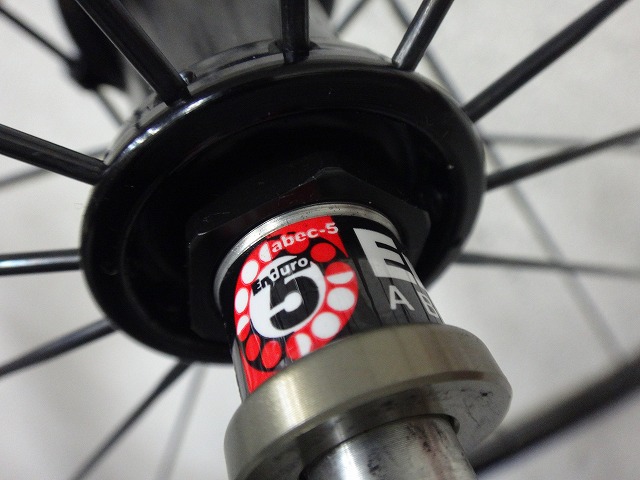
It says "Enduro brand ABEC-5 standard steel ball bearings,"
but on the Ultra Hub, it was marked as CERAMIC.
It seems the current ExtraLight hubs don't have any with ceramic bearings.
The bearing adjustment uses a hex nut,
but on the Ultra Hub it was a grooved round nut instead.
Imagine "a grooved round nut like on a French valve, just larger,"
adjusted by hand and not even locked with a locknut.
Most Mavic hubs use a cone wrench for adjustment,
but this is similar, just hand-adjusted.
The reason the rear wheel was brought in is the customer wanted it built with different spoke counts and patterns on each side
for a stiffer ride.
When you squeeze the spokes from the side of the wheel between both hands with force,
the spokes flex and bend.
I know that actual riding doesn't apply that exact stress,
but the deflection at that moment definitely relates
to how easily brake rub occurs and the perceived lateral stiffness.
As I told the customer, most of the spoke deformation was on the non-drive side.
Depending on the rider's weight, riding style, and brake-to-rim clearance,
this wheel could potentially rub only on the left side during actual riding.
I happened to have a Nomu Lab Wheel No. 5 rear wheel in the shop,
and when the customer squeezed its spokes the same way,
compared to the AX Lightness rear wheel it was "rock solid"—
the difference was that dramatic.
In other words, if the AX Lightness rim would allow spoke tension
comparable to an XR200 rim,
then we could build a wheel that's the Nomu Lab Wheel No. 5 with the rim
swapped out for an AX Lightness rim.
Having the wheel brought in helped a lot.
We could measure the original spoke tension before disassembly.
By the way, even before this rebuild, the drive side was already at its limit.
Under the condition of all Aero Lite 4/0 lacing, it's tensioned as high as possible,
and I think everything was done right.
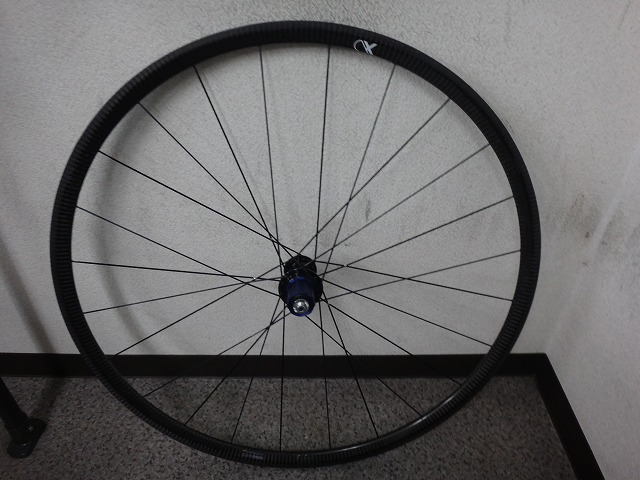
It's done.
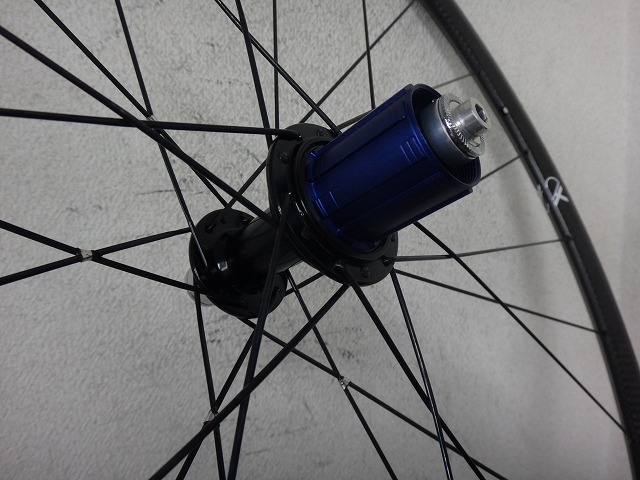
Leaf Hub 24H, black semi-compete 4/6 laced with reinforcement ring.
Lateral stiffness is definitely improved over the previous build.
However, I need to note that it's a weight increase as well.

↑Before rebuild

↑After rebuild
This 79g increase—even though the rim weight hasn't changed at all—
means the wheel overall is definitely heavier.
From my perspective, considering the factors that affect race performance,
I'm confident the wheel's performance improved over the previous build,
but it's not my decision to make—it's the rider's (the customer's).
If they decide the previous version was better,
I'll rebuild it back to the original spec, so just let me know.
What? Rim weight?
I know it, so why do I have to tell you? ←Wow, this guy's got a terrible attitude.
Sorry for the wait!
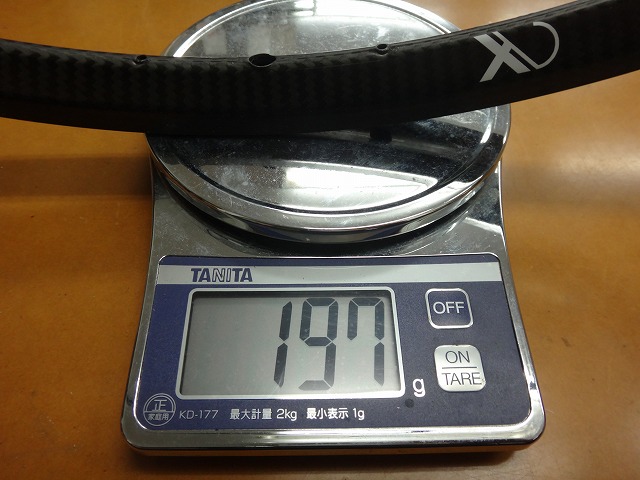
Please take a look at this image!
↑Stop it already!!