I received a comment on something I wrote recently about the flange shape of the Circus Monkey hub on a wheel I built.
"Wouldn't the notch on the high flange be more convenient for threading outpokes rather than inpokes on the low flange?
Sorry if I'm wrong about that."
The notch is actually more convenient for threading inpokes.
No need to apologize at all—quite the opposite, I'm grateful for the opportunity this comment gave me to write about it.
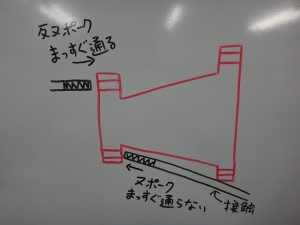
When building a high-low flange hub with tangent lacing on the non-drive side,
you end up with half inpokes and half outpokes.
Outpokes pass straight through the flange holes, so it's easy to give them a gentle bend afterward.
But with inpokes, even when the spoke is in contact with the drive-side flange,
the spoke approaches the non-drive side hole at an angle, making it extremely difficult to thread in the first place.
The spoke threads don't help either—they obstruct the insertion.
Non-drive side inpokes are difficult to thread not just on high-low flanges, but also on thick-flanged hubs like Chris King,
and likewise on Dura-Ace hubs, which additionally have slightly smaller flange holes (probably to improve the fit at the spoke seat).
(The Dura-Ace hub is only 0.5mm different in flange radius, so it can be treated as equal-diameter.)
Novatech-style hubs make non-drive side inpoke threading easier even with high-low flanges,
because their flange holes are larger and flanges thinner.
Whether a CX-RAY drops straight through under its own weight is a practical benchmark for ease of work.
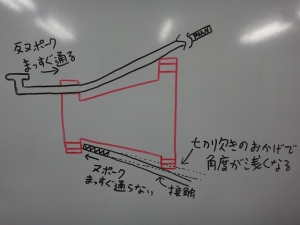
So the notch helps with both inpokes and outpokes,
but with outpokes it's a question of how much to bend after threading, whereas
with inpokes the entry angle changes during threading—so they benefit more.

The trickiest situation is when you have to pull spokes back out—whether due to lacing direction mistakes, wrong spoke length, or the like.
As the threads approach the flange hole at the end, pulling straight out becomes difficult. In that case,
you have to push the spoke toward the hub body or it won't come out.
When you do pull it out that way, the spoke tip can sometimes catch and scratch the hub body in the process.
In most cases this leaves a mark right away, so it's something to avoid at all costs.
So in situations like this, I insert my finger between the hub body and spoke to protect it.
But the real key is preventing this situation in the first place by getting the spoke length and lacing method right from the start.
Thanks for the comment.
"Wouldn't the notch on the high flange be more convenient for threading outpokes rather than inpokes on the low flange?
Sorry if I'm wrong about that."
The notch is actually more convenient for threading inpokes.
No need to apologize at all—quite the opposite, I'm grateful for the opportunity this comment gave me to write about it.
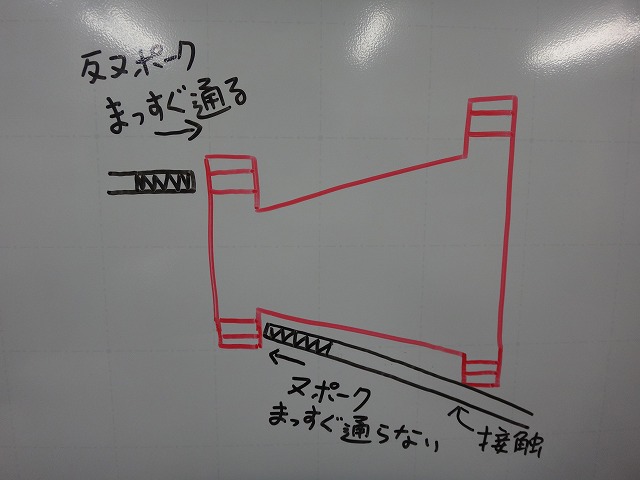
When building a high-low flange hub with tangent lacing on the non-drive side,
you end up with half inpokes and half outpokes.
Outpokes pass straight through the flange holes, so it's easy to give them a gentle bend afterward.
But with inpokes, even when the spoke is in contact with the drive-side flange,
the spoke approaches the non-drive side hole at an angle, making it extremely difficult to thread in the first place.
The spoke threads don't help either—they obstruct the insertion.
Non-drive side inpokes are difficult to thread not just on high-low flanges, but also on thick-flanged hubs like Chris King,
and likewise on Dura-Ace hubs, which additionally have slightly smaller flange holes (probably to improve the fit at the spoke seat).
(The Dura-Ace hub is only 0.5mm different in flange radius, so it can be treated as equal-diameter.)
Novatech-style hubs make non-drive side inpoke threading easier even with high-low flanges,
because their flange holes are larger and flanges thinner.
Whether a CX-RAY drops straight through under its own weight is a practical benchmark for ease of work.
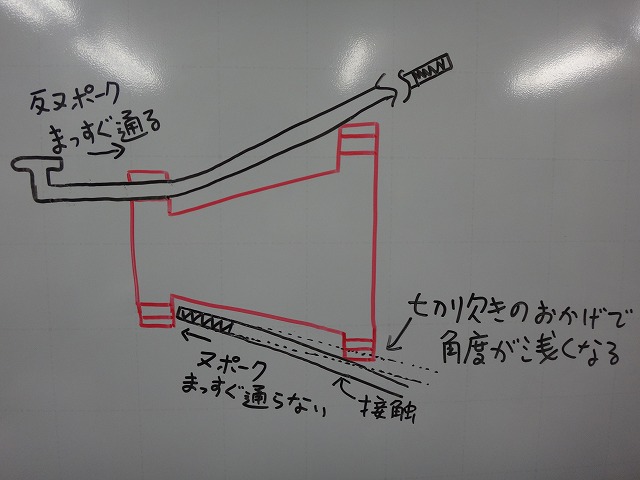
So the notch helps with both inpokes and outpokes,
but with outpokes it's a question of how much to bend after threading, whereas
with inpokes the entry angle changes during threading—so they benefit more.
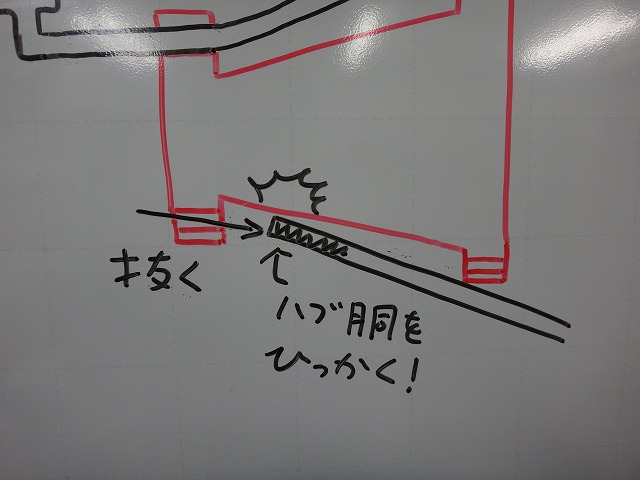
The trickiest situation is when you have to pull spokes back out—whether due to lacing direction mistakes, wrong spoke length, or the like.
As the threads approach the flange hole at the end, pulling straight out becomes difficult. In that case,
you have to push the spoke toward the hub body or it won't come out.
When you do pull it out that way, the spoke tip can sometimes catch and scratch the hub body in the process.
In most cases this leaves a mark right away, so it's something to avoid at all costs.
So in situations like this, I insert my finger between the hub body and spoke to protect it.
But the real key is preventing this situation in the first place by getting the spoke length and lacing method right from the start.
Thanks for the comment.