Yeah, another long post.
Today I'm talking about inpokes.
Not spokes, but inpokes.
When you search on Google
"Showing search results for: spokes"
comes up, so it seems there's definitely no common noun homophone.
Which makes sense, because this is my own coined term.
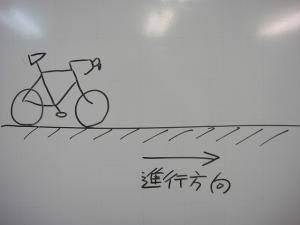
First thing. In my diagrams and photos used instead of diagrams, unless otherwise noted
the right side is the direction of travel.
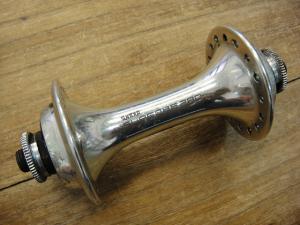
When building a wheel, you pass spokes through the hub flanges,
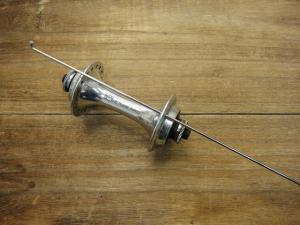
In the case where spokes are passed from the inside of the hub to the outside
↑This state, from here on in this blog I'll call it
inpoke.
It's just tedious to keep writing "spokes passed from the inside."
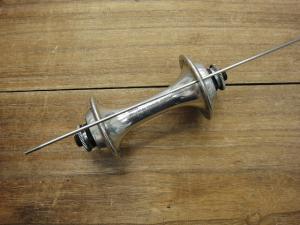
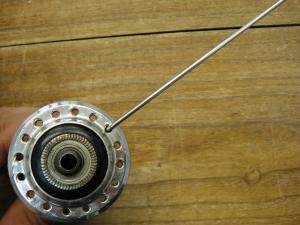
Similarly, in the case where spokes are passed from the outside of the hub to the inside
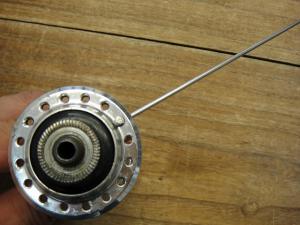
↑This state, I'll call it outpoke from here on.
Reverse inpoke would work too, but outpoke is easier to type.
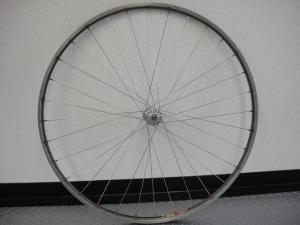
Wheels generally fall into 2 types of lacing patterns.
The type where spokes don't cross each other when viewed from the hub center
is called radial lacing because the spokes appear radial.
I think wheels in the earliest days of spoked wheels
probably used radial lacing, but radial lacing has
both advantages and disadvantages (I'll explain in detail later since this is getting long),
and until materials and structures appeared around the late 1980s that could overcome those issues,
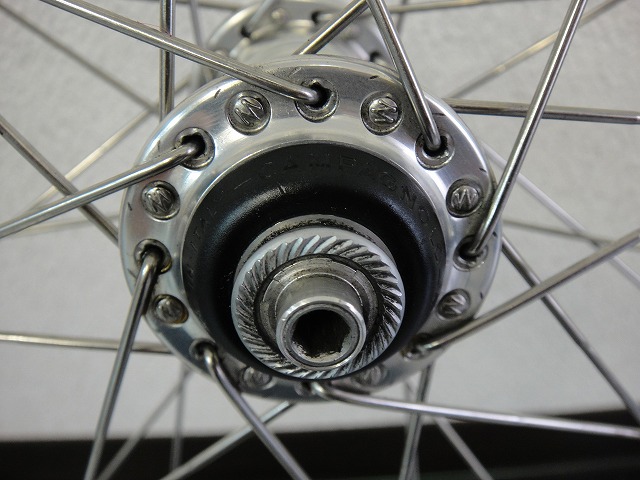
tangent lacing (like in the photo above) was
the standard for wheels.
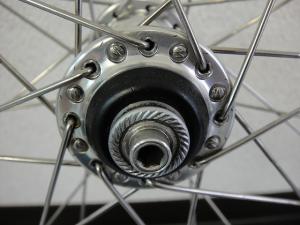
In tangent lacing, (except for special 2-spoke patterns) the spokes
passing through the hub flanges alternate between inpoke and outpoke.
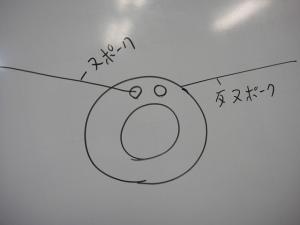
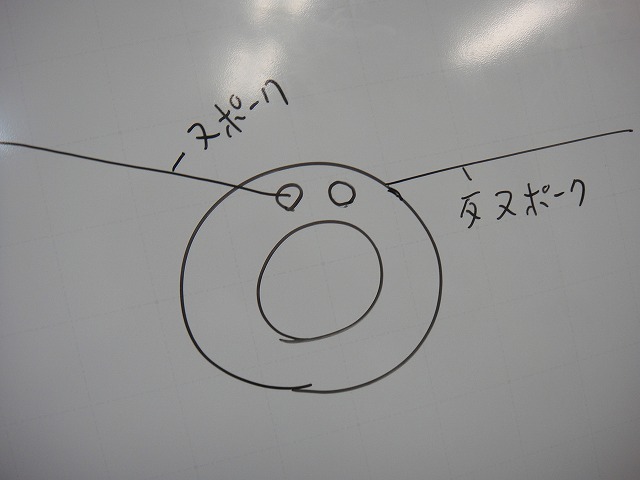
If I draw two adjacent spokes coming from neighboring hub flange holes
that extend in directions that don't contact each other,
it looks like this:
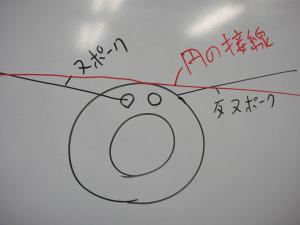
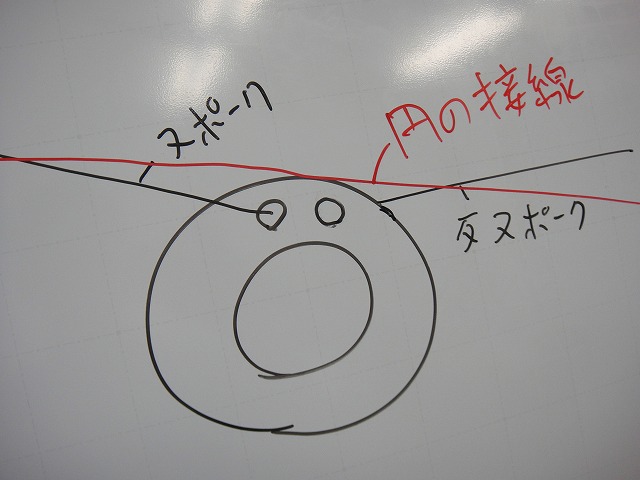
This direction is close to a tangent line to the circle,
which is why this lacing pattern is called tangent lacing.
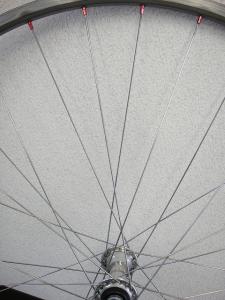
As mentioned at the start,
from here on I'll discuss everything with the right side as the direction of travel.
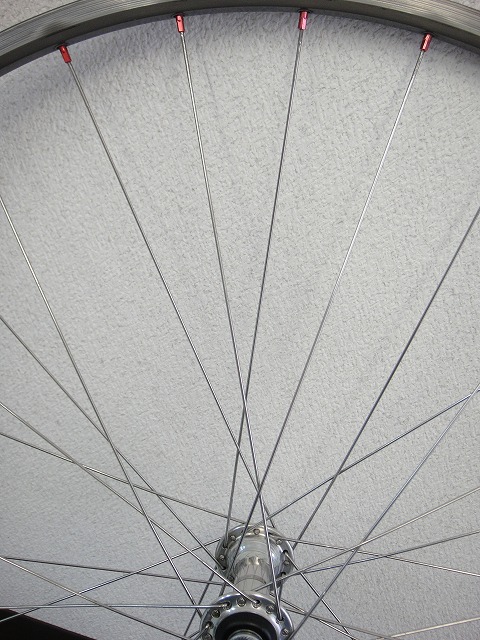
When spokes are cluttered it's hard to see, so
in the photo above I'll keep only the 4 spokes where you can see the red nipples clearly
to make it easier to view.
A normal wheel has these 4 spokes as one group, and
if there are 6 of them it's 24H, 7 is 28H, 8 is 32H...
that's how the configuration works.
Before that though...
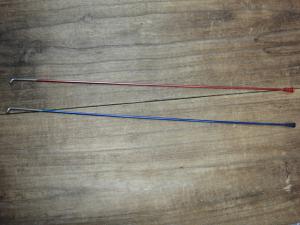
I prepared colored spokes. I'll thread these as inpokes.
Red is the inpoke closer to me,
Blue is the inpoke farther from me, and I'll thread them through the hub.
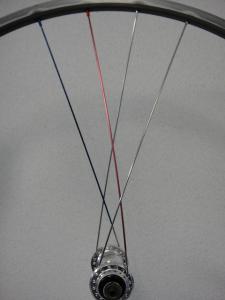
↑When the 2 rear inpokes relative to direction of travel are the inpokes out of these 4
Italian lacing.

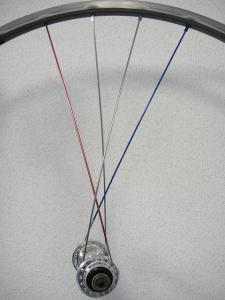
↑I flipped it from the previous state.
The inpokes are now the 2 front spokes relative to direction of travel.
This is reverse Italian lacing.
↑Conversely, when the inpokes are both front and back relative to direction of travel out of the 4
JIS lacing.
The red inpoke is the same as Italian lacing,
but the blue inpoke is opposite.
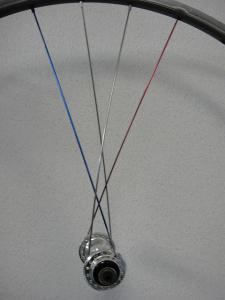
↑JIS lacing doesn't change the inpoke position relationship even when flipped.
Whether inpokes extend forward or
backward relative to direction of travel is extremely important.
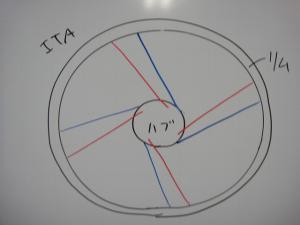
Drawing only the inpokes from a 16H tangent-laced wheel.
If I draw it with front inpokes in red and rear inpokes in blue
in Italian lacing it looks like the diagram above.
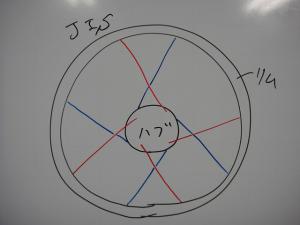
In JIS it looks like this. To reiterate,
whether Italian or JIS, the red inpokes have the same positional relationship.
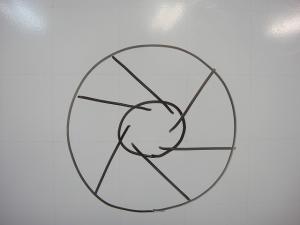
↑It's extending in this direction.

This, "when viewing the upper half of the wheel, the inpokes point backward"
is extremely important for rear wheels.
I'll call this the "porcupine direction."
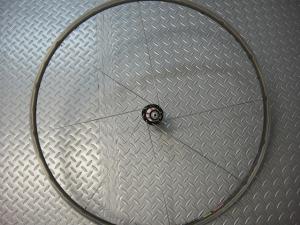
↑So I prepared a "wheel with only right inpokes."
To belabor the point again, whether Italian or JIS, the right flange
inpokes are in the porcupine direction.
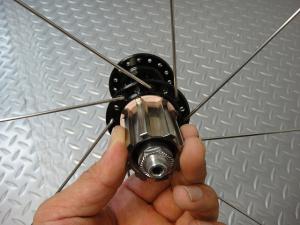
↓
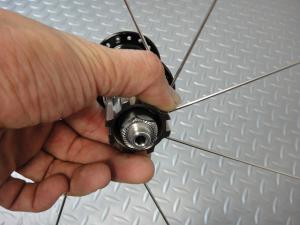
During riding, the freewheel body has a sprocket attached,
the chain runs on that, and when you push down on the pedal from above
via the crank arm, intense twisting force is applied forward.
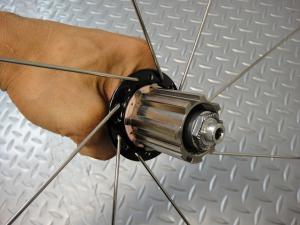
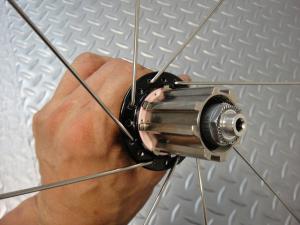
If I express that with my hand it looks like this.
When holding the freewheel section you can't see the hub flanges,
so I'll hold the hub body and twist it forward.
I want to see how the force is applied, so the spoke tension is loose
or rather not tensioned.
↓
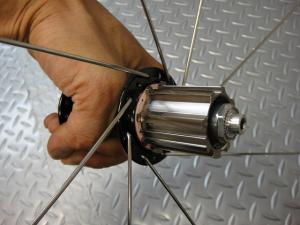
You can see the spokes are further tightened and squeezed.
In an actual built wheel it won't deform this much,
but this shows how the spokes are constantly under this kind of load.
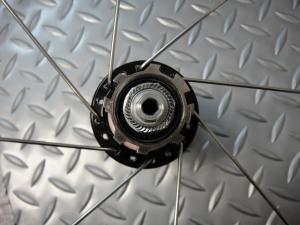
So what happens when the right inpokes are in the reverse porcupine direction?
This happens when you do reverse Italian lacing or reverse JIS lacing...
↓
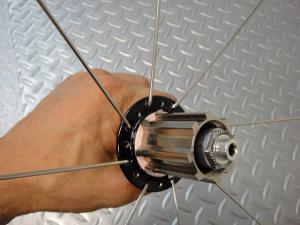
The spoke tension goes in the direction of loosening rather than tightening.
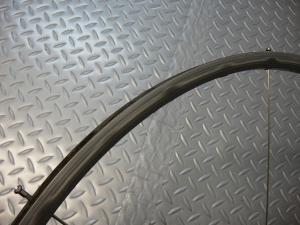
If the tire isn't tensioned, the spokes look like they'd pop out of the rim.
When you push hard on the pedals,
which one seems like it would better transmit that force to the outside of the rear wheel?
Obviously the one with right inpokes in the porcupine direction.
"That's obvious," you might say, but I've seen complete bike manufacturer hand-built wheels
laced in reverse Italian,
and complete wheels with straight-gauge spokes where the rightmost spoke
is in the reverse porcupine direction, so
it's worth examining those closely.
I'll detail specific examples of this later since it's getting long.
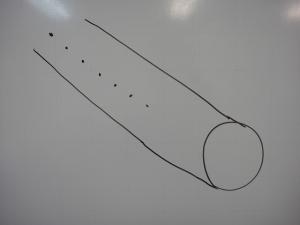
Say there's a rubber cylinder with evenly-spaced marks on it...
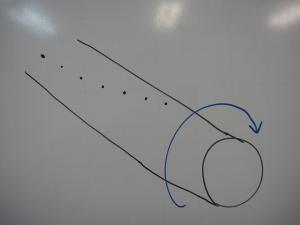
If you twist the end, the amount of twist increases
closer to where the twist originates. If I imagine that with a rear hub
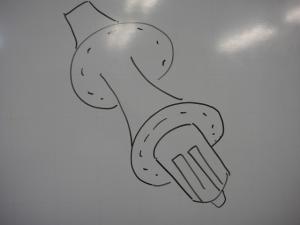
↓
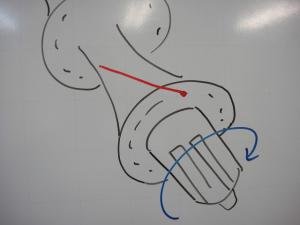
It works out like this. The spoke that receives the greatest force from pedaling power is the right inpoke, so right inpokes should be in the porcupine direction. That's the point.
Next is rim braking.
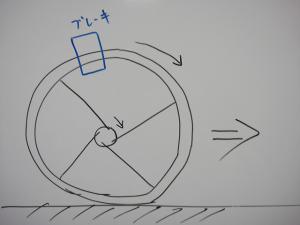
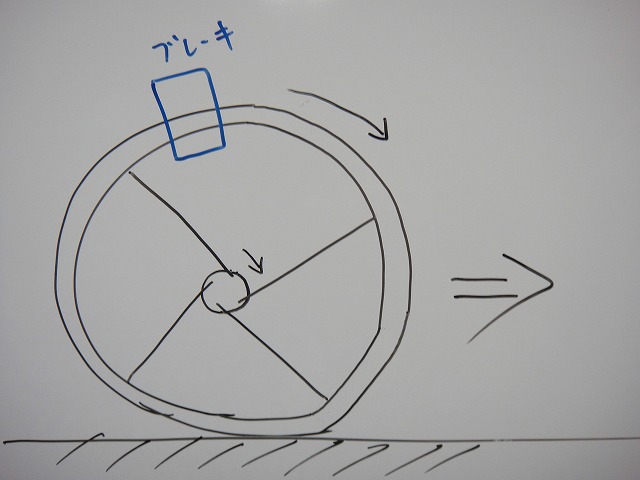
A wheel with inpokes in the porcupine direction is rolling.

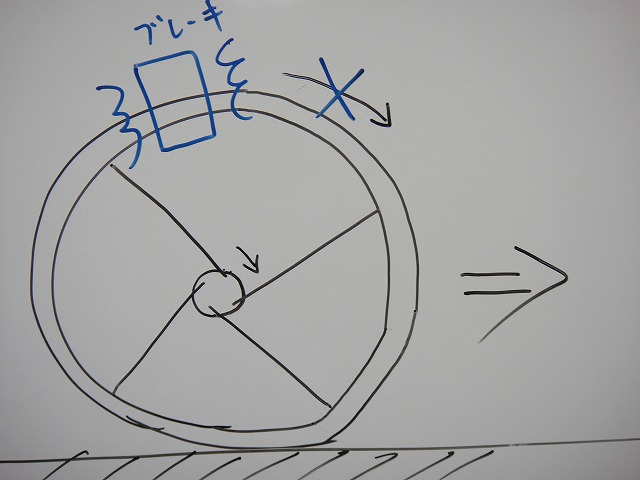
The brakes were applied from that state for hard braking.
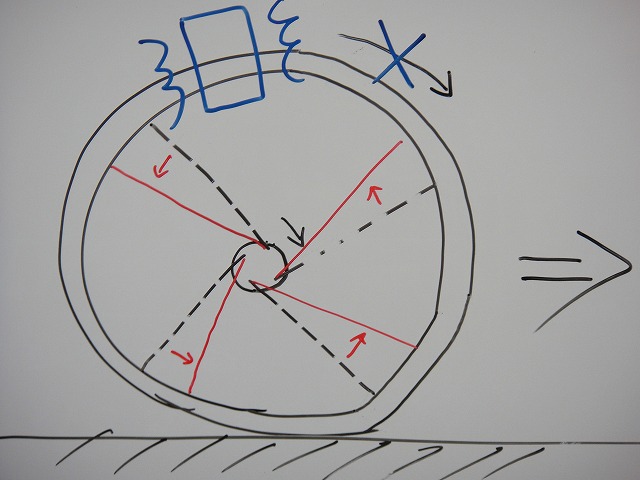
The rim rotation stopped instantly but
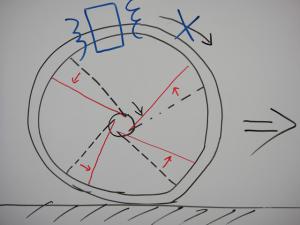
the hub didn't stop instantly, so the spokes
were further squeezed in the porcupine direction.
That phenomenon occurs.
With Italian lacing this is squeezed the same on both sides,
but with JIS lacing, only the spokes on the left relative to direction of travel
have force applied in the direction that releases tension.
That asymmetry bothers me.
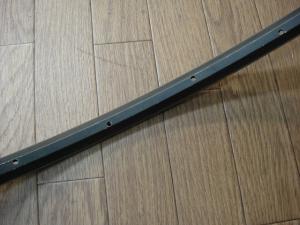
Let me look at this differently.
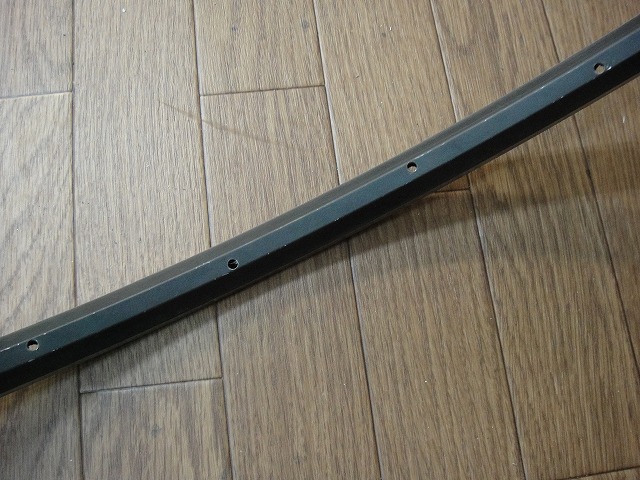
On a low-profile rim, the nipple holes alternate left and right.
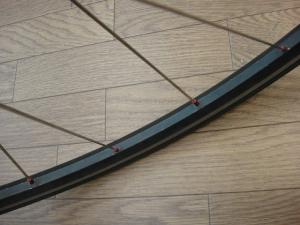
↑Built together it looks like this.

Actually this wheel is a Campagnolo Neutron,
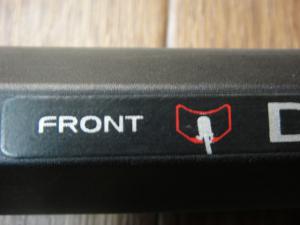
and as shown on the rim decal, the Neutron uses internal nipples.
External nipple Neutrons are...
it's getting long so I'll skip this. I won't detail this later either.
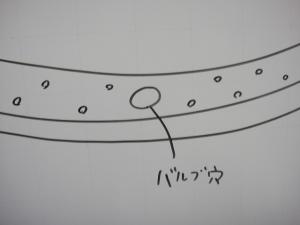
So a rim with hole offset
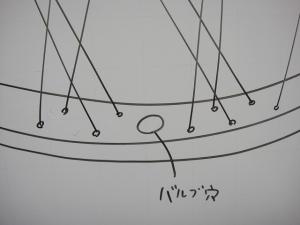
was built.
↑This is a blue marker, but here
imagine it as a "magic knife that cuts through anything like tofu super easily."

So I'll make nice clean cuts following the hole offset.
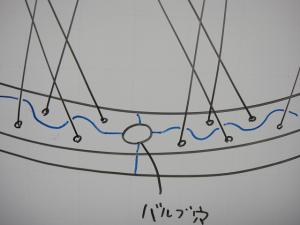
Around the valve hole I cut like this.

One more thing. Relative to the hub flanges
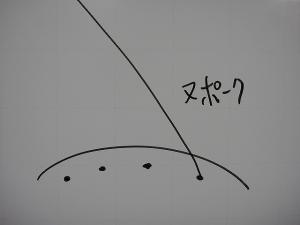
↑I'll denote inpokes like this, and
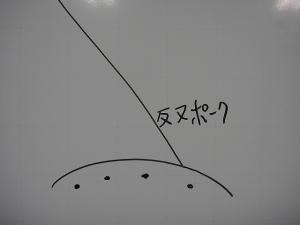
↑denote outpokes like this.
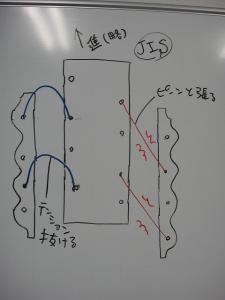
And the previous wheel laid flat would look like
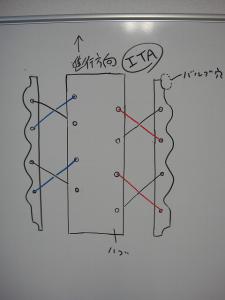
↑In Italian lacing it looks like this.
Red is right inpokes, blue is left inpokes.
The notches at the four corners are the original valve hole sections.
If you interpret the diagram accurately, this is 8H with 2 spokes each of inpoke and outpoke,
but since this is a conceptual diagram for understanding force distribution,
please don't worry about whether this wheel could actually be built.
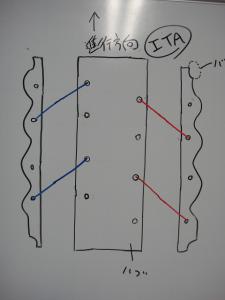
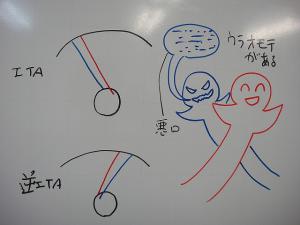
Then I kept only the inpokes.
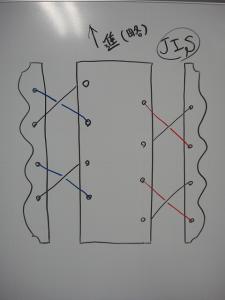
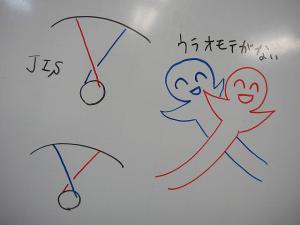
↑In JIS lacing it looks like this.
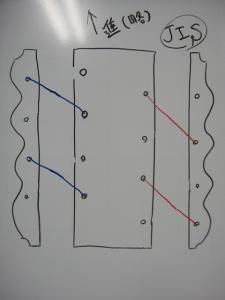
Then I kept only the inpokes.
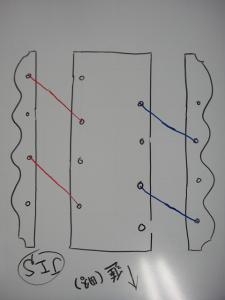
↑As a tangent, "JIS is still JIS when flipped" can also be
expressed like this.
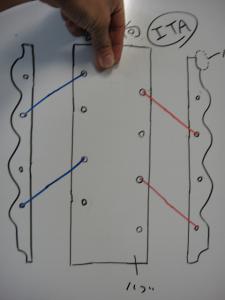
So "braking on the rim" or
"twisting the freewheel body forward on the rear wheel" is, in the diagram above,
like grabbing the hub section and pulling it up in one go.
Let me actually try it.
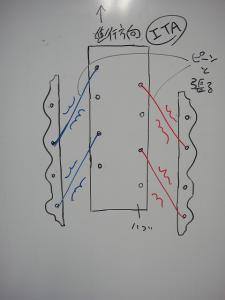
With Italian lacing, both left and right inpokes are taut with tension.
In other words, they're squeezed in the porcupine direction.
Spokes obviously don't stretch this much,
but I'm diagramming it this way to show how the force is applied.
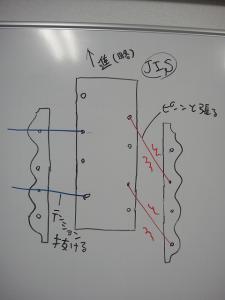
With JIS it looks like this.
I hate this asymmetrical feeling.
In this diagram
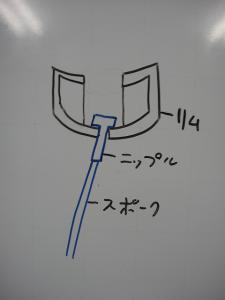
the spokes and nipples
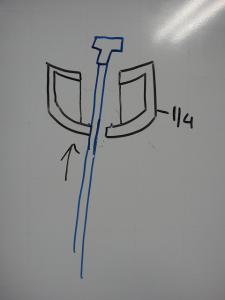
pop out from the rim, but
if the tire keeps the spokes from popping out
you could diagram it like this too.
This has gotten very long, but here's my conclusion.
・If doing tangent lacing, Italian lacing on both front and rear is desirable
・With Italian lacing, the front wheel shouldn't theoretically be reversed, so be careful
・On rear wheels where gears are on both sides, do JIS lacing so right inpokes
are always in the porcupine direction regardless of which side you put them on
These are my basic wheel-building principles (though there are various exceptions).
Also, when doing radial lacing with bent-elbow spokes, it's almost 100% done with outpokes,
but I sometimes do radial lacing with inpokes.
Also, for disc brake hubs, reverse Italian lacing is theoretically superior.
I'll detail these two points later. This sentence is already too long!
Bonus
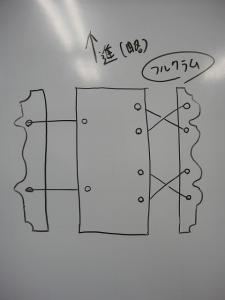
Straight spokes are, in my thinking, outpokes,
and laying out a Fulcrum rear wheel (2:1) that way looks like this.
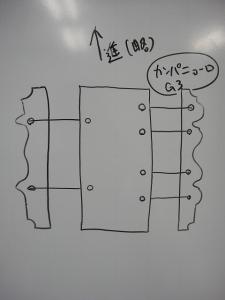
The Campagnolo G3 rear wheel looks like this.
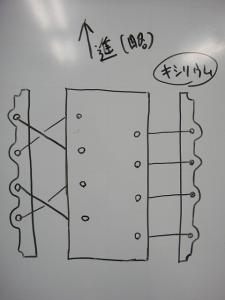
The Mavic Ksyrium rear wheel looks like this.
Freewheel side radial lacing is a kind of revolution I think,
but doing it with regular bent-elbow spokes carries significant risk.
By the way, this diagram is actually slightly wrong.
But since it's a conceptual diagram, please don't scrutinize it too deeply.
It's a crudely drawn version of what comes to mind when I'm building wheels.
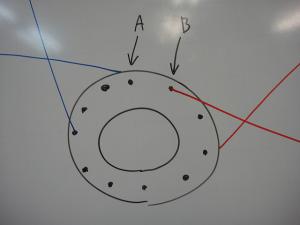
The Ksyrium rear wheel is 20H, and
if the holes in the hub flange that have tangent relationship with emerging spokes
are called A and B, then a normal wheel would
look like the diagram above, but
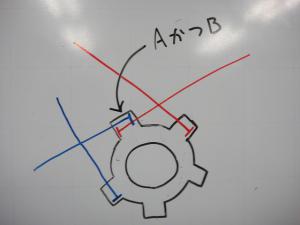
the Ksyrium has a flange shape where A and B overlap when viewed from the side.
I haven't expressed this in the layout diagram, but please forgive me.
On a normal wheel, if you consider spoke A and spoke B as one line,
it doesn't pass inside the actual tangent to the circle,
but on the Ksyrium it does.
I call such a hub a "tangent-breaking hub," and
that's one of the good things about the Ksyrium. I won't explain why it's good though.
Today I'm talking about inpokes.
Not spokes, but inpokes.
When you search on Google
"Showing search results for: spokes"
comes up, so it seems there's definitely no common noun homophone.
Which makes sense, because this is my own coined term.
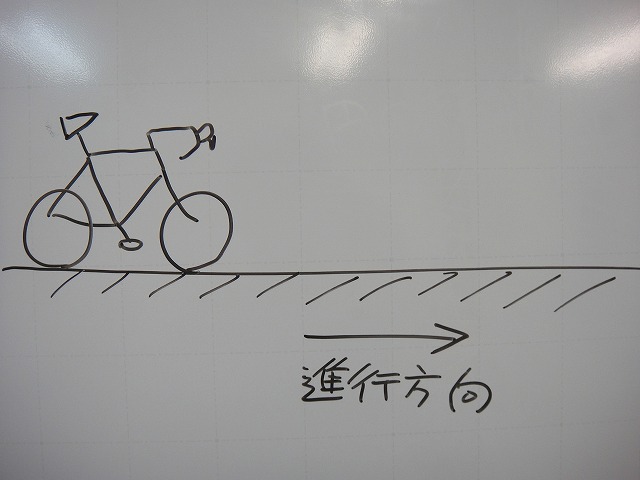
First thing. In my diagrams and photos used instead of diagrams, unless otherwise noted
the right side is the direction of travel.
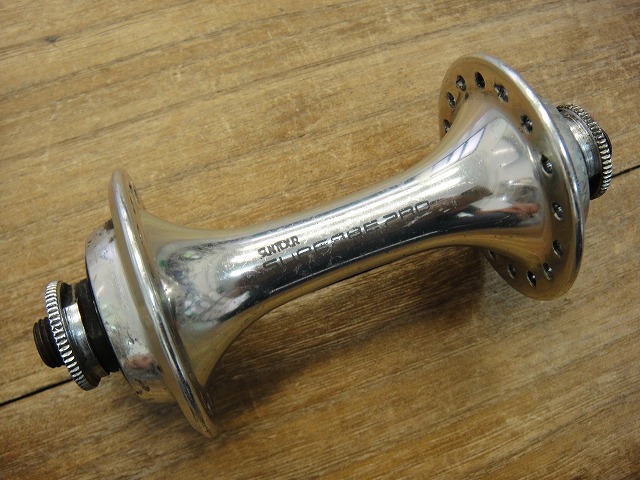
When building a wheel, you pass spokes through the hub flanges,
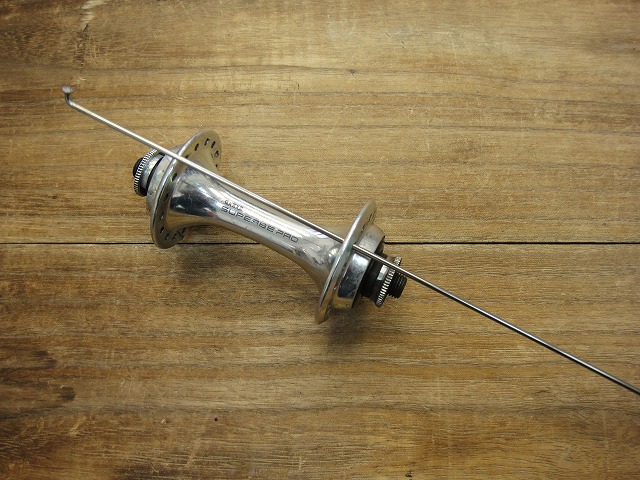
In the case where spokes are passed from the inside of the hub to the outside
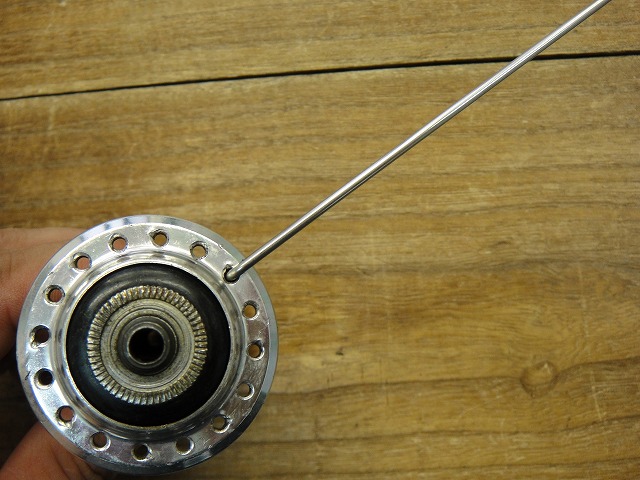
↑This state, from here on in this blog I'll call it
inpoke.
It's just tedious to keep writing "spokes passed from the inside."
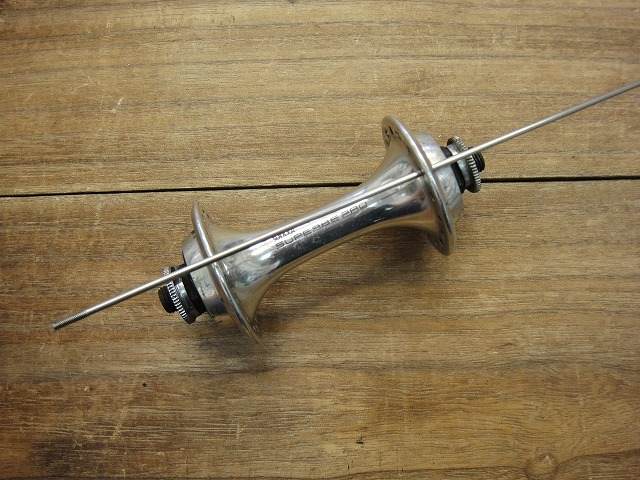
Similarly, in the case where spokes are passed from the outside of the hub to the inside
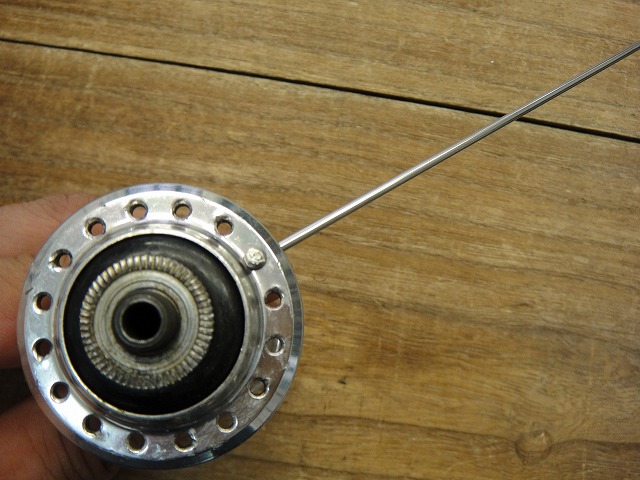
↑This state, I'll call it outpoke from here on.
Reverse inpoke would work too, but outpoke is easier to type.
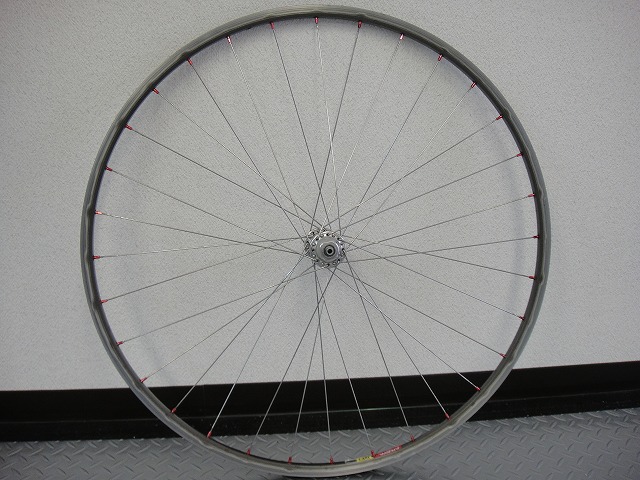
Wheels generally fall into 2 types of lacing patterns.
The type where spokes don't cross each other when viewed from the hub center
is called radial lacing because the spokes appear radial.
I think wheels in the earliest days of spoked wheels
probably used radial lacing, but radial lacing has
both advantages and disadvantages (I'll explain in detail later since this is getting long),
and until materials and structures appeared around the late 1980s that could overcome those issues,
tangent lacing (like in the photo above) was
the standard for wheels.
In tangent lacing, (except for special 2-spoke patterns) the spokes
passing through the hub flanges alternate between inpoke and outpoke.
If I draw two adjacent spokes coming from neighboring hub flange holes
that extend in directions that don't contact each other,
it looks like this:
This direction is close to a tangent line to the circle,
which is why this lacing pattern is called tangent lacing.
As mentioned at the start,
from here on I'll discuss everything with the right side as the direction of travel.
When spokes are cluttered it's hard to see, so
in the photo above I'll keep only the 4 spokes where you can see the red nipples clearly
to make it easier to view.
A normal wheel has these 4 spokes as one group, and
if there are 6 of them it's 24H, 7 is 28H, 8 is 32H...
that's how the configuration works.
Before that though...
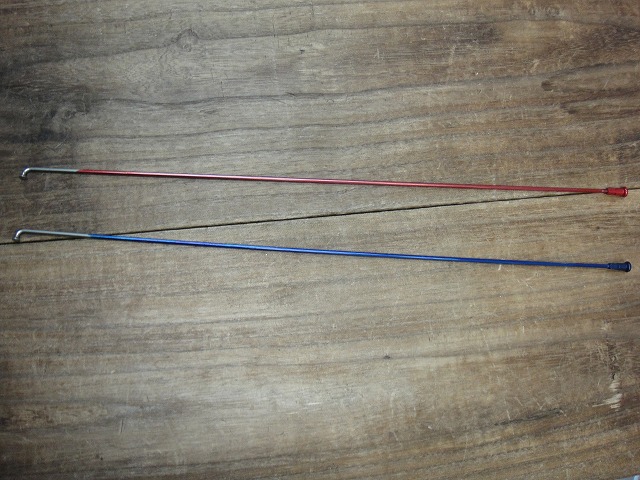
I prepared colored spokes. I'll thread these as inpokes.
Red is the inpoke closer to me,
Blue is the inpoke farther from me, and I'll thread them through the hub.
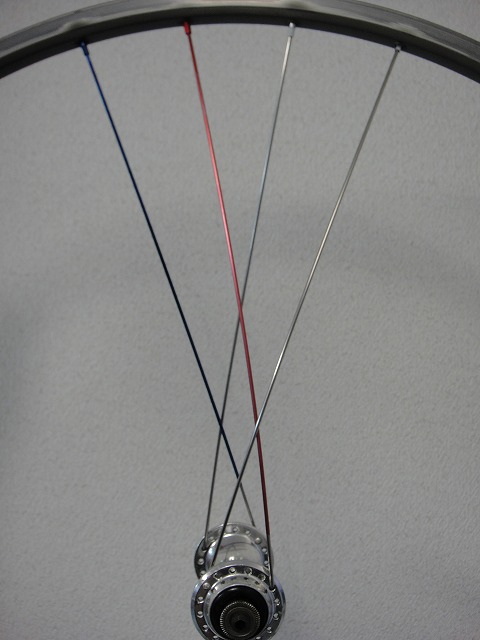
↑When the 2 rear inpokes relative to direction of travel are the inpokes out of these 4
Italian lacing.
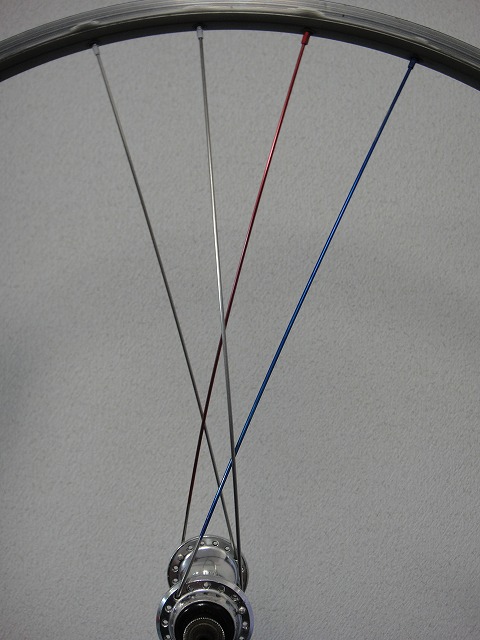
↑I flipped it from the previous state.
The inpokes are now the 2 front spokes relative to direction of travel.
This is reverse Italian lacing.
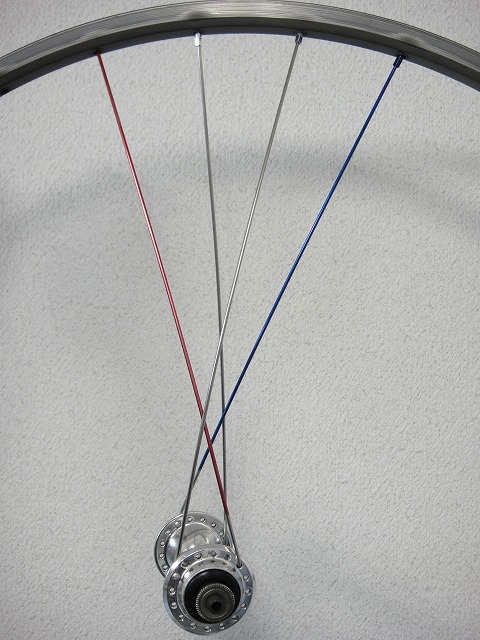
↑Conversely, when the inpokes are both front and back relative to direction of travel out of the 4
JIS lacing.
The red inpoke is the same as Italian lacing,
but the blue inpoke is opposite.
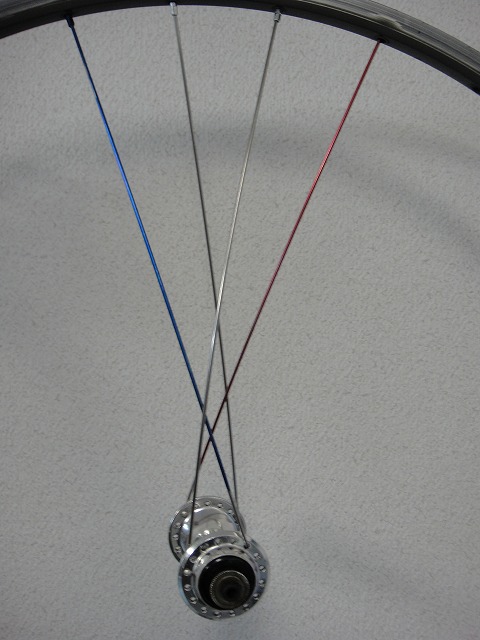
↑JIS lacing doesn't change the inpoke position relationship even when flipped.
Whether inpokes extend forward or
backward relative to direction of travel is extremely important.
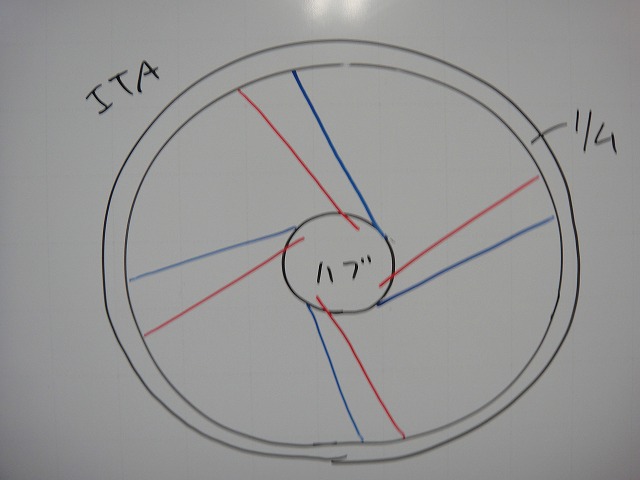
Drawing only the inpokes from a 16H tangent-laced wheel.
If I draw it with front inpokes in red and rear inpokes in blue
in Italian lacing it looks like the diagram above.
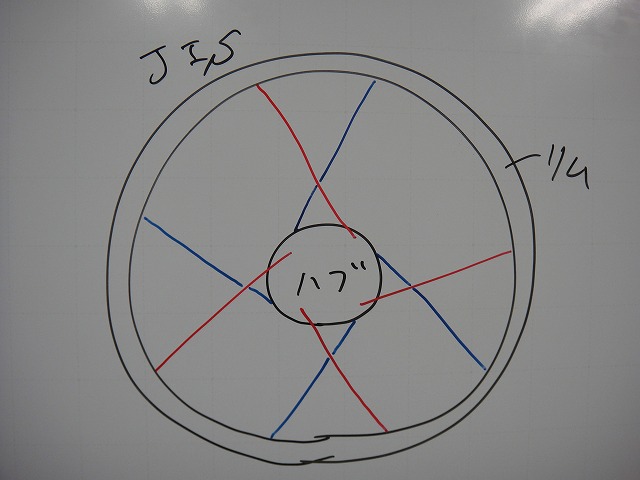
In JIS it looks like this. To reiterate,
whether Italian or JIS, the red inpokes have the same positional relationship.
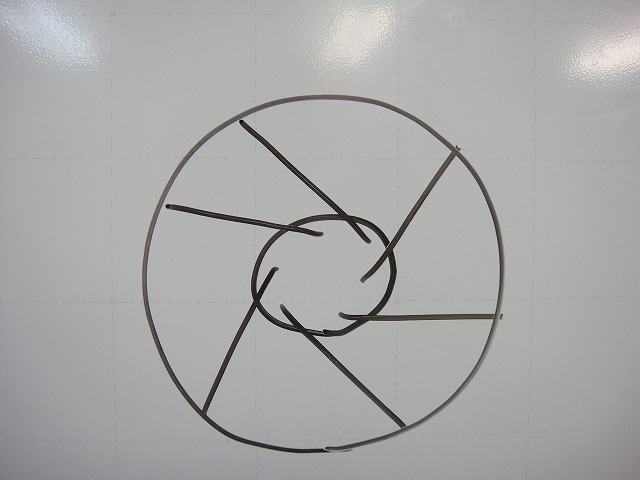
↑It's extending in this direction.

This, "when viewing the upper half of the wheel, the inpokes point backward"
is extremely important for rear wheels.
I'll call this the "porcupine direction."
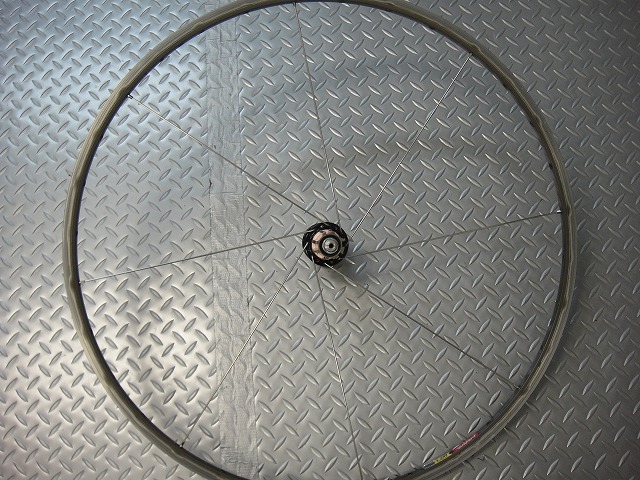
↑So I prepared a "wheel with only right inpokes."
To belabor the point again, whether Italian or JIS, the right flange
inpokes are in the porcupine direction.
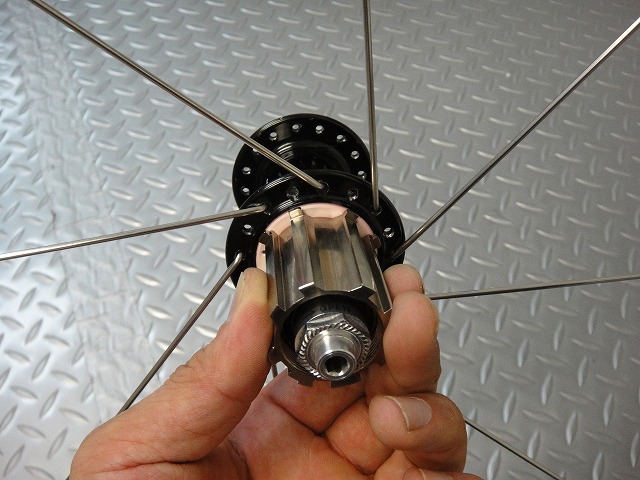
↓
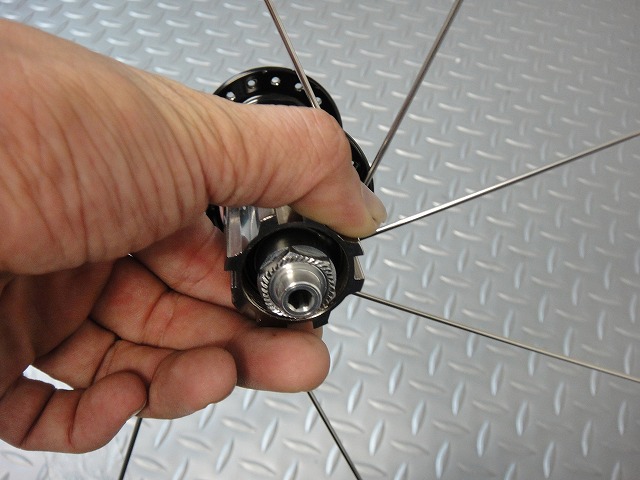
During riding, the freewheel body has a sprocket attached,
the chain runs on that, and when you push down on the pedal from above
via the crank arm, intense twisting force is applied forward.
If I express that with my hand it looks like this.
When holding the freewheel section you can't see the hub flanges,
so I'll hold the hub body and twist it forward.
I want to see how the force is applied, so the spoke tension is loose
or rather not tensioned.

↓
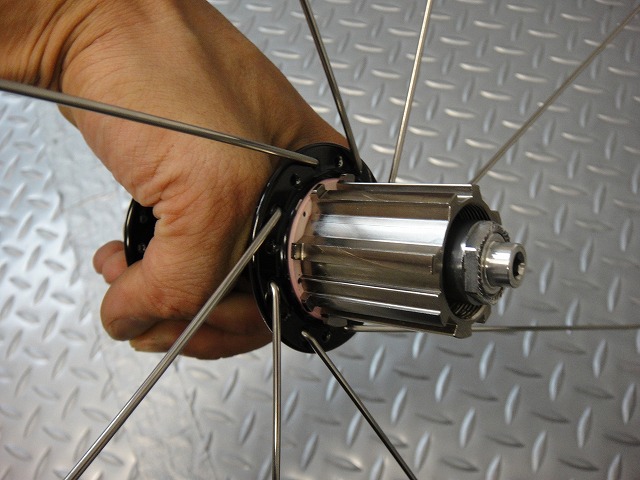
You can see the spokes are further tightened and squeezed.
In an actual built wheel it won't deform this much,
but this shows how the spokes are constantly under this kind of load.
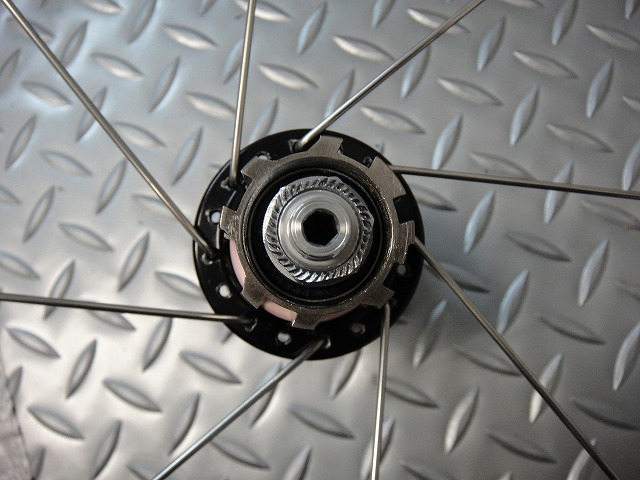
So what happens when the right inpokes are in the reverse porcupine direction?
This happens when you do reverse Italian lacing or reverse JIS lacing...
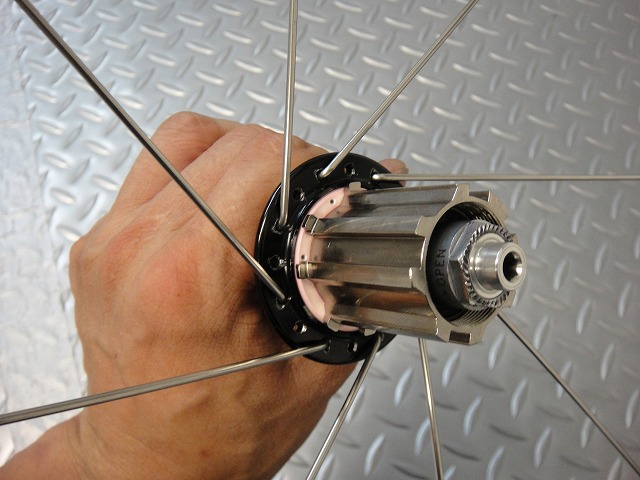
↓
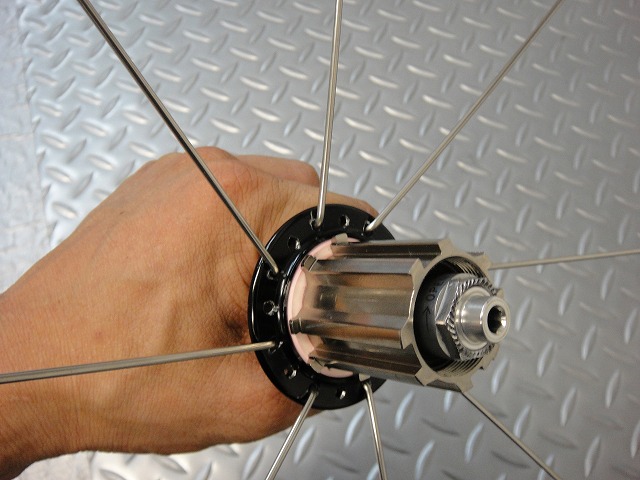
The spoke tension goes in the direction of loosening rather than tightening.
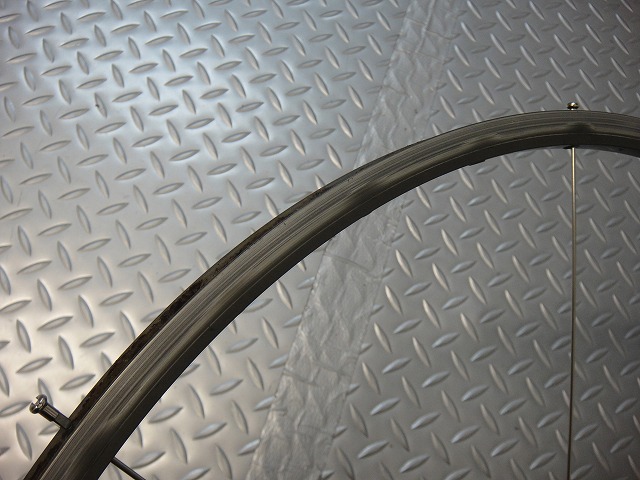
If the tire isn't tensioned, the spokes look like they'd pop out of the rim.
When you push hard on the pedals,
which one seems like it would better transmit that force to the outside of the rear wheel?
Obviously the one with right inpokes in the porcupine direction.
"That's obvious," you might say, but I've seen complete bike manufacturer hand-built wheels
laced in reverse Italian,
and complete wheels with straight-gauge spokes where the rightmost spoke
is in the reverse porcupine direction, so
it's worth examining those closely.
I'll detail specific examples of this later since it's getting long.
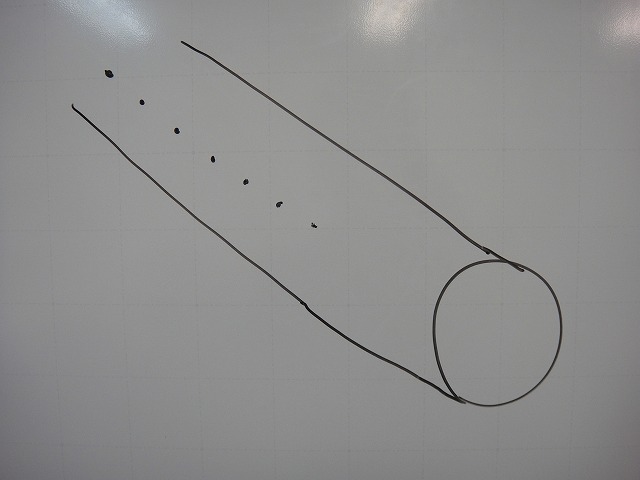
Say there's a rubber cylinder with evenly-spaced marks on it...
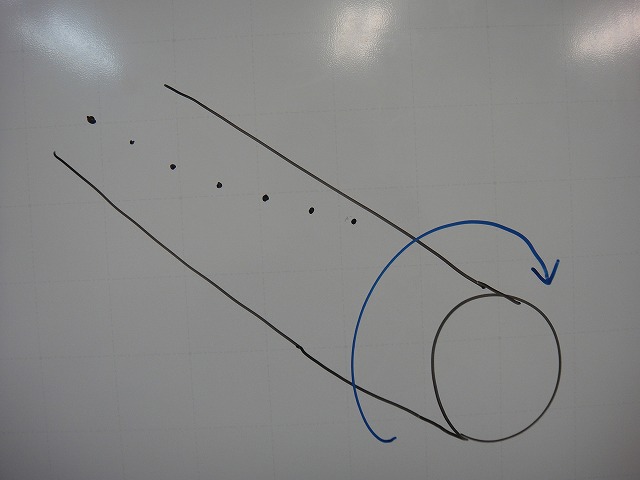
If you twist the end, the amount of twist increases
closer to where the twist originates. If I imagine that with a rear hub
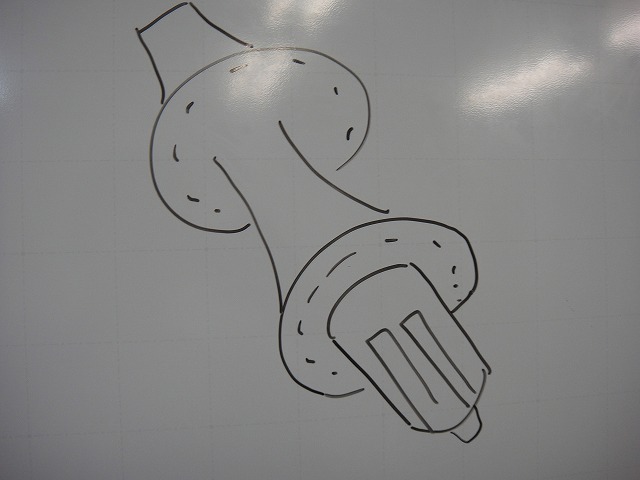
↓
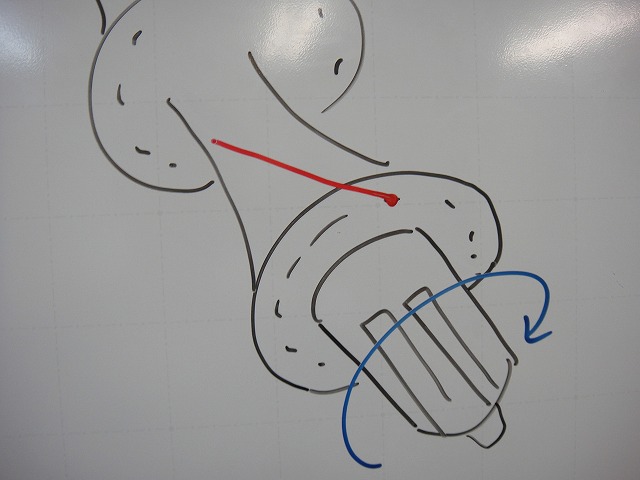
It works out like this. The spoke that receives the greatest force from pedaling power is the right inpoke, so right inpokes should be in the porcupine direction. That's the point.
Next is rim braking.
A wheel with inpokes in the porcupine direction is rolling.
The brakes were applied from that state for hard braking.
The rim rotation stopped instantly but
the hub didn't stop instantly, so the spokes
were further squeezed in the porcupine direction.
That phenomenon occurs.
With Italian lacing this is squeezed the same on both sides,
but with JIS lacing, only the spokes on the left relative to direction of travel
have force applied in the direction that releases tension.
That asymmetry bothers me.
Let me look at this differently.
On a low-profile rim, the nipple holes alternate left and right.
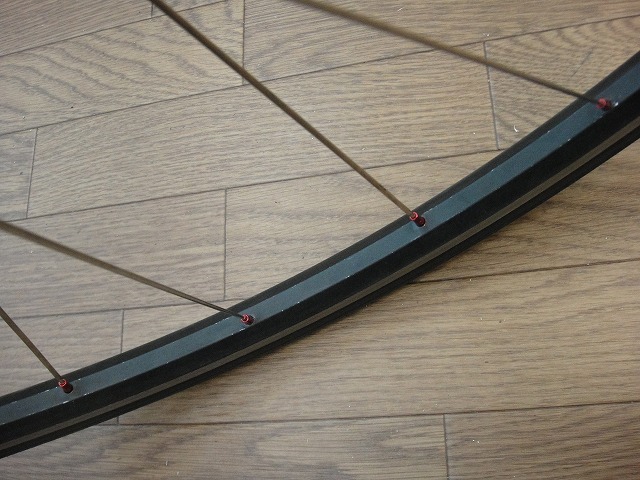
↑Built together it looks like this.
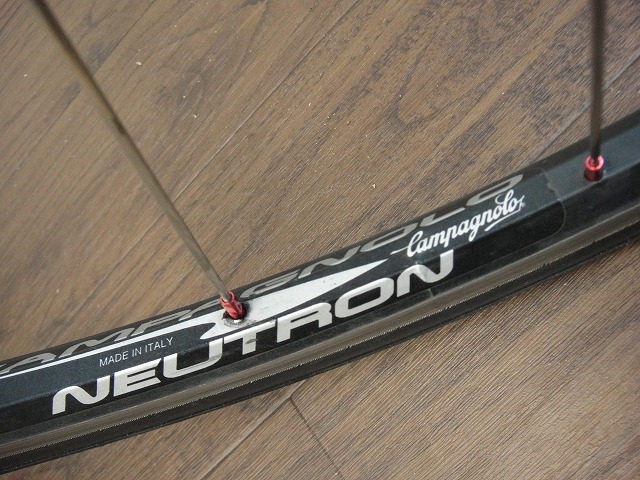
Actually this wheel is a Campagnolo Neutron,
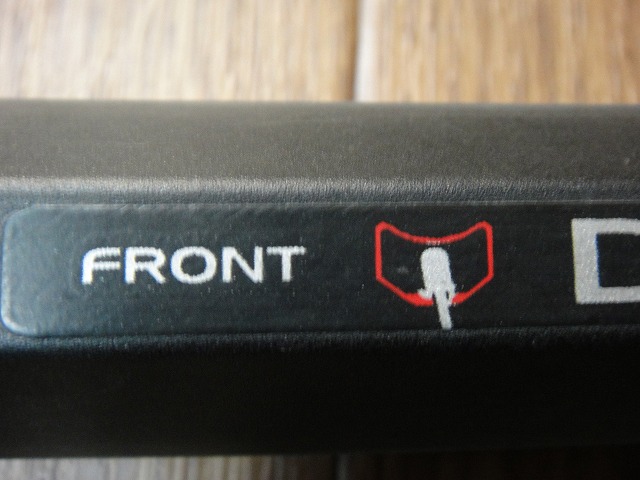
and as shown on the rim decal, the Neutron uses internal nipples.
External nipple Neutrons are...
it's getting long so I'll skip this. I won't detail this later either.
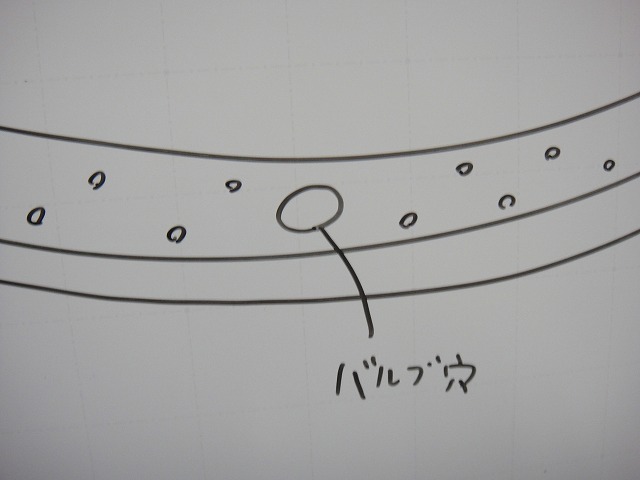
So a rim with hole offset

was built.
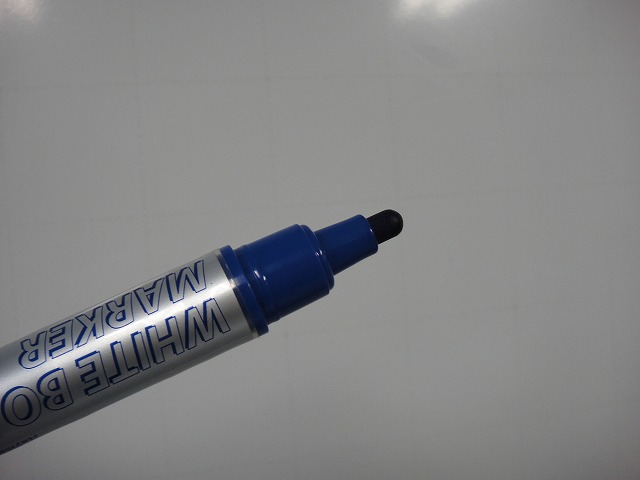
↑This is a blue marker, but here
imagine it as a "magic knife that cuts through anything like tofu super easily."
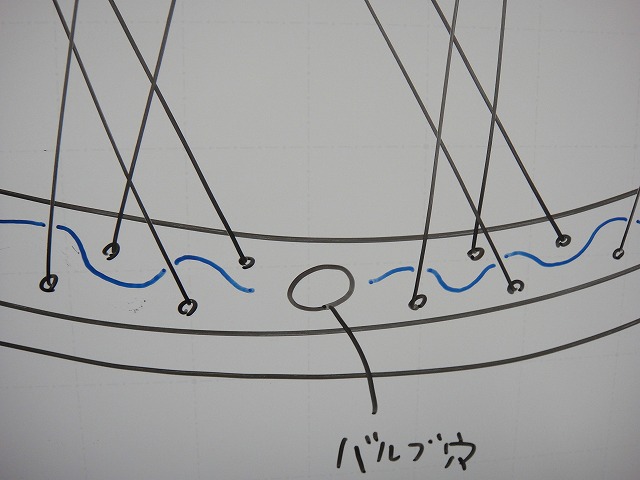
So I'll make nice clean cuts following the hole offset.
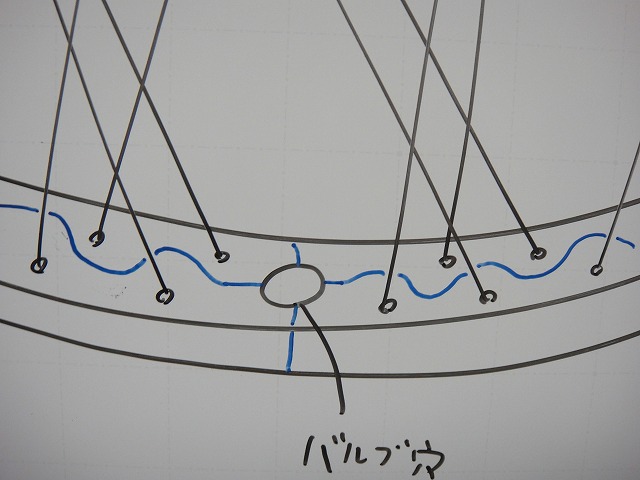
Around the valve hole I cut like this.

One more thing. Relative to the hub flanges
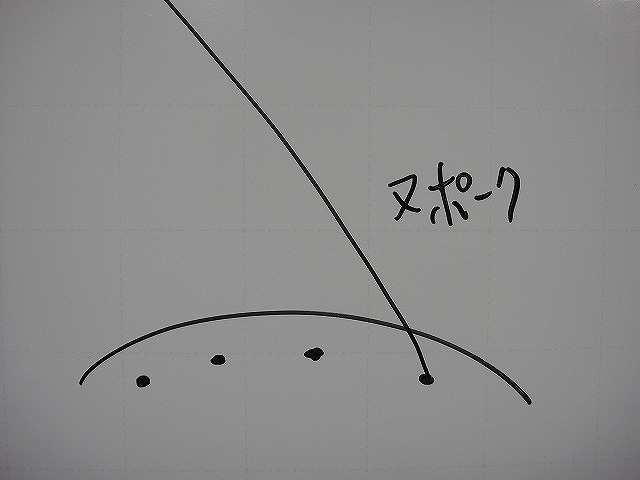
↑I'll denote inpokes like this, and
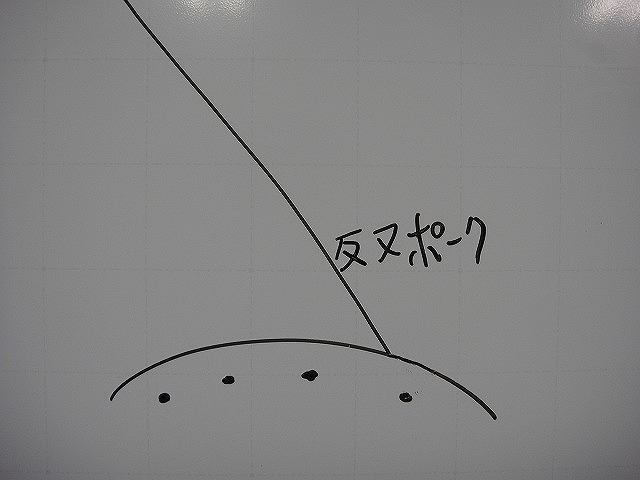
↑denote outpokes like this.
And the previous wheel laid flat would look like
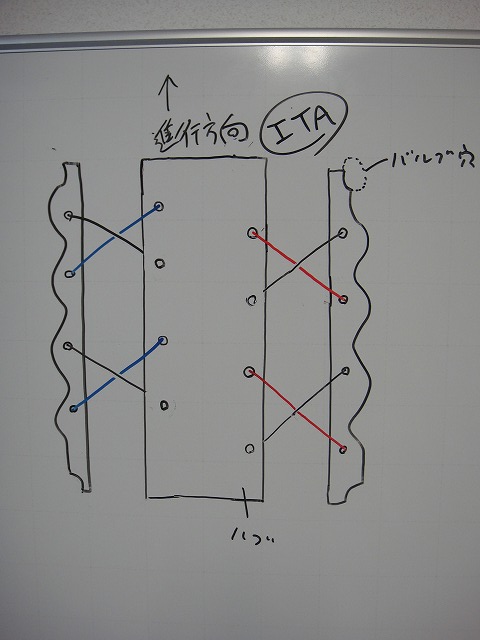
↑In Italian lacing it looks like this.
Red is right inpokes, blue is left inpokes.
The notches at the four corners are the original valve hole sections.
If you interpret the diagram accurately, this is 8H with 2 spokes each of inpoke and outpoke,
but since this is a conceptual diagram for understanding force distribution,
please don't worry about whether this wheel could actually be built.
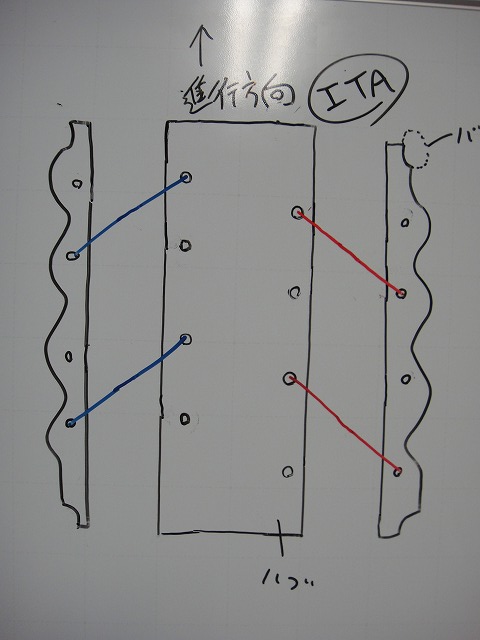
Then I kept only the inpokes.
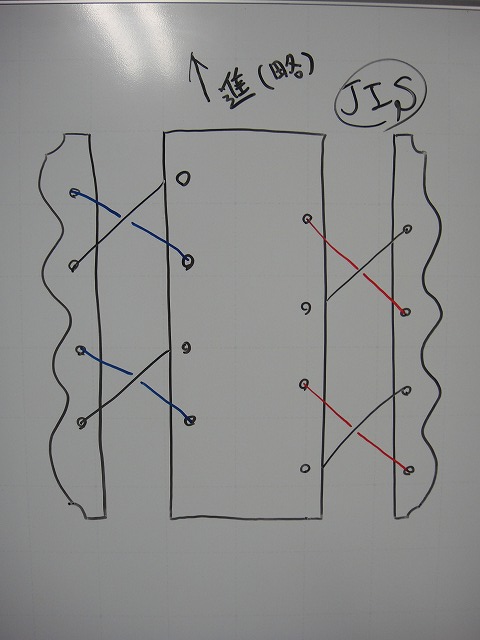
↑In JIS lacing it looks like this.

Then I kept only the inpokes.

↑As a tangent, "JIS is still JIS when flipped" can also be
expressed like this.
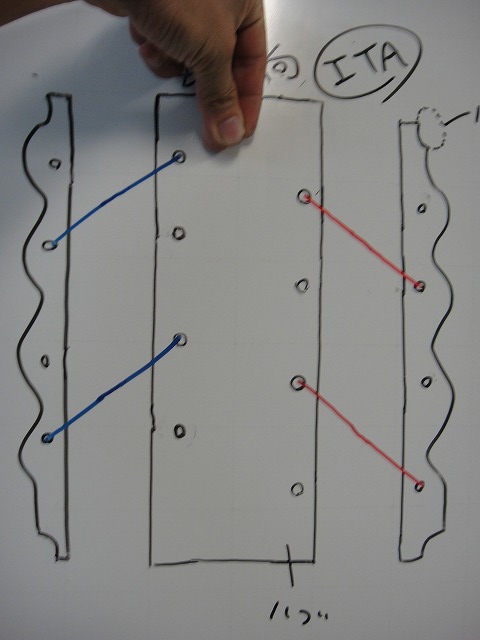
So "braking on the rim" or
"twisting the freewheel body forward on the rear wheel" is, in the diagram above,
like grabbing the hub section and pulling it up in one go.
Let me actually try it.
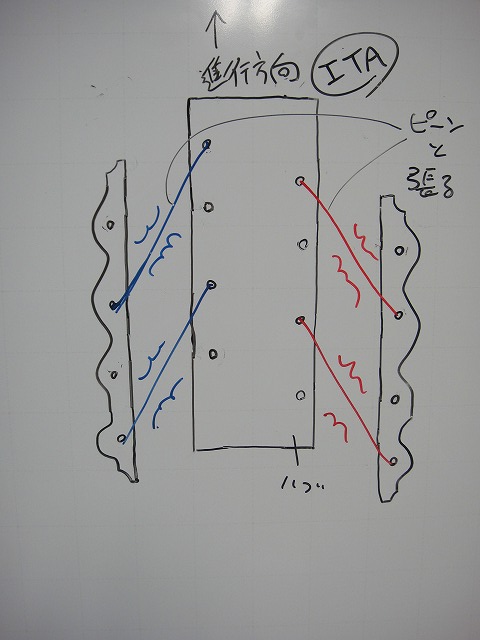
With Italian lacing, both left and right inpokes are taut with tension.
In other words, they're squeezed in the porcupine direction.
Spokes obviously don't stretch this much,
but I'm diagramming it this way to show how the force is applied.
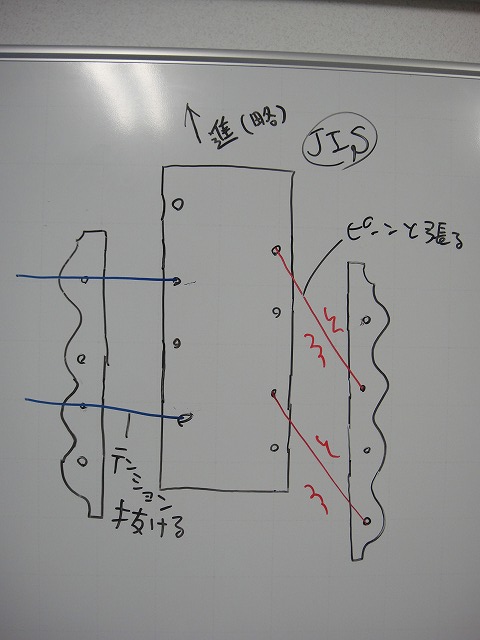
With JIS it looks like this.
I hate this asymmetrical feeling.
In this diagram
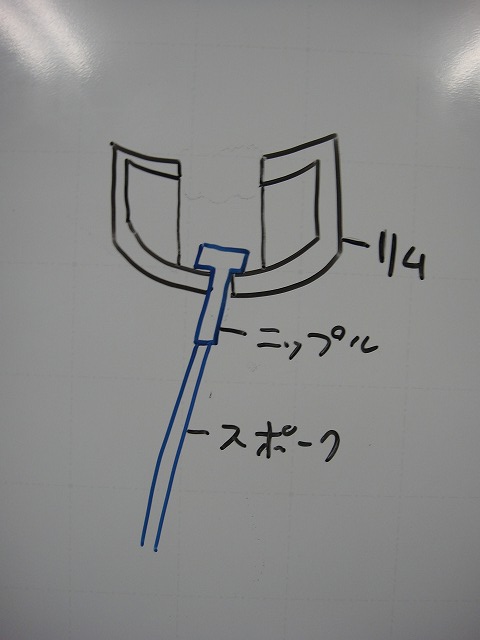
the spokes and nipples

pop out from the rim, but
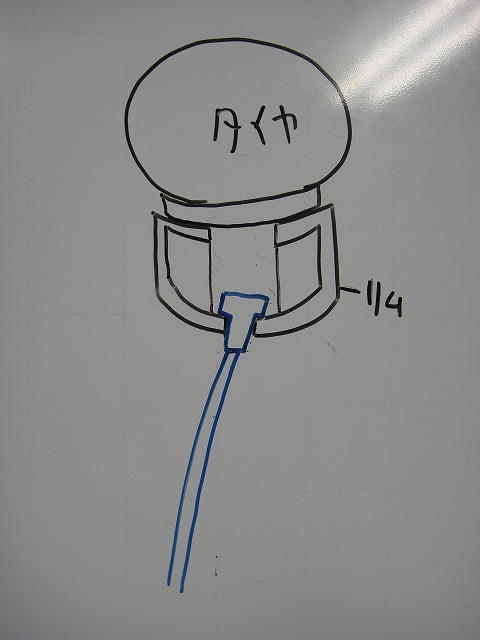
if the tire keeps the spokes from popping out
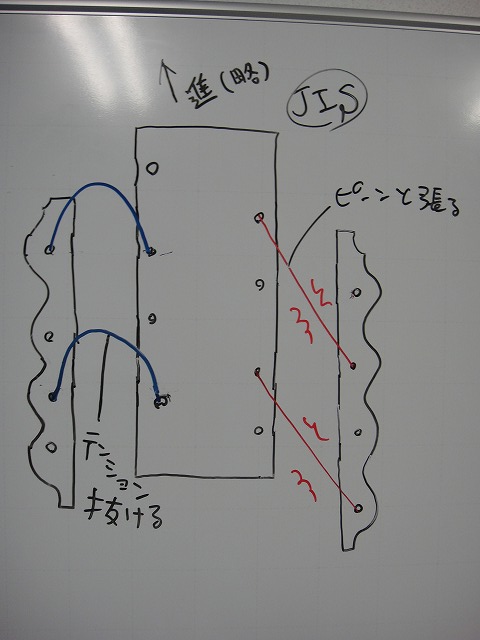
you could diagram it like this too.
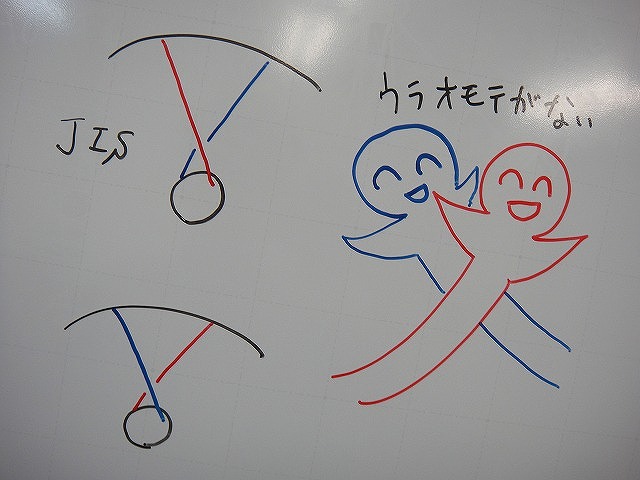
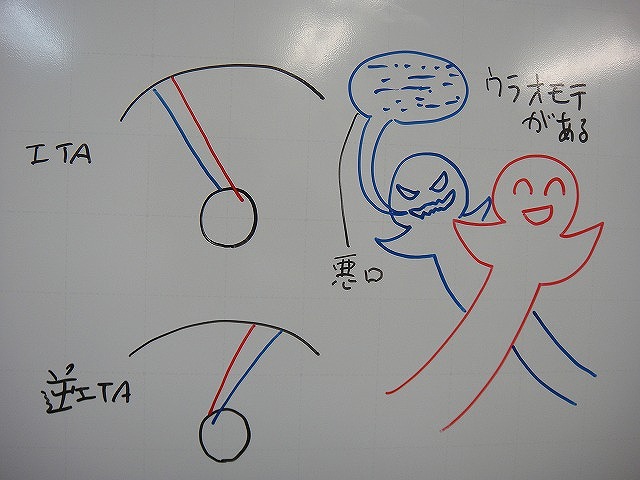
This has gotten very long, but here's my conclusion.
・If doing tangent lacing, Italian lacing on both front and rear is desirable
・With Italian lacing, the front wheel shouldn't theoretically be reversed, so be careful
・On rear wheels where gears are on both sides, do JIS lacing so right inpokes
are always in the porcupine direction regardless of which side you put them on
These are my basic wheel-building principles (though there are various exceptions).
Also, when doing radial lacing with bent-elbow spokes, it's almost 100% done with outpokes,
but I sometimes do radial lacing with inpokes.
Also, for disc brake hubs, reverse Italian lacing is theoretically superior.
I'll detail these two points later. This sentence is already too long!
Bonus
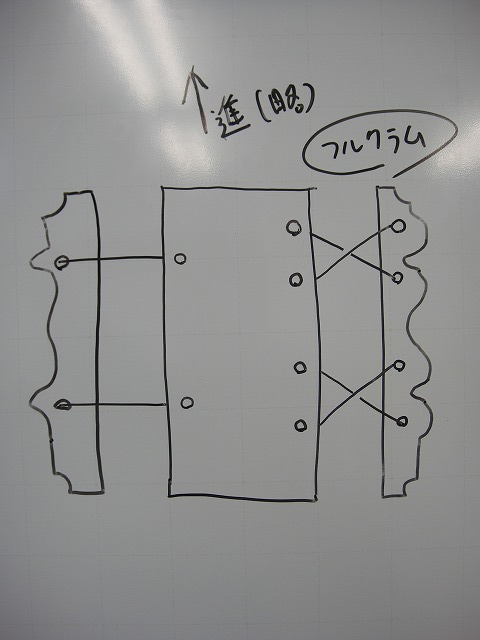
Straight spokes are, in my thinking, outpokes,
and laying out a Fulcrum rear wheel (2:1) that way looks like this.
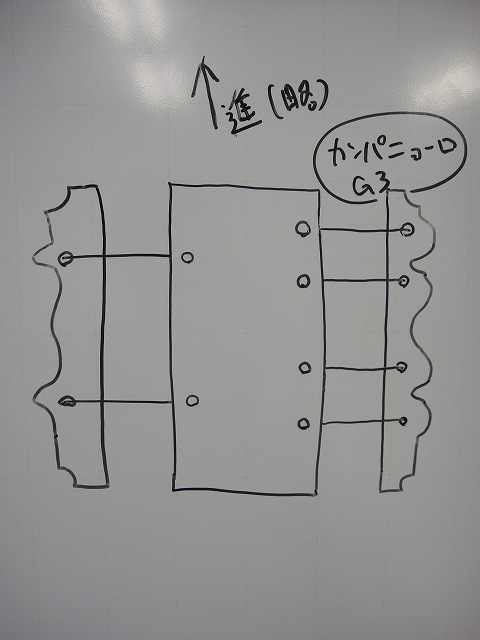
The Campagnolo G3 rear wheel looks like this.
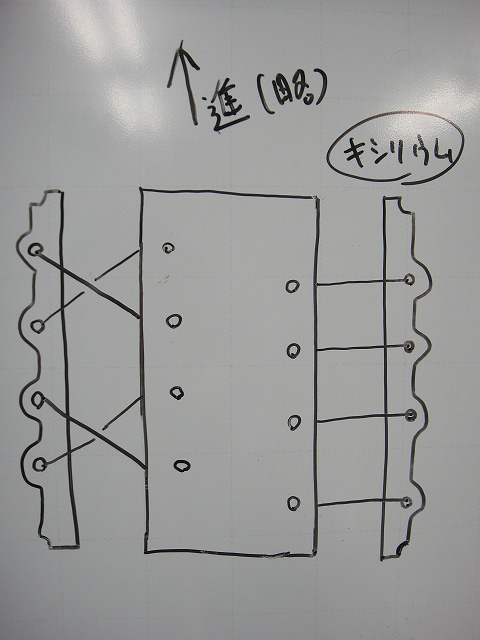
The Mavic Ksyrium rear wheel looks like this.
Freewheel side radial lacing is a kind of revolution I think,
but doing it with regular bent-elbow spokes carries significant risk.
By the way, this diagram is actually slightly wrong.
But since it's a conceptual diagram, please don't scrutinize it too deeply.
It's a crudely drawn version of what comes to mind when I'm building wheels.
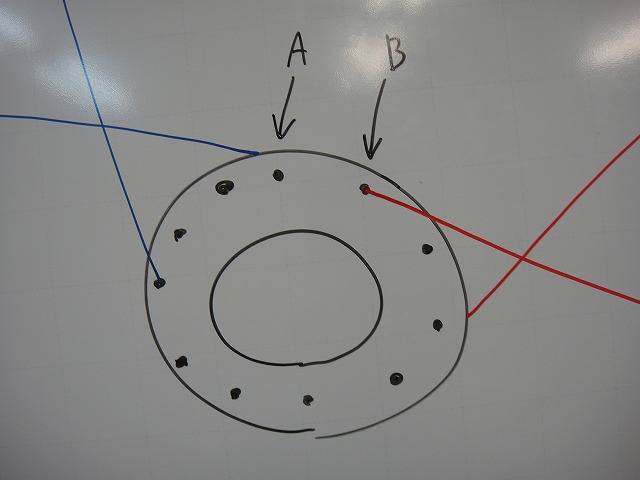
The Ksyrium rear wheel is 20H, and
if the holes in the hub flange that have tangent relationship with emerging spokes
are called A and B, then a normal wheel would
look like the diagram above, but
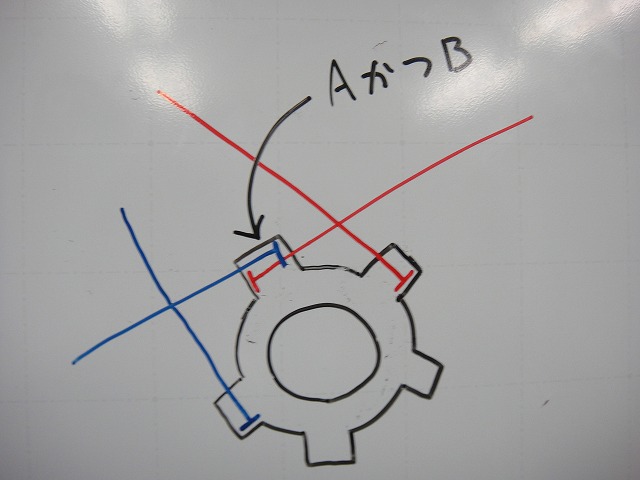
the Ksyrium has a flange shape where A and B overlap when viewed from the side.
I haven't expressed this in the layout diagram, but please forgive me.
On a normal wheel, if you consider spoke A and spoke B as one line,
it doesn't pass inside the actual tangent to the circle,
but on the Ksyrium it does.
I call such a hub a "tangent-breaking hub," and
that's one of the good things about the Ksyrium. I won't explain why it's good though.