I received an EC90 tubeless wheel from a customer.


Easton's wheel-building precision is extremely excellent.
Going in with that assumption sometimes proves you wrong,
but this time (this time too) there were no issues.
There was only the slightest amount of lateral runout, and the centering was dead-on.

The rim doesn't need rim tape, but it has a hump built up on it,
so the tubeless tire should grip and seat really solidly.


All the hub flanges have flange rings attached.
The straight spokes aren't "through-spokes" but "hooked" in,
so if a nipple happens to loosen, the spoke head won't pull free from the hub flange.
That said, the ring can come off if the spoke is bent sharply enough in an instant.
I've actually seen it happen with ZIPP hubs which use the same design.
ZIPP actually recalled certain front hub models from one year because of that.
Also, if a spoke breaks, you have to loosen the entire opposite side before the ring comes off,
so replacement is actually easier with through-spokes—that's a downside.
This is about the third time I've seen this wheel,
and the included brake shoes were outdated (at least for now).
When it comes to wide rims, there's no hard definition of what width qualifies as "wide,"
but I'd say anything with an outer width of 23mm or more could reasonably be called a wide rim.
Most wide rims are around 25mm wide,
but this wheel is unusually broad at 28mm.
And the included Swissstop brake shoes aren't the "EVO" model
which is 1mm thinner for wide rims,
but rather the conventional width.
(The EVO isn't just 1mm thinner—the rim-contact surface pattern is different too.)
When fixing the wire to the brake caliper,
you usually tighten the gap between shoe and rim a bit to match your preferred lever stroke,
then fix the wire in place.
But with this rim and the included shoes, there's hardly any clearance to begin with.
So you just fix the wire with no slack, and you don't need to tighten the gap at all.
In that state, the lever starts touching the shoe right at the beginning of the pull,
so even if you want to adjust more play, you can't.
Some brake calipers like those from FSA do exist where the shoe width when parallel
is wider than the conventional design (accommodating wide rims instead of being unsuitable for narrow ones),
but I don't think that's the kind of part most people would actively switch to from, say, Dura-Ace.
Also, when using this rear wheel with a direct-mount brake fixed behind the bottom bracket,
I've encountered cases where the included brake shoes result in
nearly constant shoe contact even before the wire is installed.
Specifically, Trek's Madone.
Wide rim, narrow mounting surface (probably), thick brake shoe—
an unfortunate combination of conditions came together.
That time I ground down the included shoes with a grinder
until the lever could move a little,
but it ended up being ground down more than the 1mm reduction of the EVO.
Obviously, the more you grind, the shorter the brake shoe's lifespan becomes.
The customer said at the time, "Bontrager has a thinner shoe for wide rims, so maybe I'll try that,"
but apparently that also ended up being about the same as Swissstop's EVO.
So here we have a wheel wider than a typical wide rim
but with thick brake shoes included—
that's outdated point number one.
And there's one more outdated aspect: the included shoes are "Yellow King."
Yellow King shoes are for carbon rims, but they're prone to heat buildup on carbon
and the shoe material is on the harder side with high aggressiveness toward the rim,
so it's better not to use them on wheels other than those that specifically call for them.
This is purely my opinion, but the Cosmic Carbonate Ultimatum is
a wheel that clearly shouldn't use the Yellow King despite it being the included shoe.
Where the shoe material has melted and bonded to the rim (yellow on yellow),
that's the only spot where braking works well,
so you get uneven braking bite and the handlebar gets shaken front and back.
You can fix it by cleaning the rim,
but doing that after every ride isn't realistic.
If you neglect it too much, thermal degradation will cause the brake zone to deform unevenly.
Once it gets bad enough, it becomes unrepairable.
(If it's minor, sandpaper might solve it.)
Yellow King is actually a pretty serious carbon rim killer.
In those cases, switching to Swissstop's Black Prince instead
will reduce rim damage,
but for wheels where the specified shoe is proprietary to someone other than Swissstop—
like Campagnolo, Fulcrum, Colima, Reynolds—
you really should stick with the manufacturer's specified shoe.
Now, with Easton rims, LEW-type finished rims like this
are often weak against Yellow King.
If Yellow King melt residue ends up depositing unevenly on the brake zone,
I'd suggest stopping use immediately and switching to the less aggressive Black Prince.
But that's just what I think,
so good little boys and girls, follow the manufacturer and use Yellow King as instructed!
↑ That's the most extreme I can put it.
So, here we are in 2016, and my opinion is that it's outdated
for this rim width and finish to not come with
my view "a Black Prince" "in EVO width."


Easton's wheel-building precision is extremely excellent.
Going in with that assumption sometimes proves you wrong,
but this time (this time too) there were no issues.
There was only the slightest amount of lateral runout, and the centering was dead-on.

The rim doesn't need rim tape, but it has a hump built up on it,
so the tubeless tire should grip and seat really solidly.
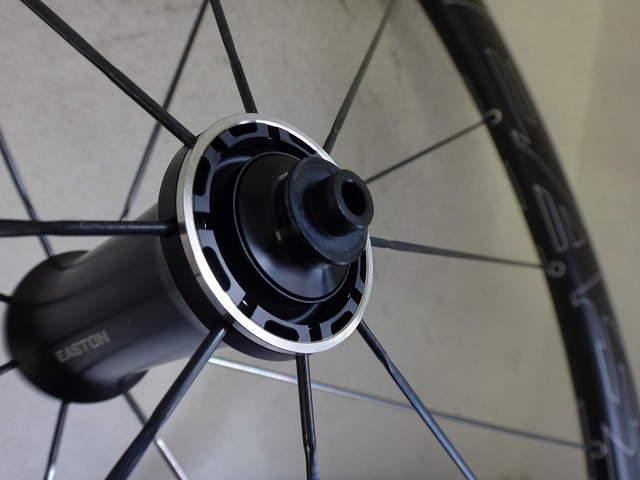
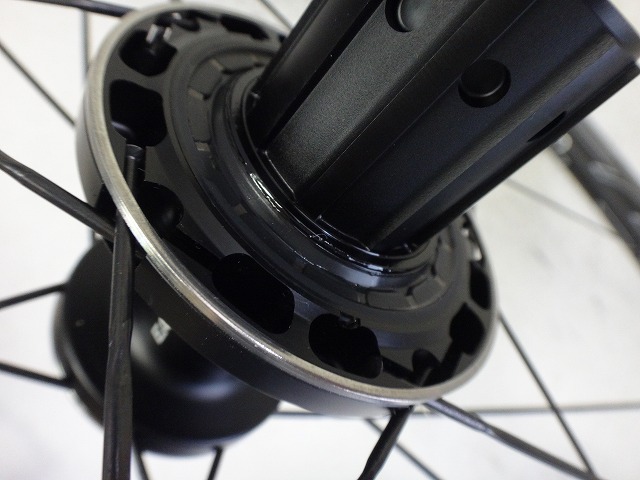

All the hub flanges have flange rings attached.
The straight spokes aren't "through-spokes" but "hooked" in,
so if a nipple happens to loosen, the spoke head won't pull free from the hub flange.
That said, the ring can come off if the spoke is bent sharply enough in an instant.
I've actually seen it happen with ZIPP hubs which use the same design.
ZIPP actually recalled certain front hub models from one year because of that.
Also, if a spoke breaks, you have to loosen the entire opposite side before the ring comes off,
so replacement is actually easier with through-spokes—that's a downside.
This is about the third time I've seen this wheel,
and the included brake shoes were outdated (at least for now).
When it comes to wide rims, there's no hard definition of what width qualifies as "wide,"
but I'd say anything with an outer width of 23mm or more could reasonably be called a wide rim.
Most wide rims are around 25mm wide,
but this wheel is unusually broad at 28mm.
And the included Swissstop brake shoes aren't the "EVO" model
which is 1mm thinner for wide rims,
but rather the conventional width.
(The EVO isn't just 1mm thinner—the rim-contact surface pattern is different too.)
When fixing the wire to the brake caliper,
you usually tighten the gap between shoe and rim a bit to match your preferred lever stroke,
then fix the wire in place.
But with this rim and the included shoes, there's hardly any clearance to begin with.
So you just fix the wire with no slack, and you don't need to tighten the gap at all.
In that state, the lever starts touching the shoe right at the beginning of the pull,
so even if you want to adjust more play, you can't.
Some brake calipers like those from FSA do exist where the shoe width when parallel
is wider than the conventional design (accommodating wide rims instead of being unsuitable for narrow ones),
but I don't think that's the kind of part most people would actively switch to from, say, Dura-Ace.
Also, when using this rear wheel with a direct-mount brake fixed behind the bottom bracket,
I've encountered cases where the included brake shoes result in
nearly constant shoe contact even before the wire is installed.
Specifically, Trek's Madone.
Wide rim, narrow mounting surface (probably), thick brake shoe—
an unfortunate combination of conditions came together.
That time I ground down the included shoes with a grinder
until the lever could move a little,
but it ended up being ground down more than the 1mm reduction of the EVO.
Obviously, the more you grind, the shorter the brake shoe's lifespan becomes.
The customer said at the time, "Bontrager has a thinner shoe for wide rims, so maybe I'll try that,"
but apparently that also ended up being about the same as Swissstop's EVO.
So here we have a wheel wider than a typical wide rim
but with thick brake shoes included—
that's outdated point number one.
And there's one more outdated aspect: the included shoes are "Yellow King."
Yellow King shoes are for carbon rims, but they're prone to heat buildup on carbon
and the shoe material is on the harder side with high aggressiveness toward the rim,
so it's better not to use them on wheels other than those that specifically call for them.
This is purely my opinion, but the Cosmic Carbonate Ultimatum is
a wheel that clearly shouldn't use the Yellow King despite it being the included shoe.
Where the shoe material has melted and bonded to the rim (yellow on yellow),
that's the only spot where braking works well,
so you get uneven braking bite and the handlebar gets shaken front and back.
You can fix it by cleaning the rim,
but doing that after every ride isn't realistic.
If you neglect it too much, thermal degradation will cause the brake zone to deform unevenly.
Once it gets bad enough, it becomes unrepairable.
(If it's minor, sandpaper might solve it.)
Yellow King is actually a pretty serious carbon rim killer.
In those cases, switching to Swissstop's Black Prince instead
will reduce rim damage,
but for wheels where the specified shoe is proprietary to someone other than Swissstop—
like Campagnolo, Fulcrum, Colima, Reynolds—
you really should stick with the manufacturer's specified shoe.
Now, with Easton rims, LEW-type finished rims like this
are often weak against Yellow King.
If Yellow King melt residue ends up depositing unevenly on the brake zone,
I'd suggest stopping use immediately and switching to the less aggressive Black Prince.
But that's just what I think,
so good little boys and girls, follow the manufacturer and use Yellow King as instructed!
↑ That's the most extreme I can put it.
So, here we are in 2016, and my opinion is that it's outdated
for this rim width and finish to not come with
my view "a Black Prince" "in EVO width."