A customer brought in a Cosmic SLR (a high-end wheel model) for me to work on.
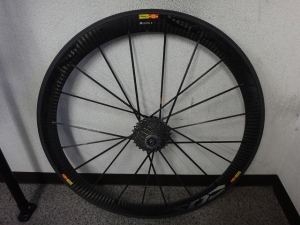
They wanted me to fix some radial runout (vertical wobble).
Apparently they'd already had the wheel trued once at a local shop,
but from what I can see, that careless work is exactly what caused the radial runout.
This wheel uses adjustable carbon spokes—a discontinued design—but
unless you're incredibly careful, the carbon spokes will twist and threaten to snap
when the nipple initially starts to turn.
There is a specialized spoke holding tool designed to prevent this,
but the drive side has higher spoke tension,
and even with the proper tool, turning those nipples requires a delicate touch.
The non-drive side has a similar structure, but the nipples turn much more smoothly there compared to the drive side.
So if you don't know about using a centering gauge,
the lazy approach would be to just tighten up the non-drive side for lateral truing and call it done.
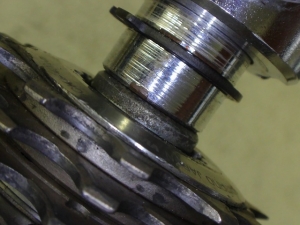
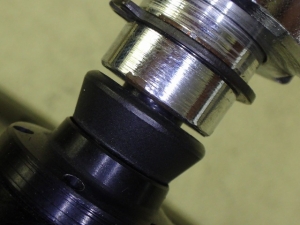
↑Which of course results in this.
They really did focus solely on lateral truing,
and the radial runout that developed was so obvious the customer caught it right away.
I sometimes hear amateurs say things like
"I can't build wheels, but I can do truing,"
but in my opinion, that's impossible.
Taking out lateral runout without introducing radial runout is something you cannot do
unless you've actually built a wheel before.
As long as the rim itself isn't bent or damaged,
truing is really just the process of bringing an incompletely built wheel from 99% to 100%—
so it is wheel building itself.
※Different people have different standards for what "100%" means
Today I also inspected a hand-built 20-inch wheel on a separate job,
and it turned out to be from a certain shop.
The radial runout was even worse than this Cosmic SLR—
in some positions the brake shoes were actually rubbing against the tire sidewall—
so I couldn't believe it was work from a fellow professional.
I actually asked the customer, "Did you build this yourself?"
The centering was also terrible, off on both wheels,
and the rear wheel was off by more than the thickness of a 500 yen coin.
(I wasn't planning to write about this, so I didn't take photos,
but I did show the customer the before and after condition)
In the end, the inspection time for both wheels was about the same as it would take me to completely rebuild the rear wheel from scratch.
I told the customer the same thing: this wheel is basically half-built.
Don't take on truing work if you can't even build wheels.
Our shop has to charge for reinspection work too,
so the customer ends up paying twice in labor costs.
If you're not completely shameless about that kind of thing,
then the kindest thing would be to put up a big sign outside saying
"We cannot build wheels, so we cannot do truing."
And one more thing.
If your standard for acceptable wheel building (what I just called "100%") is this low,
then almost certainly your standards for all the other work you do are equally low.
Personally, what bugs me about this shop is that their rear derailleur shift cable housing is comically long.
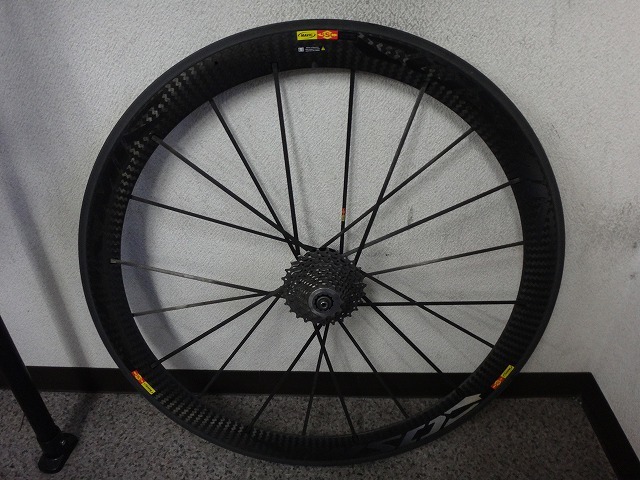
They wanted me to fix some radial runout (vertical wobble).
Apparently they'd already had the wheel trued once at a local shop,
but from what I can see, that careless work is exactly what caused the radial runout.
This wheel uses adjustable carbon spokes—a discontinued design—but
unless you're incredibly careful, the carbon spokes will twist and threaten to snap
when the nipple initially starts to turn.
There is a specialized spoke holding tool designed to prevent this,
but the drive side has higher spoke tension,
and even with the proper tool, turning those nipples requires a delicate touch.
The non-drive side has a similar structure, but the nipples turn much more smoothly there compared to the drive side.
So if you don't know about using a centering gauge,
the lazy approach would be to just tighten up the non-drive side for lateral truing and call it done.

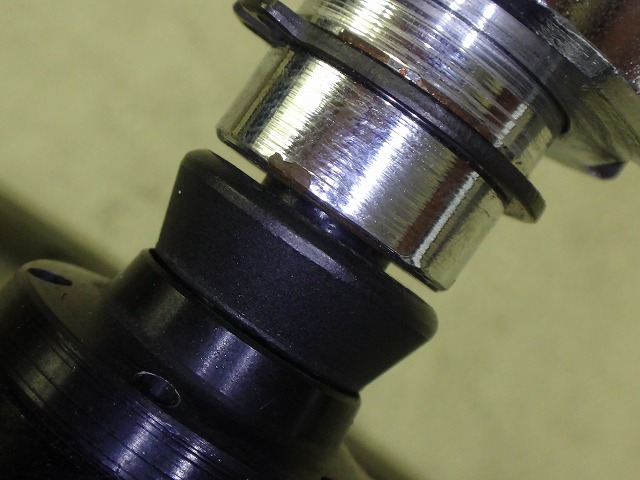
↑Which of course results in this.
They really did focus solely on lateral truing,
and the radial runout that developed was so obvious the customer caught it right away.
I sometimes hear amateurs say things like
"I can't build wheels, but I can do truing,"
but in my opinion, that's impossible.
Taking out lateral runout without introducing radial runout is something you cannot do
unless you've actually built a wheel before.
As long as the rim itself isn't bent or damaged,
truing is really just the process of bringing an incompletely built wheel from 99% to 100%—
so it is wheel building itself.
※Different people have different standards for what "100%" means
Today I also inspected a hand-built 20-inch wheel on a separate job,
and it turned out to be from a certain shop.
The radial runout was even worse than this Cosmic SLR—
in some positions the brake shoes were actually rubbing against the tire sidewall—
so I couldn't believe it was work from a fellow professional.
I actually asked the customer, "Did you build this yourself?"
The centering was also terrible, off on both wheels,
and the rear wheel was off by more than the thickness of a 500 yen coin.
(I wasn't planning to write about this, so I didn't take photos,
but I did show the customer the before and after condition)
In the end, the inspection time for both wheels was about the same as it would take me to completely rebuild the rear wheel from scratch.
I told the customer the same thing: this wheel is basically half-built.
Don't take on truing work if you can't even build wheels.
Our shop has to charge for reinspection work too,
so the customer ends up paying twice in labor costs.
If you're not completely shameless about that kind of thing,
then the kindest thing would be to put up a big sign outside saying
"We cannot build wheels, so we cannot do truing."
And one more thing.
If your standard for acceptable wheel building (what I just called "100%") is this low,
then almost certainly your standards for all the other work you do are equally low.
Personally, what bugs me about this shop is that their rear derailleur shift cable housing is comically long.