The wheel on the bike we're currently doing a component swap on here at the shop is
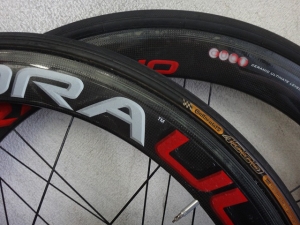
↑this Bora, but you can see marks where the brake shoes have heat-fused to the braking zone.
When brake marks look like a sword blade pattern,
they result from applying brake shoes to the regular wave deformation
caused by the rim being pulled alternately left and right by the spokes
(a phenomenon often seen on older aluminum rims),
but these scattered pitting marks from the shoe bite are different—
they indicate that the braking zone is starting to get warped and bumpy from heat damage.
Unlike bearing ball race damage, which is a concave deformation,
brake zone heat damage is a convex deformation
when something that should be smooth is no longer smooth.
The textbook answer would be to use OEM brake shoes,
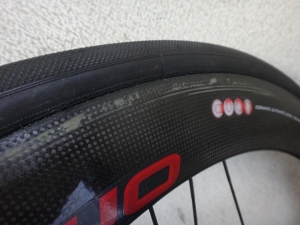
before
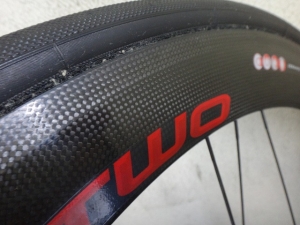
after

I cleaned it up using some mysterious liquid that dissolves only the Yellow King (brake pad brand).
We're continuing to use Yellow King brake shoes,
but I've asked them to please stop using them going forward.
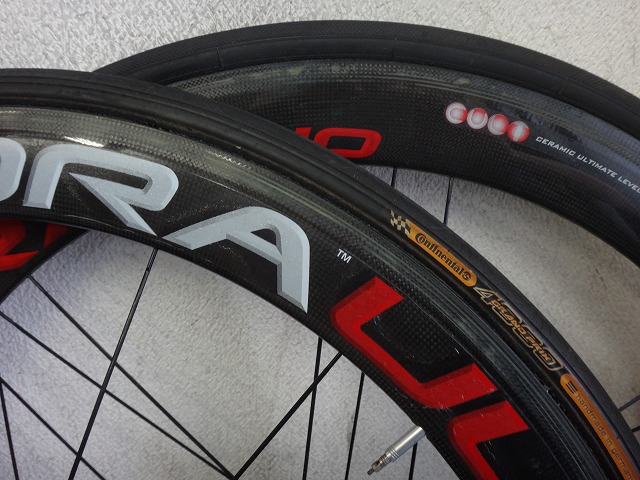
↑this Bora, but you can see marks where the brake shoes have heat-fused to the braking zone.
When brake marks look like a sword blade pattern,
they result from applying brake shoes to the regular wave deformation
caused by the rim being pulled alternately left and right by the spokes
(a phenomenon often seen on older aluminum rims),
but these scattered pitting marks from the shoe bite are different—
they indicate that the braking zone is starting to get warped and bumpy from heat damage.
Unlike bearing ball race damage, which is a concave deformation,
brake zone heat damage is a convex deformation
when something that should be smooth is no longer smooth.
The textbook answer would be to use OEM brake shoes,
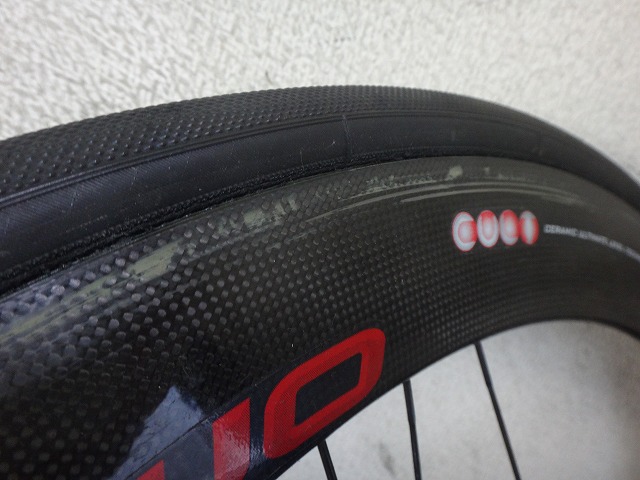
before
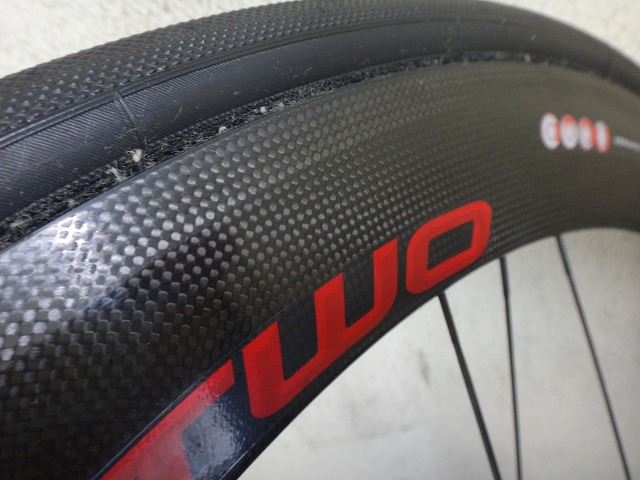
after
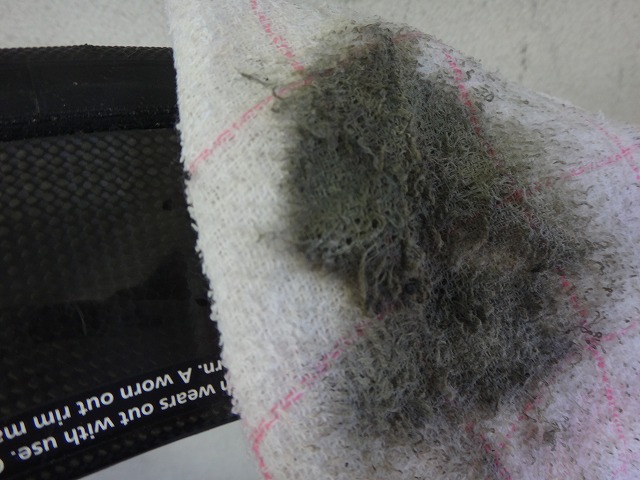
I cleaned it up using some mysterious liquid that dissolves only the Yellow King (brake pad brand).
We're continuing to use Yellow King brake shoes,
but I've asked them to please stop using them going forward.