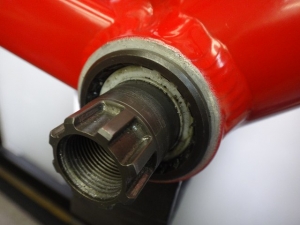
A customer (sort of) was trying to remove the BB on their younger brother's FELT bike to swap out the components,
but when two people couldn't get it off no matter what they tried,
they brought it to the nearby Cycle Base Asahi Minoh shop,
and after trying various things, they were told "We can't get it off,"
and "We'll have to send this to the distributor in Tokyo! It'll cost around 80,000 yen in shipping and labor!"
and apparently they immediately started wrapping it in bubble wrap and preparing to ship it.
Beyond just this case, there are a lot of incompetent shops that dump trivial jobs like this on their distributors,
but unless it's a serious frame defect,
I feel bad for the distributors having frames sent to them like this.
They said wait a minute and stopped the distributor shipment, then
took it to Silvest Cycle Minoh shop instead,
and after struggling for over an hour, they still couldn't get it off,
so it was brought to our shop.

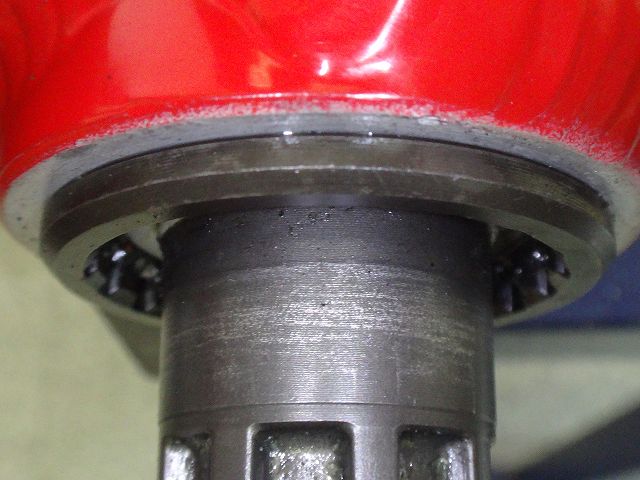
With this type of BB, there's never been a case where I couldn't get it off.
Fortunately the splines where the tool grips aren't stripped,
but even if the splines were completely mangled,
there's still a way to remove it cleanly regardless.
Also, unrelated to this case,
I'm pretty good at removing seized seatposts too.
We frequently get jobs that other shops have given up on.

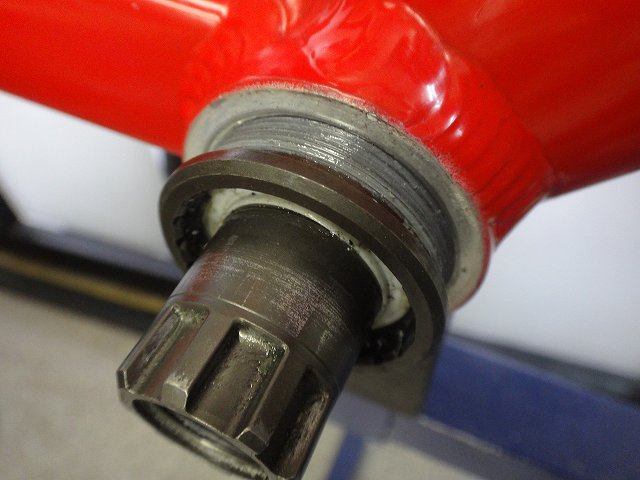
I did it right in front of the customer and it loosened in under 2 minutes of actual work,
then I could just hand-turn it out. The customer, Asahi, and Silvest—
none of these non-professional shop people could budge the BB at all,
so there's no way that it had actually started loosening before I touched it—
it wasn't some "turnip-pulling fable" situation.
The method is a trade secret, so
I only asked the customer not to take photos for their own blog.
I showed them how it's done though.
Looking at the total work time at Asahi and Silvest (number of people involved × time spent),
it fell short of even my 2 minutes alone.
And they had no results to show for it.
One thing I was impressed by was that neither shop charged the customer labor for this job.
Not charging for work that didn't produce results is one of my important rules,
but that's just my personal policy—
there's certainly another valid viewpoint that goes "Since we spent work time on this,
I'm afraid we do need to charge you something."
The most common case at our shop is probably when someone brings in a wheel that's warped potato-chip style
with no hope of truing, just on the off chance,
and we take a look and confirm it's hopeless.
No labor charge if we can't fix it.
Same with the Xysrium 125 in the previous post
I don't know if not charging hourly labor is the shop's overall policy
or an individual staff member's decision.
At least at Silvest Cycle it's probably the latter.
We end up fixing a lot of jobs where the customer got robbed with work that didn't even get done properly,
so from the customer's perspective they end up paying labor twice for one problem.
If they'd charged for labor on this one,
this article would have taken a very different, much harsher tone.
They really dodged a bullet here.
but when two people couldn't get it off no matter what they tried,

they brought it to the nearby Cycle Base Asahi Minoh shop,
and after trying various things, they were told "We can't get it off,"
and "We'll have to send this to the distributor in Tokyo! It'll cost around 80,000 yen in shipping and labor!"
and apparently they immediately started wrapping it in bubble wrap and preparing to ship it.
Beyond just this case, there are a lot of incompetent shops that dump trivial jobs like this on their distributors,
but unless it's a serious frame defect,
I feel bad for the distributors having frames sent to them like this.
They said wait a minute and stopped the distributor shipment, then
took it to Silvest Cycle Minoh shop instead,
and after struggling for over an hour, they still couldn't get it off,
so it was brought to our shop.
With this type of BB, there's never been a case where I couldn't get it off.
Fortunately the splines where the tool grips aren't stripped,
but even if the splines were completely mangled,
there's still a way to remove it cleanly regardless.
Also, unrelated to this case,
I'm pretty good at removing seized seatposts too.
We frequently get jobs that other shops have given up on.
I did it right in front of the customer and it loosened in under 2 minutes of actual work,
then I could just hand-turn it out. The customer, Asahi, and Silvest—
none of these non-professional shop people could budge the BB at all,
so there's no way that it had actually started loosening before I touched it—
it wasn't some "turnip-pulling fable" situation.
The method is a trade secret, so
I only asked the customer not to take photos for their own blog.
I showed them how it's done though.
Looking at the total work time at Asahi and Silvest (number of people involved × time spent),
it fell short of even my 2 minutes alone.
And they had no results to show for it.
One thing I was impressed by was that neither shop charged the customer labor for this job.
Not charging for work that didn't produce results is one of my important rules,
but that's just my personal policy—
there's certainly another valid viewpoint that goes "Since we spent work time on this,
I'm afraid we do need to charge you something."
The most common case at our shop is probably when someone brings in a wheel that's warped potato-chip style
with no hope of truing, just on the off chance,
and we take a look and confirm it's hopeless.
No labor charge if we can't fix it.
I don't know if not charging hourly labor is the shop's overall policy
or an individual staff member's decision.
At least at Silvest Cycle it's probably the latter.
We end up fixing a lot of jobs where the customer got robbed with work that didn't even get done properly,
so from the customer's perspective they end up paying labor twice for one problem.
If they'd charged for labor on this one,
this article would have taken a very different, much harsher tone.
They really dodged a bullet here.