A customer entrusted me with a PowerTap straight-spoke rear hub,
the "GS".

The original plan was to disassemble Nomulab Wheel #5, which was built not long ago,
and reuse its rim,
but we set that aside and instead
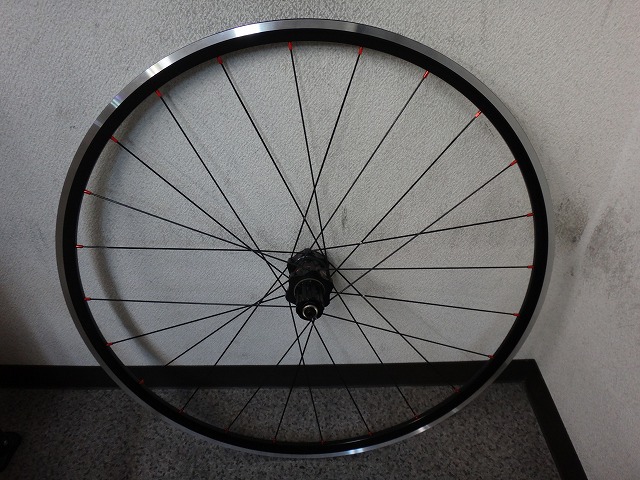
ended up building another Nomulab Wheel #5 rear wheel.

GS hub 24H, black half-spokes, 4-4 lacing equivalent with reinforced trussing,
and red aluminum nipples.
I couldn't incorporate asymmetric lacing on left and right, and
since round butted black straight-gauge spokes are hard to source,
I made the freewheel side 14-gauge plain.
Although it's a separate-axle flange hub, I could have woven the final cross,
so I left the freewheel side unwoven and wove the non-freewheel side with reinforced trussing.
Without doing this, I couldn't match the performance
of the Nomulab Wheel #5 the customer already owns.

This flange can only be laced 2-cross on both sides,
but it's equivalent to JIS lacing.

The hub manufacturer wasn't Novatech but DT.
I measure the over-locknut dimension when calculating spoke length,
and it came to about 131mm. For a 10-speed freebody it would be about 130mm.

Since the spoke angle leaving the hub is constant,
the spoke length relative to the rim inner diameter becomes fixed.

PowerTap publishes a quick reference table for rim inner diameter and spoke length,
but these values are completely unreliable.
The length that ERD (rim inner diameter) refers to differs between me and PowerTap.
The rim inner diameter mentioned here isn't my usual standard,
but uses the same interpretation as Mavic and others,
so PowerTap's interpretation shouldn't be the general one.
The rim inner diameter on DT's rim label is clearly wrong too, so
maybe the rim inner diameter referred to here is that value instead.
Whether it's "the inner diameter of the rim ignoring nipple hole thickness"
or "the distance between the positions where nipples sit inside the rim" is unclear,
but DT's value is neither.
For example, Mavic uses the latter; the Open Pro is nominally 300.7mm (Mavic gives radius),
but actual measurement shows a diameter of around 601.4mm or 601.5mm.
I've figured out the correction factor (the difference between the length from the table and actual length),
so in the future I could find spoke length using this table and the correction.
But I won't do that—I'll measure the hub dimensions and calculate instead.

It says to add or subtract length by the amount of nipples and washers,
but the length discrepancy found from this table exceeds that range.
Also, it says the freewheel side and non-freewheel side can use the same length,
but that's not how it works.
For a rear hub with symmetric lacing on both sides and no high-low flange,
the freewheel side length is roughly minus 2mm from the non-freewheel side
(I calculate it properly every time without relying on this rule of thumb, by the way),
and even on this hub with its somewhat narrow flanges,
the calculation showed a left-right difference of 1.51mm.
You shouldn't blindly trust what fools say when they take such careless approaches to wheels.
the "GS".
The original plan was to disassemble Nomulab Wheel #5, which was built not long ago,
and reuse its rim,
but we set that aside and instead
ended up building another Nomulab Wheel #5 rear wheel.

GS hub 24H, black half-spokes, 4-4 lacing equivalent with reinforced trussing,
and red aluminum nipples.
I couldn't incorporate asymmetric lacing on left and right, and
since round butted black straight-gauge spokes are hard to source,
I made the freewheel side 14-gauge plain.
Although it's a separate-axle flange hub, I could have woven the final cross,
so I left the freewheel side unwoven and wove the non-freewheel side with reinforced trussing.
Without doing this, I couldn't match the performance
of the Nomulab Wheel #5 the customer already owns.
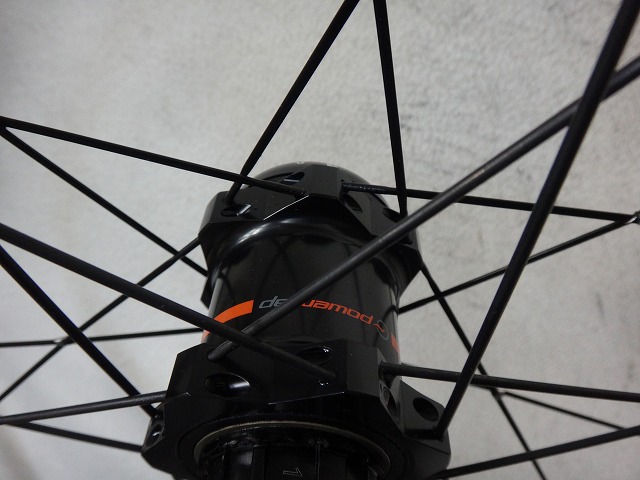
This flange can only be laced 2-cross on both sides,
but it's equivalent to JIS lacing.
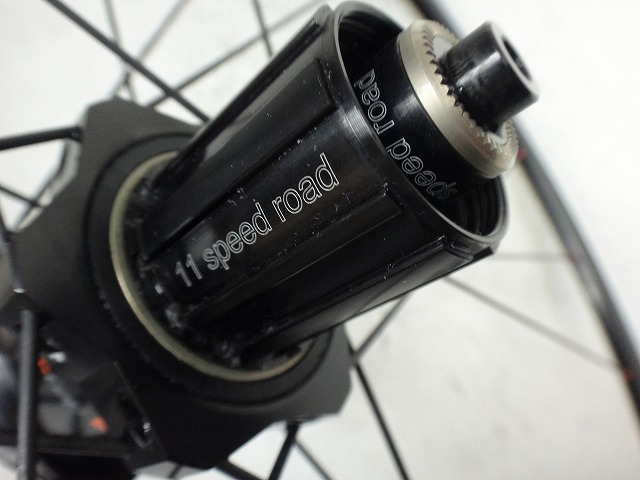
The hub manufacturer wasn't Novatech but DT.
I measure the over-locknut dimension when calculating spoke length,
and it came to about 131mm. For a 10-speed freebody it would be about 130mm.
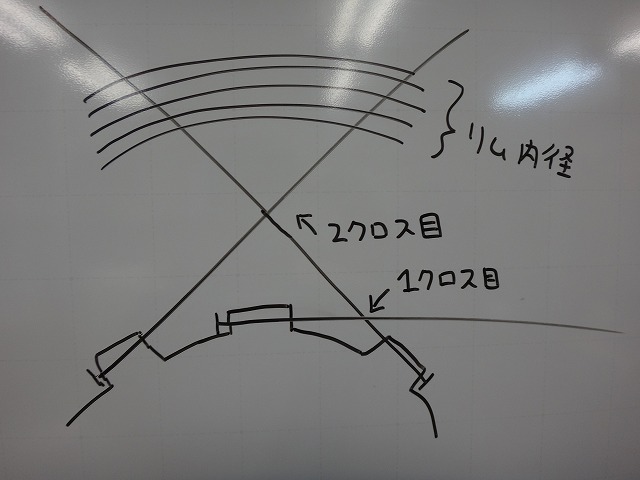
Since the spoke angle leaving the hub is constant,
the spoke length relative to the rim inner diameter becomes fixed.
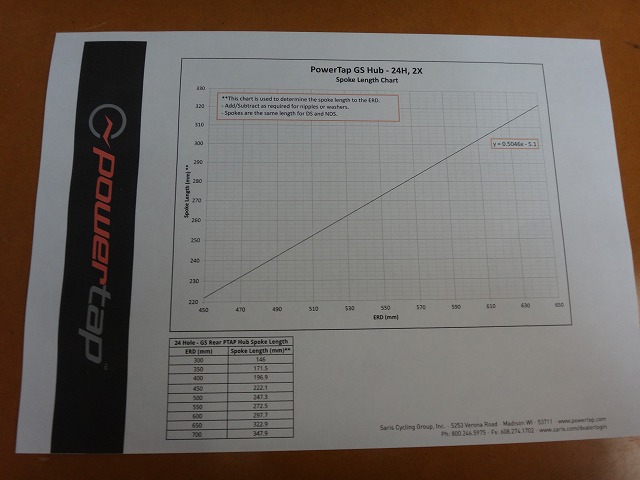
PowerTap publishes a quick reference table for rim inner diameter and spoke length,
but these values are completely unreliable.
The length that ERD (rim inner diameter) refers to differs between me and PowerTap.
The rim inner diameter mentioned here isn't my usual standard,
but uses the same interpretation as Mavic and others,
so PowerTap's interpretation shouldn't be the general one.
The rim inner diameter on DT's rim label is clearly wrong too, so
maybe the rim inner diameter referred to here is that value instead.
Whether it's "the inner diameter of the rim ignoring nipple hole thickness"
or "the distance between the positions where nipples sit inside the rim" is unclear,
but DT's value is neither.
For example, Mavic uses the latter; the Open Pro is nominally 300.7mm (Mavic gives radius),
but actual measurement shows a diameter of around 601.4mm or 601.5mm.
I've figured out the correction factor (the difference between the length from the table and actual length),
so in the future I could find spoke length using this table and the correction.
But I won't do that—I'll measure the hub dimensions and calculate instead.
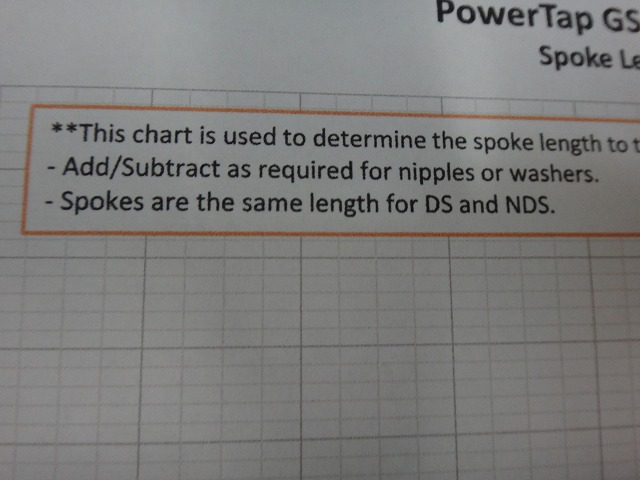
It says to add or subtract length by the amount of nipples and washers,
but the length discrepancy found from this table exceeds that range.
Also, it says the freewheel side and non-freewheel side can use the same length,
but that's not how it works.
For a rear hub with symmetric lacing on both sides and no high-low flange,
the freewheel side length is roughly minus 2mm from the non-freewheel side
(I calculate it properly every time without relying on this rule of thumb, by the way),
and even on this hub with its somewhat narrow flanges,
the calculation showed a left-right difference of 1.51mm.
You shouldn't blindly trust what fools say when they take such careless approaches to wheels.